


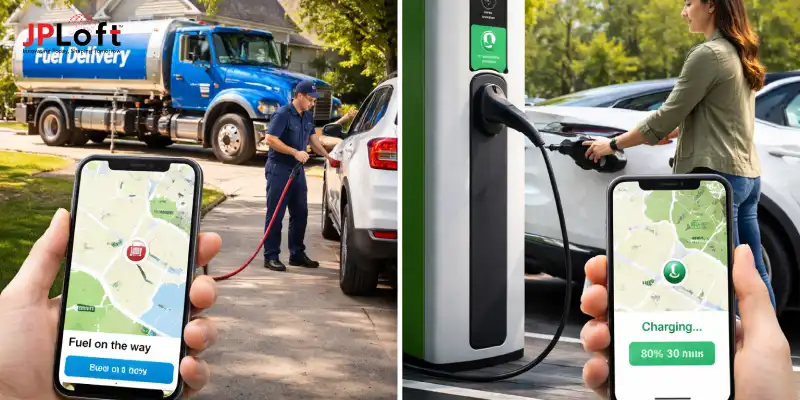
Key Takeaways:
Fuel delivery apps solve urgent refueling needs with on-demand convenience, making them ideal for fleets, emergencies, and fuel-heavy regions that value speed and operational efficiency.
EV charging apps support long-term clean mobility by helping users locate, reserve, and manage charging, aligning strongly with sustainability goals and EV-first infrastructure growth.
The core difference in fuel delivery app vs EV charging app lies in logistics versus infrastructure; one moves fuel to users, the other guides users to energy networks.
Choosing the right model improves ROI by matching market readiness, user behavior, and regulatory environment instead of chasing trends without local demand validation.
Mobility app success depends on scalable architecture, real-time tracking, secure payments, and compliance readiness, which directly impacts retention, trust, and monetization.
Partnering with JPLoft helps businesses launch compliant, scalable mobility platforms faster, with proven expertise in on-demand delivery systems and future-ready app development.
The future of mobility is convenience. The global fuel delivery app market is projected to reach USD 10.1 billion by 2033, growing at a CAGR of 7.3%. On the other hand, when it comes to EV charging apps, this market is expected to reach USD 137.77 billion by 2031.
In this growing market, as an entrepreneur, you can contribute. But, one of the major question that rise is which model to select, “fuel delivery app vs EV charging app.”
The difference is that fuel delivery apps deliver fuel directly to the offices and homes, while EV charging apps help users to locate, access, and manage vehicles. There are many other key comparison points that you should consider.
In this guide of comparison between fuel delivery app vs the EV charging app, we have discussed it all.
What is a Fuel Delivery App?
Before you proceed to create a fuel delivery app (if decided), identifying an overview of the app is important. Hence, let’s check it all out.
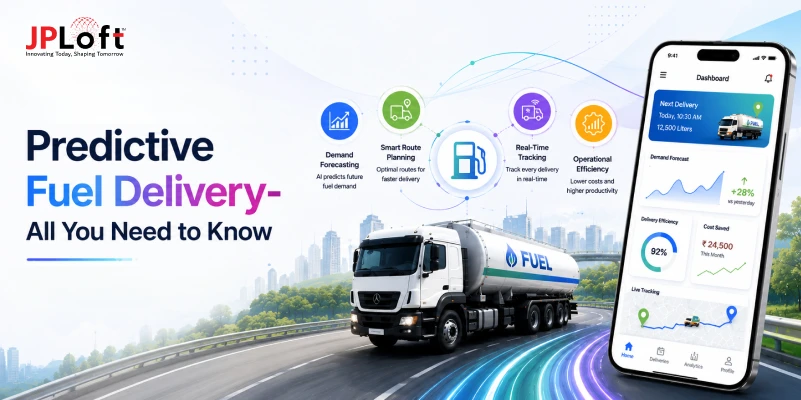
A fuel delivery app is an on-demand platform that connects users with fuel providers to have gasoline or diesel delivered directly to their location. These apps enable users to schedule deliveries, track, and pay for fuel, by offering convenience.
When it comes to the market, the global fuel delivery market size is likely to be valued at USD 6.2 billion in 2026, and is further projected to reach USD 10.1 billion by 2033, growing at a CAGR of 7.3%.
► Characteristics
Here is the list of features to evaluate for a fuel delivery app.
-
Location tracking and planning: The users can pin their exact location on the map for fuel delivery.
-
Real-Time Tracking: This helps users to fetch real-time tracking details through GPS tracking and API driven mapping.
-
Order History and Receipts: This feature offers access to past orders and digital receipts for expense tracking.
-
Navigation and Route Optimization: Navigation and route optimization include built-in GPS to find the fastest routes.
-
Push notifications: Here, one can find order status updates, delivery, and in some cases, special offers.
-
Vendor management: Offers tools to manage fuel suppliers and, in some cases, delivery agents.
-
Payment gateway integration: Find secure, in-app payment options such as credit/debit cards, wallets, and UPI.
► Working Process of Fuel Delivery App
The working process of the fuel delivery app starts when a user downloads or installs the app. The process of the app working does impact the complete cost to make a fuel delivery app. Let’s check out the complete process below:
Step 1: User Registration and Location Pinning
Here, the user locates their place and fills in the information related to their home, office, etc. You can find the key components, such as user details, security measures, and optional fields.
Step 2: Search and Filters
Search and filters for different types of fuels. Here, the users can select the type of fuel that they want.
Step 3: Order Confirmation
Then the users can receive confirmation mail and msgs related to the orders. Here, the system assigns the nearest available fuel truck to fulfill the user orders.
Step 4: Dispatch and Tracking
Now, the users can track the truck’s real-time location via an in-app map, which is very similar to the food delivery apps.
Step 5: Delivery and Fueling
In this step, the driver arrives, dispenses the fuel, and completes the transaction. Further, the payment process takes place.
Step 6: Review and Ratings
Here, the user provides reviews and adds ratings for the fuel delivery services, which helps them to build users’ trust and scale further.
Now, let’s examine the complete details related to the EV charging app in the following section.
What is an EV Charging App?
An EV charging app helps the electric vehicle drivers to locate, access, and pay for charging stations, while monitoring charging sessions in real-time. These apps allow users to begin and finish charging the car or any vehicle from an app on their phone.
You can create an EV charging app by developing a user-centric, map-based interface with key features like station searching, secure payments, and charger booking.
The global electric vehicle charging station market size was valued at USD 18.16 billion in 2025. This market is projected to grow from USD 22.93 billion in 2026 to USD 139.93 billion by 2034.
Let’s evaluate the features of the EV charging app in the following section.
► Characteristics
The selection of features does impact the cost to make an EV charging app. Let’s determine the list of features below, related to EV charging apps.
-
Station location and Map: find the nearby charging stations, offering filters for charger types, connector compatibility, and distance.
-
Real-Time Data and Status: This feature notifies users of whether the charger is available or is out of order.
-
Payment and Authentication: Facilitates seamless, cashless payments using credit cards and other UPI methods.
-
Notification and Alerts: The users can receive notifications related to tracking details, low battery, and nearby available stations.
-
Reservation Systems: There are certain apps that allow users to pre-book a charging spot to guarantee availability.
-
Vehicle Integration: Advanced apps connect with the vehicle to show precise battery levels and calculate real-time pricing.
► Working Process of EV Charging App
Here is a set of working processes of a fuel delivery app:
Step 1: Registration and Setup
Users download the app, register with their phone, and set up a profile with vehicle details. This further comprises the app identity, authentication and security, store listing setup, and offers access control to the users.
Step 2: Search and Find a Spot
Now, the user can find near-by charging station, and can drive to that station. Here, through the app, the user can book a spot at the station to avoid standing in a queue.
Step 3: Navigate and Start the Charging Session
Here, the user navigates through the app and provides turn-by-turn navigation to the selected station, and upon arrival, the user can scan a QR code or tap their phone to authenticate and initiate the charging process smoothly.
Step 4: Monitor Charging Progress and Payment
Users can monitor real-time charging points, including battery percentage, charging speed, time remaining, and cost accumulation, directly from the app.
Step 5: Complete Session and Provide Feedback
Once charging is completed, the app automatically processes payment. Here, the users can submit feedback based on their experience.
For building an EV charging app, you can connect with EV charging app development services.
Now, if you are confused about which to select among the fuel delivery app Vs EV charging app, then studying the following section and comparison is important.
Why is this Comparison Important for Today?
Whether you choose the fuel delivery app or an EV charging app, the comparison of the apps will help you to decide with respect to fuel delivery and EV charging. Let’s evaluate the following points to capture more detail.
-
Better Decision Making: Evaluating the difference between a fuel delivery app and an EV charging app can help you to make strategic decisions related to which solution to invest in, develop, or adopt.
-
Rapidly Evolving Technology and Market Dynamics: In today’s fast-paced digital landscape, technology and consumer preferences change rapidly. Hence, coping with the changing market dynamics is important.
-
Maximizing ROI and Avoiding Costly Mistakes: A thorough comparison does help businesses to understand the strengths and weaknesses of different approaches, which helps to prevent failed investments.
-
To Standout in the Competitive Environment: Learning about fuel delivery apps Vs EV charging apps can help you to gain a competitive advantage and knowledge related to fuel delivery apps and EV charging apps. You can have a first-mover advantage here.
Now, it's time to learn about the EV charging app Vs fuel delivery app. Let’s evaluate the following section for more.
Fuel Delivery App Vs EV Charging App
One of the key differences that you can evaluate is in its purpose; fuel delivery apps directly deliver fuel to vehicles, while, for the EV charging apps the users locate and book spots at nearby charging stations.
When you hire a mobile app developer, its essential to know which model can suits you the best.
Hence, let’s evaluate the complete comparison between the fuel delivery app Vs EV charging app in the given table.
|
Key Comparisons |
Fuel Delivery Apps |
EV Charging Apps |
|
Core Purpose |
Deliver fuel directly to vehicles at homes, offices, or roadside locations |
Help users locate, access, and manage electric vehicle charging stations |
|
Target Users |
ICE vehicle owners, logistics fleets, construction sites, generators, and emergency users |
EV owners, fleet operators, ride-sharing drivers, and eco-conscious commuters |
|
Primary Use Case |
On-demand refueling without visiting fuel stations |
Finding nearby chargers and managing charging sessions |
|
Market Maturity |
Emerging but growing fast in urban and semi-urban regions |
Rapidly expanding alongside EV adoption and government incentives |
|
User Dependency |
High during emergencies, fleet operations, and time-sensitive scenarios |
High for daily EV usage and long-distance travel planning |
|
Core Features |
Live fuel truck tracking, fuel type selection, safety compliance checks, and scheduled delivery |
Charger locator, real-time availability, charging status, route-based planning |
|
Payment Flow |
In-app payments for fuel quantity, delivery fees, and subscriptions |
Pay-per-use charging, wallet balance, memberships, charging credits |
|
Pricing Model |
Fuel cost + delivery fee + surge pricing |
Charging per kWh, per minute, or subscription plans |
|
Operational Complexity |
High due to fuel logistics, safety regulations, permits, and the supply chain |
Moderate, mainly software-driven with hardware integrations |
|
Regulatory Requirements |
Strict fuel transport laws, safety certifications, and local authority approvals |
Energy regulations, utility partnerships, EV standards compliance |
|
Hardware Dependency |
Fuel trucks, IoT meters, safety equipment |
Charging stations, connectors, smart meters |
|
Real-Time Tracking |
Fuel vehicle location, ETA, and delivery status |
Charger availability, charging speed, and session progress |
|
Scalability Challenges |
Logistics expansion, fleet management, fuel sourcing |
Charger network expansion, grid load balancing |
|
Monetization Opportunities |
Fuel margins, subscriptions, B2B fleet contracts, emergency pricing |
Charging fees, memberships, partnerships, ads, and energy analytics |
|
Environmental Impact |
Supports traditional fuel usage, higher carbon footprint |
Promotes clean energy adoption and sustainability |
|
Tech Stack Focus |
GPS tracking, route optimization, IoT integration, compliance systems |
Maps, energy APIs, IoT, smart grid integration |
|
Customer Retention Drivers |
Speed, reliability, safety, pricing transparency |
Charger coverage, uptime reliability, and charging speed |
|
Business Risk Factors |
Fuel price volatility, regulatory changes, and safety liabilities |
Infrastructure costs, charger downtime, and grid dependency |
|
Long-Term Market Outlook |
Medium to long-term viability with niche and fleet focus |
Strong long-term growth aligned with EV transition |
|
Ideal Business Fit |
Logistics companies, fuel distributors, and on-demand service startups |
Energy companies, EV ecosystem startups, smart city initiatives |
Now, here come one of the important measure related to model selection. Let’s learn more about the same in the following section.
Which Model Fits Which Market?
You need to evaluate which model fits which market so that you can determine which model fits well.
The core principle is identifying an undereserved market need and delivering a product that solves this issue efficiently. Hence, let's evaluate the complete model that fits the market well in the table below.
|
Market Condition |
Better Fit |
|
High fuel usage, low EV adoption |
Fuel Delivery App |
|
Strong EV incentives and infrastructure |
EV Charging App |
|
Fleet-heavy, logistics-driven economy |
Fuel Delivery App |
|
Sustainability-focused, urban markets |
EV Charging App |
|
Emergency and on-demand use cases |
Fuel Delivery App |
|
Long-term clean mobility vision |
EV Charging App |
Now, let's evaluate the complete process for selecting the right model for the investment in the following section.
How to Select the Right Model for Your Investment?
It's normal if you get confused when selecting the right model from the EV charging app Vs fuel delivery app. Before you think to hire dedicated app developers, it's important to learn about the right model for your investment.
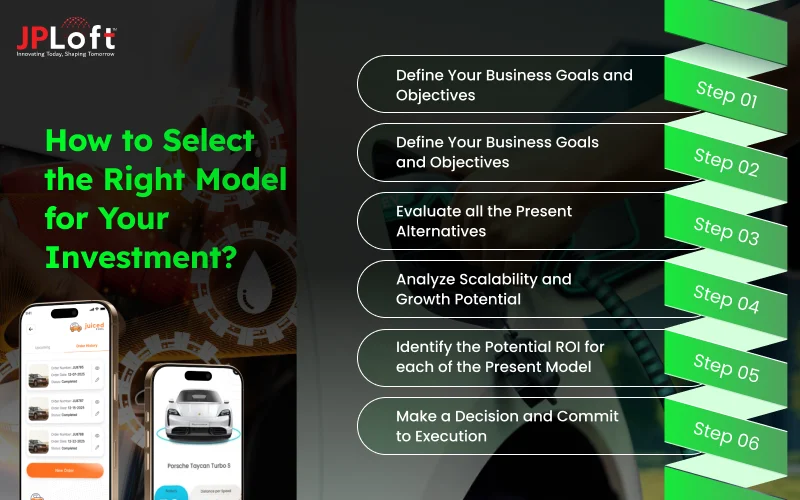
You can select the right model for your investment by going through the list of steps as defined below.
Step 1: Define Your Business Goals and Objectives
This is the first step when it comes to deciding on the right model. You should define your business goals and objectives. It is crucial to identify the primary success metrics, such as revenue targets, user acquisition goals, and market share objectives.
Step 2: Assess Your Available Budget and Financial Resources
You should conduct a thorough evaluation of your available capital. It is important to determine your funding resources, such as personal savings, loans, and investors, and understand the financial commitments that each investment model requires.
Step 3: Evaluate all the Present Alternatives
Now, you should examine and evaluate the complete alternatives by studying various investment models that are relevant to your industry, such as freemium, subscription, marketplace, and traditional retail models.
Step 4: Analyze Scalability and Growth Potential
You should analyze the scalability and growth potential of each of the models. This is one of the important steps that you should consider when it comes to geographic expansion, product diversification, and increased customer capacity.
Step 5: Identify the Potential ROI for each of the Present Model
It is crucial to identify the potential ROI for each of the present models. You should develop detailed financial projections for each potential investment model. Here, you need to consider both short-term cash flow needs and long-term profitability.
Step 6: Make a Decision and Commit to Execution
Now, you should make a valid decision and commit to the execution of the present model. After examining different strategies, you should stick to one strategy and commit to its execution.
How JPLoft Can Help you Launch a Scalable, Compliant App?
Building a successful fuel delivery app requires more than just innovative features; it demands scalability, regulatory compliance, robust security, and a deep understanding of market dynamics to ensure long-term viability and user trust.
The right development partner transforms your vision into a market-ready solution that meets industry standards while delivering exceptional user experiences.
As a leading fuel delivery app development company, JPLoft specializes in creating cutting-edge applications that combine advanced technology with strict compliance to safety regulations, environmental standards, and data protection laws.
Our expert team handles everything from initial concept and MVP development to full-scale deployment and ongoing support, ensuring your app scales seamlessly as your business grows.
JPLoft's proven expertise in on-demand delivery solutions, real-time tracking systems, secure payment integrations, and regulatory compliance frameworks. We deliver fuel delivery applications that drive revenue, build customer loyalty, and establish your brand as a trusted leader in the competitive fuel delivery marketplace.
Conclusion
Choosing between a fuel delivery app and an EV charging app depends on market readiness, infrastructure, user behavior, and long-term business goals. Fuel delivery apps address immediate convenience, fleet efficiency, and emergency needs in fuel-dominant regions.
EV charging apps align with sustainability goals, policy support, and the rapid shift toward electric mobility. Both models demand strong technology foundations, regulatory awareness, and scalable architecture.
The real success lies in matching the right model to the right market and executing it with precision. With a clear strategy, realistic ROI planning, and the right development partner, businesses can build future-ready mobility platforms that scale confidently.
FAQs
A fuel delivery app brings fuel directly to vehicles on demand, while an EV charging app helps users locate, access, reserve, and pay for electric vehicle charging stations.
Fuel delivery apps work best in regions with high fuel usage, limited EV adoption, fleet-driven industries, traffic congestion, and strong demand for on-demand or emergency refueling services.
EV charging apps perform better in markets with strong EV adoption, government incentives, dense charging infrastructure, sustainability-focused consumers, and long-term clean mobility initiatives.
Fuel delivery apps often generate faster short-term revenue through immediate demand, fuel margins, delivery fees, and B2B fleet contracts in fuel-dependent economies.
EV charging apps are more future-proof due to global electrification trends, policy support, sustainability goals, and long-term growth in electric vehicle infrastructure.

Savannah is a passionate tech enthusiast with a sharp understanding of client needs across diverse digital domains. With expertise spanning financial platforms, on-demand solutions, and emerging technologies, she brings a unique blend of analytical insight and interpersonal skills, helping businesses decode complexities and make informed decisions in today's rapidly evolving digital world.


Share this blog