



Key Takeaways:
The cost to develop a sports app typically ranges from $20,000 to $150,000+, depending on features and complexity.
Sports apps generate revenue through subscriptions, ads, and in-app purchases, making the right monetization model essential.
Core features like live scores, streaming, and real-time updates drive user engagement and retention.
Building a sports app usually takes 3 to 9+ months, based on app scope and technical requirements.
Partnering with JPLoft helps you build and scale a sports app efficiently with the right strategy.
The sports world has moved beyond stadiums and TV screens into fast, mobile-first digital experiences. Fans now expect live scores, instant updates, and smooth streaming directly on their phones.
For business owners, this shift creates a strong chance to build engaging sports platforms that users open every single day. But before you begin, one big question needs a clear answer. How much does it cost to create a sports app in 2026?
Many founders enter this space without proper cost clarity and face delays or budget issues later. Small choices in features, design, and technology can quickly increase the overall spend.
This sports app development cost guide will help you understand pricing simply and practically. With the right approach, you can control the cost and avoid common mistakes.
How Much Does it Cost to Build a Sports App?
The cost to build a sports app in 2026 usually ranges between $20,000 to $150,000+. This wide range depends on your app features, design quality, and overall complexity. A simple app costs less, while advanced platforms need a higher investment.
If you only need basic features like scores and schedules, your budget will stay on the lower side. But if you plan to build a mobile app with features like live streaming, real-time updates, and user interaction, costs will increase quickly.
The cost to make a sports app also depends on your development team and technology stack. Choosing the right partner can help you avoid delays and extra expenses.
|
App Type |
Features Included |
Estimated Cost |
|
Basic Sports App |
Live scores, schedules, basic UI |
$20,000 – $40,000 |
|
Mid-Level Sports App |
User login, notifications, APIs, better UI/UX |
$40,000 – $80,000 |
|
Advanced Sports App |
Live streaming, real-time analytics, chat, high-end UI |
$80,000 – $150,000+ |
This sports app development cost breakdown gives you a clear idea of what to expect at each stage. As your feature list grows, your cost will increase as well.
Key Factors That Affect Sports App Development Cost
Building a sports app is not just about one fixed price. Several factors directly influence how much you need to invest in your project. Understanding these elements helps you plan better and avoid unexpected expenses during development.

Let’s break down the key factors that shape the final app development cost.
1. Features
Features are the core of your app and define how users interact with it. Basic features like scores and schedules cost less, while advanced options need more time and effort.
Adding live streaming, chat, or real-time updates increases complexity. More app features mean more development hours, which directly raises the total cost.
Cost Impact: $3,500 – $25,000+
2. Design
App design plays a big role in user experience and retention. A simple layout is quicker to build, while custom designs take more time and effort.
If you want animations, smooth transitions, and a modern interface, costs will rise. Good design improves engagement, but it also needs skilled designers.
Cost Impact: $3,000 – $25,000+
3. Backend
The backend manages data, user activity, and app performance. A simple backend works for basic apps, but advanced apps need strong infrastructure.
Handling large user traffic, real-time updates, and data storage increases backend complexity. This requires more development time and better architecture planning.
Cost Impact: $3,000 – $35,000+
4. Real-time Data APIs
Sports apps rely heavily on real-time data like scores and match updates. Integrating third-party APIs helps deliver this information quickly to users.
However, these APIs often come with subscription costs and integration efforts. The more data sources you use, the higher your overall expenses.
Cost Impact: $1,500 – $20,000+ (excluding ongoing API fees)
5. Platform Choice
Choosing between iOS, Android, or both platforms affects your budget. Building for one platform costs less compared to developing for both.
Considering cross-platform to build a sports app can save money, but native apps may offer better performance. Your choice depends on your target audience and business goals.
Cost Impact: $7,000 – $30,000+
6. Team Location
The cost of hiring a development team varies by location. Teams in regions like the US or Europe usually charge higher rates.
Hiring experienced developers from cost-effective regions can reduce expenses. But you must balance cost with quality and communication.
Cost Impact: $2,000 – $15,000+

Detailed Feature-Wise Cost Breakdown for a Sports App
Understanding feature-level pricing helps you plan your budget in a more practical and controlled way. Instead of guessing the total cost, you can break it down based on what your app actually needs.
Each feature adds its own cost depending on complexity, integrations, and development time. Starting with essential features and scaling later is a smart strategy for most businesses.
Below is a simple feature-wise cost breakdown to help you estimate your investment better.
|
Feature |
Estimated Cost |
|
Live Score Integration |
$500 – $2,000 |
|
Video Streaming |
$3,000 – $6,000 |
|
User Profiles |
$300 – $1,000 |
|
Push Notifications |
$300 – $800 |
|
Match Scheduling & Calendar |
$500 – $1,500 |
|
Real-Time Chat |
$2,000 – $4,500 |
|
Social Sharing |
$300 – $900 |
|
Payment Integration |
$800 – $2,500 |
|
Admin Dashboard |
$1,500 – $4,000 |
|
Analytics & Reports |
$1,000 – $3,000 |
Tech Stack for Sports Apps & Its Cost Impact
Your tech stack is the backbone of your sports app. It defines how your app performs, scales, and handles real-time user demand.
Choosing the right app tech stack helps you reduce long-term costs and avoid performance issues. A poor tech stack can increase maintenance and slow down your app's growth.
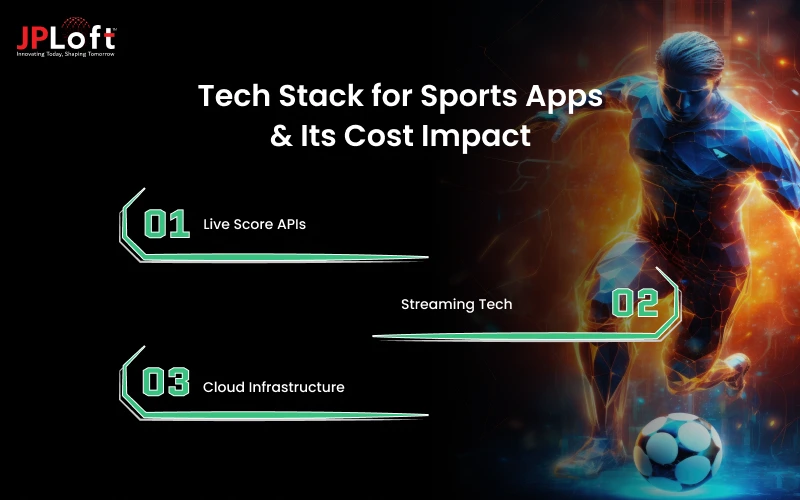
► Live Score APIs
Live score APIs are used to fetch real-time match data from trusted providers. Popular options include SportdataAPI, API-Football, and RapidAPI Sports.
These APIs provide match stats, player data, and live updates. The cost depends on request volume, data depth, and update frequency.
Cost Impact: $1,000 – $12,000+ per year
► Streaming Tech
For live streaming, you need technologies like HLS (HTTP Live Streaming), WebRTC, and RTMP. Platforms like AWS IVS, Wowza, or Vimeo can also be used.
These tools help deliver smooth and high-quality video to users. Costs increase based on streaming hours, users, and video quality.
Cost Impact: $10,000 – $50,000+
► Cloud Infrastructure
Cloud platforms like AWS, Google Cloud, and Microsoft Azure are widely used for hosting sports apps. They support storage, databases, and backend services.
You may also use services like Firebase for real-time databases and notifications. Costs depend on traffic, storage, and server usage.
Cost Impact: $3,000 – $20,000+ per year
Hidden Costs in Developing a Sports App
Many founders only focus on development costs and miss the hidden expenses. These costs appear after launch and can affect your overall budget.
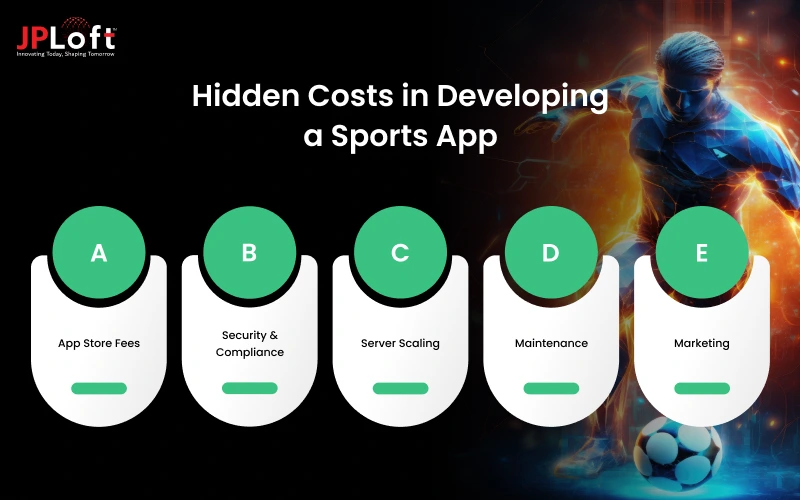
Understanding these early helps you plan better and avoid financial surprises. Let’s look at the most common hidden costs you should consider.
(1) App Store Fees
Publishing your app on the app store involves certain fees. You may need to pay for developer accounts and in-app purchase commissions.
These fees may seem small at first but grow as your app generates more revenue. They are important to consider early.
Cost Impact: 5% – 15% of total budget
(2) Security & Compliance
Sports apps handle user data, payments, and real-time information. This makes app security an important part of your development process.
Implementing data protection, encryption, and compliance standards adds extra cost. Ignoring security can lead to bigger losses later.
Cost Impact: 10% – 20% of total budget
(3) Server Scaling
When your app gains more users, your servers need to handle higher traffic. This is especially important during live matches or big events.
Scaling servers ensures smooth performance, but it increases your cloud and infrastructure costs over time. Poor planning can lead to sudden spikes in expenses.
Cost Impact: 15% – 30% of total budget
(4) Maintenance
After launch, your app needs regular updates, bug fixes, and performance improvements. Maintenance services are not a one-time task, but an ongoing process.
You also need to update your app for new OS versions and user feedback. However, ignoring maintenance can impact user experience and retention.
Cost Impact: 15% – 20% annually
(5) Marketing
Even a great app needs strong marketing to reach users. You must invest in ads, social media, and user acquisition strategies.
Marketing costs vary based on your goals and competition. Without proper promotion, your app may struggle to gain visibility.
Cost Impact: 20% – 40% of total budget
Real-World Cost Examples Inspired by Popular Sports Apps
Looking at well-known sports apps gives you a clearer picture of how features impact development cost. These apps are built with strong technology and an advanced user experience.
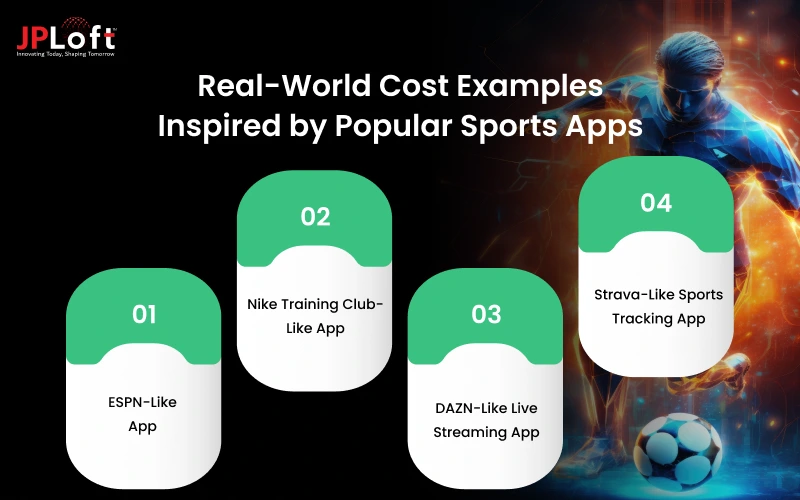
While you may not need all their features at the start, they help you understand realistic budgeting. Let’s explore some popular examples and their estimated development cost.
[1] ESPN-Like App
An app like ESPN focuses on live scores, breaking news, and detailed match statistics. It handles large traffic and delivers real-time updates smoothly.
You need strong backend systems, reliable APIs, and personalized content feeds. Supporting multiple sports also increases overall complexity.
Estimated Cost: $40,000 – $100,000+
[2] Nike Training Club-Like App
Apps like Nike Training Club offer workout plans, video sessions, and fitness tracking. They focus on user engagement and personalized experiences.
High-quality video content and smooth navigation are key features here. You can offer subscription models for premium access when building a fitness app.
Estimated Cost: $30,000 – $80,000+
[3] DAZN-Like Live Streaming App
A platform like DAZN delivers live sports streaming with high-quality video and minimal delay. It requires strong infrastructure and streaming technology.
You need scalable servers, content delivery networks, and smooth playback features. Costs increase with higher user traffic and streaming quality.
Estimated Cost: $80,000 – $150,000+
[4] Strava-Like Sports Tracking App
A fitness app like Strava tracks running, cycling, and other activities using GPS. It focuses on performance tracking and social sharing.
You need map integration, activity tracking, and user analytics. Social features like sharing and challenges also add to the development effort.
Estimated Cost: $40,000 – $100,000+
How to Reduce the Sports App Development Cost?
Building a sports app does not always mean spending a huge budget. With the right approach, you can control costs without affecting quality.
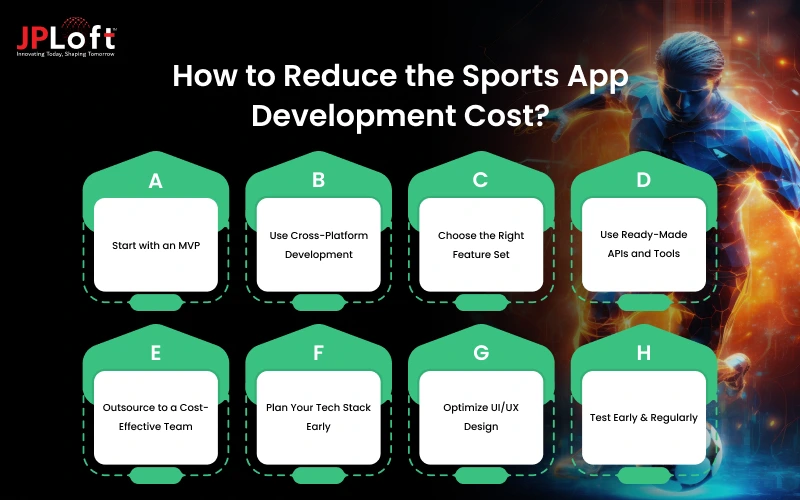
Smart planning and the right decisions at each stage can help you save a significant amount. Let’s look at practical ways to reduce your overall investment.
A. Start with an MVP
Instead of building a full-featured app, launch with only core features first. This helps you test your idea and reduce initial development effort.
You can add advanced features later based on real user feedback. This approach avoids wasting money on unused features.
Cost Savings: 30% – 50%
B. Use Cross-Platform Development
Building separate apps for iOS and Android increases cost and development time. Cross-platform frameworks like Flutter or React Native help you build for both platforms.
This reduces development effort while maintaining good performance. It is a smart choice for startups with limited budgets.
Cost Savings: 20% – 40%
C. Choose the Right Feature Set
Avoid adding too many features in the beginning. Focus only on what your users actually need for the first version.
Unnecessary features increase complexity and cost without adding real value. Keep your app simple and scalable.
Cost Savings: 15% – 30%
D. Use Ready-Made APIs and Tools
Instead of building everything from scratch, use third-party APIs for features like live scores and notifications. This saves both time and development effort.
Reliable tools can speed up your launch and reduce technical workload. Just ensure they are scalable and secure.
Cost Savings: 10% – 25%
E. Outsource to a Cost-Effective Team
Hiring developers from high-cost regions can increase your budget significantly. Working with experienced teams from cost-effective regions can help reduce expenses.
Make sure you choose a reliable development partner with proven expertise. Quality should not be compromised for lower cost.
Cost Savings: 20% – 50%
F. Plan Your Tech Stack Early
Choosing the wrong technology can lead to rework and higher costs later. Considering the top programming frameworks ensures smooth development and scalability.
It also reduces maintenance issues and improves long-term performance. Early planning helps avoid expensive changes.
Cost Savings: 10% – 20%
G. Optimize UI/UX Design
A simple and clean design costs less compared to complex custom interfaces. Focus on usability instead of heavy animations in the early stage.
You can always upgrade the design once your app starts growing. This helps you save on initial design costs.
Cost Savings: 10% – 25%
H. Test Early & Regularly
Fixing issues during development is cheaper than fixing them after launch. Regular testing helps you identify problems early.
This reduces post-launch maintenance costs and improves app quality. Early testing also saves time and effort.
Cost Savings: 10% – 20%
By following these strategies, you can control the cost to create a sports app without compromising on quality. A smart and phased approach always leads to better results and higher returns.

Why Choose JPLoft for Your Dream Sports App?
Choosing the right development partner can make or break your sports app journey. JPLoft brings strong 15+ years of experience in building scalable and high-performance mobile apps for startups and growing businesses.
Our sports app development services focus on understanding your business goals before starting development. Hence, this helps us create a solution that fits your budget and delivers real value to your users.
We follow a clear and structured development process to avoid delays and unexpected costs. From design to deployment, every step is planned to ensure smooth execution.
JPLoft also helps you choose the right tech stack and features based on your needs. This approach helps reduce waste and improve long-term performance.
With our expertise, you get quality, transparency, and ongoing support. Therefore, we aim to build apps that grow with your business and keep users engaged.
Conclusion
The cost to build a sports app in 2026 is not fixed. It depends on your features, tech stack, and business goals. A basic app may start around $20,000, while advanced platforms can exceed $1,50,000 with complex features.
Every decision, from real-time APIs to streaming and backend setup, directly affects your total investment. Ignoring these factors can lead to budget overruns and delayed launches.
A smart approach is to start with a clear roadmap and focus on core features first. This helps you validate your idea and reduce unnecessary spending in the early stage.
You should also plan for hidden costs like scaling, maintenance, and marketing. These expenses play a key role in your app’s long-term success.
With the right strategy and experienced team, you can control costs and build a scalable sports app that delivers strong user engagement and business growth.
FAQs
The cost usually ranges from $20,000 to $150,000+ based on features and complexity. Advanced features like live streaming and real-time updates increase the total budget.
Yes, you need proper broadcasting or data rights to stream or display official content. Without permissions, your app may face legal issues or restrictions.
You can start with Android or iOS based on your target audience. Launching one platform first helps reduce initial development cost.
Yes, APIs provide live scores, stats, and match updates quickly. However, they come with usage limits and ongoing subscription costs.
Focus on real-time features, smooth performance, and personalized content. A fast and engaging experience helps attract and retain users.

Kris Jacobs brings 20+ years of experience in digital product strategy, user-focused design, and solving complex product challenges. She has worked across on-demand services, travel, entertainment, sports, insurance, education, and service marketplaces, including handyman, dog-walking, courier, event-management, and equine platforms. Her focus is on shaping practical, scalable digital experiences that align user needs with business goals and long-term product growth.



Share this blog