


Key Takeaways
Building a sports streaming app like DAZN requires scalable streaming technology, licensing support, and seamless multi-device experiences.
The cost of sports streaming app development generally ranges from $10,000 to $150,000+.
Essential sports streaming app features improve user engagement, content accessibility, and personalized viewing experiences.
The development timeline for a sports streaming app usually ranges from 2 to 7+ months, varying based on app complexity.
Low-latency streaming is critical for delivering real-time sports viewing experiences without delays or buffering issues.
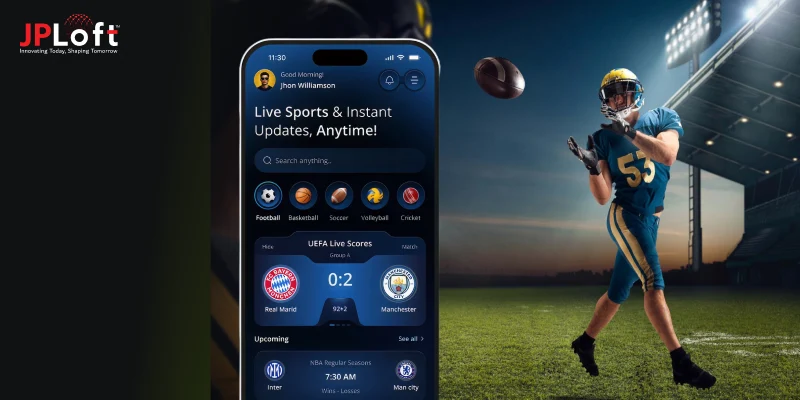
Sports fans are no longer waiting for the next TV broadcast. They are streaming live matches, replays, and highlights directly on their phones, tablets, and smart TVs.
This shift is creating a massive business opportunity. The global sports streaming market is projected to reach $68.30 billion by 2030, growing at a CAGR of 12.6%.
Apps like DAZN have already cracked the formula by operating in 200+ markets and generating billions through a direct-to-consumer subscription model.
The audience is there too. Millions of Americans stream live sports monthly, and Gen Z has increased its streaming habits in the past year alone.
For businesses, this is not a trend to watch from the sidelines. It is an opportunity to build, invest, and lead. In this blog, we will discuss how to develop a sports streaming app like DAZN, its features, cost, and more.
What is the DAZN App?
DAZN is a global sports streaming platform founded in 2016. It operates on a direct-to-consumer (D2C) subscription model.
The app has over 50 million downloads with a rating of 4.4 on the Play Store. Moreover, it eliminates the need for cable bundles and gives fans affordable, flexible access to live and on-demand sports content.
Unlike traditional broadcasters, DAZN built its success on three core pillars.
-
First, exclusive broadcasting rights for high-demand sports, including boxing, MMA, football, and the NFL.
-
Second, a seamless multi-device experience covering smartphones, smart TVs, tablets, and gaming consoles.
-
Third, an AI-driven personalized feed that recommends content based on individual viewing habits.
What made DAZN truly stand out was its simplicity. No long-term contracts, no channel packages, no hidden fees. Just sports, on demand, at a price fans are willing to pay.
How Sports Streaming Apps Like DAZN Work?
DAZN delivers live and on-demand sports content through a well-structured, step-by-step process:
-
Users download the app, create an account, and choose a subscription plan. DAZN offers flexible monthly and annual options with no long-term contracts required.
-
After logging in, users land on a personalized home screen showing live matches, upcoming events, replays, and AI-driven recommendations.
-
Users tap on any match or event to start streaming instantly. The app supports live viewing as well as on-demand replays for previously aired content.
-
As the stream plays, the app automatically adjusts video quality based on the user's internet connection, ensuring a smooth experience.
-
Users can switch between devices mid-stream, whether on a smartphone, tablet, smart TV, or gaming console, without losing their place.
-
While watching, users can access real-time match stats, live scores, and highlights.
-
Users can update their subscription, manage payment details, set content preferences, and download select content for offline viewing, all from within the app.
Core Features of Sports Streaming Apps Like DAZN
If you want to create a sports streaming app like DAZN, features are what separate a platform users love from one they abandon after the first match. The right app feature set drives engagement, reduces churn, and directly impacts revenue.
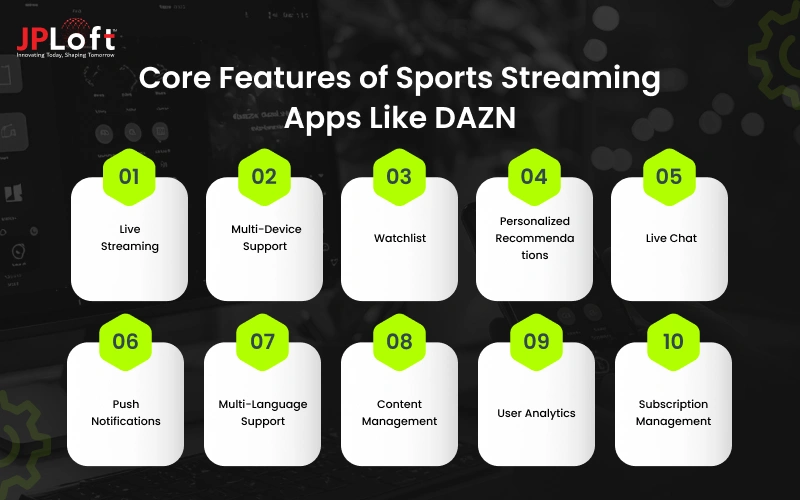
Below are the core features your sports streaming app must have to compete at a professional level.
[1] Live Streaming
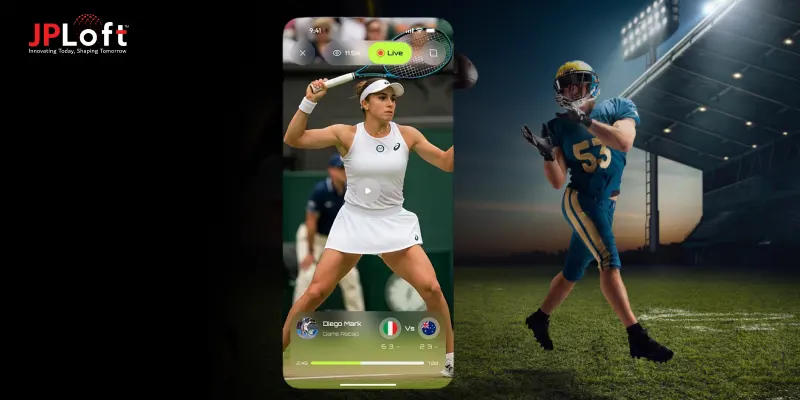
Live streaming is the backbone of any sports streaming platform. Users can watch live matches, fights, and events in real time with adaptive bitrate technology ensuring smooth, buffer-free playback across all network conditions.
[2] Multi-Device Support
Users expect to switch between smartphones, tablets, smart TVs, and gaming consoles without interruption. Your app must deliver a consistent, high-quality viewing experience across every screen and operating system.
[3] Watchlist
Watchlist allows users to save upcoming matches, events, and on-demand content for later viewing. A simple but powerful retention feature that keeps users coming back to the platform regularly.
[4] Personalized Recommendations
AI analyzes each user's viewing history, preferred sports, and behavior patterns to surface relevant content automatically. This keeps users engaged longer and significantly reduces the chances of them leaving the platform.
[5] Live Chat
Enables fans to interact with each other in real time during live events. Live chat builds community, increases session duration, and makes the viewing experience far more engaging and social.
[6] Push Notifications
Timely alerts for match kickoffs, score updates, breaking sports news, and subscription renewals keep users informed and consistently bring them back to the app at the right moment.
[7] Multi-Language Support
Serving a global audience requires content and UI available in multiple languages. This feature removes language barriers, expands your market reach, and significantly improves user experience across different regions.
[8] Content Management
A robust backend CMS allows admins to upload, schedule, categorize, and manage all live and on-demand content efficiently. It ensures the right content reaches the right audience at the right time.
[9] User Analytics
Tracks viewing behavior, session duration, drop-off points, and content preferences. These insights help platform owners make data-driven decisions to improve content strategy, user experience, and overall retention.
[10] Subscription Management
Handles plan selection, billing cycles, payment processing, upgrades, downgrades, and cancellations seamlessly. A smooth subscription experience directly impacts revenue and reduces involuntary churn caused by payment failures.
Advanced Features to Integrate in Apps Like DAZN
Building a competitive platform today means going beyond the basics. These advanced features are what transform a good sports streaming app into an experience users cannot find anywhere else.
|
Feature |
What It Does |
Why It Matters |
|
AI Highlights |
Auto-detects and compiles the best match moments using machine learning. |
Reduces need for full replays and boosts on-demand engagement. |
|
Multi-Camera Streaming |
Let's users switch between multiple camera angles during live events. |
Creates a personalized, immersive viewing experience. |
|
AR/VR Experiences |
Delivers 360-degree viewing and augmented match overlays on compatible devices. |
Attracts tech-forward audiences and future-proofs the platform. |
|
Voice Search |
Let's users find matches, teams, and events using natural voice commands. |
Speeds up content discovery, especially on smart TVs. |
|
Smart Recommendations |
Uses deep learning to suggest content based on viewing habits and preferences. |
Increases session time, reduces churn, and improves retention. |
Step-by-Step DAZN-Like App Development Process
To build a sports app that functions well, businesses require a clear, structured approach.
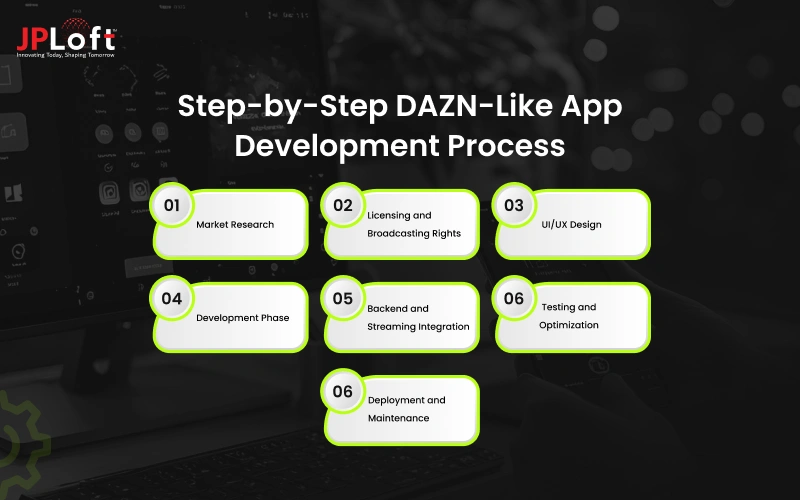
If you want to develop apps like DAZN, follow these seven steps to move from idea to a fully functional, market-ready product.
Step 1: Market Research
Before you build a sports streaming app like DAZN, skipping market research is the fastest way to build a product nobody wants. Understanding your market before writing a single line of code saves time, money, and resources.
► Analyze Target Audience and Competitors
Identify who your users are, what sports they follow, and what competing platforms are missing. This shapes every product decision that follows.
► Define Business Model and App Goals
Decide early whether you will monetize through subscriptions, ads, or pay-per-view. Clear goals keep your development focused and investor pitch compelling.
Step 2: Licensing and Broadcasting Rights
Content is your product. Knowing how to develop an app like DAZN means understanding that without the right licenses in place, even the most technically advanced platform cannot legally stream a single match.
► Secure Sports Content Licensing
Negotiate broadcasting rights directly with leagues, federations, or rights holders. Licensed content protects your platform legally and builds credibility with users.
► Manage Regional Streaming Permissions
Different regions have different broadcasting restrictions. Define which content is available in which markets to stay compliant and avoid costly legal disputes.
Step 3: UI/UX Design
A great streaming experience starts with great UI/UX design services. When you create a sports streaming app like DAZN, users decide within seconds whether it's worth their subscription money.
► Create User-Friendly Streaming Interfaces
Design clean, intuitive screens that make browsing, discovering, and watching content effortless. Simplicity drives engagement and reduces user drop-off significantly.
► Optimize Multi-Device Viewing Experience
Ensure your app design adapts seamlessly across smartphones, tablets, smart TVs, and desktops. Consistent experience across devices builds user trust and loyalty.
Step 4: Development Phase
This is where your platform takes shape. The development phase transforms research, design, and planning into a fully functional product ready for real-world testing and user interaction.
► Build Core Sports Streaming Features
Start with the features that matter most. Live streaming, user authentication, subscription management, and basic content discovery form the technical backbone of any serious sports streaming platform.
► Integrate Third-Party Services and APIs
Connect payment gateways, push notification services, analytics tools, and CDN providers during this phase. Early integration prevents compatibility issues and reduces rework during testing.
Step 5: Backend and Streaming Integration
The backend is what keeps your platform running under pressure. Businesses looking to build an app like DAZN must prioritize a robust infrastructure that will not buckle the moment a high-demand match goes live.
► Develop Scalable Backend Infrastructure
Build a backend that handles thousands of concurrent users without performance drops. Cloud-based architecture with auto-scaling capabilities is essential for live sports traffic.
► Integrate Video Streaming and CDN Services
Connect your platform to reliable streaming servers and a Content Delivery Network. This ensures fast, low-latency content delivery to users across every region.
Step 6: Testing and Optimization
Launching without thorough app testing is a risk no serious platform can afford. Understanding how to create a sports streaming app like DAZN means treating every bug, lag, and security gap as a threat to user trust and platform credibility.
► Perform Performance and Security Testing
Stress test the platform under peak traffic conditions and run app security audits to identify vulnerabilities. A stable, secure platform builds long-term user confidence.
► Optimize Streaming Speed and User Experience
Fine-tune buffering times, video load speeds, and UI responsiveness. Even minor performance improvements directly impact user satisfaction and retention rates.
Step 7: Deployment and Maintenance
Launch day is just the beginning. Every business that wants to make a sports streaming app like DAZN needs a long-term maintenance strategy to stay competitive, secure, and relevant in a fast-moving market.
► Launch the Sports Streaming App
Submit your app to the App Store, Play Store, and web platforms simultaneously. A coordinated launch with a marketing push ensures maximum visibility and strong early user acquisition.
► Provide Continuous Updates and Technical Support
Regular app maintenance services, bug fixes, and new feature rollouts keep users engaged. Responsive technical support reduces churn and reinforces trust in your platform long term.
Cost to Develop a Sports Streaming App Like DAZN
The cost to create an app like DAZN usually ranges from $10,000 to $150,000+. However, the final cost to develop a sports app depends on the complexity of features, technology choices, and the development team you work with.
Below is a realistic breakdown to help you plan your investment.
|
Development Component |
Estimated Cost |
|
UI/UX Design |
$500 - $15,000 |
|
Frontend Development |
$1,500 - $20,000 |
|
Backend Development |
$2,000 - $25,000 |
|
Streaming Infrastructure & CDN |
$1,500 - $20,000 |
|
DRM & Security Integration |
$500 - $15,000 |
|
AI & Personalization Features |
$1,500 - $20,000 |
|
Third-Party API Integrations |
$500 - $10,000 |
|
Testing & Quality Assurance |
$1,000 - $15,000 |
|
Deployment & Launch |
$500 - $10,000 |
|
Total Estimated Cost |
$10,000 - $150,000+ |
Challenges in Building Sports Streaming Apps Like DAZN
Knowing how to build a sports streaming app like DAZN is only half the battle. Several mobile app development challenges can directly impact user experience, platform reputation, and revenue if not addressed early.
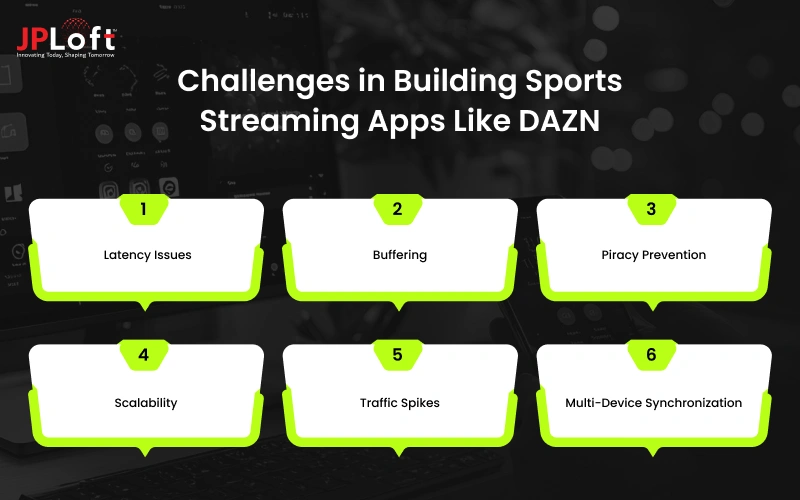
Let’s discuss in detail:
Challenge 1: Latency Issues
High latency ruins the live sports experience. When a user receives a stream seconds behind the actual event, it breaks immersion and exposes them to spoilers through social media before the moment plays out on screen.
Solution: Implement low-latency protocols like WebRTC or CMAF to bring live stream delays under two seconds.
Challenge 2: Buffering
Buffering is the number one reason users abandon a streaming platform. Inconsistent internet speeds, poor CDN configuration, and unoptimized video encoding all contribute to frustrating playback interruptions during critical match moments.
Solution: Use adaptive bitrate streaming to automatically adjust video quality based on the viewer's real-time internet speed.
Challenge 3: Piracy Prevention
Unauthorized redistribution of licensed sports content is a serious legal and financial threat. Piracy not only violates broadcasting agreements but also directly reduces subscriber numbers and damages relationships with rights holders.
Solution: Integrate DRM technologies such as Widevine, PlayReady, and FairPlay alongside token-based authentication to protect all streamed content.
Challenge 4: Scalability
A platform that performs well with 1,000 users can completely collapse under 100,000 concurrent viewers. Sports streaming apps face unpredictable demand, and infrastructure that cannot scale on demand will fail at the worst possible moment.
Solution: Build on cloud infrastructure with auto-scaling capabilities, such as AWS or Google Cloud, to handle sudden traffic growth seamlessly.
Challenge 5: Traffic Spikes
Major sporting events like championship finals or boxing title fights can send traffic surging within minutes. Most platforms are not architected to absorb these sudden spikes without significant performance degradation.
Solution: Use load balancers, edge servers, and a multi-CDN strategy to distribute traffic efficiently during peak event periods.
Challenge 6: Multi-Device Synchronization
Users expect a seamless experience, whether they start watching on a phone and switch to a smart TV mid-match. Maintaining consistent playback position, quality, and session state across different devices is technically complex to achieve.
Solution: Implement centralized session management with real-time state synchronization across all supported devices and platforms.
Monetization Strategies to Have in a Sports App Like DAZN
To make an app like DAZN profitable, you need more than just a subscription button. The most successful sports streaming platforms combine multiple revenue streams to maximize earnings and reduce dependency on a single model.
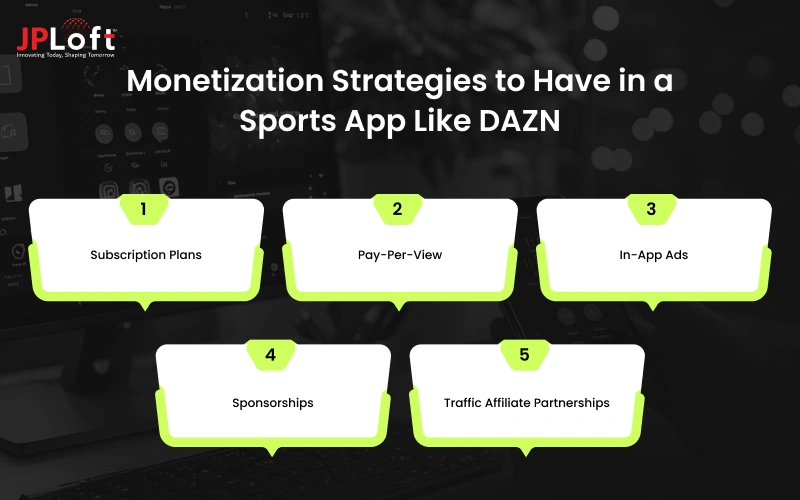
Below are the best app monetization models you can choose from.
[A] Subscription Plans
Offer monthly and annual plans at different price points.
Tiered plans with basic, standard, and premium access give users flexibility while increasing revenue per user.
[B] Pay-Per-View
Charge a one-time fee for premium events like championship fights and exclusive matches.
PPV works best for high-demand events where fans willingly pay beyond their regular subscription.
[C] In-App Ads
An ad-supported free tier attracts users who are unwilling to commit to a paid plan.
In-stream ads and banner placements generate consistent revenue without requiring any subscription from users.
[D] Sponsorships
Partner with sports brands and manufacturers for sponsored segments and branded content placements.
Sponsorships deliver high-value revenue while keeping the overall user experience clean and non-intrusive.
[E] Affiliate Partnerships
Integrate affiliate deals with merchandise stores, betting platforms, and ticketing services.
Every completed purchase through your platform earns a commission with zero additional development effort required.
AI Trends in Sports Streaming Apps Like DAZN
AI in sports apps is no longer an optional add-on. In 2026, it is the core engine driving personalization, content delivery, and user retention.
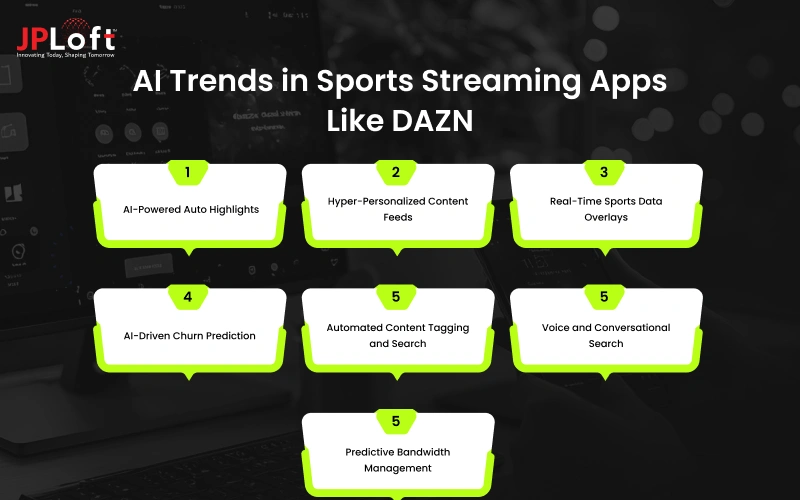
Here are the most impactful AI trends shaping the future of sports streaming.
1. AI-Powered Auto Highlights
AI now automatically detects key moments such as goals, knockouts, and match-winning plays and compiles them into short highlight reels in real time. Users no longer need to watch full replays to catch the best moments.
2. Hyper-Personalized Content Feeds
Machine learning models analyze viewing history, preferred sports, watch time, and engagement patterns to build a unique content feed for every individual user. The result is a platform that feels personally curated rather than generic.
3. Real-Time Sports Data Overlays
AI integrates live player statistics, heat maps, and performance data directly into the video stream. This gives viewers a broadcast experience far richer than traditional television without any manual input from production teams.
4. AI-Driven Churn Prediction
Platforms can now identify users who are likely to cancel their subscription before they actually do. AI models flag at-risk users based on declining engagement, allowing the platform to trigger retention offers at the right moment.
5. Automated Content Tagging and Search
AI automatically tags every piece of content by sport, team, player, and event type. This makes search faster, content discovery more intuitive, and backend content management significantly more efficient for platform operators.
6. Voice and Conversational Search
Natural language processing allows users to search for content using conversational voice commands. Instead of typing, users simply say what they want to watch, and the platform delivers results instantly.
7. Predictive Bandwidth Management
AI monitors network conditions in real time and predicts congestion before it happens. This allows the platform to proactively adjust stream quality and reroute delivery paths, significantly reducing buffering during peak traffic periods.
Competitor Comparison of DAZN-Like Apps
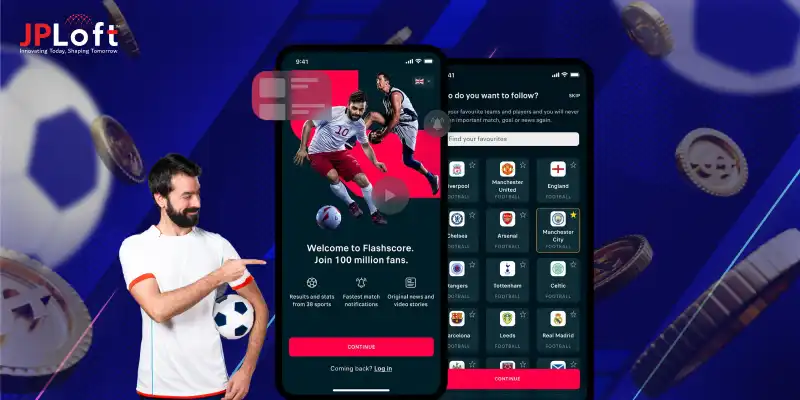
DAZN is not the only player in the sports streaming space. Although there are several similar platforms, businesses are also looking to create a sports app like Flashscore, ESPN, and more.
Understanding how it compares against other leading platforms helps businesses identify market gaps and build a more competitive product.
|
Feature |
DAZN |
ESPN+ |
Sling TV |
FuboTV |
|
Content Focus |
Sports Only |
Sports Only |
Sports + Entertainment |
Sports + Live TV |
|
Availability |
200+ Countries |
Primarily USA |
USA Only |
USA, Canada, Spain |
|
Pricing Model |
Subscription + PPV |
Subscription + PPV |
Channel-Based Packages |
Subscription Packages |
|
Exclusive Rights |
Boxing, Serie A, LaLiga |
UFC, NHL, MLS |
NFL, NBA, MLB |
NFL, NBA, Bundesliga |
|
4K Streaming |
Yes |
Yes |
No |
Yes |
|
DVR Feature |
No |
No |
Yes |
Yes |
|
Offline Viewing |
Yes |
Yes |
No |
No |
|
Multi-Screen Support |
Yes |
Yes |
Yes |
Yes |
|
Free Trial |
No |
No |
Yes |
Yes |
Why Choose JPLoft to Develop an App Like DAZN?
Not every development company understands the technical depth that a live sports streaming platform demands. Streaming architecture, DRM security, CDN strategy, and real-time scalability are not skills every team carries.
JPLoft does. From low-latency streaming integration to AI-powered personalization, our team handles every technical complexity so you do not have to.
Our custom sports app development approach means your platform is built around your specific business goals, target audience, and revenue model. Not a recycled template.
We have successfully delivered high-performance apps for startups and enterprises across sports, entertainment, and media verticals globally.
Transparent pricing, clear timelines, and end-to-end support from day one to post-launch. With JPLoft, you get a single accountable partner committed to building a platform that competes at the highest level.
Conclusion
Developing a sports streaming app like DAZN is a significant technical undertaking with a clearly defined path.
The architecture decisions you make early will determine how your platform performs under real conditions.
Streaming protocols, CDN strategy, DRM setup, and monetization models are not afterthoughts. They are the foundation.
Platforms winning in this space are built on scalable infrastructure and designed around genuine user behavior.
Every section of this guide gives you that foundation. Features, costs, challenges, and AI trends are all connected.
Knowing how to build an app like DAZN that truly competes comes down to one thing.
Choosing a technology partner who understands every layer of a live sports streaming platform.
FAQs
To build apps like DAZN, businesses need to focus on live streaming technology, sports broadcasting rights, scalable backend infrastructure, and user-friendly features such as subscriptions, real-time updates, and multi-device streaming support.
The cost to develop a sports streaming app like DAZN ranges from $10,000 to $150,000+, depending on features, streaming infrastructure, platform complexity, and third-party integrations.
Important features include live streaming, user profiles, subscriptions, push notifications, real-time scores, multi-device support, and personalized content recommendations.
Sports streaming app development may take 2-7+ months, depending on app complexity, feature set, UI/UX design, backend infrastructure, and testing requirements.
Low-latency streaming helps users watch live sports events in near real-time without delays, buffering, or synchronization issues.

Kris Jacobs brings 20+ years of experience in digital product strategy, user-focused design, and solving complex product challenges. She has worked across on-demand services, travel, entertainment, sports, insurance, education, and service marketplaces, including handyman, dog-walking, courier, event-management, and equine platforms. Her focus is on shaping practical, scalable digital experiences that align user needs with business goals and long-term product growth.


Share this blog