


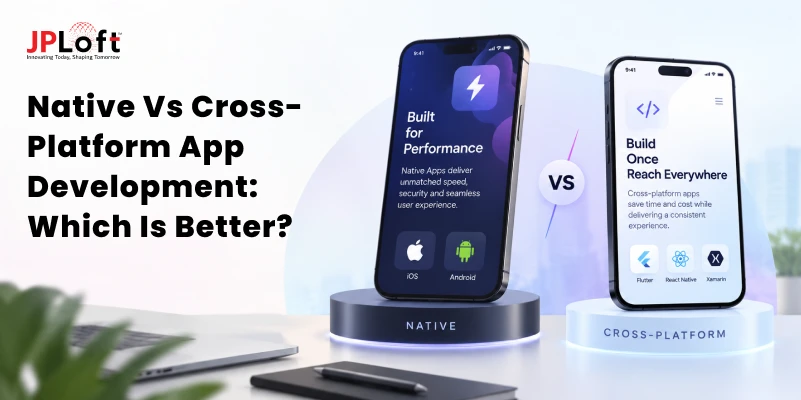
Every year, businesses pour millions into mobile apps, only to watch some flop within weeks while others become industry giants.
What separates them? Often, it's a decision made before a single line of code is written: native or cross-platform development.
Here's the twist: there's no universal "right" answer. Instagram uses native for buttery-smooth performance.
Alibaba and Google Ads run on Flutter, proving cross-platform can scale to millions of users without breaking a sweat. So why do two wildly successful companies choose completely opposite paths?
The truth is, this isn't just a technical decision; it's a strategic one that can make or break your app's speed, cost, and user experience.
If you choose the right tech stack, you set your app up for long-term success. Whereas, if you pick wrong, you could be looking at expensive rebuilds down the road.
So which path should you take? Let's break down the real differences, beyond the buzzwords, and help you make a decision you won't regret
Explore this guide to native vs. cross-platform app development to find out what suits your business. Let’s get right into it:
Native vs Cross-Platform App Development: What’s the Difference?
When considering whether to choose native or cross-platform app development, the answer is that it depends on your priorities, performance, budget, speed to market, and long-term goals.
First, understand “What is Native App Development?”
Native app development simply means building separate apps for iOS & Android using platform-specific languages (Swift, Objective-C for iOS & Kotlin for Android).
This approach delivers the highest performance, smoothest animations, and deepest access to device features, like the camera, GPS, and biometrics.
For Android, they use Kotlin or Java with Android Studio. Because the app is written specifically for one operating system, it can take full advantage of the device’s hardware and software features.
This results in faster performance, smoother animations, better security, and a user experience that feels completely natural on that platform.
Now, “What is Cross-Platform Mobile Development?”
Cross-platform app development uses a single codebase to create apps that run on both iOS and Android.
Popular frameworks like Flutter and React Native allow developers to write the code once and deploy it across multiple platforms.
While the final apps may not always match the absolute peak performance of native apps, modern cross-platform tools have closed the gap significantly and deliver excellent results for most businesses and consumer applications.
In short:
-
Choose Native when you need maximum performance, complex animations, or full hardware access.
-
Choose Cross-Platform when you want faster launch, lower cost, and easier maintenance across both platforms.
The right choice comes down to what matters most for your specific project.

Here’s a comparison table for you to help you understand the difference better:
|
Aspect |
Native Development |
Cross-Platform Development |
|
Languages |
Swift/Objective-C (iOS), Kotlin/Java (Android) |
JavaScript, Dart (React Native, Flutter) |
|
Performance |
Excellent, closer to hardware |
Good, but slightly slower than native |
|
Codebase |
Separate for each platform |
Single shared codebase |
|
Development Cost |
Higher (two teams/builds) |
Lower (one team/build) |
|
Development Time |
Longer |
Faster |
|
UI/UX Consistency |
Fully platform-specific, native feel |
Consistent across platforms, near-native feel |
|
Access to Device Features |
Full and immediate access |
Good, but may need plugins/bridges for latest APIs |
|
Maintenance |
Requires updating two codebases |
Update once, applies everywhere |
|
Best For |
High-performance apps (games, AR/VR, heavy graphics) |
MVPs, startups, budget-conscious projects |
|
Popular Examples |
Instagram, Spotify (partially) |
Alibaba, Google Ads, Tesla app |
Native vs Cross-Platform: How Do They Work?
One of the big challenges in mobile app development is to find which approach is right for your business.
In native vs cross-platform development, native apps are created specifically for platforms such as iOS or Android using their respective technologies, while cross-platform apps use a shared codebase to run across different platforms.
This difference affects the overall development speed, performance, customization, and maintenance.
How Native Mobile Apps Work:
-
Choose the Platform & Tools: Developers pick either iOS or Android and set up the official tools: Xcode with Swift for iOS & Android Studio with Kotlin for Android. Everything starts platform-specific from day one.
-
Write Platform-Specific Code: The entire app is coded using the language and frameworks designed for that operating system. This gives the app direct access to the device’s camera, GPS, and sensors, and other hardware features.
-
Design the Interface Natively: UI elements follow Apple’s Human Interface Guidelines or Google’s Material Design. Buttons, animations, and gestures feel natural because they are built exactly the way the platform experts built exactly the way platform experts intended.
-
Compile the Code: The code is compiled directly into machine code that the device understands. This is why native apps usually run faster and feel smoother than most alternatives.
-
Test on Real Devices & Emulators: Thorough app testing happens on actual iPhones or Android phones to catch performance issues, battery drain, and platform-specific bugs.
-
Deploy to the Official Store: The finished app is submitted to the App Store or Google Play, following each platform’s strict review guidelines.
Native Mobile App Development: Pros & Cons
Native mobile app development means building separate apps for each platform, one for iOS using Swift, and one for Android using Kotlin.
It’s the traditional approach, and for good reason: it delivers unmatched performance and access to every device feature available.
Advantages of Native Apps
-
Faster, smoother performance since apps run directly on the OS
-
Full access to hardware features like camera, GPS, sensors, and biometrics
-
Platform-consistent design that feels familiar and intuitive to users
-
Better support for complex, high-performance functionality
-
Fewer compatibility issues since apps are built specifically for one OS
Limitations of Native Apps
-
Requires building and maintaining two separate codebases (iOS and Android)
-
Higher mobile app development time due to duplicated work across platforms
-
Increased overall cost compared to a single shared codebase
-
Every update must be built and tested twice
-
Not ideal for startups or teams with tight budgets and timelines
Cross-Platform App Development: Pros & Cons
Cross-platform mobile development lets you write one codebase and deploy it across both iOS and Android.
Frameworks like Flutter and React Native make this approach faster and more reliable, fueling the ongoing cross-platform vs native mobile development debate.
Here are some pros & cons to explore:
Advantages of Cross-Platform Apps
-
Faster development with a single codebase for both iOS and Android
-
Lower cost since you're not maintaining two separate apps
-
Simultaneous launch on both platforms instead of staggered releases
-
Quicker updates since changes only need to be made once
-
Easier to scale across multiple platforms with shared resources
Limitations of Cross-Platform Apps
-
Slightly lower performance compared to native, especially in graphics-heavy apps
-
Delayed access to newly released or advanced device features
-
Occasional reliance on plugins or bridges for certain native functionality
-
Minor UI inconsistencies possible across different platforms
-
Not always ideal for highly complex, performance-critical applications
Native vs Cross-Platform: Key Differences
When comparing native vs cross-platform mobile app development, a handful of factors consistently make the biggest difference in outcomes:
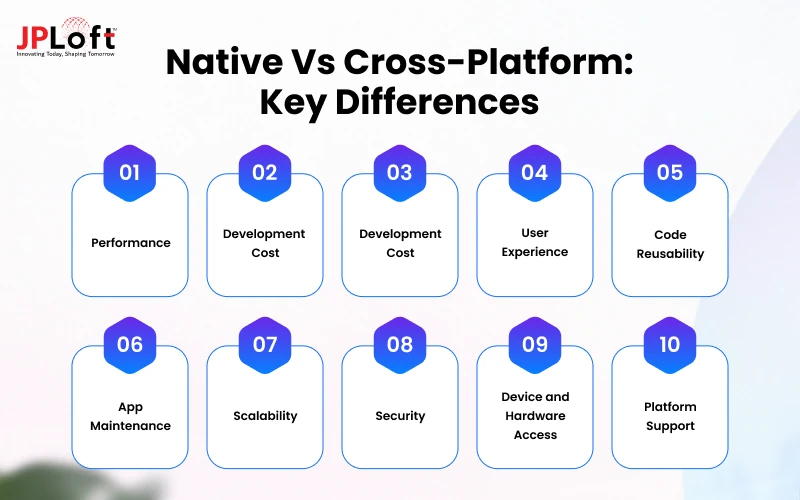
1. Performance
Native apps generally perform better since they're built specifically for one operating system. Cross-platform apps have narrowed this gap significantly, but native still edges ahead for complex, resource-heavy tasks.
2. Development Cost
Cross-platform development is usually more budget-friendly since a single build keeps overall app development cost lower than building twice. Native mobile development costs more upfront but can pay off for apps with highly specialized requirements.
3. Development Time
A single shared codebase means cross-platform apps typically reach the market faster. Native apps take longer simply because two versions need to be built and tested separately.
4. User Experience
Native apps tend to feel more polished since they follow each platform's exact design guidelines. Cross-platform apps have improved a lot, but occasional inconsistencies can still show up.
5. Code Reusability
Cross-platform vs native mobile development: you should know that cross-platform frameworks allow up to 90% code reuse across platforms, saving serious development time. Native apps offer little to no code sharing between iOS and Android.
6. App Maintenance
Maintaining one codebase is simpler and faster than juggling two separate native apps. This makes reliable app maintenance services especially appealing for lean teams working with limited resources.
7. Scalability
Both approaches can scale well, but native apps often handle heavy, complex growth more smoothly. When it comes to cross-platform mobile development, apps scale efficiently enough for most standard business use cases without added complexity.
8. Security
Native apps benefit from platform-specific security features built directly into the OS, offering strong mobile app security by default. Cross-platform apps are secure too, but require careful configuration to match native-level protection.
9. Device and Hardware Access
Native mobile app development offers instant, full access to every hardware feature a device supports. Cross-platform apps may need plugins or bridges to reach the same level of access.
10. Platform Support
Native apps are built exclusively for one platform at a time, requiring separate projects. Cross-platform apps support both iOS and Android from a single, unified codebase.
Native vs Cross-Platform: Which Is More Cost-Effective?
If budget is your biggest concern, cross-platform development almost always wins.
Building one codebase instead of two cuts development costs significantly, since you're paying for a single development effort rather than duplicating work across platforms.
Ongoing maintenance stays lighter too, with fewer resources needed for updates and bug fixes.
Native development can still be worth the investment for apps that demand top-tier performance or deep hardware integration, where the added cost translates directly into a better, more capable product for users.
Native vs Cross-Platform: Which Offers Better Performance?
Native apps remain the go-to choice for raw speed and responsiveness, especially for gaming or graphics-intensive apps that demand every ounce of processing power.
That said, modern cross-platform frameworks like Flutter have closed the gap dramatically, using optimized rendering engines to deliver near-native speeds.
For most everyday business apps, performance differences are barely noticeable to the average user, making cross-platform a perfectly viable choice for the majority of use cases.
Native vs Cross-Platform: Which Is Better for User Experience?
Native apps typically deliver a slightly smoother, more platform-authentic experience since they follow each OS's design language precisely, right down to animations, gestures, and navigation patterns.
This makes interactions feel instantly familiar to users.
Cross-platform apps have come a long way, though, and tools like Flutter now produce interfaces that feel just as polished and natural.
With careful design, most users won't notice a real difference. Ultimately, user experience today depends more on execution quality than the framework you choose.
Native vs Cross-Platform: Which Is Easier to Maintain?
Cross-platform apps are far easier to maintain since updates, bug fixes, and new features only need to be built once and deployed everywhere.
This saves significant time and reduces the chances of inconsistencies between versions.
Native apps require double the effort, as every change has to be implemented, tested, and released separately on both iOS and Android.
Over time, this adds up to higher maintenance costs and slower turnaround for fixes and feature rollouts.
When Should You Choose Native App Development?
Native development makes the most sense when your app has demanding requirements that cross-platform simply can't match as efficiently.
-
High-performance applications — apps that need maximum speed and processing power, like real-time trading or navigation tools
-
Graphics-intensive apps — games or AR/VR experiences that rely on smooth rendering and heavy visual processing
-
Apps requiring advanced device features — apps using cutting-edge hardware like advanced camera sensors, biometrics, or Bluetooth integrations
-
Platform-specific experiences — apps designed to fully leverage iOS or Android's unique design language and system capabilities
-
Long-term, complex products — large-scale apps expected to grow in features and complexity over several years
-
Apps with strict security needs — applications handling sensitive data that benefit from platform-level security controls
When Should You Choose Cross-Platform Mobile App Development?
The benefits of cross-platform app development make it the smarter choice when speed, budget, and reach matter more than pixel-perfect platform optimization.
-
Startups and MVPs — early-stage products that need to validate an idea quickly without heavy upfront investment
-
Budget-conscious projects — teams working with limited resources who need maximum functionality for minimum spend
-
Faster market launches — businesses that want to release on iOS and Android at the same time
-
Apps targeting multiple platforms — products aiming for broad reach without building separate native versions
-
Simple to moderately complex apps — apps like e-commerce, content, or utility apps that don't need heavy hardware access
-
Frequent iteration cycles — products that expect regular updates and want to push changes quickly across platforms
Native vs Cross-Platform: Which Is Better for Startups?
For most startups, cross-platform development is the practical winner.
It lets you launch an MVP faster, test your idea with real users, and keep costs manageable while you validate product-market fit before investing further.
Since startups often operate with limited budgets and tight timelines, building one codebase instead of two makes a real difference in speed and affordability.
It also gives founders room to pivot quickly based on user feedback, without the burden of maintaining two separate native apps during those early, uncertain stages of growth.
Native vs Cross-Platform: Which is Better for Your Business in 2026?
There's no universal answer — it depends entirely on your goals.
Businesses prioritizing speed, budget, and multi-platform reach lean toward cross-platform, especially as frameworks like Flutter and React Native continue to mature and close the performance gap.
Companies building performance-critical or hardware-heavy apps, such as gaming platforms or AR-driven experiences, still benefit more from going native.
As user expectations rise in 2026, the smartest businesses are the ones matching their development approach to their actual product needs, rather than following trends.
The right choice ultimately comes down to what your app truly requires to succeed.
How to Choose Between Native and Cross-Platform App Development?
Making the right choice comes down to a few key considerations specific to your business goals, budget, and long-term product vision.
► Define Your Target Audience
Know where your users actually spend their time — iOS, Android, or both. Solid app market research helps you understand user habits and choose a development approach that fits them perfectly.
► Evaluate App Complexity
Simple, straightforward apps thrive on cross-platform frameworks, while complex, feature-heavy applications often need native development to handle advanced functionality smoothly and reliably.
► Set Your Development Budget
Your available budget quickly narrows the decision — cross-platform saves money upfront, while native demands more investment for specialized performance and features.
► Consider Time to Market
Speed matters in competitive markets; cross-platform development gets your app launched significantly faster, helping you capture users before competitors do.
► Plan for Future Scalability
Think beyond launch day; choosing an approach that supports growth, new features, and evolving user demands avoids a costly rebuild later.
Native vs Cross-Platform: Final Verdict
Both approaches have earned their place in modern app development. Let’s find out which to choose when:
You Should Pick Native When:
-
Your app needs top-tier performance and speed
-
You're building a graphics-heavy app or game
-
You require deep access to device hardware
-
You want a fully platform-specific user experience
-
Security and compliance are top priorities
-
You're building a long-term, feature-rich product
You Should Pick Cross-Platform When:
-
You're launching a startup or MVP quickly
-
Your budget is limited
-
You want to launch on iOS and Android together
-
Your app has simple to moderate complexity
-
You plan frequent updates and fast iterations
-
You want to reach a wider audience efficiently
Why Choose JPLoft: The Right Development Partner for You
Picking the right partner can make or break your app's success.
As a trusted mobile app development company, JPLoft brings together deep technical expertise, industry experience, and a genuine commitment to your business goals.
Whether you need native precision or cross-platform speed, our team helps you make the right call based on your budget, timeline, and long-term vision — not a one-size-fits-all approach.
With 16+ years of experience, a 98% client retention rate, and 1250+ projects delivered, we've helped startups launch MVPs quickly and enterprises build scalable, high-performance apps that stand the test of time.
From strategy and design to development and post-launch support, we stay invested in your success at every stage.
With JPLoft, you get a partner who prioritizes clarity, quality, and results, not just code.
Conclusion
Choosing between native and cross-platform development isn't about picking the "better" option; it's about picking the right one for your specific goals.
Native app development delivers unmatched performance, deep hardware access, and a truly platform-authentic experience, making it ideal for complex, high-performance products.
Cross-platform development, on the other hand, offers speed, affordability, and simplicity, making it a smart choice for startups, MVPs, and businesses targeting multiple platforms at once.
There's no universal winner here, only the approach that aligns with your budget, timeline, audience, and long-term vision.
Whichever path you choose, partnering with an experienced team like JPLoft ensures your app is built strategically, tested thoroughly, and positioned for real, lasting success.
FAQs
Yes, many large businesses successfully use cross-platform development, especially for apps that don't require heavy hardware integration or extreme performance.
Yes, many businesses start with cross-platform for speed and later transition to native as their app scales and requirements grow more complex.
No, cross-platform apps go through the same App Store and Google Play review process as native apps, with no added disadvantage.
Yes, Flutter is one of the most popular choices for startups due to its speed, cost-efficiency, and near-native performance.
The best way is to evaluate your budget, timeline, target audience, and app complexity, or consult a development partner like JPLoft for guidance.

Rahul Sukhwal is the CEO and Founder of JPLoft, a visionary technologist with 18+ years at the forefront of emerging tech innovation and software engineering. He channels deep software engineering and AI expertise into building smarter, scalable solutions that shape how forward-thinking businesses worldwide harness the true power of AI.





Share this blog