


Key Takeaways:
Agriculture software improves farming efficiency by combining data, automation, and smart tools to support better decision-making and productivity.
Understanding different software types helps businesses choose the right solution based on specific farming needs and operational goals.
A structured approach ensures smooth execution, reduces risks, and helps build scalable and reliable platforms.
The cost to develop agriculture software ranges from $10,000 to $120,000+, depending on features, complexity, and integrations required.
Emerging trends like AI, IoT, and data analytics are transforming agritech and making software solutions smarter and more efficient.
Partnering with an experienced development team like JPLoft helps turn your idea into a scalable, user-friendly solution aligned with real market needs.
Agriculture is changing fast, but many farms still rely on outdated methods. This gap creates inefficiencies and limits growth. That’s where this agriculture software development guide becomes important. It helps businesses understand how technology can simplify farming operations.
Today, Agritech is reshaping how farmers plan, monitor, and improve productivity. In fact, the global agritech market is expected to grow from $38.56 billion in 2026 to $58.79 billion in 2030.
This shift is not just about technology but also about smarter decision-making. If you want to build a scalable solution, understanding the right approach is key.
In this blog, you will explore agricultural software types, development steps, cost factors, and key challenges. You will also learn about the latest trends shaping the future of agriculture software.
Overview of Agriculture Software
Agriculture software is designed to simplify and improve everyday farming operations. It helps farmers manage crops, monitor soil, and track resources with ease.
Modern agriculture software solutions focus on data-driven decision-making. They collect real-time information and turn it into useful insights. This helps farmers plan efficiently and reduce resource waste, ultimately improving overall yield.
At its core, agri software connects different farming activities into one system. From weather tracking to inventory management, everything becomes more organized and accessible.
With the rise of agritech, these tools are becoming smarter and more efficient. Features like automation and predictive analysis are now common.
As a result, farmers can increase productivity while saving time and effort.
Agritech Industry Market Growth: Facts & Figures
The agriculture industry is evolving quickly with the rise of digital tools and smart systems. This growth is driven by increasing demand for efficient and sustainable farming. Today, agriculture software solutions play a key role in this transformation.
Here are some important facts that show how fast the industry is growing:
-
The market is projected to cross $58.79 billion by 2030, showing long-term expansion and innovation.
-
Precision irrigation technologies can reduce water usage by up to 30%, improving sustainability.
-
Global investment in agrifood tech startups reached $29.6 billion, highlighting strong investor interest.
-
The industry is growing at a CAGR of over 11.5%, driven by the rising adoption of AI, IoT, and smart farming technologies.
These numbers clearly show that agriculture is becoming more technology-driven. As adoption increases, businesses are investing more in digital solutions to stay competitive.
Major Types of Agriculture Software
Agriculture software is designed to improve farming efficiency through specialized digital tools. These tools help farmers manage operations, reduce risks, and increase productivity. Today, many agriculture software solutions focus on solving real-world farming challenges.
Below are the key types of software used in modern farming:
|
Type |
Description |
Best For |
|
Farm Management Software |
Helps manage daily farm activities like planning, budgeting, and reporting. |
Farmers and agribusiness owners |
|
Precision Farming Software |
Uses GPS, sensors, and data to optimize crop production and resource usage. |
Large-scale farms |
|
Livestock Management Software |
Tracks animal health, breeding, and feeding schedules. |
Dairy farms and livestock owners |
|
Supply Chain Management Software |
Manages storage, transportation, and distribution of agricultural products. |
Agribusiness companies |
|
Weather Forecasting Software |
Provides real-time weather updates for better planning and risk reduction. |
All types of farmers |
|
Irrigation Management Software |
Monitors water usage and improves irrigation efficiency. |
Water-sensitive farming regions |
|
Marketplace and Trading Platforms |
Connects farmers directly with buyers and suppliers. |
Startups and digital marketplaces |
|
Drone and Field Monitoring Software |
Uses drones and imaging tools to monitor crop health and land conditions. |
Tech-driven farms |
Each type of agri software addresses a specific need, helping farmers operate more efficiently. With the rapid growth of agritech, these tools are becoming smarter and more integrated.
Understanding these types also helps businesses decide how to build agriculture software based on their goals and user needs.
If you plan to build such a platform, working with a reliable mobile app development company can help you create scalable and efficient solutions.
How to Develop Agriculture Software: A Step-by-Step Process
Building a reliable agriculture platform needs a clear and structured approach. A well-planned agriculture software development process helps reduce risks, control costs, and deliver better results. It also ensures your solution solves real farming problems instead of adding complexity.
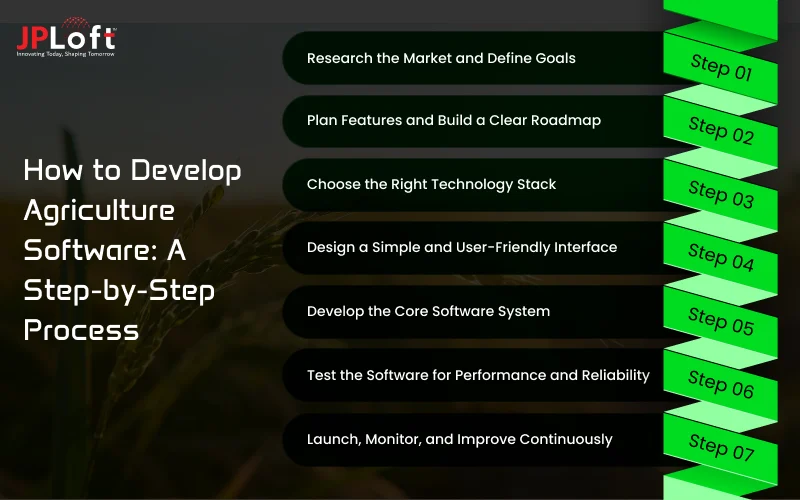
Let’s break down each step to understand how the entire process works smoothly.
Step 1: Research the Market and Define Goals
If you are planning to develop a custom software, start by studying the agriculture industry and your target users carefully. Identify daily challenges faced by farmers and agribusiness owners. Focus on real problems like crop monitoring, weather risks, or supply chain delays.
-
Analyze existing platforms to understand what they offer and where they fall short. Look at user feedback, pricing, and feature gaps in detail.
-
Define clear goals for your platform based on these insights. Decide the core purpose and expected outcomes early.
-
Validate your idea through surveys or small pilot testing. This ensures your concept has real demand before development begins.
Step 2: Plan Features and Build a Clear Roadmap
Once your idea is validated, list all features your platform will include. Focus on solving user problems with simple and practical solutions. Understanding top custom software features at this stage helps ensure your platform is built around real farming needs.
-
Divide features into core and advanced groups to avoid confusion later. Start with essential features to build a strong base.
-
Create a clear roadmap with timelines, milestones, and deliverables. This helps keep the development process organized and on track.
-
A structured roadmap makes it easier to understand priorities and manage resources efficiently. It also reduces delays and unexpected challenges.
Step 3: Choose the Right Technology Stack
Selecting the right technology stack is critical for performance and scalability. Choose tools that support long-term growth and stability.
-
Use modern frontend frameworks to create smooth and responsive interfaces. Select backend technologies that handle data securely and efficiently.
-
Pick databases that can manage large volumes of agricultural data without slowing down. Cloud platforms can help with storage and system flexibility.
-
This step plays a key role in deciding how to build agriculture software that performs well under different conditions.
Step 4: Design a Simple and User-Friendly Interface
A clean and simple interface improves user experience and adoption. Farmers prefer tools that are easy to understand and use daily.
-
Start with wireframes to map the user journey clearly. Then create prototypes to test usability before development begins.
-
Use simple layouts, readable text, and clear buttons for smooth navigation. Avoid clutter and keep the design consistent across screens.
-
A thoughtful design approach helps you learn how to create agriculture software that users trust and rely on regularly.
Step 5: Develop the Core Software System
Now begin building the main system by combining frontend and backend components. Focus on creating a stable and scalable architecture.
-
Follow an agile approach to develop features in small cycles. This allows regular improvements and reduces the risk of major errors.
-
Integrate key features like data tracking, alerts, reporting tools and agentic AI in software development. Ensure the system supports real-time updates. smooth performance and smarter automation within core workflows.
-
This phase defines how effectively you can make an agriculture software that meets real user expectations and business goals.
Step 6: Test the Software for Performance and Reliability
Testing is essential to ensure your platform works in real conditions. Perform functional, performance, and security testing carefully.
-
Check system behavior under different loads and network conditions. Identify bugs and fix them before launching the final version.
-
Test the platform across devices and user scenarios for better reliability. This ensures a smooth experience for all users.
-
A strong testing phase improves product quality significantly and ensures a stable user experience at launch.
Step 7: Launch, Monitor, and Improve Continuously
After testing, launch your platform for real users and gather feedback. Monitor how users interact with the system daily.
-
Track important metrics like usage, performance, and user engagement. Use this data to improve features and fix issues quickly.
-
Release updates regularly to keep your platform efficient and relevant. Continuous improvement helps maintain long-term growth.
-
This final stage completes the journey of how to make agriculture software that adapts to changing user needs.
Tech Stack to Use While Developing Agriculture Software
Choosing the right technology stack is essential to build a scalable and high-performing platform. When you plan to develop an agriculture software that performs well, selecting the right tools ensures better efficiency and long-term stability.
Modern agriculture software solutions rely on real-time data, automation, and smart integrations. With the rapid growth of agritech, your tech stack must support advanced features and large-scale data processing.
Below is the essential technology stack used in developing an agriculture software:
|
Layer |
Technology |
Description |
|
Frontend |
React, Angular, Vue, Flutter |
Builds responsive interfaces for dashboards, mobile apps, and user interactions. |
|
Backend |
Node.js, Django, Laravel, Spring Boot |
Manages data processing, system logic, and real-time communication between services. |
|
Database |
PostgreSQL, MongoDB, MySQL |
Stores crop data, weather insights, and user records securely. |
|
Cloud & Storage |
AWS, Google Cloud, Microsoft Azure |
Supports scalable storage and ensures high availability during peak usage. |
|
IoT Integration |
Arduino, Raspberry Pi, MQTT Protocol |
Connects field sensors to collect soil, weather, and crop data in real time. |
|
AI & Data Processing |
Python, TensorFlow, OpenCV |
Enables predictive analytics, disease detection, and smart recommendations. |
|
APIs & Integrations |
Weather APIs, Maps APIs, Payment Gateways |
Integrates external services for weather tracking, location mapping, and payments. |
|
Security |
SSL Encryption, OAuth, Multi-factor Authentication |
Protects sensitive data and prevents unauthorized access. |
|
Notifications |
Firebase, Twilio |
Sends alerts for weather changes, system updates, and important actions. |
A well-planned tech stack improves system performance. Also, it helps you understand how to build agriculture software that can scale with future needs. If needed, you can hire software developers with domain expertise to build a reliable and scalable solution.
How Much Does it Cost to Develop Agriculture Software?
The cost to develop agriculture software usually ranges from $10,000 to $120,000+.
This depends on features, system complexity, and the overall agriculture software development process you follow. Basic solutions cost less, while advanced platforms with AI and IoT require higher investment.
Planning the right feature set helps control custom software development cost while ensuring long-term value. This approach allows you to make an agriculture software that balances performance and budget.
Below is a breakdown of costs based on different complexity levels:
|
Software Complexity |
Features Included |
Estimated Cost |
Development Timeline |
|
Basic (MVP) |
User login, farm data tracking, basic reports, notifications |
$10,000 – $25,000 |
2 – 3 months |
|
Mid-Level Software |
MVP features + weather data, analytics dashboard, API integrations, admin panel |
$25,000 – $60,000 |
4 – 6 months |
|
Advanced Software |
Mid-level features + AI insights, IoT integration, real-time monitoring, predictive analytics |
$60,000 – $120,000+ |
7 – 10 months |
Key Factors That Influence the Cost
-
Feature complexity: More features increase development time and cost.
-
Technology stack: Advanced tools and integrations require higher investment.
-
UI/UX design: Custom designs and smooth interfaces take more effort.
-
Third-party integrations: APIs for weather and maps add to the budget.
-
Development team location: Costs vary across regions based on hourly rates and the software development services you choose.
-
Maintenance and updates: Ongoing support typically costs 15–20% annually.
A clear understanding of these factors helps you estimate costs accurately and avoid unexpected expenses.
Challenges One May Face While Creating Agriculture Software
If you are exploring how to create agriculture software, you may face several issues during development. These software development challenges can affect performance, usability, and long-term growth if not handled properly.
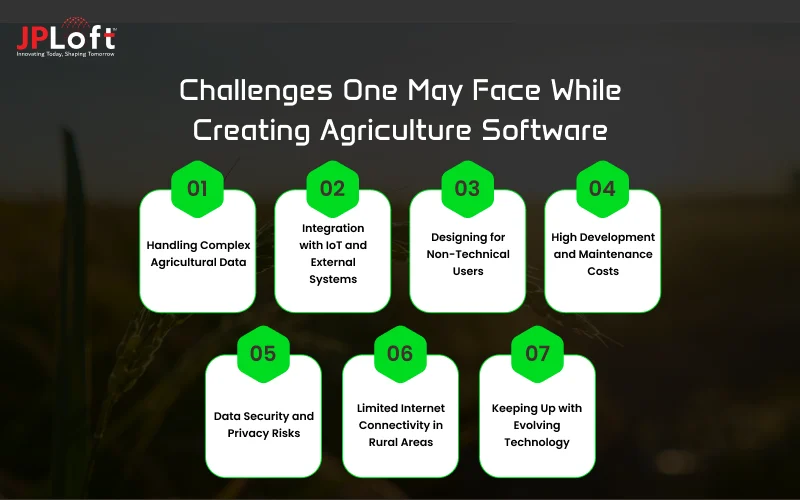
Here are the key challenges and their practical solutions:
Challenge 1: Handling Complex Agricultural Data
Agriculture platforms handle weather, soil, crop health, and market data, making accurate management difficult across multiple systems.
Solution: Use structured databases and cloud storage with real-time processing tools for accurate data analysis and improved decision-making efficiency.
Challenge 2: Integration with IoT and External Systems
Modern farming relies on sensors, drones, and third-party tools. Integrating these systems into one platform can be technically challenging.
Solution: Use reliable APIs and IoT protocols for real-time connectivity, ensuring strong and scalable agriculture software solutions integration.
Challenge 3: Designing for Non-Technical Users
Many farmers are not familiar with complex digital tools. A difficult interface can reduce adoption and engagement.
Solution: Focus on simple design, clear navigation, and local language support to improve usability and user accessibility effectively.
Challenge 4: High Development and Maintenance Costs
Building a feature-rich platform can require significant investment. Costs may increase due to changing requirements or added features.
Solution: Start with an MVP, prioritize essential features, and scale gradually. Business may also hire dedicated developers to create an agriculture software within a controlled budget.
Challenge 5: Data Security and Privacy Risks
Agriculture platforms handle sensitive data like farm records and financial transactions. Any security issue can lead to trust loss.
Solution: Use strong encryption, secure authentication, and regular system audits. Protecting user data ensures the reliability and long-term success of your platform.
Challenge 6: Limited Internet Connectivity in Rural Areas
Many agricultural regions have poor internet connectivity. This can affect real-time data access and system performance.
Solution: Build offline functionality and data sync features. This ensures users can access important information even with low connectivity.
Challenge 7: Keeping Up with Evolving Technology
The agriculture industry is changing quickly with new tools and innovations. Staying updated can be challenging for businesses.
Solution: Adopt a scalable architecture and update your platform regularly. This helps you stay competitive and adapt to future changes.
Addressing these challenges early helps you build a reliable and scalable platform. With the right strategy, you can overcome these issues and deliver effective solutions for modern agriculture.
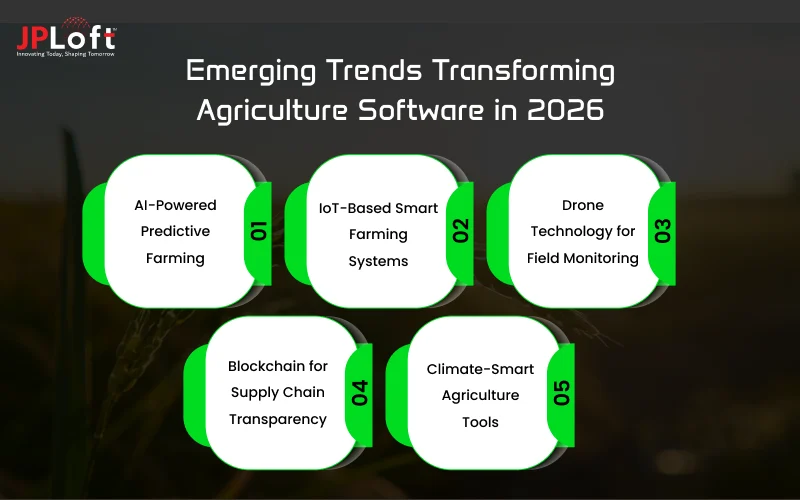
Emerging Trends Transforming Agriculture Software in 2026
Technology is reshaping agriculture quickly. Innovations are making farming smarter, faster, and more efficient. Businesses that follow these changes stay competitive.
These shifts also align with broader top software development outsourcing trends shaping modern digital solutions.
1. AI-Powered Predictive Farming
Artificial intelligence helps farmers plan and manage crops with better accuracy. It analyzes large datasets and improves decision-making.
-
Predicts crop yield and disease risks
-
Suggests optimal planting and harvesting time
-
Improves decisions with real-time insights
To bring these capabilities into real products, many businesses turn to AI app development services that can handle complex data models.
2. IoT-Based Smart Farming Systems
IoT devices collect real-time data from fields and equipment. This improves monitoring and automation across farms.
-
Tracks soil moisture and temperature
-
Automates irrigation systems
-
Monitors crop health continuously
Seamless device connectivity often depends on choosing the right IoT app development company with real-world integration experience.
3. Drone Technology for Field Monitoring
Drones provide aerial insights that are difficult to capture manually. They help farmers act faster and reduce effort.
-
Captures high-resolution field images
-
Detects crop diseases early
-
Supports spraying and monitoring tasks
This technology improves efficiency and supports better farm management across large fields.
4. Blockchain for Supply Chain Transparency
Blockchain improves trust and traceability in agriculture supply chains. It secures data and reduces fraud risks.
-
Tracks products from farm to market
-
Ensures transparent transactions
-
Builds trust among stakeholders
Businesses planning to build an agriculture software often collaborate with a blockchain development company to implement reliable solutions.
5. Climate-Smart Agriculture Tools
Climate-focused tools help farmers adapt to changing weather conditions. They support sustainable and efficient farming practices.
-
Provides weather-based recommendations
-
Suggests climate-resilient crops
-
Optimizes water usage
These tools support sustainable farming and long-term growth.
Adopting these trends helps businesses build future-ready agriculture software and stay ahead in the evolving market.

How JPLoft Can Help You Develop an Agriculture Software?
Building a successful agriculture platform requires the right mix of strategy, technology, and industry understanding. That is where JPLoft brings real value to your project.
As a trusted agriculture software development company, we focus on delivering solutions that match real farming needs.
Our team works closely with you to understand your goals, target users, and business model. We help you build an agriculture software that is simple, scalable, and user-friendly. From planning to deployment, every step is handled with clarity and precision.
We combine modern technologies with practical insights to ensure strong performance and long-term growth. Our experts also support testing, integration, and post-launch improvements.
With the right approach, we help you develop an agriculture software that stands out in a competitive market and delivers real value to users.
Conclusion
Agriculture is evolving with technology, and software plays a key role in this change. This agriculture software development guide has explained the important steps, tools, and strategies involved. From planning to launch, each stage requires careful decisions and a clear approach.
Understanding user needs, choosing the right tech stack, and managing costs are all important for success. It also becomes easier to handle challenges when you follow a structured process.
If you are wondering how to make agriculture software, the answer lies in building simple and scalable solutions. A well-planned platform not only improves farming efficiency but also supports long-term growth in the agriculture industry.
FAQs
To create an agriculture software, start by understanding user needs and market gaps. Plan features, choose the right tech stack, and build an MVP first. Test the platform carefully and improve it based on real user feedback.
The cost usually ranges from $10,000 to $120,000 or more. It depends on features, complexity, and integrations. A basic version costs less, while advanced systems with AI and IoT require higher investment and longer development time.
Important features include crop monitoring, weather updates, data analytics, and reporting tools. Some platforms also include IoT integration and AI-based insights. These features help farmers make better decisions and improve overall productivity.
Development time depends on the complexity of the software. A basic version may take two to three months. More advanced platforms with integrations and custom features can take six to ten months or longer.
Agriculture software helps farmers manage operations more efficiently. It provides real-time data, improves planning, and reduces risks. These tools support better productivity and help businesses grow in a competitive and changing agricultural environment.

Rahul Sukhwal is the CEO and Founder of JPLoft, a visionary technologist with 18+ years at the forefront of emerging tech innovation and software engineering. He channels deep software engineering and AI expertise into building smarter, scalable solutions that shape how forward-thinking businesses worldwide harness the true power of AI.



Share this blog