


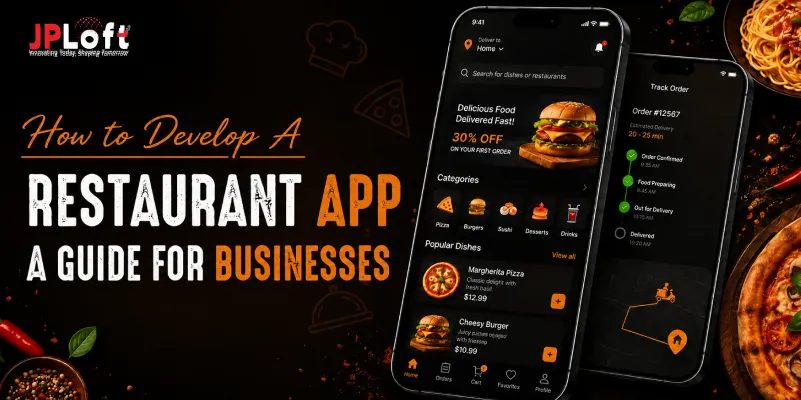
Key Takeaways:
Building a restaurant app involves strategic planning, market research, feature selection, technology choices, testing, deployment, and ongoing maintenance to deliver a scalable, secure, and user-friendly digital solution.
Restaurant apps help increase customer convenience, streamline operations, boost direct orders, strengthen loyalty, and stay competitive.
Building a restaurant app brings challenges like security, performance, payment, scalability, and real-time order management.
The cost to build a restaurant app ranges from USD 15,000 to USD 100,000+, depending on complexity, features, and business.
JPLoft delivers customized development for a restaurant app with modern features, expert support, and long-term business goals.
A great restaurant experience no longer ends when customers leave the table. Today, people expect to discover menus, order meals, reserve tables, make payments, and track deliveries directly from their smartphones.
For restaurants, this digital shift creates new opportunities to improve service, increase direct orders, and build stronger customer relationships.
Whether you operate a single restaurant, cloud kitchen, or multi-location chain, a well-designed restaurant app can simplify operations while giving customers a faster and more convenient way to interact with your business.
From online ordering and secure payments to loyalty programs and real-time updates, the right features can turn an app into a powerful growth channel.
But building a successful restaurant app requires more than adding features.
In this blog, you'll learn how to develop a restaurant app, explore core features, development costs, and more.
What is a Restaurant App?
A restaurant app is a mobile or web platform that connects customers with restaurants digitally. Restaurant apps help manage orders, reservations, customer data, and loyalty programs from a single dashboard.
It connects diners and businesses through one seamless, always-available digital experience.
Here's how a restaurant app works from the customer's side:
-
Browse the menu — view dishes, prices, photos, and availability without calling or visiting in person
-
Place orders — select items, customize preferences, and add them to a cart in a few taps
-
Reserve a table — pick a date, time, and party size, and get instant confirmation
-
Make secure payments — pay through cards, wallets, or UPI directly inside the app
-
Track deliveries — follow order status in real time, from kitchen prep to doorstep
-
Receive personalized offers — get loyalty points, discounts, and deals based on past orders
Why Do Restaurants Need a Mobile App in 2026?
In 2026, mobile apps for restaurants have become essential for growth and customer satisfaction.
A dedicated app helps restaurants stay competitive and unlock new revenue streams.
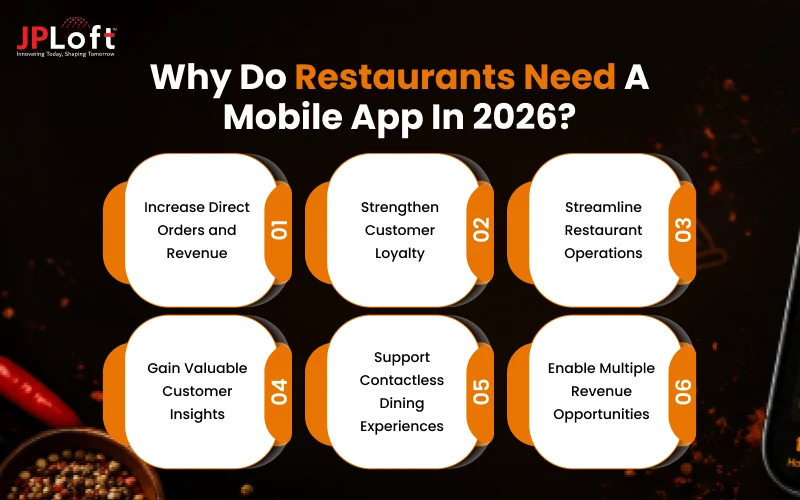
1. Increase Direct Orders and Revenue
A restaurant app encourages customers to order directly instead of relying on third-party platforms. This reduces commission fees and improves profit margins. Working with experienced restaurant mobile app developers ensures the ordering flow is built for conversions from day one.
2. Strengthen Customer Loyalty
Mobile apps make it easy to reward repeat customers through loyalty points, cashback, and personalized deals. These features encourage frequent visits and help build long-term customer relationships.
3. Streamline Restaurant Operations
Knowing how to build a restaurant app with automation in mind pays off here. A well-built app handles table reservations, payments, and support tasks with minimal manual work.
4. Gain Valuable Customer Insights
Apps collect data like ordering habits, favorite items, and spending patterns. These insights help restaurants improve services, run targeted campaigns, and optimize their menus.
5. Support Contactless Dining Experiences
Customers increasingly prefer contactless interactions for speed and convenience. A custom restaurant app enables QR menus, digital payments, and self-service features that cut wait times.
6. Enable Multiple Revenue Opportunities
Beyond food sales, restaurant apps generate revenue through subscriptions, delivery charges, and featured menu promotions. These income streams help businesses diversify earnings and boost overall performance.
Types of Restaurant Apps Businesses Can Build
Restaurants have different goals, and no single app type fits every business model. Knowing the types available before exploring how to make a restaurant app helps you choose the right fit for your growth plans.
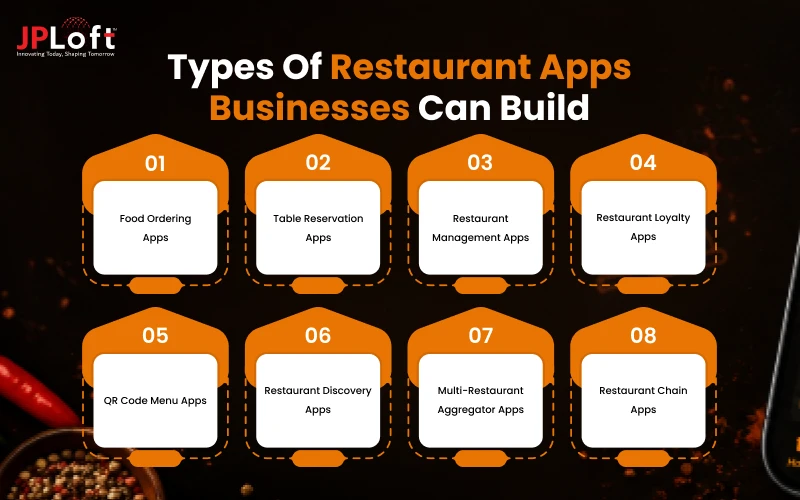
Type 1: Food Ordering Apps
These apps let customers browse menus, place orders, make payments, and track deliveries or pickups. They help start an online restaurant business with strong direct sales and a convenient ordering experience.
Type 2: Table Reservation Apps
Table reservation apps let customers book dining slots in advance. They cut waiting times, improve customer satisfaction, and help restaurants manage seating more efficiently during peak hours.
Type 3: Restaurant Management Apps
These apps help owners manage inventory, staff schedules, orders, and billing from a single platform. Building a restaurant POS system into this setup simplifies daily operations and boosts productivity.
Type 4: Restaurant Loyalty Apps
Loyalty apps focus on retention by offering reward points, discounts, cashback, and exclusive deals. They encourage repeat visits and help restaurants build long-term customer relationships.
Type 5: QR Code Menu Apps
QR menu apps give customers digital menus accessible through smartphones. Backed by contactless dining technology, they allow real-time menu updates and cut printing costs.
Type 6: Restaurant Discovery Apps
These apps help users find restaurants by location, cuisine, ratings, reviews, and pricing. Restaurants benefit from higher visibility and attract new customers searching nearby.
Type 7: Multi-Restaurant Aggregator Apps
These platforms connect customers with multiple restaurants in one app. Users compare menus, prices, and reviews, while restaurants gain access to a broader customer base.
Type 8: Restaurant Chain Apps
Large restaurant brands use dedicated apps to manage multiple outlets, loyalty programs, and customer engagement. These apps keep the experience consistent across locations while strengthening brand loyalty.
Key Features Every Restaurant App Should Have
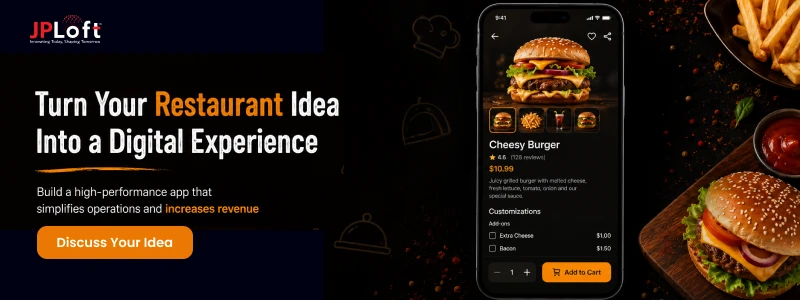
The process of how to create a restaurant app starts by selecting essential features. The right features enhance user experience, improve efficiency, and support business growth.
Here are the top restaurant app features that should essentially be included:
|
Feature |
Purpose |
|
User Registration & Login |
Enables customers to create accounts and manage their profiles securely. |
|
Restaurant Menu Management |
Displays menu categories, item details, prices, and availability. |
|
Search & Filters |
Helps users quickly find dishes, cuisines, or restaurant offerings. |
|
Table Reservation |
Enables users to book tables in advance and avoid waiting times. |
|
Multiple Payment Options |
Supports secure payments through cards, wallets, UPI, and other methods. |
|
Order Tracking |
Provides real-time updates on order preparation and delivery status. |
|
Loyalty & Rewards Program |
Encourages repeat purchases through points, discounts, and rewards. |
|
Customer Support |
Provides assistance through chat, calls, or help desk features. |
|
Analytics Dashboard |
Helps restaurant owners track orders, revenue, and customer behavior. |
|
Staff & Order Management |
Helps manage incoming orders, staff assignments, and operational workflows. |
Step-Wise Process to Create a Restaurant App
The process to build a mobile app involves much more than coding an interface. Every stage, from defining goals to scaling post-launch, plays a crucial role in success.
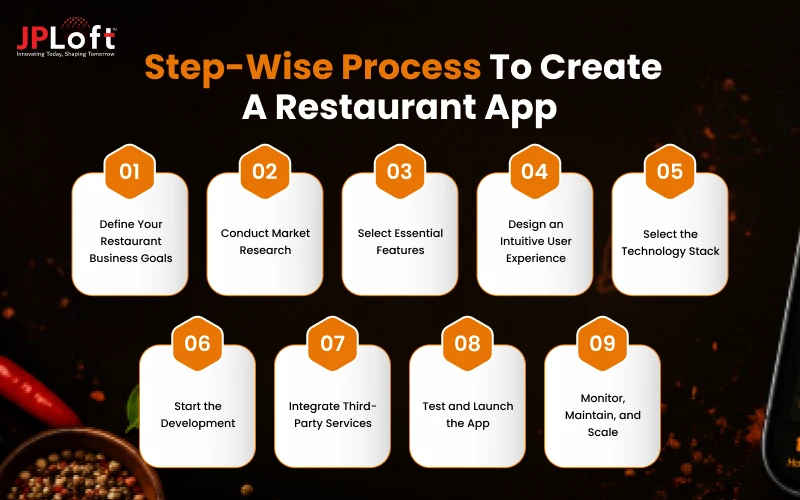
Here are the steps for how to build a restaurant app that delivers real value and growth:
Step 1. Define Your Restaurant Business Goals
Start by identifying the core purpose of your app before exploring how to create a restaurant app. Clear goals shape your features and strategy from day one. Focus areas typically include:
-
Food ordering and delivery management
-
Table reservations and booking flow
-
Customer loyalty and retention programs
-
Monetization through subscriptions or premium features
These decisions guide every stage that follows, from design through launch and beyond.
Step 2. Conduct Market Research
Analyze the best restaurant apps in your category and study customer preferences before development begins. This research uncovers real opportunities. Look closely at:
-
Competitor strengths and weaknesses
-
Gaps in features or user experience
-
Local customer expectations and habits
This information helps you build a solution that offers genuine value and solves real customer problems, not assumed ones.
Step 3. Select Essential Features
Create a feature roadmap based on business requirements and customer needs, factoring in your chosen app type. Prioritize app features that matter for launch. Core functionalities usually include:
-
Menu management and online booking
-
Payment integration and order tracking
-
Customer reviews and push notifications
Focus on must-have features first. Secondary features like gamification or referral programs can follow in later updates.
Step 4. Design an Intuitive User Experience
An attractive, easy-to-use interface drives customer engagement and repeat visits. A user-friendly restaurant app design increases retention. Focus your design efforts on:
-
Simple, minimal-step navigation
-
Fast, clutter-free ordering flow
-
Clear menu displays with high-quality photos
A smooth checkout experience reduces cart abandonment and keeps customers coming back for future orders.
Step 5. Select the Technology Stack
Choose the restaurant app tech stack needed for frontend, backend, databases, APIs, and cloud hosting. This decision affects long-term scalability. Key choices include:
-
Native Android and iOS development
-
Cross-platform frameworks for faster builds
-
Cloud infrastructure for future growth
The right stack ensures your app performs reliably as your restaurant business and order volume expand.
Step 6. Start the Development
Hire app developers to begin building the customer app, admin panel, and backend system together. Skilled restaurant mobile app developers ensure smooth integration across every layer. Development typically covers:
-
Customer-facing ordering interface
-
Admin dashboard and reporting tools
-
Backend systems for data and orders
Agile development practices keep the project moving with faster feedback loops and fewer costly delays.
Step 7. Integrate Third-Party Services
Modern mobile app development for restaurants relies on external services for added functionality. These integrations simplify daily operations. Common services include:
-
Payment gateways and digital wallets
-
GPS tracking for delivery orders
-
SMS and push notification tools
These integrations improve the overall user experience while reducing the manual workload on restaurant staff.
Step 8. Test and Launch the App
Perform extensive testing before deployment to confirm the app works exactly as intended. Testing should verify:
-
App performance and loading speed
-
Payment functionality and data security
-
Compatibility across devices and screen sizes
Once testing wraps up, launch the restaurant app on the App Store or Play Store for public access.
Step 9. Monitor, Maintain, and Scale
App development does not end at launch. Continuously monitor performance, gather feedback, and release updates based on real usage data. Ongoing priorities include:
-
Fixing bugs and performance issues
-
Adding features based on restaurant app trends
-
Scaling infrastructure as order volume grows
Regular maintenance keeps your custom restaurant app competitive and maximizes long-term returns on your investment.
What is the Cost to Develop A Restaurant App?
The cost to develop a restaurant app ranges from $15,000 to $100,000+. The final cost depends on business requirements, customization needs, and scalability goals.
A basic app costs significantly less than an advanced app with AI suggestions, loyalty programs, and analytics.
Here is a table of estimated restaurant app development costs for various complexities:
|
Restaurant App Type |
Estimated Development Cost |
|
Basic Restaurant App (MVP) |
$15,000 - $30,000 |
|
Mid Level Restaurant App |
$30,000 - $70,000 |
|
Multi-Restaurant Aggregator App |
$70,000 - $100,000+ |
Factors Affecting Restaurant App Development Cost
Several factors influence the overall development costs of a restaurant app:
-
App Complexity: More features require additional development hours and resources.
-
Platform Selection: Android, iOS, or cross-platform development impacts overall costs.
-
UI/UX Design: Custom designs increase development and testing efforts.
-
Third-Party Integrations: Payment gateways, maps, and notification services add expenses.
-
Backend Infrastructure: A scalable architecture requires higher development investment.
-
Security Requirements: Advanced security measures increase implementation costs.
-
Development Team Location: Rates vary depending on the region and expertise level.
-
Maintenance and Updates: Ongoing support, restaurant app maintenance, and feature enhancements require additional budget.
Popular Restaurant Apps To Consider For Inspiration
Looking at successful restaurant apps in the market gives you a clear picture of what customers actually expect.
Here's what a few of the biggest names get right.
1. Starbucks
Starbucks lets customers order ahead, pay in-app, and earn Stars toward free drinks and food. The app rates 4.9 on the App Store with 8.2M reviews and has crossed 10M+ downloads on the Play Store.
-
Mobile order and pay with saved favorites
-
Tiered rewards program
-
Store locator with drive-thru and Wi-Fi info
-
eGift sending via email or text
2. DoorDash
DoorDash connects users to restaurants, groceries, and retail stores in one app, with real-time order tracking. It holds a 4.8 rating from 23M reviews on the App Store and over 50M+ downloads on the Play Store.
-
Real-time delivery tracking
-
No-minimum ordering
-
DashPass subscription for $0 delivery fees
-
Multiple payment options including SNAP/EBT
3. Uber Eats
Uber Eats offers food and grocery delivery from thousands of restaurants and stores worldwide. The app has a 4.8 rating with 11M reviews on the App Store and 100M+ downloads on the Play Store.
-
Schedule orders in advance
-
Pickup and delivery options
-
Uber One membership for discounted fees
-
Live order tracking on a map
4. Chick-fil-A
The Chick-fil-A app focuses on order-ahead convenience and a simple points-based loyalty system. It holds a 4.9 rating from 4.2M on the App Store and 10M+ downloads on the Play Store.
-
Order ahead with pickup method selection
-
Chick-fil-A One rewards with tiered benefits
-
Personalized menu that remembers preferences
-
QR code scan for in-store point earning
5. Taco Bell
Taco Bell's app centers on fast reordering and app-exclusive deals like weekly Tuesday Drops. It carries a 4.7 rating on the App Store with 10M+ downloads on the Play Store, reflecting known reliability issues worth studying.
-
Order ahead for pickup or delivery
-
Saved customizations under "My Mods"
-
App-only exclusive offers and drops
-
Fast reorder from saved favorites
6. GrubHub
GrubHub focuses on connecting diners with local restaurants, alcohol delivery, and no-fee ordering over $50. It rates 4.7 on the App Store and has 10M+ downloads on the Play Store.
-
No delivery or service fees on orders over $ 50
-
Grubhub+ membership for perks
-
Wide restaurant and grocery selection
-
Order scheduling in advance
Common Challenges in Restaurant App Development
While you make a restaurant app, you might face various challenges, such as technical, operational, and user-related. These restaurant app development challenges can impact performance, customer satisfaction, and scalability.
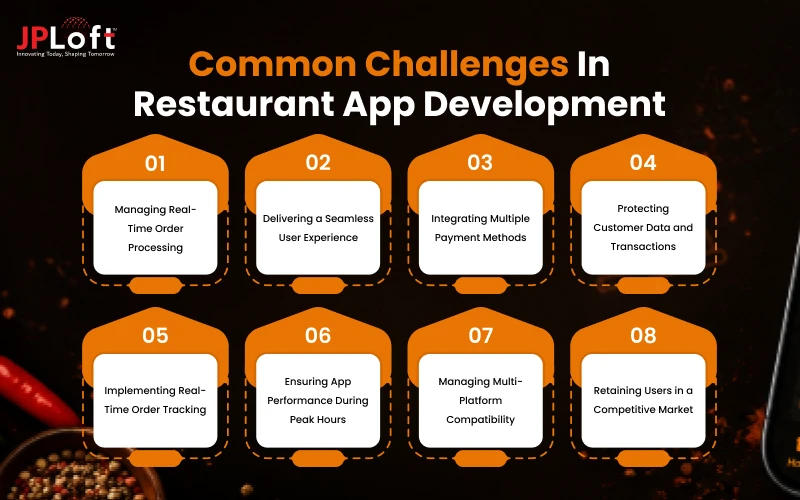
Knowing these challenges helps you ensure smoother and more successful app development for a restaurant:
Challenge 1: Managing Real-Time Order Processing
Handling multiple orders simultaneously while maintaining accuracy can be challenging. Delays, duplicate orders, or incorrect order statuses can affect customer trust and restaurant operations.
Solution: Hire dedicated developers to implement a robust backend system with real-time synchronization capabilities.
Challenge 2: Delivering a Seamless User Experience
Customers expect fast navigation, easy ordering, and smooth checkout processes. Poor app design or complicated workflows can increase abandonment rates and negatively impact customer satisfaction and retention.
Solution: Focus on intuitive UI/UX design and conduct regular usability testing of the restaurant app.
Challenge 3: Integrating Multiple Payment Methods
Customers prefer platforms with various payment options, including cards or digital wallets. Ensuring secure and seamless payment processing across different methods requires careful integration and testing.
Solution: Use trusted payment gateways with strong security and compliance standards.
Challenge 4: Protecting Customer Data and Transactions
Restaurant apps store personal information and payment details, making security a major concern. Data breaches can damage brand reputation and customer trust.
Solution: Implement encryption, secure authentication, and regular restaurant app security audits.
Challenge 5: Implementing Real-Time Order Tracking
Customers expect visibility into order preparation and delivery status. Providing accurate tracking information requires integration with location services and operational systems.
Solution: Use GPS tracking and automated status update mechanisms.
Challenge 6: Ensuring App Performance During Peak Hours
High traffic during lunch, dinner, or promotional campaigns can affect app speed and responsiveness. Poor performance may result in lost orders and dissatisfied customers. Platform crashes during high traffic have been one of the biggest reasons for the restaurant app's failure.
Solution: Build a scalable infrastructure capable of handling traffic spikes efficiently.
Challenge 7: Managing Multi-Platform Compatibility
The app must function consistently across various devices, operating systems, and screen sizes. Compatibility issues can lead to poor user experiences and technical problems.
Solution: Conduct cross-platform testing throughout the development process.
Challenge 8: Retaining Users in a Competitive Market
With many restaurant apps available, attracting and retaining users is challenging. Businesses must continuously provide value and engage customers effectively.
Solution: Introduce loyalty programs, personalized offers, and regular feature enhancements.
Future Trends in Developing a Restaurant App
Restaurant app development keeps evolving as technology advances.
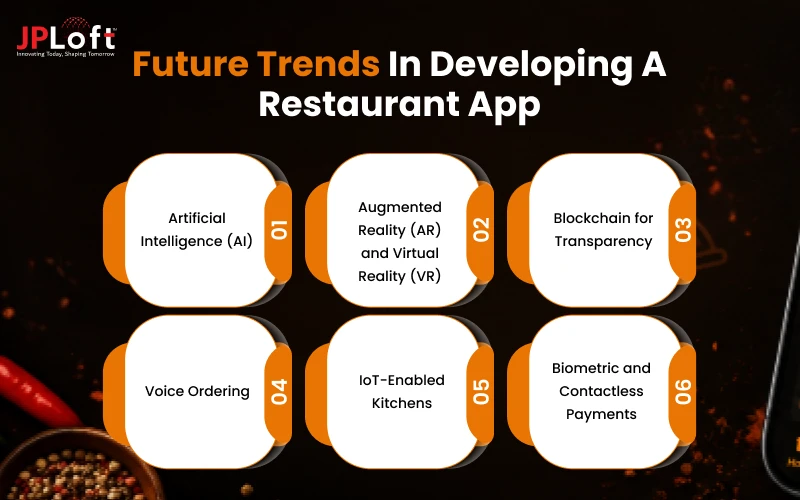
Staying ahead of these trends helps restaurants remain competitive and future-ready.
1. Artificial Intelligence (AI)
AI in restaurant apps recommend menu items, predict preferences, and automate support through chatbots.
Demand forecasting also helps restaurants manage inventory and reduce food waste with greater accuracy across daily operations.
2. Augmented Reality (AR) and Virtual Reality (VR)
AR and VR in restaurant apps let customers preview dishes through interactive 3D menus before ordering.
Some restaurants also use VR for staff training, cutting onboarding time and improving retention for new hires.
3. Blockchain for Transparency
Blockchain records every step of the supply chain, creating a traceable ingredient history.
This helps restaurants catch contamination risks early and builds stronger customer trust around sourcing claims.
4. Voice Ordering
The feature of AI voice ordering in restaurant apps supports hands-free interactions as smart assistants become part of daily routines.
Customers can reorder favorites or check loyalty points through simple voice commands, reducing friction at checkout.
5. IoT-Enabled Kitchens
IoT devices connect kitchen equipment and inventory systems directly to the restaurant app.
This enables real-time stock tracking, automatic reorder alerts, and predictive maintenance during busy service hours.
6. Biometric and Contactless Payments
Pay-by-face and biometric payments are emerging as the next step beyond tap-to-pay.
Paired with mobile wallets, these methods speed up checkout while keeping contactless convenience intact for customers.
Why Choose JPLoft to Develop a Restaurant App?
To build a restaurant app, you will require more than great design. It demands a development partner who understands customer expectations, restaurant operations, and the latest digital technologies.
At JPLoft, we create custom restaurant apps that help businesses streamline operations, increase direct orders, and improve customer engagement. Whether you need an app for food ordering, table reservation, cloud kitchen, or a multi-restaurant marketplace, we deliver a scalable and secure app tailored to your business goals.
JPLoft, a highly experienced restaurant app development company, integrates essential features such as online ordering, real-time order tracking, secure payment gateways, loyalty programs, push notifications, and restaurant management dashboards to create seamless user experiences.
We follow an agile development process that ensures transparency, faster delivery, and continuous collaboration throughout the project.
From strategy and development to deployment and post-launch support, JPLoft provides end-to-end development services, helping businesses stay competitive and achieve long-term growth.
Conclusion
Restaurant apps have become an essential part of the modern dining experience. It helps businesses meet evolving customer expectations while improving operational efficiency.
A properly designed restaurant app can create a seamless experience that drives customer satisfaction and business growth.
The process of building a restaurant app requires careful planning, selecting the right features, choosing suitable technologies, and addressing development challenges effectively.
Whether you operate a single restaurant, a growing chain, or a cloud kitchen, investing in an app can help strengthen your brand, increase direct revenue, and improve customer retention.
You must follow the right development process, implement best practices, and continuously enhance the platform after launch. Hence, this helps you create an app that is a scalable digital solution that supports long-term success.
FAQs
Start by defining business goals, researching competitors, and selecting the right app type for your business goals. Then plan essential features, design an intuitive interface, choose a suitable tech stack, develop the app, integrate services, test thoroughly, and maintain the app after launch.
A restaurant app helps businesses increase direct orders, improve customer engagement, simplify operations, strengthen loyalty, and reduce dependence on third-party platforms. It also supports digital dining experiences, making restaurants more competitive and better prepared for changing customer expectations.
The ideal app depends on your business model. Restaurants can choose food ordering, table reservation, loyalty, delivery management, cloud kitchen, or multi-restaurant marketplace apps based on customer needs, operational goals, and long-term expansion plans.
Developing a restaurant app usually costs between USD 15,000 and USD 100,000+. The final price depends on app complexity, features, supported platforms, design requirements, development team expertise, and scalability requirements.
Businesses should focus on user-friendly design, fast performance, secure payments, real-time order tracking, scalable architecture, and personalized experiences. Loyalty programs and regular feature updates improve user satisfaction and support long-term business growth.
Common challenges include ensuring a seamless user experience, managing real-time orders, integrating payment gateways, securing customer data, handling peak traffic, and supporting multiple devices through continuous improvements and engagement strategies.

Conor has 10+ years of experience in software development, application engineering, solution design, and UX/UI. He has worked across digital products in restaurant technology, food and grocery delivery, healthcare, media, streaming, and social platforms, bringing both technical and user-experience perspectives to product development. His experience working with large organizations and growth-focused digital products helps businesses translate complex requirements into practical, user-focused solutions.



Share this blog