



Key Takeaways
Mobile app development cost in Dubai typically ranges from AED 55,000 to AED 734,000+ ($15,000 and $200,000+), driven by app complexity, features, and long-term scalability needs.
Clear MVP planning reduces risk, controls budget, and helps validate demand before investing in advanced features.
Platform choice directly impacts cost and maintenance. Single-platform apps cost less, while dual-platform builds require higher investment.
Strong UI/UX, backend architecture, and security planning improve app performance and user retention in Dubai’s competitive market.
Hidden costs like compliance, localization, testing, and infrastructure scaling can affect budgets if not planned early.
Partnering with JPLoft ensures smarter cost control, scalable architecture, and faster execution for building growth-ready mobile apps in Dubai.
Dubai has quickly become one of the most active hubs for mobile app development in the Middle East, and the numbers back it up. Businesses across fintech, e-commerce, logistics, healthcare, and on-demand services are investing heavily in mobile solutions to reach a tech-first audience.
That naturally leads to one common question founders and decision-makers ask early on: how much does it cost to develop a mobile app in Dubai?
The short answer is this. The mobile app development cost in Dubai ranges from AED 55,000 to AED 734,000+ ($15,000 and $200,000+), depending on the scope of the project.
A simple MVP with core features sits on the lower end, while feature-rich apps with advanced UI, backend integrations, security layers, and scalability requirements push budgets higher.
What really shapes the cost is not just the idea, but the scope. App complexity, platform choice, design depth, compliance needs, and long-term maintenance all influence the final number.
This guide breaks down those factors clearly so you can plan your app budget with confidence and zero guesswork.
Mobile App Market of Dubai, UAE
Well, before you learn the overall cost to build a mobile app in Dubai, UAE, you should know what the Dubai market is talking about.
Whether it's about learning the cost of hiring mobile app developers in Dubai or evaluating the complete cost figure, a brief overview of the market will inform you about the latest trends and updates.
The mobile app market of Dubai is continuously growing. Here, let's explore the complete market stats in this section.
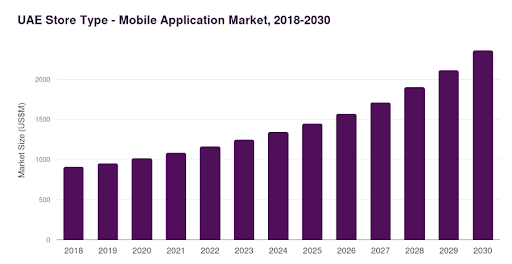
-
The overall UAE app development market generated a revenue of USD 1,339.3 million in 2024 and is expected to reach USD 2,357.6 million by 2030.
-
The UAE market is expected to grow at a CAGR of 10.3% from 2025 to 2030.
-
Along with this, when it comes to testing, the UAE mobile application testing services market is poised for robust growth, projected to reach $12billion by 2030 at a CAGR of 15.3% from 2019 to 2030.
-
About 43% of those UAE-based developers publish apps on both Android and iOS, which represents a trend towards cross-platform strategies among local creators.
-
A segment gaining attention is the UAE intelligence apps market, which is projected to grow at a 12.5% CAGR from 2019 to 2030, that is driven by AI and 5G.
These stats provide you with a defined reason to build an app in Dubai.
Together, these insights highlight why Dubai remains a strong market for scalable, high-value mobile app investments.
The city combines rapid digital adoption, government-backed innovation, and a diverse user base. This creates ideal conditions for long-term app growth and monetization.
After learning about these trends, let’s evaluate the total cost to make a mobile app in Dubai, UAE, below.
Average Cost to Create a Mobile App in Dubai
The average cost to create a mobile app in Dubai typically ranges from AED 55,000 to AED 734,000+ ($15,000 and $200,000+), depending on app complexity, features, technology stack, and compliance needs. A basic app with limited screens and standard functionality sits at the lower end of the range.
Apps with advanced UI/UX, real-time features, and integrations cost more, while high-end apps need stronger security, performance, and compliance, increasing the overall budget and directly influencing the cost to build an app in Dubai.
Development costs in Dubai also reflect access to skilled talent, modern infrastructure, and strong quality standards, which support building scalable and enterprise-ready mobile applications
What this really means is that cost is not just about building the app, but about ensuring it performs reliably, scales smoothly, and supports long-term business goals in a competitive digital market.
Let’s learn these factors in detail in the following section.

Key Factors Impacting the Cost to Make a Mobile App in the UAE
The key factors impacting the overall cost to develop an application in Dubai are app complexity and feature scope, UI/UX app design, platform choice, and many more.
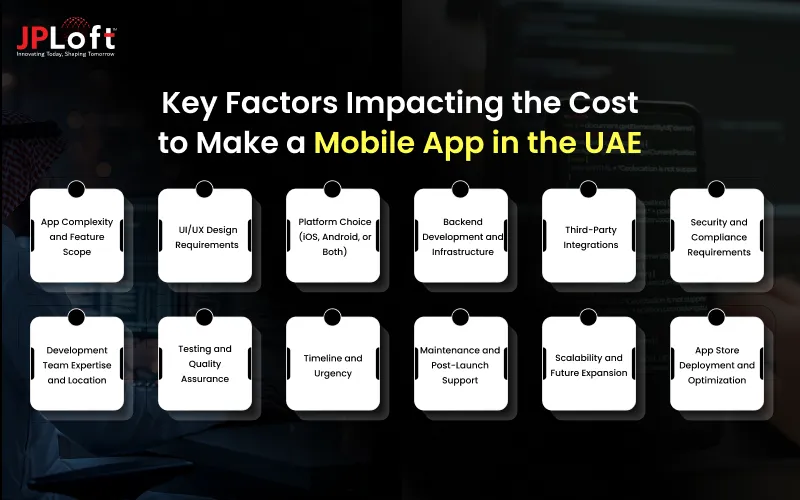
Let's discuss the complete factors in detail below.
1. App Complexity and Feature Scope
The more complex the app, the higher the development cost. A simple app with basic screens and static content costs far less than an app with real-time data, dashboards, or advanced workflows. Hence, you can say that the cost to build a mobile app in Dubai is impacted by the complex features and size of the app.
Features like live tracking, AI recommendations, or multi-user roles significantly increase development effort and directly influence the cost to develop an app in Dubai. Complexity also affects testing, maintenance, and scalability requirements, as outlined in the cost table below.
|
Feature Scope Basis |
Cost Range (USD) |
Impact Level |
What This Includes |
|
Basic feature set |
$15,000 – $40,000 |
Low |
Static screens, simple flows, limited user actions |
|
Mid-level complexity |
$40,000 – $120,000 |
Medium |
Real-time data, dashboards, multiple user roles |
|
Advanced feature depth |
$120,000 – $200,000+ |
High |
AI logic, complex workflows, scalability planning |
2. UI/UX Design Requirements
Mobile app design quality has a major cost impact in the UAE market, where users expect polished, premium experiences. Custom UI, animations, and interactive elements require more design hours and iterations.
Apps built for competitive sectors often require user research, prototyping, and usability testing through professional UI/UX design services, which directly impacts the cost to build an app in Dubai. Strong UX improves retention, but it also increases the upfront investment, as shown in the cost figures below.
|
Design Basis |
Cost Range (USD) |
Impact Level |
What This Includes |
|
Basic UI/UX design |
$5,000 – $15,000 |
Low |
Standard layouts, template-based components |
|
Mid-level custom design |
$15,000 – $40,000 |
Medium |
Custom UI, animations, interaction design |
|
Advanced UX strategy |
$40,000+ |
High |
User research, prototyping, usability testing |
3. Platform Choice (iOS, Android, or Both)
Building for a single platform costs less than developing for both iOS and Android. Separate native apps require different codebases, testing cycles, and ongoing maintenance. You can launch your app on the App Store or submit an app on the Play Store, as per the target audience.
Cross-platform development can reduce cost but may limit advanced performance or customization, which directly impacts the cost to make an app in Dubai. The platform decision affects both the initial build and long-term updates.
|
Platform Basis |
Cost Range (USD) |
Impact Level |
What This Includes |
|
Single platform |
$15,000 – $50,000 |
Low |
iOS or Android only |
|
Cross-platform build |
$50,000 – $120,000 |
Medium |
Shared logic using cross-platform frameworks |
|
Native apps for both |
$120,000 – $200,000+ |
High |
Separate iOS and Android codebases |
4. Backend Development and Infrastructure
The backend powers user authentication, data storage, APIs, and app logic. Apps with complex workflows, real-time sync, or high user traffic need a robust backend architecture. You should select the mobile app tech stack effectively, as it impacts the complete cost to build a mobile app in the UAE.
Cloud hosting, database design, and server scalability all add to cost. Poor backend planning often leads to expensive fixes later.
|
Backend Basis |
Cost Range (USD) |
Impact Level |
What This Includes |
|
Basic backend setup |
$10,000 – $30,000 |
Low |
Simple APIs, small user base |
|
Mid-level infrastructure |
$30,000 – $80,000 |
Medium |
Real-time sync, cloud hosting |
|
Enterprise backend |
$80,000+ |
High |
High traffic handling, fault tolerance |
5. Third-Party Integrations
Integrations with payment gateways, maps, analytics, CRMs, or external APIs increase development effort. Each integration requires setup, testing, and security validation.
Some third-party services also involve licensing or usage fees. The more systems your app connects to, the higher the mobile app development cost in Dubai and the ongoing maintenance load. Let’s discuss the cost, given in the table.
|
Integration Basis |
Cost Range (USD) |
Impact Level |
What This Includes |
|
Basic integrations |
$5,000 – $15,000 |
Low |
One or two simple APIs |
|
Standard integrations |
$15,000 – $40,000 |
Medium |
Payments, maps, analytics |
|
Complex integrations |
$40,000+ |
High |
Custom APIs, usage-based services |
6. Security and Compliance Requirements
Apps in fintech, healthcare, logistics, or enterprise sectors require strong security measures. This includes encryption, secure authentication, data protection, and audit logs. The higher the mobile app security is, the more will be the cost to develop a mobile app in Dubai.
Compliance with regional regulations and industry standards adds extra development and testing layers, and security is not optional, as it directly impacts the cost to make an app in Dubai.
|
Security Basis |
Cost Range (USD) |
Impact Level |
What This Includes |
|
Basic security |
$10,000 – $25,000 |
Low |
Encryption, basic authentication |
|
Advanced protection |
$25,000 – $70,000 |
Medium |
Data protection, access controls |
|
Regulatory compliance |
$70,000+ |
High |
Audits, compliance standards |
7. Development Team Expertise and Location
The skill level of developers significantly affects pricing. Senior engineers, architects, and domain experts charge more but reduce long-term risk. A high-skilled developer pursues the ability to optimize the overall mobile app development cost in Dubai, UAE.
Teams experienced with UAE market expectations often deliver higher quality, especially when you hire dedicated developers, which directly affects the cost to develop an app in Dubai. Lower-cost teams may seem attractive, but they often lead to rework and delays.
|
Team Basis |
Cost Range (USD) |
Impact Level |
What This Includes |
|
Junior or mixed team |
$15,000 – $40,000 |
Low |
Limited domain experience |
|
Senior developers |
$40,000 – $120,000 |
Medium |
Skilled engineers, domain experts |
|
Enterprise specialists |
$120,000+ |
High |
Architects, large-scale systems |
8. Testing and Quality Assurance
Comprehensive testing ensures the app works smoothly across devices and scenarios. Functional testing, performance testing, security testing, and user acceptance testing all add time and cost. Along with this, the mobile app testing should be considered before launching it on the platform.
Apps with complex logic or high user volumes require deeper QA cycles, which significantly influence the cost of application development in Dubai. Skipping testing often leads to costly post-launch fixes.
|
QA Basis |
Cost Range (USD) |
Impact Level |
What This Includes |
|
Basic QA |
$5,000 – $15,000 |
Low |
Functional testing |
|
Extended QA |
$15,000 – $40,000 |
Medium |
Device and regression testing |
|
Advanced QA |
$40,000+ |
High |
Security, load, UAT testing |
9. Timeline and Urgency
Shorter development timelines usually increase cost. Tight deadlines require larger teams, parallel development, and faster decision-making. If you have an urgency to make a mobile app, then it will impact the cost to make a mobile app in Dubai.
Rushed projects also demand more coordination and risk mitigation, which directly answers how long it takes to build a mobile app. A realistic timeline helps control costs and improve overall build quality.
|
Timeline Basis |
Cost Range (USD) |
Impact Level |
What This Includes |
|
Flexible timeline |
$5,000 – $15,000 |
Low |
Standard delivery pace |
|
Moderate urgency |
$15,000 – $40,000 |
Medium |
Parallel development |
|
Fast-track delivery |
$40,000+ |
High |
Larger teams, accelerated cycles |
10. Maintenance and Post-Launch Support
App cost does not end at launch. Ongoing maintenance includes bug fixes, performance optimization, OS updates, and feature enhancements.
Apps built for scale need continuous monitoring and support. Factoring maintenance early prevents unexpected expenses after release. For maintenance or understanding the frequency of the same, it's essential to connect with the leading mobile app maintenance services.
|
Maintenance Basis |
Cost Range (USD / year) |
Impact Level |
What This Includes |
|
Basic maintenance |
$3,000 – $10,000 |
Low |
Bug fixes, minor updates |
|
Ongoing support |
$10,000 – $30,000 |
Medium |
OS updates, performance tuning |
|
Continuous improvement |
$30,000+ |
High |
Monitoring, feature upgrades |
11. Scalability and Future Expansion
Apps designed for future growth require more upfront planning and architecture work. Supporting more users, regions, or features increases initial cost but saves money later. If you want your app to be scalable, this can affect the mobile app development cost in Dubai.
Scalable systems avoid expensive rebuilds as the business grows. Long-term vision directly affects development investment.
|
Scalability Basis |
Cost Range (USD) |
Impact Level |
What This Includes |
|
Limited growth planning |
$10,000 – $25,000 |
Low |
Basic scaling support |
|
Modular architecture |
$25,000 – $70,000 |
Medium |
Flexible system design |
|
Global-ready systems |
$70,000+ |
High |
Multi-region, high-load readiness |
12. App Store Deployment and Optimization
Preparing the app for store approval involves compliance checks, performance optimization, and store assets. App Store and Play Store guidelines must be followed carefully.
Optimization for discoverability and performance adds extra effort. This step is often underestimated, but it impacts launch success.
|
Deployment Basis |
Cost Range (USD) |
Impact Level |
What This Includes |
|
Basic submission |
$2,000 – $5,000 |
Low |
Store listing and approval |
|
Optimized launch |
$5,000 – $15,000 |
Medium |
Performance optimization |
|
Relaunch & ASO |
$15,000+ |
High |
Rejections, ASO, relaunch work |
There are other factors, too, that you should consider while analyzing the complete cost to develop a mobile app.
You can switch to the following section for the same.
Hidden Development Cost to Develop a Mobile App in Dubai
The hidden development cost comprises regulatory approvals, performance optimization, content localization, third-party services, and many more.
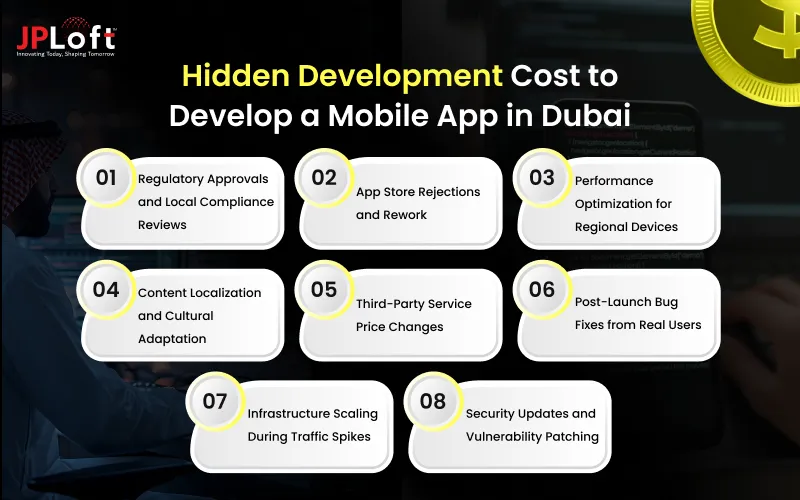
Here is a detail on the hidden development cost to look forward.
1. Regulatory Approvals and Local Compliance Reviews
Certain app categories require approvals from the UAE authorities or sector regulators. The review process may involve revisions, documentation, or security audits.
These steps add time, legal consultation costs, and redevelopment effort that many teams don’t plan for upfront.
2. App Store Rejections and Rework
Apple App Store and Google Play rejections can trigger unplanned redesigns or code changes. Even small compliance issues may require multiple resubmissions.
Each cycle increases development hours, testing effort, and release delays.
3. Performance Optimization for Regional Devices
Apps often need optimization for device models commonly used in the UAE, and when you hire mobile app developers, this effort directly influences the cost to create an app in Dubai. Performance tuning across screen sizes, network conditions, and OS versions adds engineering and testing work beyond initial estimates.
4. Content Localization and Cultural Adaptation
Arabic language support, right-to-left layouts, and culturally appropriate UI adjustments require additional design and development effort.
Localization goes beyond translation and often includes UX revisions, content changes, and extra QA cycles.
5. Third-Party Service Price Changes
Many apps rely on external services for maps, messaging, notifications, or analytics, and their pricing models can change as usage grows, directly impacting the cost to create an app in Dubai.
Increased API usage or tier upgrades often lead to unexpected monthly costs. These changes have a large impact on the total cost to make a mobile app in the UAE.
6. Post-Launch Bug Fixes from Real Users
User behavior in real-world conditions often reveals issues not caught during testing. Fixing these bugs quickly is critical for app ratings and retention.
Emergency patches and hotfixes increase post-launch development costs.
7. Infrastructure Scaling During Traffic Spikes
Sudden user growth, promotions, or seasonal demand can push server and cloud costs higher. Scaling infrastructure reactively is more expensive than planned growth.
This hidden cost affects apps that gain traction faster than expected.
8. Security Updates and Vulnerability Patching
New security threats, OS updates, or compliance changes require ongoing security patches. These updates are essential but rarely included in initial cost estimates.
Delaying them can create legal and operational risks.
Pursuing this hidden cost, let's switch to the impactful strategies to reduce the overall mobile app development cost in Dubai.
How to Reduce the Cost to Develop a Mobile App in Dubai?
You can reduce the mobile app development cost by following strategies such as regulatory approvals, app store rejections and rework, performance optimization for regional devices, and more.
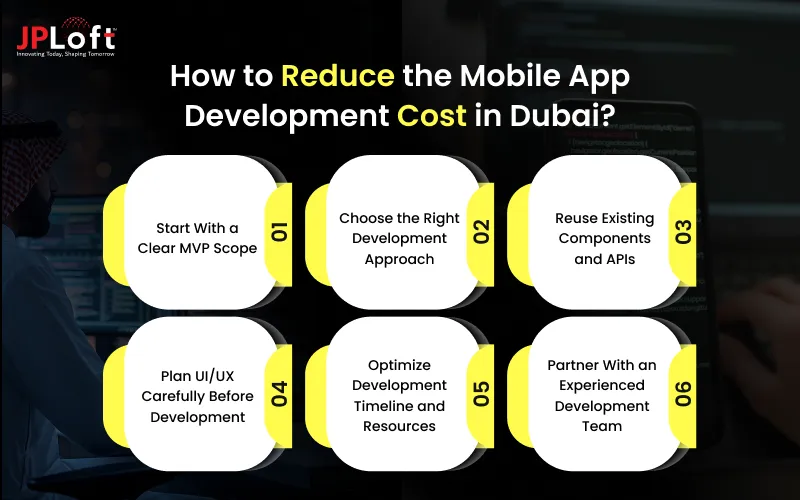
Let’s discuss all the strategies given below.
1] Start With a Clear MVP Scope
Define only the core features needed to validate your idea. An MVP avoids unnecessary functionality that inflates cost and timelines. Launching lean helps you test the market before investing further. You can always expand features based on real user feedback.
2] Choose the Right Development Approach
Cross-platform development can reduce cost by using a single codebase for iOS and Android. For many apps, this delivers strong performance at a lower price. Native development should be reserved for apps that truly need platform-specific capabilities.
3] Reuse Existing Components and APIs
Custom development increases cost quickly. Using proven frameworks, ready-made modules, and reliable third-party APIs reduces build time. This approach also lowers testing effort and speeds up launch without sacrificing stability.
4] Plan UI/UX Carefully Before Development
Frequent design changes increase rework and cost. Investing time in wireframes and prototypes helps finalize the user flow early. Clear design direction reduces revisions during development and keeps budgets under control.
5] Optimize Development Timeline and Resources
Avoid rushed deadlines that require larger teams or parallel work. A realistic timeline allows better resource planning and fewer mistakes. Controlled pacing improves efficiency and reduces hidden expenses.
6] Partner With an Experienced Development Team
An experienced team may cost more per hour but saves money overall by avoiding rework and delays. Skilled developers build scalable, clean architecture from the start. This reduces long-term maintenance and upgrade costs.
Apart from the investment, you can evaluate the mobile app monetization practices to earn money in the following section.
How to Monetize a Mobile App in Dubai?
You can monetize a mobile app in Dubai by following strategies such as subscription plans, freemium with paid upgrades, in purchases, commission-based transactions, and many others.

Let’s learn about the top mobile app monetization strategies in the list below.
1. Subscription Plans
Subscriptions offer predictable, recurring revenue through monthly or annual plans. Apps can tier access by features, usage limits, or service levels.
This model works especially well for productivity, finance, fitness, and B2B apps. Clear value upgrades reduce churn and improve lifetime value.
2. Freemium With Paid Upgrades
A freemium model attracts users by offering core features for free. Advanced tools, higher limits, or premium content are locked behind paid upgrades.
This lowers entry barriers while converting engaged users into paying customers. It’s effective for competitive Dubai markets where users test before committing.
3. In-App Purchases
In-app purchases monetize specific actions, content, or add-ons without subscriptions. Users pay only when they see immediate value.
This suits gaming, learning, and utility apps where optional enhancements matter. Flexible pricing encourages impulse purchases.
4. Commission-Based Transactions
Apps that facilitate bookings, orders, or payments can earn commissions per transaction. This aligns revenue directly with platform usage.
On-demand services, marketplaces, and delivery apps use this model effectively. Higher volume leads to scalable revenue growth.
5. Advertising and Sponsored Listings
Advertising generates revenue by promoting brands, services, or featured placements. Native ads and sponsored listings perform better than intrusive formats.
This model works best for high-traffic apps with strong user engagement. Careful placement preserves user experience.
6. Enterprise Licensing and White-Labeling
Businesses can monetize by licensing the app to enterprises or offering white-label versions. This creates high-value contracts with fewer customers.
It’s common in logistics, fintech, and service platforms. Long-term agreements improve revenue stability.

Ready to Scale Your App Idea in Dubai with JPLoft?
An experienced team may cost more per hour but saves money overall by avoiding rework and delays. Skilled developers build scalable, clean architecture from the start. This reduces long-term maintenance and upgrade costs.
This is where execution matters. JPLoft brings deep experience in building mobile apps that are designed to grow, adapt, and perform under real-world demand.
As a top mobile app development company in Dubai, JPLoft focuses on more than just development. The team works on product strategy, architecture planning, performance optimization, and future scalability so your app is ready for growth, not just launch.
What this really means is fewer rebuilds, faster go-to-market, and technology that supports expansion across users, features, and geographies. If your goal is to turn an app idea into a scalable digital product in Dubai, partnering with JPLoft gives you the clarity, execution strength, and confidence to grow.
Conclusion
The cost to develop a mobile app in Dubai is shaped by a wide range of technical and business decisions made throughout the project lifecycle.
App complexity, platform selection, design expectations, security standards, scalability planning, and post-launch support all play a direct role in the overall investment. Dubai’s fast-moving digital ecosystem demands apps that are stable, compliant, and ready to scale from day one.
By understanding the key cost drivers, accounting for hidden expenses, and choosing the right development strategy, businesses can avoid surprises and make smarter budgeting decisions.
Partnering with an experienced development team ensures better execution, fewer reworks, and a mobile product that supports long-term growth in the UAE market.
FAQs
Mobile app development in Dubai usually costs between AED 55,000 to AED 734,000+ ($15,000 and $200,000+), depending on features, app complexity, platform selection, security needs, and scalability. Apps built for regulated or high-traffic industries typically require additional investment for compliance, testing, and infrastructure planning.
Key factors include app complexity, UI/UX design depth, platform choice, backend infrastructure, third-party integrations, security compliance, testing scope, and team expertise.
Long-term considerations like scalability, maintenance, and future upgrades also significantly influence overall cost.
Yes, cross-platform development often reduces cost by using a single codebase for iOS and Android. However, apps requiring advanced performance, heavy animations, or deep native integrations may still benefit more from native development.
Yes, hidden costs include regulatory approvals, app store rejections, localization needs, performance optimization, and post-launch bug fixes.Unexpected increases in third-party service usage or infrastructure scaling can also add to long-term expenses.
Costs can be reduced by starting with a clear MVP, reusing existing components, selecting the right development approach, and planning UI/UX early. Working with an experienced team helps avoid rework, delays, and costly architectural mistakes later.

Priyanka Sukhwal is the Managing Director and Business Head of JPLoft, with 10+ years of experience in technology, digital product strategy, and business growth. She has worked closely with businesses building mobile applications, custom software, marketplaces, and on-demand platforms across mobility, automotive, consumer services, and startup ecosystems. At JPLoft, she focuses on understanding business models, identifying product opportunities, and helping companies plan digital solutions that can scale with changing market needs.


Share this blog