


Key Takeaways:
Generative AI enables platforms to create personalized content automatically, improving engagement, creativity, and overall social media user experiences.
Generative models help users instantly generate images, captions, and videos, making digital content creation faster and more accessible.
Automated moderation and content generation tools help platforms manage large communities while maintaining safety, quality, and meaningful interactions.
Businesses can build innovative digital communities by integrating generative technologies that support creators, brands, and personalized user experiences.
JPLoft helps businesses build scalable generative AI-powered platforms through expert development and innovative technology solutions.
Social media has evolved rapidly over the past decade, moving from simple text updates to highly interactive, algorithm-driven platforms. Today, a new transformation is emerging as generative AI in social media platforms enables users to create images, captions, videos, and entire posts using simple prompts.
This technology is changing how content is produced and experienced online. Creators can generate ideas instantly, brands can scale engagement, and communities can interact with more dynamic digital experiences.
These innovations are shaping the future of social media with generative AI, where platforms support AI-assisted storytelling, personalized content creation, and smarter user interactions.
In this blog, we explore how generative AI is transforming social media platforms, its key applications, real-world examples, and best practices for building AI-powered social platforms.
What Is Generative AI and Why Does It Matter for Social Media Platforms?
Generative AI refers to artificial intelligence systems that can create new content, such as text, images, videos, and audio, based on prompts or training data.
Unlike traditional automation tools that analyze information, generative models actively produce original outputs.
Today, generative artificial intelligence enables social media users to generate captions, design visuals, automate storytelling, and create engaging posts within seconds.
These technologies are already transforming digital creativity and online communication.
Key Data & Industry Insights
Here are some of the latest statistics showcasing how generative AI is transforming social media platforms.
-
The generative AI market is expected to exceed $1 trillion by 2034, highlighting massive investment in AI-driven digital platforms.
-
Generative AI can reduce content production time by up to 60%, especially in marketing and social media campaigns.
Why Generative AI Matters for Social Media Platforms?
Social media platforms depend heavily on content creation, engagement, and personalization. This is where the impact of generative AI in social media becomes significant.
AI can help users instantly create visuals, write posts, or generate short videos, dramatically increasing content volume and creativity.
For businesses planning to build gen AI-driven social platforms, understanding the evolving landscape of AI in social media is becoming essential.
Modern creators and brands are looking for smarter tools that simplify content production while improving engagement.
At the same time, developers building next-generation platforms must also evaluate social media app development trends because generative AI is shaping how platforms support creator economies, automate media generation, and deliver personalized digital experiences.
How Generative AI Is Reshaping Social Media Platforms?
Social media platforms are entering a new phase of innovation where content creation is no longer limited to human effort alone.
Generative AI in social media platforms is enabling users to produce engaging media instantly, transforming how creators, businesses, and communities interact online.
As a result, the role of generative AI in social media is shifting from simple automation to creative collaboration.
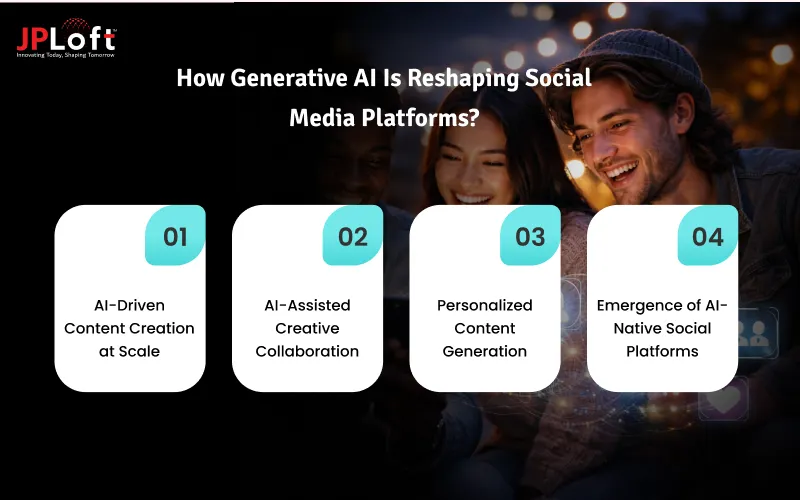
Below are the key ways generative technologies are reshaping modern social networks.
1. AI-Driven Content Creation at Scale
One of the biggest transformations is the rapid growth of AI-generated social media content. Generative systems help create a variety of content from captions to visuals and short videos within seconds, enabling creators to publish more content consistently.
These generative AI social media tools reduce the time required for production while improving creative possibilities.
For entrepreneurs exploring new social media app ideas, integrating generative content features can enable users to produce engaging posts quickly while focusing more on storytelling and audience engagement.
2. AI-Assisted Creative Collaboration
Social media is increasingly becoming a collaborative space between humans and intelligent systems. Generative AI by handling the content creation in all means from suggesting captions to enhancing images or expanding short posts into complete stories, helps creators refine their ideas.
For founders exploring how to create a social media app, these collaborative capabilities can help boost user engagement and retention on your newly launched gen AI-driven social media.
As creators work alongside AI systems, the impact of generative AI in social media becomes evident through faster workflows and more innovative digital storytelling experiences.
3. Personalized Content Generation
Traditional social media algorithms recommend existing content. Generative AI goes further by creating new media tailored to user interests.
With the help of generative technology, platforms can simplify generating personalized content either visuals, captions, or short videos, aligned with audience preferences.
This shift is driving the growth of generative technology social media, where users interact with highly customized digital feeds. Such personalization improves engagement rates while allowing platforms to deliver unique experiences to every user.
4. Emergence of AI-Native Social Platforms
A new generation of gen AI-powered social media platforms is emerging that integrates generative capabilities at the core of the platform. These networks enable users to create AI avatars, virtual influencers, and interactive digital stories.
Instead of simply sharing posts, users can design immersive content experiences powered by generative systems. Businesses building such platforms often rely on generative AI development services to integrate scalable models and real-time content generation capabilities.
This transformation reflects the broader future of social media with generative AI, where creativity and technology work together to redefine digital interaction.
Generative technologies are not only enhancing content creation but also redefining how social platforms function. As these capabilities evolve, generative AI will continue shaping the next generation of interactive, creator-driven social media ecosystems.
Modern Problems Generative AI Is Solving in Social Media
As social networks expand globally, platforms face multiple challenges such as content fatigue, engagement decline, and moderation complexity.
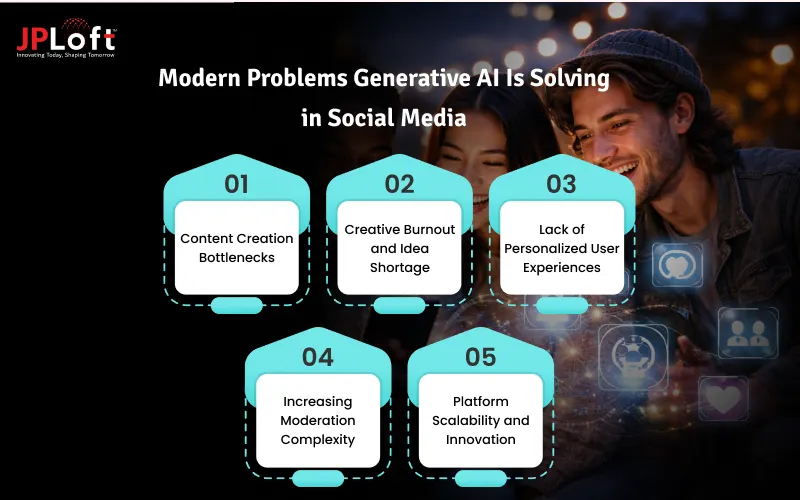
The impact of generative AI in social media is becoming crucial because generative systems can create, refine, and optimize content workflows. This helps platforms overcome structural limitations and support both creators and users more effectively.
► Content Creation Bottlenecks
Creators often struggle to maintain a consistent publishing schedule due to the time required for content creation (visuals, captions, videos, etc.)
Generative technology helps address this issue by enabling AI-generated social media content that can be produced quickly using prompts.
These automated capabilities reduce production effort while allowing creators to experiment with different formats and storytelling approaches.
► Creative Burnout and Idea Shortage
Many creators experience creative fatigue after producing content regularly for long periods.
On the other hand, generative technologies provide inspiration by generating ideas, captions, and visual concepts automatically.
These capabilities represent practical generative AI social media applications that help creators overcome idea blocks.
As a result, users can explore new styles of storytelling while maintaining consistent audience engagement across platforms.
► Lack of Personalized User Experiences
Traditional recommendation algorithms mostly distribute existing posts based on user behavior.
Whereas generative technologies allow platforms to create tailored visuals, captions, or media experiences for individual users.
This shift supports the rise of generative AI-powered social media, where personalized content can be dynamically generated.
Such customization helps improve user satisfaction and increases the time users spend interacting with digital communities.
► Increasing Moderation Complexity
Social media platforms process massive volumes of posts every day, making moderation extremely challenging.
Harmful content, misinformation, and spam require faster identification and response mechanisms.
Generative technologies combined with intelligent detection systems can support moderation teams by analyzing patterns and generating contextual responses.
At the same time, strong social media app security frameworks remain essential to ensure safe and responsible AI usage.
► Platform Scalability and Innovation
As social platforms expand, they must constantly introduce new features while maintaining performance and stability.
Generative AI enables faster experimentation with content formats, automated interactions, and creator tools to innovate and incorporate those updates in the platform.
However, developers must still address critical social media app development challenges, including infrastructure scalability, ethical AI deployment, and integration with complex platform architectures.
Generative technologies are therefore helping social media platforms address key operational challenges while supporting creators, improving engagement, and enabling more scalable digital ecosystems.
Key Applications of Generative AI in Social Media Platforms
As social networks evolve into creator-driven ecosystems, generative technologies are enabling new ways to produce content, engage audiences, and build immersive digital communities.
Instead of relying only on traditional automation, generative artificial inteligence in social media platforms allows users and businesses to generate media, personalize interactions, and streamline creative workflows.
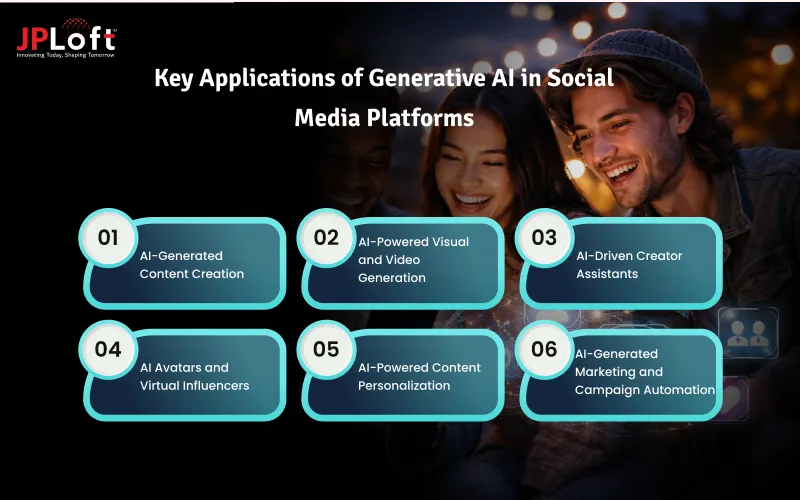
Below are the most impactful generative AI social media applications shaping modern platforms.
#1: AI-Generated Content Creation
One of the most common applications of generative technology is automated content creation. Now, users can create any sort of content (visuals, captions, memes, short videos, etc.) easily by using prompts or simple inputs.
This capability supports the rapid growth of AI-generated social media content, enabling creators to publish frequently without complex editing tools.
To implement such features effectively, developers must build a scalable social media app tech stack capable of supporting generative models and real-time media processing.
#2: AI-Powered Visual and Video Generation
Visual storytelling drives engagement across social platforms, making image and video generation a powerful application of generative technology.
Modern generative AI social media tools allow users to create images, graphics, and short animations directly from text prompts.
These tools simplify creative workflows for creators and brands that want to experiment with different formats.
By enabling quick visual production, platforms can encourage more dynamic content creation and higher user participation.
#3: AI-Driven Creator Assistants
Generative AI is also transforming how creators manage their content strategies through intelligent assistants.
These assistants can help create required content and suggest topic ideas based on current trends.
As the role of generative AI in social media continues to grow, such assistants help streamline creative workflows and improve productivity.
Platforms that integrate these capabilities allow creators to focus on storytelling while AI handles repetitive content planning tasks.
#4: AI Avatars and Virtual Influencers
Another emerging application involves creating AI avatars and virtual influencers capable of producing digital content and interacting with audiences.
Many gen AI-powered social media platforms now enable users to design virtual personalities that generate posts, respond to comments, and participate in brand campaigns.
These AI-driven characters offer new engagement possibilities for brands and communities, while expanding the boundaries of digital storytelling and online identity.
#5: AI-Powered Content Personalization
Generative technologies allow social platforms to move beyond traditional recommendation systems.
Instead of simply showing existing posts, gen AI can dynamically generate personalized media experiences tailored to each user.
This innovation supports the expansion of generative AI-powered social media, where personalized content and interactions enhance engagement.
To ensure reliability and performance, platforms must rely on structured social media app testing practices to validate AI-driven features and maintain consistent user experiences.
#6: AI-Generated Marketing and Campaign Automation
Businesses are increasingly adopting generative tools to automate marketing campaigns and brand storytelling across social platforms.
Gen AI systems can generate promotional content and campaign concepts that align with audience preferences.
For entrepreneurs evaluating social media app features, integrating such marketing capabilities can attract creators, advertisers, and businesses.
These capabilities help brands access scalable digital promotion tools within modern social media ecosystems.
Generative technologies are transforming social platforms into intelligent, creative ecosystems. As these capabilities evolve, the future of social media with generative AI will focus on automated creativity, personalized engagement, and AI-driven digital communities.
Real-World Examples of Generative AI in Social Platforms
Generative technology is no longer experimental in the social media ecosystem. Several leading platforms are already integrating generative capabilities to enhance content creation, engagement, and personalization.
These implementations demonstrate how generative AI systems in social media platforms is evolving from optional tools into core platform capabilities that shape modern digital experiences.
Below are real-world examples showing how companies are implementing generative AI social media tools to improve user experiences and empower creators.
|
Platform |
Generative AI Feature |
How It Works |
Impact on Social Media |
|
Instagram Thread |
AI Image & Caption Generation |
Instagram Thread integrates generative capabilities that help users create captions and stylised images through AI prompts. |
Improves creator productivity and accelerates AI-generated social media content creation. |
|
Snapchat |
AI Selfie & Image Generation |
Snapchat enables users to generate stylised selfies and visual effects through AI-powered prompts and filters. |
Encourages interactive storytelling and enhances creative engagement. |
|
TikTok |
AI Video & Script Tools |
TikTok experiments with AI-driven tools that generate video ideas, scripts, and captions for creators. |
Supports rapid content production and strengthens the creator ecosystem. |
|
|
AI Writing Assistants |
LinkedIn integrates generative writing assistants that help professionals draft posts and refine messaging. |
Demonstrates the growing role of generative AI in social media within professional communities. |
|
|
AI Visual Discovery |
Pinterest leverages generative technologies to enhance visual search and personalized content discovery. |
Supports highly tailored feeds aligned with generative models' experiences in social media. |
These examples highlight how generative capabilities are becoming an essential component of modern social platforms.
Companies building similar systems must also prioritize long-term platform performance and scalability.
Best Practices for Building Generative AI Social Media Platforms
Developing modern social platforms powered by generative technologies requires thoughtful planning, scalable infrastructure, and responsible AI integration.
While generative models in social media unlock powerful creative opportunities, businesses must balance innovation with reliability, security, and user experience.
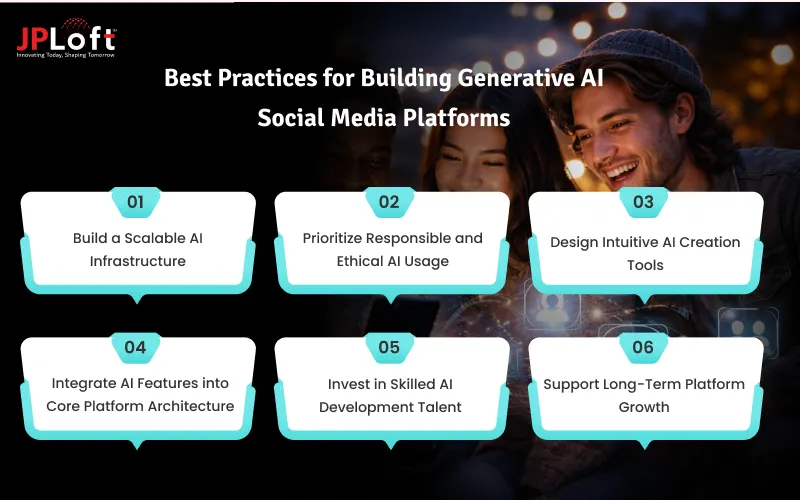
The following best practices help organizations design scalable and engaging generative AI-powered social media platforms.
1. Build a Scalable AI Infrastructure
Generative features require high computational power, real-time processing, and reliable cloud infrastructure.
Platforms must integrate scalable systems capable of supporting AI models, media processing, and high user activity.
Businesses planning such systems should carefully evaluate the social media app development cost.
Advanced gen AI infrastructure often requires GPU resources, optimized APIs, and distributed storage systems to ensure fast performance and seamless user experiences.
2. Prioritize Responsible and Ethical AI Usage
Generative systems can produce large volumes of media content automatically, which makes responsible AI governance essential.
Platforms must establish policies for transparency, moderation, and content authenticity to prevent misuse or misinformation.
Ensuring the responsible creation of AI-generated social media content helps maintain user trust and protect digital communities.
It also enables platforms to leverage generative technologies safely and ethically.
3. Design Intuitive AI Creation Tools
Advanced technology should always remain easy for users to access and operate.
Platforms must design intuitive interfaces that allow users to generate and customize content using simple prompts.
Businesses exploring how to design a social media app should prioritize user-friendly workflows and intuitive creation experiences.
They should also include visual editing options and interactive tools that make generative features accessible to both creators and everyday users.
4. Integrate AI Features into Core Platform Architecture
Generative capabilities should not function as isolated tools. Instead, they should be integrated into the core platform architecture to support content creation, personalization, and engagement.
Many organizations partner with an AI development company to implement scalable machine learning models and optimize platform performance.
This also helps ensure smooth integration of generative technologies within evolving social ecosystems.
5. Invest in Skilled AI Development Talent
Building advanced social platforms requires expertise in machine learning engineering, data pipelines, and scalable backend systems.
Organizations frequently hire AI developers who specialize in training and deploying generative models across large digital platforms.
Skilled AI professionals help ensure that generative systems operate efficiently while supporting new creative tools and features within the social platform.
6. Support Long-Term Platform Growth
Social platforms must continuously evolve as user expectations and technologies change.
Businesses often partner with an experienced mobile app development company to maintain platform stability, introduce new features, and optimize performance over time.
This approach supports long-term innovation while helping organizations adapt to emerging generative AI social media applications and changing digital engagement patterns.
By following these best practices, businesses can successfully develop scalable social ecosystems powered by generative technologies. As the role of generative AI in social media continues to expand, platforms must combine strong infrastructure, ethical governance, and intuitive creator tools. These elements will shape the next generation of digital communities.

How JPLoft Helps Businesses Build Generative AI Social Platforms?
As generative technologies continue to reshape digital communities, businesses need experienced technology partners to build scalable and intelligent social platforms.
As a trusted social media app development company, JPLoft helps organizations design and develop modern platforms that support advanced gen AI capabilities and engaging user experiences.
Our development team focuses on building secure and scalable infrastructures that integrate intelligent content creation systems, personalized feeds, and creator-focused tools.
We help businesses leverage the full potential of gen AI technology in social media platforms to introduce innovative features that enhance user interaction and digital storytelling.
From product strategy and UI design to AI model integration and deployment, JPLoft supports businesses throughout the entire development lifecycle.
This approach helps companies launch innovative social platforms that encourage creativity, improve engagement, and adapt to the evolving social media landscape.
Conclusion
Generative technologies are rapidly transforming how people create, share, and interact with content online.
The rise of generative AI in social media platforms is enabling smarter content creation, deeper personalization, and more engaging digital communities.
From automated media generation to intelligent content discovery, these capabilities are redefining how modern social networks operate.
As the impact of generative AI in social media continues to grow, businesses have an opportunity to build innovative platforms that empower creators and enhance user experiences.
Organizations that strategically adopt advanced gen AI-driven social media solutions can unlock new engagement models and scalable growth opportunities.
By combining thoughtful platform design with responsible AI implementation, companies can shape the next generation of interactive social ecosystems.
FAQs
Generative technology in social media platforms refers to AI systems that can automatically create content such as text, images, videos, captions, and recommendations. These systems analyze user data and trends to generate personalized and engaging content. As a result, social platforms can improve user experiences, support creators, and increase engagement through intelligent automation.
Traditional AI mainly analyzes data and predicts user behavior, such as recommending posts or detecting spam. In contrast, generative technology-driven social media focuses on creating new content automatically. This includes generating posts, visuals, captions, and creative media that users can share or customize.
Common generative AI social media applications include automated text creation, AI-generated visuals, personalized content feeds, chatbot interactions, and content moderation. These tools help platforms improve engagement while making it easier for creators and brands to produce high-quality content quickly.
AI-generated social media content helps creators and businesses produce posts faster while maintaining creativity and consistency. It can generate high-quality images, text and content ideas based on audience preferences. This allows brands to scale their content strategies without significantly increasing time or resources.
The future of social media with generative AI will likely focus on highly personalized experiences, AI-assisted content creation, and interactive digital communities. Platforms will increasingly rely on generative tools to support creators, streamline workflows, and deliver more immersive social experiences.

Conor has more than 10 years of experience in software development, app creation, solution engineering, and UX/UI design. With an impressive track record of high retention and growth working with Fortune 500 companies, he brings the technical depth and strategic perspective needed to help businesses build impactful, user-focused digital solutions.





Share this blog