



Key Takeaways
Content moderation is essential for maintaining safe, trustworthy, and engaging social media platforms in today’s digital environment.
Effective social media content moderation helps filter harmful content while improving user experience and overall platform credibility.
Combining AI tools with human review ensures better accuracy, scalability, and context-aware moderation decisions across diverse content types.
Selecting the right moderation approach helps platforms balance speed, control, and community standards effectively as they grow.
Following strong content moderation best practices supports compliance, enhances security, and ensures long-term platform scalability and performance.
JPLoft helps businesses build secure platforms with advanced moderation systems, ensuring scalability, performance, and reliable user experiences.
Content moderation has become a critical challenge as social platforms struggle to manage the explosion of user-generated content and rising online risks.
As per a report, YouTube alone uploads over 500 hours of video every minute. This simply highlights the massive scale of content that platforms need to manage.
Every minute, various platforms share millions of posts, making safety, trust, and compliance essential.
Content moderation in social media apps helps platforms detect, filter, and manage harmful or misleading content before it impacts users.
From preventing spam and abuse to maintaining brand credibility, effective social media content moderation plays a key role in shaping positive online experiences.
In this blog, we will explore how content moderation works, its benefits, types, technologies, challenges, and best practices for building safer social platforms.
What is Content Moderation in Social Media Apps & How Do They Work?
Content moderation refers to the process of monitoring, evaluating, and managing user-generated content to ensure it aligns with platform policies and community standards.
It helps filter harmful, misleading, or inappropriate posts while maintaining a safe and engaging environment.
Effective social media content moderation combines automated systems and human oversight to protect users and strengthen platform credibility.
Today, with the growing role of AI in social media, moderation systems are becoming faster and more scalable. This enables platforms to manage massive volumes of content efficiently.
How Content Moderation Works in Social Media?
Understanding how content moderation works in social media helps businesses build safer platforms.
The process typically includes:
-
Content Detection: Systems scan posts, images, and videos to identify potential violations
-
Automated Filtering: AI models classify content based on risk and relevance
-
Flagging & Reporting: Users and systems highlight harmful or suspicious content
-
Human Review: Moderators evaluate complex or context-sensitive cases
-
Action Execution: Content is removed, restricted, or labeled based on policies
-
Continuous Improvement: Systems evolve using moderation data and feedback
For businesses planning how to create a social media app, integrating moderation early ensures better scalability and user trust.
In short, strong moderation systems help platforms maintain a balance between safety, engagement, and freedom of expression.
Benefits of Content Moderation in Social Media Apps
Content moderation ensures safer interactions, stronger trust, and long-term platform growth in an increasingly complex digital ecosystem.
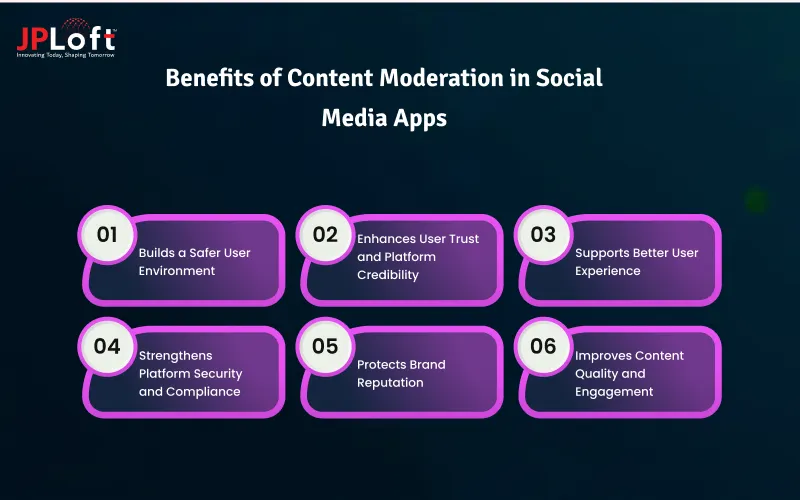
Below are the key benefits of implementing effective content moderation for social media platforms:
1. Builds a Safer User Environment
Effective moderation helps detect harmful, abusive, or misleading posts early, ensuring users interact in a secure environment. It reduces risks associated with harmful content and fosters a safer, more positive community experience.
2. Enhances User Trust and Platform Credibility
The content moderation best practices improve transparency and accountability, making users feel more confident about the platform. This clearly reflects the importance of content moderation in social media in building long-term trust and credibility.
3. Supports Better User Experience
Well-structured social media moderation ensures that users are exposed to relevant and meaningful content. Clean feeds, reduced spam, and improved interactions contribute to a seamless experience aligned with expectations of evolving social media app features.
4. Strengthens Platform Security and Compliance
Implementing effective moderation systems helps platforms meet regulatory standards and protect users from harmful activities. It also supports mobile app security best practices, ensuring safer interactions and reducing the risk of fraud or malicious content.
5. Protects Brand Reputation
Consistent social media app content moderation helps prevent the spread of inappropriate or offensive content that could harm brand image. It allows platforms to maintain a professional environment while managing large volumes of user interactions effectively.
6. Improves Content Quality and Engagement
By prioritizing relevant and high-quality posts, moderation systems help improve engagement and user retention. This helps platforms in encouraging meaningful interactions and ensuring users keep on returning for valuable, safe, and well-managed content experiences.
In conclusion, these benefits showcase the importance of content moderation in social media for not only safeguarding users but also driving platform growth, trust, and sustainable engagement.

Types of Content Moderation Used in Social Media Apps
Different moderation approaches help platforms manage diverse content formats while ensuring safety, compliance, and user trust.
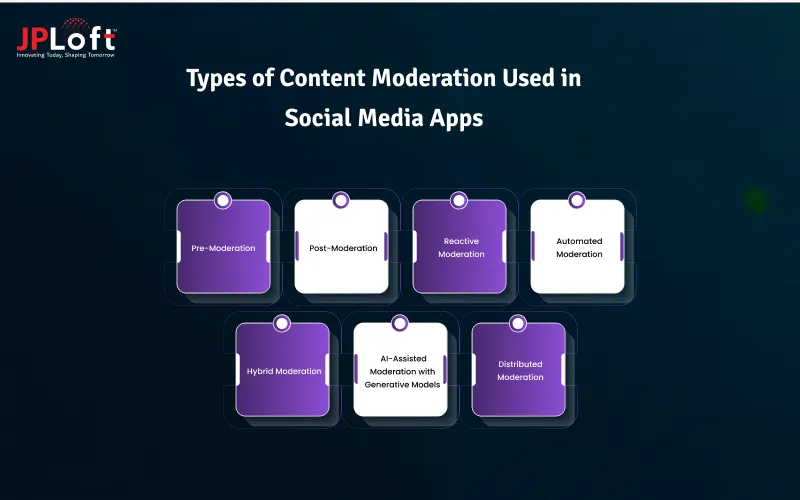
Below are the different types of content moderation in social media used across platforms:
Type 1: Pre-Moderation
Pre-moderation involves reviewing content before it goes live, ensuring harmful or inappropriate posts never reach users. This approach strengthens content moderation in social media apps by maintaining strict control over what gets published and protecting community standards.
Type 2: Post-Moderation
Post-moderation allows content to be published instantly and reviewed afterwards. It supports real-time engagement while relying on social media content moderation systems to identify and remove violations. This helps platforms balance speed with safety and content quality.
Type 3: Reactive Moderation
Reactive moderation depends on users reporting inappropriate or harmful posts. This method supports moderating user-generated content at scale, enabling platforms to involve communities in maintaining standards. It also helps address issues that automated systems might miss.
Type 4: Automated Moderation
Automated moderation uses advanced tools and algorithms to scan and filter content instantly. With growing adoption of AI content moderation, platforms can detect spam, hate speech, and violations efficiently. This advantage makes the approach essential for handling large volumes of data.
Type 5: Hybrid Moderation
Hybrid moderation combines automation with human judgment to improve decision accuracy. It supports more reliable social media content filtering, especially in complex scenarios where context matters. This ensures both efficiency and fairness in moderation outcomes.
Type 6: Distributed Moderation
Distributed moderation empowers users to participate in evaluating and rating content. This approach enhances transparency and is often refined through processes like social media app testing to improve moderation accuracy and user-driven governance over time.
Type 7: AI-Assisted Moderation with Generative Models
With the rise of generative AI in social media platforms, moderation systems are evolving to detect deepfakes and synthetic media. This helps platforms stay ahead of emerging threats while improving the overall effectiveness of modern moderation strategies.
Choosing the right one out of these different types of content moderation in social media ensures better scalability, control, and safer user interactions across evolving ecosystems.
Key Technologies Used for Content Moderation
Modern moderation systems rely on advanced technologies to manage large-scale content efficiently while maintaining accuracy, speed, and user safety.
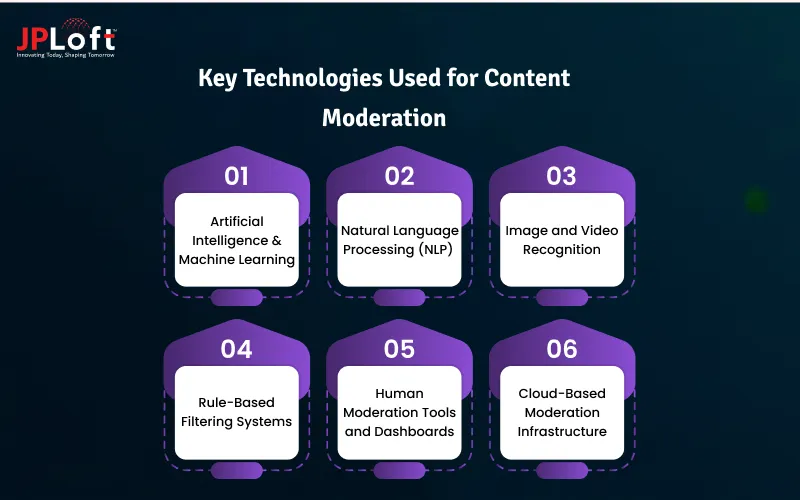
Below are the key technologies used for content moderation:
► Artificial Intelligence & Machine Learning
AI and machine learning form the backbone of modern content moderation in social media apps, which enables platforms to automatically detect harmful or inappropriate content.
In addition, these systems continuously learn from patterns, resulting in improved AI content moderation accuracy over time. Therefore, many businesses partner with an AI development company to build scalable, intelligent moderation solutions.
Meta is a real-world example of using AI models to proactively detect hate speech, nudity and violence across Facebook and Instagram. Also, it removes a majority of violating content before users even report it.
► Natural Language Processing (NLP)
NLP enables platforms to understand and analyze text across posts, comments, and messages. It plays a critical role in social media content moderation by identifying spam, hate speech, and abusive language. This allows platforms to respond quickly and maintain healthier online communities.
For example, Twitter (now known as X Corp.) uses NLP models to detect harmful conversations. It also prompts users with warnings before posting potentially offensive replies to encourage safer interactions.
► Image and Video Recognition
Image and video recognition technologies help scan visual content for explicit or harmful material. These systems enhance social media content filtering by identifying inappropriate visuals in real time. This makes them essential for platforms handling large volumes of multimedia content daily.
YouTube is a strong example that uses advanced visual recognition systems to automatically detect copyrighted material, violence, or unsafe content. It uses Content ID and safety detection technologies to manage and filter such content effectively.
► Rule-Based Filtering Systems
Rule-based systems use predefined conditions and keyword filters to detect policy violations. They support content moderation on social media apps by handling basic moderation tasks efficiently. These systems often work alongside AI systems to create a more robust and layered moderation framework.
For example, Reddit allows communities (subreddits) to set custom moderation rules and keyword filters. This allows automated removal of posts that violate specific community guidelines.
► Human Moderation Tools and Dashboards
Human moderation tools provide interfaces for reviewing flagged content and making context-based decisions. These tools are essential for handling sensitive cases that automation may miss. Businesses assessing the cost to hire AI developers often balance human expertise with automation investments.
TikTok is a real-world example, employing thousands of human moderators globally. They review flagged videos and enforce platform policies to ensure more nuanced decisions in complex moderation scenarios.
► Cloud-Based Moderation Infrastructure
Cloud infrastructure enables scalable and real-time moderation across global platforms. It ensures high performance, reliability, and seamless integration. Many organizations collaborate with a cloud development company to build secure systems capable of supporting large-scale moderation operations efficiently.
For example, many platforms rely on solutions like Amazon Web Services to scale moderation systems efficiently. Solutions like this support real-time processing and global content delivery without performance bottlenecks.
Together, these technologies enable faster, scalable, and accurate moderation that ensures safer and more reliable social media platforms.
AI vs Human Moderation: Finding the Right Balance
Balancing automation and human judgment is essential for building effective, scalable, and reliable moderation systems in modern social platforms.
When it comes to moderating user-generated content, relying solely on automation or human reviewers is not sufficient. Platforms must combine the speed of AI content moderation with human intelligence to ensure accuracy, fairness, and consistency in decision-making across diverse types of content.
Let’s have a look at the key differences between the two approaches preferred for moderating content on social media apps.
|
Aspect |
AI Moderation |
Human Moderation |
|
Speed |
Processes large volumes instantly, enabling real-time social media app content moderation |
Slower due to manual review processes |
|
Accuracy |
Highly effective for detecting clear violations like spam or explicit content |
Excels in handling nuanced and context-sensitive cases |
|
Scalability |
Easily scales with increasing platform data and activity |
Limited by workforce size and operational capacity |
|
Context Understanding |
Limited ability to understand tone, sarcasm, or cultural nuances |
Strong contextual understanding and decision-making |
|
Cost Efficiency |
Reduces long-term operational costs through automation |
Requires continuous investment in human resources |
|
Consistency |
Applies rules uniformly across all content |
May vary depending on individual interpretation |
Why a Hybrid Approach Works Best?
A hybrid moderation model allows platforms to balance speed and accuracy effectively. AI systems handle repetitive and high-volume tasks, while human moderators review complex or sensitive cases. This is especially important when moderating user-generated content, where context plays a critical role in decision-making.
To build scalable moderation systems, businesses often hire dedicated developers who can design intelligent workflows that combine automation with human oversight. This ensures faster response times while maintaining moderation quality across growing user bases.
A balanced moderation strategy ensures safer platforms by combining speed, accuracy, and human judgment effectively.
Challenges in Moderating Content on Social Media Platforms
Content moderation comes with complex technical, operational, and ethical challenges that platforms must address to ensure safety, scalability, and compliance.
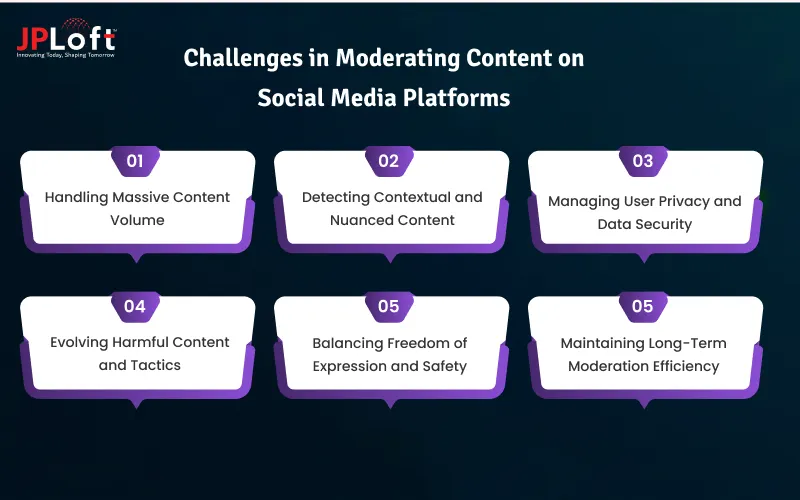
Below are the key challenges in content moderation for social media platforms, along with their practical solutions:
Challenge 1: Handling Massive Content Volume
Managing massive volumes of posts, images, and videos daily makes social media content filtering highly complex. This is also one of the major social media app development challenges platforms face while scaling efficiently.
Solution: Implement a scalable social media moderation service combined with automation to process large datasets efficiently. This reduces manual workload while maintaining accuracy, ensuring faster moderation decisions across rapidly growing platforms.
Challenge 2: Detecting Contextual and Nuanced Content
Understanding sarcasm, cultural context, or intent remains difficult for automated systems. This affects social media app content moderation, as misinterpretation can lead to incorrect removals or harmful content remaining undetected on platforms.
Solution: Combine AI systems with human moderation to improve contextual understanding. This hybrid approach enhances decision accuracy and ensures sensitive or ambiguous content is reviewed carefully before taking moderation actions.
Challenge 3: Managing User Privacy and Data Security
Moderation systems often require access to user data, raising concerns about privacy and compliance. Following content moderation best practices while respecting data protection laws becomes a major challenge for global platforms.
Solution: Adopt strict data protection protocols and encryption standards. Align moderation processes with compliance frameworks to protect user privacy while ensuring content is reviewed securely and ethically across different regions.
Challenge 4: Evolving Harmful Content and Tactics
Harmful content continuously evolves, making social media moderation difficult. New formats like deepfakes or coded language challenge traditional moderation systems and increase the risk of undetected violations over time.
Solution: Continuously update moderation models and train them with new datasets. Leveraging advanced AI tools helps platforms stay ahead of emerging threats and improve detection capabilities for evolving harmful content patterns.
Challenge 5: Balancing Freedom of Expression and Safety
Striking a balance between open expression and platform safety is difficult in content moderation on social media apps. Over-moderation can restrict users, while under-moderation increases risks, one of the key reasons why social media apps fail in the long term.
Solution: Establish clear policies and transparent moderation processes. Platforms should regularly update guidelines and communicate decisions effectively to maintain user trust while ensuring a safe and respectful environment.
Challenge 6: Maintaining Long-Term Moderation Efficiency
Sustaining moderation performance over time is a major concern as platforms scale. Without continuous improvements, systems become outdated and inefficient, impacting user trust and overall platform reliability.
Solution: Investing in ongoing updates and app maintenance services ensures systems remain efficient and up to date. Continuous monitoring, performance optimization, and system improvements help platforms maintain long-term moderation quality.
Addressing these challenges effectively ensures scalable, accurate, and reliable moderation systems that support long-term platform success.
Best Practices to Implement Content Moderation When Developing a Social Media App
Implementing the right moderation strategies during development ensures platforms remain safe, scalable, and user-friendly from the start.
For effective social media content filtering, businesses must focus on a combination of technology, policy, and user experience.
Many organizations choose to hire software developers early in the process to design moderation systems that integrate seamlessly with the overall platform architecture.
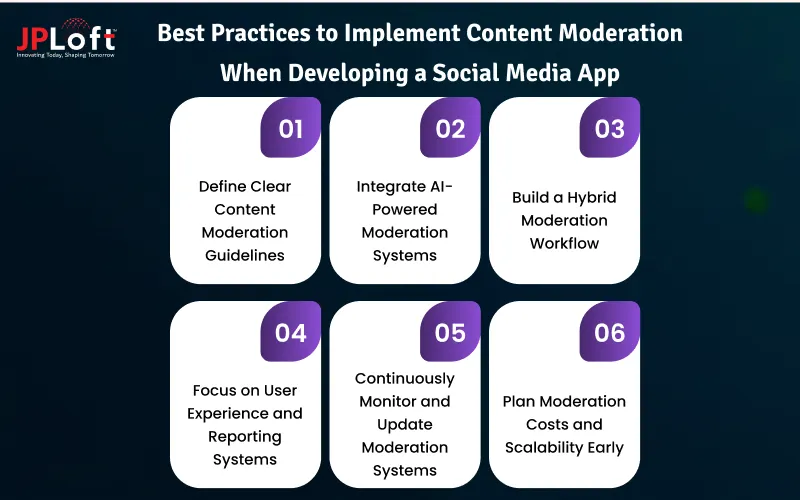
Below are the best practices for implementing effective content moderation on social media apps:
[1] Define Clear Content Moderation Guidelines
Establishing clear and well-defined policies is the foundation of any moderation system. Clear policies help platforms manage expectations, ensure consistency, and support effective moderation of user-generated content across different regions and audiences.
[2] Integrate AI-Powered Moderation Systems
Using AI content moderation tools allows platforms to automate detection and filtering processes at scale. These systems enhance social media app content moderation by identifying harmful content quickly while reducing the burden on manual moderation teams.
[3] Build a Hybrid Moderation Workflow
Combining automation with human review ensures higher accuracy and fairness. This approach strengthens content moderation for social media platforms by addressing both high-volume content and complex, context-sensitive cases effectively.
[4] Focus on User Experience and Reporting Systems
A seamless reporting mechanism empowers users to flag harmful content easily. Investing in intuitive interfaces and UI/UX design services ensures moderation tools are accessible, improving engagement while supporting efficient social media moderation services.
[5] Continuously Monitor and Update Moderation Systems
Moderation is not a one-time implementation. Platforms must regularly evaluate performance, update policies, and refine detection models. This helps maintain strong content moderation best practices and ensures systems evolve with changing content trends.
[6] Plan Moderation Costs and Scalability Early
Budgeting for moderation infrastructure is essential for long-term success. Factors like tools, workforce, and system upgrades directly influence the social media app development cost, making it important to plan scalable moderation strategies from the beginning.
Implementing these best practices ensures scalable, efficient, and reliable moderation systems that support long-term platform success.

How JPLoft Can Help Build Safe Social Platforms with Advanced Content Moderation?
Building a secure and scalable social platform requires the right blend of technology, expertise, and strategy.
As a leading social media app development company, JPLoft specializes in developing platforms with advanced content moderation in social media apps to ensure user safety and compliance.
JPLoft integrates intelligent AI content moderation systems with human-centric workflows to deliver accurate and scalable moderation solutions.
From implementing robust content moderation guidelines to designing seamless reporting mechanisms, the team ensures platforms are equipped to handle real-time challenges effectively.
With a focus on performance, scalability, and user experience, JPLoft helps businesses build platforms that maintain trust, enhance engagement, and ensure long-term success through reliable social media content moderation strategies.
Conclusion
Content moderation is no longer optional; it has become a core requirement for building safe, trustworthy, and scalable social platforms.
From understanding how content moderation works in social media to applying the right tools and strategies, every step directly impacts user experience and platform credibility.
Effective content moderation for social media platforms helps prevent harmful interactions while fostering a positive digital environment.
By combining AI-driven systems with human judgment and continuously refining moderation approaches, businesses can create secure and engaging communities.
Ultimately, strong moderation practices not only protect users but also drive long-term growth and platform success in an increasingly competitive landscape.
FAQs
Content moderation is the process of monitoring, filtering, and managing user-generated content to ensure it follows platform rules. It also involves removing harmful material and maintaining a safe and positive user environment.
Content moderation is important because it protects users from harmful content, builds trust, and ensures compliance with regulations. It also helps platforms maintain a positive brand image and improve overall user experience and engagement.
The main types include pre-moderation, post-moderation, reactive moderation, automated moderation, hybrid moderation, and distributed moderation. Each type offers different levels of control, speed, and scalability depending on platform needs.
Automated content moderation uses machine learning, natural language processing, and image recognition to detect and filter inappropriate content. It helps platforms manage large volumes of data quickly and efficiently with minimal human intervention.
The best approach is a hybrid model that combines AI tools with human review. This ensures faster processing, better accuracy, and improved handling of complex or context-sensitive content across social media platforms.

Conor has more than 10 years of experience in software development, app creation, solution engineering, and UX/UI design. With an impressive track record of high retention and growth working with Fortune 500 companies, he brings the technical depth and strategic perspective needed to help businesses build impactful, user-focused digital solutions.





Share this blog