


Key Takeaways:
Building a CAFU-like app costs $25,000–$100,000+, but real success depends on managing long-term operational expenses effectively.
Your business model choice directly impacts scalability, revenue potential, and the overall development cost of the app.
Starting with an MVP and cross-platform tech can cut costs by up to 60% while speeding up your market launch.
Post-launch costs like hosting, APIs, and marketing often exceed development, making operational planning crucial.
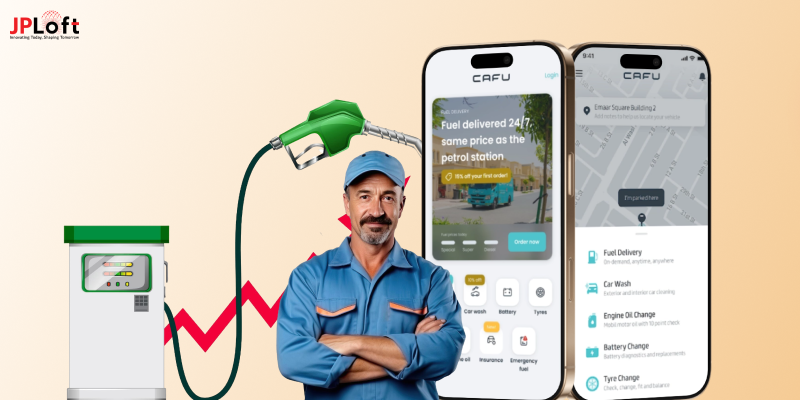
CAFU flipped a 100-year-old habit on its head. The fuel now comes to the car, not the other way around.
Launched in 2026, CAFU now serves millions across Dubai, Abu Dhabi, and beyond. It has raised over $100 million from Softbank Vision Fund.
The company turned a boring chore into a billion-dirham business.
That success has every founder asking the same question. How much does it actually cost to build an app like CAFU in 2026?
The honest answer ranges from $25,000 to $100,000+. The number depends on features, tech stack, and the team you hire.
But the cost is only half the work. Most CAFU clones fail because founders budget for development. They forget to budget for operations.
Let’s explore the guide to CAFU clone app development cost, including business models, cost factors, and tips to reduce spending without cutting corners.
Business Models & Revenue Models of CAFU App
CAFU is not one product. It is four business models stacked on one operations layer. That layering is why it scales. It is also why cloning is expensive.
Here are the four revenue models CAFU runs today:
-
On-Demand Fuel Delivery: Users pay AED 18 per order. Fuel is delivered to the car in under an hour.
-
Subscription Plans: CAFU Go charges AED 26 per month. It includes unlimited overnight deliveries for one vehicle.
-
Car Services Marketplace: Oil change, tyre swap, battery replacement, and car wash. Each service is a separate revenue line.
-
B2B Fleet Services: Corporate fleets pay bulk rates. This is the highest-margin segment CAFU operates.
The UAE has roughly 3.5 million vehicles on the road. Even a small share creates massive revenue potential.
Revenue Models Explained:
Before you build, pick one of these models. Each decides your tech stack and your margins.
► Aggregator Model: You connect users to independent fuel suppliers. You earn a commission on every order. This works best in cities with multiple fuel vendors.
► Dedicated Model: You own the trucks, the fuel supply, and the delivery operation. Higher control. Higher capital requirement. This is the CAFU model.
► Subscription Model: Users pay monthly for unlimited or capped deliveries. Best for corporate fleets and frequent commuters.
The smartest play for 2026 is hybrid. Combine on-demand ordering with a subscription tier. Add car services as the third revenue stream. This stacks three income sources on one app.
Key Factors Affecting the Cost to Build an App Like CAFU
Development cost is not one number. It is the sum of seven variables. Get anyone wrong, and the budget doubles.
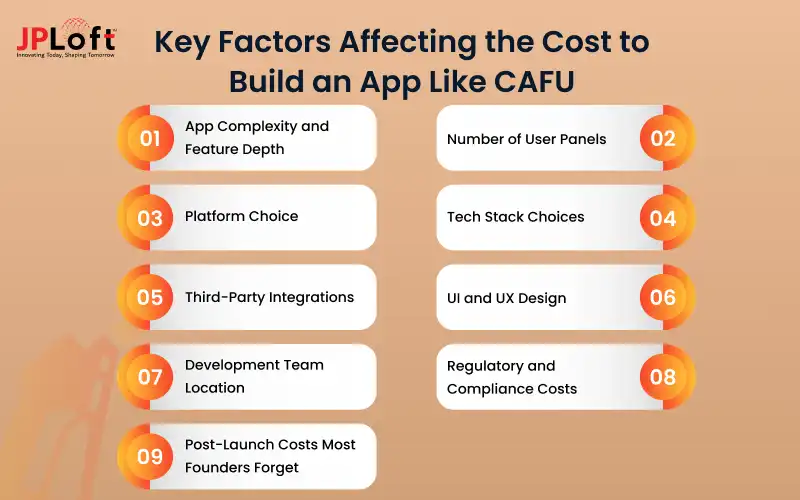
Here are the factors that decide your final cost to develop an app like CAFU:
1. App Complexity and Feature Depth
Features of a fuel delivery app can make or break the success of an app. A basic on-demand fuel delivery app should offer user-friendly features such as scheduling, ordering, tracking, secure payments, and GPS, along with dedicated tools for delivery personnel like dashboards, route navigation, performance tracking, request management, and notifications.
A feature-rich app like CAFU can increase the overall price.
-
Basic MVP: Signup, fuel booking, GPS tracking, and payments.
-
Mid-Level App: Push notifications, driver dashboards, ratings, analytics.
-
Advanced App: AI demand forecasting, IoT integration, dynamic pricing, multi-language.
Pick the tier that matches your market. Do not overbuild for the first year.
2. Number of User Panels
A fuel delivery app is not one app. It is three apps working together.
-
Customer App: Where users order fuel and track deliveries.
-
Driver App: Where pilots receive jobs and manage routes.
-
Admin Panel: Where you manage operations, pricing, and analytics.
Each panel adds development hours. Each panel also adds testing time. Skipping the admin panel to save money is the most common early-stage mistake.
3. Platform Choice
You can build for iOS, Android, or both. But, the thing here is that the cost to create an app like CAFU can increase or decrease as per the platform you are choosing, such as:
-
Single Platform (iOS or Android): Cheapest. Good for testing a market.
-
Cross-Platform (Flutter or React Native): One codebase for both platforms.
-
Native Apps (Swift and Kotlin): Built separately for iOS and Android. Best performance. Highest cost.
For 2026, Flutter or React Native is the smart default. Native only makes sense at enterprise scale.
4. Tech Stack Choices
The tech stack of a fuel delivery app decides performance and scalability. It also decides your long-term costs.
Here is the stack that works for a CAFU-like app:
-
Frontend: Flutter or React Native for mobile. React.js for the admin dashboard.
-
Backend: Node.js or Python with microservices architecture.
-
Database: PostgreSQL for structured data. MongoDB for flexible data.
-
Real-Time Layer: Firebase or Socket.io for live tracking and chat.
-
Maps and Routing: Google Maps API or Mapbox for delivery routes.
-
Payments: Stripe, Razorpay, or PayPal for secure transactions.
-
Cloud Hosting: AWS or Google Cloud for scaling.
-
AI Layer: OpenAI API or fine-tuned models for demand forecasting.
A smart stack saves money over five years. A cheap stack forces a rebuild in 18 months.
5. Third-Party Integrations
Every other integration adds cost to make an app like CAFU, but most are unavoidable.
The essentials for a fuel delivery app include payment gateways, SMS services, push notifications, and mapping APIs.
Identity verification and KYC add another layer. IoT fuel sensors and telematics systems are optional but valuable.
Budget 5 to 15% of your total cost for third-party services. Expect ongoing monthly fees after launch.
6. UI and UX Design
Good design of a fuel delivery app, it’s a retention tool.
A clean, intuitive design costs $5,000 to $15,000. It includes wireframes, prototypes, and user testing. Skipping this phase saves money upfront, but it also kills user retention after launch.
The rule is simple. A pretty app without a clear flow still fails.
7. Development Team Location
Where you hire decides 40% of your final CAFU app development cost.
Here are the average hourly rates for 2026:
-
North America (US, Canada): $100 to $200 per hour.
-
Western Europe (UK, Germany): $80 to $150 per hour.
-
Eastern Europe (Ukraine, Poland): $40 to $70 per hour.
-
South Asia: $25 to $50 per hour.
-
Middle East: $50 to $90 per hour.
Quality varies inside every region; the cheapest quote is rarely the best outcome.
The smartest play is hiring a mobile app development firm with strong on-demand app experience.
8. Regulatory and Compliance Costs
Fuel delivery is regulated; every market has different rules. Skipping compliance early means rebuilding the entire operation under legal pressure later.
Budget for fire safety permits, transport licenses, environmental approvals, and insurance. These can add $10,000 to $30,000+ before you launch. They also add ongoing annual costs.
Ignoring compliance in a fuel delivery app is the fastest way to get shut down.
9. Post-Launch Costs Most Founders Forget
This is the number nobody publishes. It also bankrupts more fuel apps than any other factor.
Plan for these monthly recurring expenses:
-
Cloud hosting and servers: $500 to $5,000 per month.
-
Third-party API fees: $1,000 to $3,000 per month.
-
Bug fixes and updates: 15 to 20% of development cost annually.
-
Customer support: $2,000 to $10,000 per month.
-
Marketing and user acquisition: $5,000 to $50,000 per month.
Build cost is a one-time hit. Operations cost is what actually runs the business.
How to Reduce CAFU-Like App Development Cost?
Cutting costs is not about cutting quality. It is about sequencing smart decisions. Here are the proven ways to reduce your CAFU like app development cost without hurting the product:
►Start With an MVP, Not a Full Product
Build some core features and launch an MVP.
Functionalities such as Signup, fuel ordering, real-time tracking, payment,s and ratings. Everything else waits for another version.
This approach cuts initial development by 40% to 60%. It also gets you to market in 12 to 16 weeks.
►Pick Cross-Platform Over Native
Flutter or React Native can cut your application development cost nearly in half without hurting performance.
One codebase runs smoothly on both iOS and Android, which means one team builds it and one QA cycle tests it.
That single decision saves months of time and thousands of dollars in engineering hours.
►Use Ready-Made APIs
Do not build maps from scratch, and do not waste months coding a payment gateway from scratch.
Use proven APIs like Google Maps, Stripe, Firebase, and Twilio to handle the heavy lifting for you. These tools save months of development time and thousands in engineering costs.
They also come with built-in compliance, security, and global scalability out of the box. Smart founders integrate.
►Outsource to the Right Region
Hiring an app development company in San Francisco costs four times more than hiring in Asia. The quality gap is smaller than the price gap suggests.
The smart move is finding a team in the Philippines, Eastern Europe, or the UAE. Look for experience in on-demand apps specifically. Fuel delivery logic is not a generic app work.
►Use Agile Development Sprints
Build in two-week sprints instead of locking yourself into a rigid six-month waterfall plan.
Each sprint ships a small working feature and collects real user feedback before the next cycle begins. This avoids expensive rework and keeps the scope tight as priorities shift.
The numbers back it up. Waterfall projects go over budget 70% of the time, while agile projects stay on track nearly 80% of the time. So, this truly helps you to reduce the overall cost to develop a fuel delivery app like CAFU.
►Use White-Label Solutions for Early Validation
A white-label fuel delivery app ships in 4 to 8 weeks without heavy investment.
Use it as a low-risk way to test real market demand before committing to the full cost to build an app like CAFU.
Collect user data, measure retention, and prove the business model actually works. Once the numbers justify it, invest confidently in a fully custom build.
How JPLoft Can Help You Make an App Like CAFU?
With 15+ years in the industry, JPLoft has shipped over 1,100 projects globally. The team operates from Denver, with offices in the UK, India, Australia, and Saudi Arabia.
That global setup gives clients the best of two worlds. You get US-level project management. You also get cost-efficient engineering teams.
What JPLoft Brings to a Fuel Delivery Build
-
On-Demand App Expertise: The team has shipped apps in food delivery, healthcare, logistics, and transportation. The patterns translate directly to fuel delivery.
-
AI and IoT Integration: Smart matching, demand forecasting, and fleet sensors are built in from Day One. Not bolted on later.
-
Flutter and Native Development: You choose the platform. JPLoft builds it right the first time.
-
End-to-End Delivery: Strategy, UI and UX, development, QA, launch, and maintenance. All under one roof.
-
Transparent Pricing: No hidden fees. Clear sprint budgets. Fixed-price or dedicated-team models.
Clients JPLoft Has Worked With
The client list includes 2U Fuel, Juiced Fuel, and Stay Fueled. JPLoft is a leading provider of fuel delivery app development services, known for on-time delivery and quality work.
98% of JPLoft's clients return for more work. That number alone tells the story.
If you want to build a CAFU-like app without burning a million dollars, JPLoft is worth a conversation. The team offers free consultations. You can discuss scope, cost, and timeline in the same call.
Conclusion
Launching an app like CAFU is not cheap, but it is far from impossibly expensive.
The smartest founders win by focusing on what actually matters. They pick the right business model, build an MVP with five features instead of fifty, and launch in one city before scaling outward.
The ones who fail do the opposite and burn through their runway before finding product-market fit.
The on-demand fuel market will cross $5 billion by the end of 2026. The only real question is whether you will build smart enough to become one of its winners.
FAQs
CAFU is an on-demand fuel delivery app that allows users to order fuel directly to their location, eliminating the need to visit petrol stations.
The cost to develop an app like CAFU typically ranges between $25,000 to $100,000+, depending on features, integrations, platform choice, and overall app complexity.
Launching an app like CAFU usually takes around 3 to 6 months, depending on feature complexity, development approach, testing cycles, and deployment readiness.
A CAFU-like app should include user registration, fuel ordering, real-time tracking, secure payments, scheduling, notifications, an admin dashboard, and delivery management for smooth operations.
Investing in a CAFU-like app can be profitable due to increasing demand for convenience, recurring usage, scalable business models, and opportunities in untapped markets globally.

Savannah Bustos is a technology professional with experience across financial platforms, mobility solutions, and on-demand digital products. Her areas of expertise include FinTech, digital banking, eWallets, lending, BNPL, stock trading, fuel delivery, and taxi-booking platforms. She combines a strong understanding of business requirements with practical technology insight, helping companies evaluate challenges, define product needs, and make informed decisions about scalable digital solutions.



Share this blog