


Key Takeaways
AI stock prediction apps use machine learning, predictive analytics, and market data to forecast potential stock price movements.
Key features of AI stock prediction software include real-time market data integration, sentiment analysis, algorithmic trading, and portfolio management tools.
The process to build an AI stock prediction app involves data collection, feature engineering, AI model training, UI development, API integration, and testing.
The cost to build an AI stock prediction app typically ranges from $15,000 to $250,000+, depending on complexity, AI models, and integrations.
Challenges such as market volatility, data quality, model accuracy, and security impacts on development can be addressed with advanced AI models and scalable infrastructure.
Businesses investing in AI-powered trading apps can benefit from growing fintech demand and the rapid expansion of AI-driven financial technologies.
Stock investing has become one of the most popular ways for individuals and modern investors to grow their wealth.
Reports suggest that over 62% of Americans actively participate in the stock market, reflecting the rapid growth of digital trading platforms and retail investing.
However, one major challenge investors face is the uncertainty and volatility of the stock market, where prices fluctuate due to economic conditions, company performance, and global events.
This is where artificial intelligence (AI) is transforming the trading landscape. AI-powered systems can analyze large volumes of historical and real-time market data, identify hidden patterns, and forecast potential stock price movements.
These insights help investors make more informed and data-driven investment decisions. The growing demand for intelligent trading tools also creates opportunities for businesses to make an AI stock prediction app.
The development process typically involves defining platform goals, collecting and processing financial data, training AI models, designing the app interface, and testing and launching the platform for users.
In this blog, we will explore how to build an AI stock prediction app along with the key features, development process, costs, and associated challenges.
What is an AI Stock Prediction Software/App & How It Works?
An AI software to predict stock market can be defined as a digital tool powered by advanced tech. These technologies include artificial intelligence, machine learning, and predictive analytics to analyze market data and forecast potential stock price movements.
Unlike traditional trading tools that rely primarily on manual research and static indicators, AI-driven systems aim to automate the entire process.
An AI stock prediction website app continuously processes large volumes of financial data, identifies hidden patterns, and generates predictive insights that help investors make more informed trading decisions.
By transforming massive datasets into actionable insights, AI prediction software enables traders and financial institutions to reduce research time and improve decision-making accuracy.
How the AI Stock Market Prediction App Works?
Now, let’s focus on how the best AI stock prediction software works:
-
Data Collection: AI tools gather historical prices, trading volumes, financial reports, and market data.
-
Data Processing: The collected data is then cleaned and structured into raw data for accurate analysis.
-
Feature Engineering: Converts data into indicators like moving averages and volatility signals.
-
Model Training: Machine learning models learn patterns from historical market data.
-
Predictive Analysis: AI analyzes real-time data to forecast stock price trends.
-
Sentiment Analysis: NLP evaluates news, reports, and social media sentiment.
-
Trading Signals: Generates buy, sell, or hold recommendations.
-
Automated Execution: Advanced systems automatically execute trades using AI insights.
Key Market Insights Justifying The Current Need for an AI Stock Trading App
Here are some of the key stats that justify why focusing on an AI app for stock market prediction in 2026 is an intelligent choice.
-
The global AI trading platform market is expected to reach $33.45 billion by 2030, growing at a 20% CAGR.
-
Algorithmic trading, which heavily relies on AI and machine learning, is projected to reach $28.44 billion by 2030, showing strong growth in automated trading strategies.
-
Studies show that AI-powered algorithms now influence nearly 89% of global trading volume, demonstrating how AI has become central to modern stock market operations.
-
The AI agents in the financial services market are projected to grow from $691 million in 2025 to $6.7 billion by 2033, highlighting increasing automation in investment analysis and financial decision-making.
-
Last but not least, the global AI market is expected to reach $2.48 trillion by 2034, reflecting the massive expansion of AI technologies across industries, including fintech.
These data indicate why there is a need to plan for an advanced AI stock prediction app and market to grab the next business opportunity.
Benefits of Investing in an AI App to Predict Stock Market
For entrepreneurs focusing on how to build an AI stock prediction app, understanding the potential benefits associated with it is important.
As financial markets become increasingly complex, AI in stock trading is helping more traders and investors make faster and more informed decisions while improving overall trading efficiency.
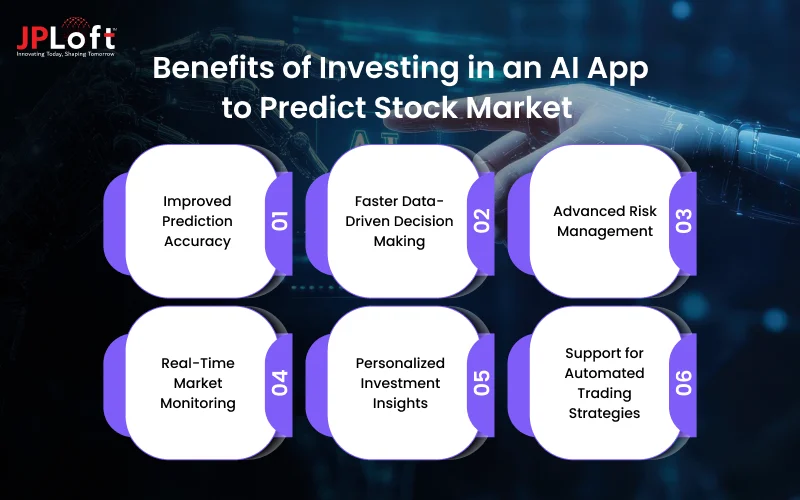
Here are some of the key benefits of investing in building the best AI app for stock prediction:
1. Improved Prediction Accuracy
AI-powered trading and prediction platforms analyze vast datasets, including historical prices, trading patterns, and market indicators, to identify hidden trends. This ensures more accurate forecasting of stock movements compared to traditional analysis methods.
2. Faster Data-Driven Decision Making
Artificial intelligence can process massive volumes of financial data within seconds. This allows investors and traders to receive real-time insights and make quick trading decisions based on data rather than speculation.
3. Advanced Risk Management
These advanced tech-powered stock trading platforms can analyze market volatility, historical performance, and portfolio exposure to detect potential risks. This helps traders adjust strategies and reduce potential financial losses.
4. Real-Time Market Monitoring
AI tools constantly track stock market movements, economic indicators, and trading activity, even when the investor is offline. Such helps the platform to provide real-time alerts and predictive signals, enabling investors to react quickly to market changes.
5. Personalized Investment Insights
AI algorithms analyze user behavior, investment preferences, and trading patterns to deliver customized stock recommendations. This enhances user experience and improves portfolio management strategies.
6. Support for Automated Trading Strategies
Many AI prediction platforms integrate with algorithmic trading systems that automatically execute trades based on predictive insights and predefined strategies, improving efficiency and reducing manual effort.
Essential Features of an AI Stock Market Prediction Software
To build an AI stock market prediction app, businesses must integrate advanced analytics, intelligent forecasting models, and user-focused trading tools.
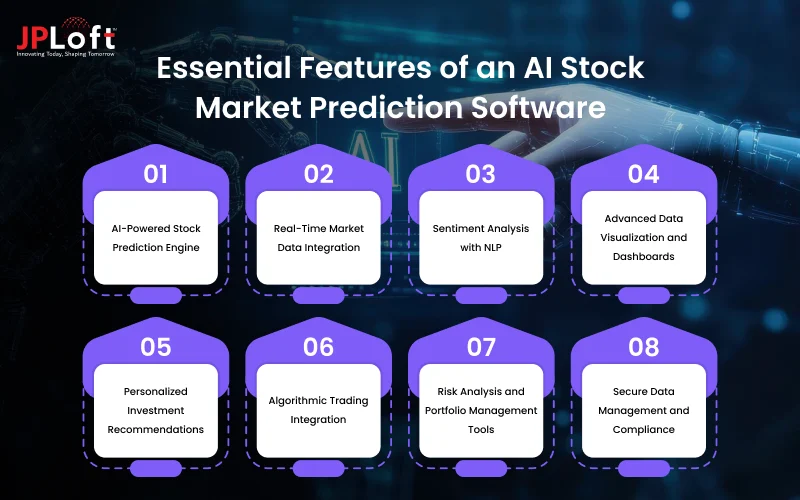
Here are some of the key features of a stock trading app powered by AI for market prediction. These features further play a critical role in ensuring a better user experience and app performance in the uncertain marketplace.
[1] AI-Powered Stock Prediction Engine
The core of an AI stock prediction platform is that it should include machine learning models capable of analyzing historical and real-time market data.
These models identify patterns and generate predictions about potential stock price movements and market trends.
[2] Real-Time Market Data Integration
Another feature to consider is that the AI stock price prediction app must connect with stock exchanges and financial data providers to gather live market updates.
Real-time price feeds, trading volumes, and market indicators ensure that predictions and insights remain accurate and timely.
[3] Sentiment Analysis with NLP
The advanced AI software to predict stock market should analyze financial news, earnings reports, and social media discussions using natural language processing.
Such a feature can be integrated with the help of an expert NLP development company, which can help detect market sentiment that may influence stock prices.
[4] Advanced Data Visualization and Dashboards
When planning to make an AI stock market prediction software, ensure that it has Interactive dashboards, charts, and analytics tools. These tools help users understand market trends and predictions more clearly.
Integrating tools providing visual insights improves decision-making by presenting complex data in an easy-to-understand format.
[5] Personalized Investment Recommendations
To ensure the success of the AI app for stock prediction, ensure that it has AI algorithms that can analyze user behavior, portfolio preferences, and trading patterns to generate personalized stock suggestions.
These stock suggestions in your app help investors align their trading decisions with their financial goals.
[6] Algorithmic Trading Integration
An innovative and advanced feature that should be planned if building an AI stock prediction app is algorithmic trading integration.
The platform should support automated trading strategies where AI-generated signals trigger trade execution. This allows users to implement data-driven trading strategies with minimal manual intervention.
[7] Risk Analysis and Portfolio Management Tools
AI stock prediction platforms integrate AI-powered risk assessment tools to help investors evaluate portfolio performance and potential exposure to market volatility.
These tools enable investors to ensure smarter asset allocation and focus on portfolio diversification strategies.
[8] Secure Data Management and Compliance
The integration of AI tools for stock prediction should not compromise the user data and ensure the security level.
Stock prediction platforms must ensure strong mobile app security through encryption, secure APIs, and compliance with financial regulations. This protects sensitive financial data and maintains trust among users.
Partnering with an expert mobile app development company can help make an AI stock prediction app with these advanced features. In the next section, we will discuss the step-by-step development process in detail.
Step-by-Step Process of Building an AI Stock Prediction App
The simplest answer to how to create an AI stock prediction app is that it requires a structured approach that combines financial data analysis, machine learning technologies, and scalable software infrastructure.
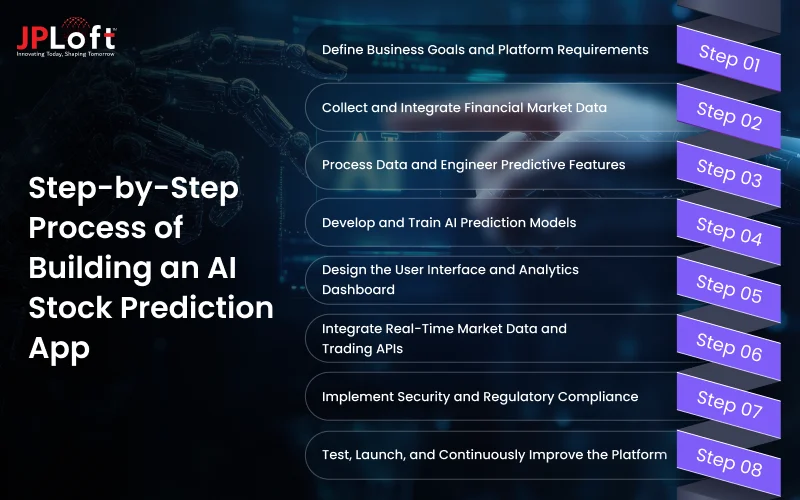
Each stage of the development process focuses on building accurate prediction capabilities while ensuring a smooth user experience and secure trading environment.
Step 1: Define Business Goals and Platform Requirements
The first step is to clearly define the purpose of the AI stock prediction app and identify the target users.
The entrepreneurs must determine whether their plan to build a stock trading app with AI capabilities will focus on predictive insights, automated trading, portfolio management, or comprehensive investment analysis.
At this stage, the development team outlines the core features of the AI prediction app, identifies user needs, and analyzes competing platforms. This helps create a clear development roadmap and ensures the platform delivers meaningful value to traders and investors.
Step 2: Collect and Integrate Financial Market Data
The next step is to plan for datasets that the AI systems will utilise to generate real-time responses.
AI prediction systems rely on large datasets to generate accurate insights. Hence, it is important that developers integrate reliable financial data sources that provide historical market data, company financial reports, trading volumes, and macroeconomic indicators.
This step also includes connecting with real-time market data providers and financial APIs. Access to high-quality data ensures that the AI models can analyze market behavior effectively and generate meaningful predictions.
Step 3: Process Data and Engineer Predictive Features
Once the datasets have been finalised, the next step to make an AI stock prediction app is to process the data and plan for key features to be incorporated in the platform.
Raw financial data must be cleaned and prepared before it can be used for machine learning. Data preprocessing removes inconsistencies, fills missing values, and converts the dataset into a structured format suitable for analysis.
During feature engineering, developers create technical indicators such as moving averages, volatility metrics, and momentum signals. These indicators help AI models detect patterns and improve the accuracy of stock price predictions.
Step 4: Develop and Train AI Prediction Models
Once the dataset is prepared, machine learning models are developed and trained to analyze financial trends and forecast potential stock price movements.
Different algorithms, such as regression models, decision trees, and deep learning networks, may be used depending on the complexity of predictions.
The models are trained using historical stock market data and optimized through testing and validation techniques. Continuous model refinement ensures that predictions become more accurate as the system processes more market data.
Step 5: Design the User Interface and Analytics Dashboard
An intuitive user interface is essential for delivering complex financial insights in a clear and accessible way. Hence, it is recommended that you look for experienced UI/UX design services that can help with preparing an engaging UI/UX.
The AI stock prediction app or website should have interactive dashboards, stock charts, and prediction visualizations that help users understand market trends.
The interface also includes features such as portfolio tracking, real-time alerts, and market insights. A well-designed interface improves user engagement and enables investors to act quickly on AI-generated predictions.
Step 6: Integrate Real-Time Market Data and Trading APIs
The next step is to integrate the AI systems with the real-time systems so that the AI stock price prediction app can provide accurate predictions and up-to-date insights.
The entrepreneurs should hire dedicated developers to integrate financial APIs that can enable the platform to access live stock prices, trading activity, and market updates.
Many AI stock prediction platforms also integrate with trading APIs that allow users to execute trades directly from the app. This integration creates a seamless experience where investors can analyze predictions and act on them instantly.
Step 7: Implement Security and Regulatory Compliance
Integrating AI systems with real-time trading platforms can bring convenience and an improved experience for the users. But along with several security and regulatory compliance challenges needs to be considered.
The best AI app for stock prediction must have strong encryption protocols, secure authentication methods, and safe data storage systems.
In addition, the platform must follow financial regulations and data protection standards. Compliance with industry regulations helps build user trust and ensures the platform operates legally within financial markets.
Step 8: Test, Launch, and Continuously Improve the Platform
Before launching the AI app for stock market prediction, it is important to conduct a comprehensive app testing to evaluate performance, prediction accuracy, and system security.
The experienced developers conduct model validation, performance testing, and usability testing to ensure the platform functions reliably.
After testing, the prediction app is deployed in real-time scenarios, so that it can provide relevant insights, and accordingly, the investment decisions can be made.
Post deployment, the AI models continue to learn from new market data. Regular updates, model retraining, and feature improvements help maintain prediction accuracy and keep the platform aligned with evolving financial market trends.
Cost To Build an AI App For Stock Prediction
Along with focusing on how to make an AI stock prediction app, it is equally important to focus on the cost to develop an AI app.
The average cost to create an AI stock prediction app ranges anywhere from $15,000 to $250,000. Also, the final budget can vary and can even exceed, depending on the complexity of the platform, the sophistication of AI models, data integrations, and security requirements.
|
App Complexity |
Features Included |
Estimated Cost |
|
Basic MVP |
Basic stock prediction model, user login, watchlist, simple dashboards |
$15,000 – $40,000 |
|
Mid-Level App |
Real-time market data integration, AI analytics, alerts, portfolio tracking |
$40,000 – $120,000 |
|
Advanced Platform |
Deep learning models, sentiment analysis, algorithmic trading, and advanced dashboards |
$120,000 – $250,000 |
Key Factors That Influence Development Cost
Let’s focus on some of the key factors impacting the AI stock market prediction app development cost.
► AI Model Development
Advanced machine learning models such as deep learning networks or time-series forecasting models require additional data engineering, model training, and testing, which increases development costs.
► Financial Data APIs and Integrations
AI prediction apps depend on multiple financial data sources such as stock exchanges, market data providers, and news feeds. Integrating these APIs adds to both development time and operational costs.
► Platform Type and Technology Stack
Developing native apps for both iOS and Android, along with a web platform, increases the overall cost. Cross-platform frameworks may reduce development expenses but still require optimization for performance.
► Security and Compliance Requirements
An AI app to predict stock market must implement encryption, multi-factor authentication, secure payment gateways, and regulatory compliance systems, which increase the overall development budget.
► UI/UX and Data Visualization
Interactive dashboards, predictive charts, and analytics visualizations require specialized front-end development and a team of experts, which increases the cost to build an AI software to predict stock market.
► Cost of Developer
Another factor impacting the total budget is the cost to hire AI developers for the project. An AI expert with hands-on experience on such a project will charge more than a fresher or a developer with limited experience.
Best AI Stock Prediction App Examples
Let’s focus on some of the best AI apps for stock prediction that support the successful integration of AI in stock prediction apps.
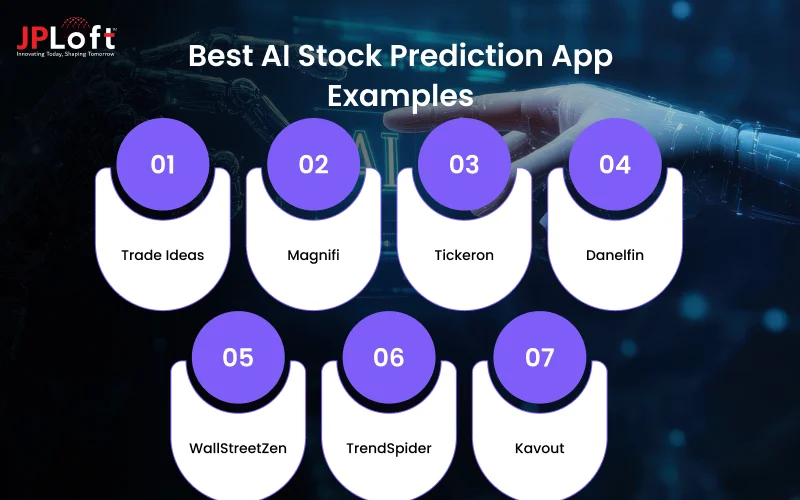
These apps use machine learning, data analytics, and algorithmic models to analyze market trends, identify patterns, and generate investment insights. Focusing on these apps’ algorithms and workings can help better decide how to make an AI stock prediction app.
1. Trade Ideas
Trade Ideas is one of the most advanced AI-powered stock trading platforms that uses ML algorithms and an AI assistant called Holly to scan the market in real time and generate trading signals. The platform analyzes thousands of stocks and provides actionable insights, entry points, and exit strategies for traders.
2. Magnifi
Magnifi is an AI-driven investing platform that acts like a financial search engine. Investors can ask questions in natural language, and the platform analyzes portfolios, ETFs, and stocks to provide investment recommendations.
3. Tickeron
Tickeron provides AI-powered stock forecasts using pattern-recognition algorithms and automated trading bots. Its AI systems continuously scan charts and market signals to identify potential breakout patterns and predict stock price movements.
4. Danelfin
Danelfin is a data-driven AI stock analytics platform that evaluates thousands of U.S. stocks and ETFs using multiple indicators. The system generates predictive scores that estimate the probability of a stock outperforming the market in the coming months.
5. WallStreetZen
WallStreetZen offers AI-powered stock analysis through its Zen Ratings system. It analyzes various financial and technical factors to provide investors with simplified ratings and insights for better investment decisions.
6. TrendSpider
TrendSpider is an AI-based technical analysis platform widely used by traders for automated chart analysis. The platform automatically detects patterns, trend lines, and support or resistance levels, helping investors identify trading opportunities faster.
7. Kavout
Kavout uses deep learning algorithms to evaluate stocks and generate a K-Score, which predicts the probability of a stock outperforming the market. It analyzes large datasets, including fundamentals, market sentiment, and technical indicators.
Challenges in Developing an AI Stock Prediction App
Building an AI-powered stock prediction app requires advanced data processing, machine learning models, and real-time financial analysis.
Developers often encounter technical, data-related, and operational challenges while creating reliable prediction systems.
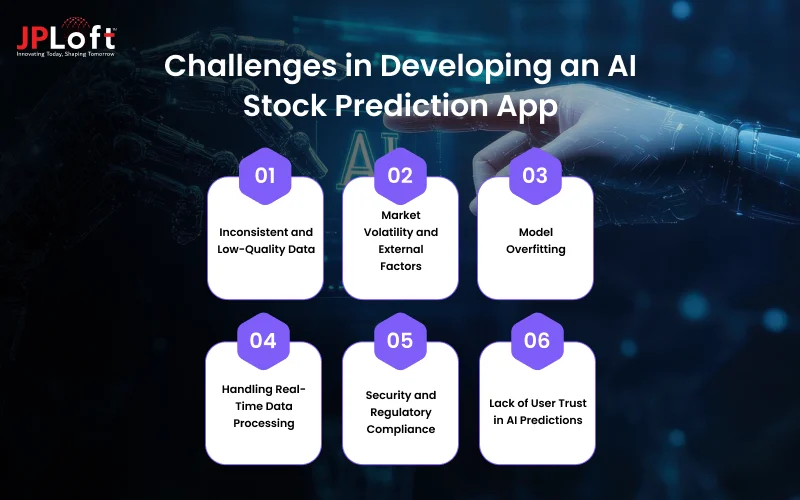
Below are some key challenges and their solutions.
Challenge 1: Inconsistent and Low-Quality Data
AI models depend heavily on financial data such as historical stock prices, market indicators, and trading volumes. Hence, in such a scenario, incomplete, inconsistent, or outdated datasets can significantly impact prediction accuracy.
Solution: To overcome such challenges, it is important to develop robust data pipelines that clean, normalize, and validate datasets before model training. Integrating multiple data sources, such as market feeds, financial reports, and sentiment data, can also improve data reliability and model performance.
Challenge 2: Market Volatility and External Factors
Stock markets are highly dynamic and influenced by economic news, geopolitical events, and investor sentiment. These unpredictable factors make accurate forecasting extremely challenging. Even with AI platforms, predicting the stock market becomes challenging.
Solution: Combine multiple analytical approaches such as technical indicators, sentiment analysis, and macroeconomic data. Advanced machine learning development services and ensemble techniques can help capture complex market patterns.
Challenge 3: Model Overfitting
The performance of the AI models depends mainly on how they are being trained. Hence, an AI model that has been trained extensively on historical market data may perform well during testing but fail to adapt to new or changing market conditions.
Solution: Hire mobile app developers who can use cross-validation techniques, regularization methods, and diverse training datasets. Continuous retraining with updated market data helps maintain model accuracy and adaptability.
Challenge 4: Handling Real-Time Data Processing
Another potential challenge with the AI stock price prediction app is ensuring that it can process large volumes of market data in real time to generate timely insights and trading signals.
Also, the market can be highly volatile in certain scenarios, and hence, performing seamlessly in such scenarios is a key challenge.
Solution: Implement scalable cloud infrastructure and distributed data processing frameworks. Technologies such as stream processing and real-time analytics platforms can ensure efficient handling of high-frequency market data.
Challenge 5: Security and Regulatory Compliance
Financial applications handle highly sensitive data and hence must comply with strict security standards and regulatory guidelines. Further, when exposed to an open environment through AI integration, the security challenges worsen.
Solution: Partner with an expert AI development company to implement strong security practices such as data encryption, secure APIs, and compliance frameworks aligned with financial regulations. Regular audits and monitoring can also help maintain compliance.
Challenge 6: Lack of User Trust in AI Predictions
AI can better evaluate and provide real-time insights from the stock market. But making users trust the responses provided by the AI is the key challenge. Also, if the users don’t understand how the system produces recommendations, they will still be hesitant about the AI responses.
Solution: Integrate explainable AI features that show prediction confidence levels, key influencing factors, and supporting analytics. Providing transparent insights can help build user trust and improve adoption.
Why Choose JPLoft To Build an AI Stock Prediction App?
An AI-powered stock prediction app is not like any other app, with key features integrated into a platform and made available to users. Developing an AI stock market prediction app requires the developers to deal with the stock market complications, along with implementing the AI expertise.
Hence, partnering with an expert stock trading app development company like JPLoft can help you bring your vision of an AI stock prediction app to reality.
We bring strong experience in developing advanced fintech applications that combine ML models, real-time market data integration, and intelligent analytics to deliver accurate stock prediction capabilities.
At JPLoft, we follow a structured development approach that includes AI model development, secure API integrations, intuitive user interface design, and scalable cloud infrastructure.
This ensures that the platform can process large financial datasets, deliver real-time insights, and support high trading activity without performance issues.
From strategy and development to deployment and ongoing optimization, JPLoft offers end-to-end support for businesses looking to launch AI-powered stock prediction platforms.
With a focus on security, reliability, and innovation, the company helps businesses build intelligent trading solutions that can adapt to evolving financial market trends.
Conclusion
AI is rapidly transforming how investors analyze financial markets and make trading decisions.
By leveraging machine learning, predictive analytics, and real-time data processing, AI prediction apps enable more accurate market forecasting, faster decision-making, and improved risk management.
These platforms are becoming an essential component of modern fintech ecosystems, helping traders and financial institutions gain deeper insights into market behavior.
For businesses, developing an AI stock prediction app presents a strong opportunity to enter the growing AI-driven trading technology market.
The development process includes focusing on key goals, reliable data integration, training, and deploying the AI model with a scalable infrastructure. Companies can build powerful platforms that deliver intelligent investment insights and enhanced trading experiences.
Partnering with an experienced development company like JPLoft ensures that businesses can build secure, high-performance AI stock prediction platforms tailored to evolving market demands and user expectations.
FAQs
An AI stock price prediction app is a fintech platform that uses artificial intelligence and machine learning algorithms to analyze historical and real-time market data. It identifies patterns, predicts potential stock price movements, and provides trading insights to help investors make informed decisions
AI predicts stock market trends by analyzing large datasets such as historical prices, trading volumes, financial reports, and market sentiment. Machine learning models detect patterns in this data and generate forecasts about possible stock price movements and market behavior.
AI-powered stock prediction apps typically use technologies such as machine learning, deep learning, natural language processing (NLP), big data analytics, and cloud computing. They also integrate financial APIs to access real-time stock market data and trading systems.
The cost of building an AI stock prediction app ranges anywhere from $15,000 to $250,000. The cost can exceed the range depending on factors such as feature complexity, AI model development, data integration, and platform type (web or mobile).
Key features include AI-powered stock prediction models, real-time market data integration, sentiment analysis, advanced data visualization dashboards, personalized investment insights, portfolio management tools, and algorithmic trading integration.

Savannah is a passionate tech enthusiast with a sharp understanding of client needs across diverse digital domains. With expertise spanning financial platforms, on-demand solutions, and emerging technologies, she brings a unique blend of analytical insight and interpersonal skills, helping businesses decode complexities and make informed decisions in today's rapidly evolving digital world.



Share this blog