



Key Takeaways:
The cost to develop a mobile app in Denver typically ranges from $20,000 to $220,000+, depending on complexity and features.
App complexity, platform choice, integrations, and design quality significantly influence the overall mobile app development cost in Denver.
Hidden costs such as maintenance, updates, security, and third-party services can increase the total cost of developing an app in Denver.
Hiring models matters. Local Denver agencies offer better collaboration, while offshore teams may reduce upfront development costs.
Launching an MVP, prioritizing essential features, and choosing the right tech stack can help startups control development budgets.
JPLoft helps Denver businesses build scalable, high-performance apps with strategic guidance, transparent pricing, and long-term product support.
Denver has rapidly emerged as a thriving hub for technology and innovation, attracting startups, entrepreneurs, and established companies alike.
As businesses look to expand their digital presence, mobile applications have become an essential tool for growth and customer engagement.
However, one of the first questions on every founder’s mind is: How much does it cost to develop an app in Denver?
Typically, prices range from $20,000 to $220,000+, depending on app complexity, features, and design requirements.
Understanding these costs is crucial for budgeting, planning features, and choosing the right development partner.
This blog dives deep into the Denver app market, breaking down cost factors, complexity levels, hidden charges, and practical tips to help businesses make informed decisions without overspending.
Denver App Market Overview
Denver has rapidly become one of the most dynamic technology ecosystems in the United States.
With strong venture capital activity, a growing startup culture, and access to skilled tech talent, the city continues to attract entrepreneurs building digital products.
For businesses planning a mobile application, understanding how much does it cost to create an app in Denver, requires looking beyond development hours and considering the broader market environment.
A thriving tech ecosystem directly impacts development pricing because demand for experienced engineers, designers, and product strategists continues to rise.
Key Market Insights
The following data stats and insights highlight Denver’s rapidly expanding startup ecosystem, strong tech workforce, and rising investment activity.
-
Denver hosts 1,500+ startups, making it one of the fastest-growing startup ecosystems in North America.
-
The region’s tech workforce is expected to surpass 160,000 professionals by 2027, highlighting strong demand for software development talent.
-
Denver startups collectively attract over $1.8–$3.9 billion in venture capital funding annually, accelerating digital product innovation.
Because of this momentum, many entrepreneurs first explore top startup ideas in Denver before launching their own platforms.
However, a competitive ecosystem also increases hiring demand, which directly influences the cost of mobile app development Denver and overall product investment.
For founders validating the best mobile app ideas, understanding Denver’s tech landscape helps estimate realistic budgets, prioritize features, and plan scalable development strategies from the start.

How Much Does it Cost to Develop A Mobile App in Denver?
One of the most common questions founders ask is: How much does it cost to develop an app in Denver? The answer depends on several factors, including app complexity, design requirements, integrations, and the development team you hire. On average, the cost to create a mobile app in Denver ranges between $20,000 and $220,000+.
Startups building an MVP may spend significantly less, while enterprise-level platforms with advanced features such as AI integrations, real-time analytics, or large user ecosystems require larger investments.
Businesses planning to develop a mobile app should also account for design, backend infrastructure, testing, and ongoing maintenance.
To provide a clearer picture, here’s a typical pricing breakdown for app costs in Denver based on project complexity.
|
App Type |
Estimated Cost Range |
Development Timeline |
|
Basic App (Simple features, minimal UI) |
$20,000 – $50,000 |
2 – 3 months |
|
Standard App (APIs, authentication, dashboards) |
$50,000 – $120,000 |
3 – 6 months |
|
Advanced App (real-time features, integrations) |
$120,000 – $180,000 |
6 – 9 months |
|
Enterprise-Level App (AI, complex architecture) |
$180,000 – $220,000+ |
9 – 12+ months |
These estimates represent the typical range of mobile app development costs businesses encounter when working with experienced development teams in Denver.
However, the exact cost to build an app in Denver depends heavily on the feature set, technology stack, and development strategy chosen for the project.
Cost Ranges by App Complexity
The biggest factor influencing the cost to develop a mobile app in Denver is the level of complexity involved in the product.
A simple MVP with limited functionality requires fewer development hours, while enterprise-grade applications demand advanced architecture, integrations, and security frameworks.
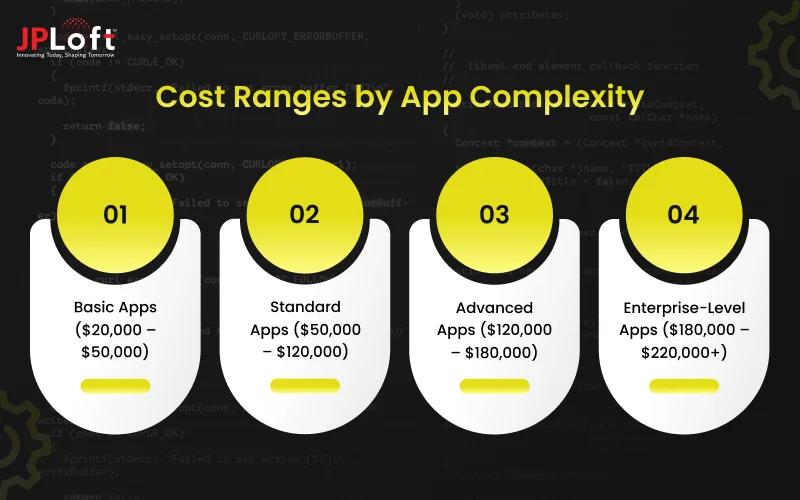
For businesses asking how much does it cost to build an app in Denver, understanding these complexity levels helps set realistic expectations for budget and development timelines.
1. Basic Apps ($20,000 – $50,000)
Basic apps are typically designed for startups or businesses testing an idea with a Minimum Viable Product (MVP). These applications include simple functionality and limited integrations.
Common features include:
-
User login and authentication
-
Basic navigation and UI
-
Simple backend database
-
Push notifications
Because these apps are relatively lightweight, the app development cost Denver remains lower.
However, the final price can still vary depending on the mobile app tech stack chosen for the project, as technologies such as Flutter, React Native, or native development affect both performance and development hours.
2. Standard Apps ($50,000 – $120,000)
Standard applications include more interactive features and integrations that improve the user experience. At this stage, businesses begin focusing more heavily on product scalability and usability.
Typical features include:
-
API integrations
-
User dashboards
-
In-app payments
-
Analytics and reporting tools
-
Cloud-based backend infrastructure
These projects often involve additional UI/UX work, which increases development time. As a result, the mobile app development cost in Denver increases due to expanded development scope and infrastructure requirements.
3. Advanced Apps ($120,000 – $180,000)
Advanced applications support larger user bases and include real-time functionality. Businesses investing in these apps usually aim to launch competitive digital products within established markets.
Advanced features often include:
-
Real-time messaging or tracking
-
AI-driven recommendations
-
Third-party integrations (payment gateways, CRM tools)
-
Advanced security and data encryption
At this stage, product success heavily depends on intuitive mobile app design, because a well-designed interface directly influences user engagement, retention, and overall app performance.
4. Enterprise-Level Apps ($180,000 – $220,000+)
Enterprise apps represent the most complex category. These platforms often support large-scale operations, multiple user roles, and extensive backend infrastructure.
Enterprise apps commonly include:
-
AI and machine learning features
-
Enterprise integrations (ERP, CRM systems)
-
Advanced analytics dashboards
-
High-level data security and compliance
Because of the complexity involved, the cost of mobile app development Denver can exceed $200,000 for large-scale digital platforms.
Understanding these complexity tiers helps businesses estimate the development investment and choose the right product strategy.
Key Factors That Affect App Development Costs in Denver
When businesses evaluate how much does it cost to create an app in Denver, the answer depends on several technical and strategic factors.
Development pricing can vary based on features, team expertise, integrations, and long-term product goals.
Understanding these variables helps founders estimate the cost of app development in Denver more accurately and avoid unexpected expenses during development.
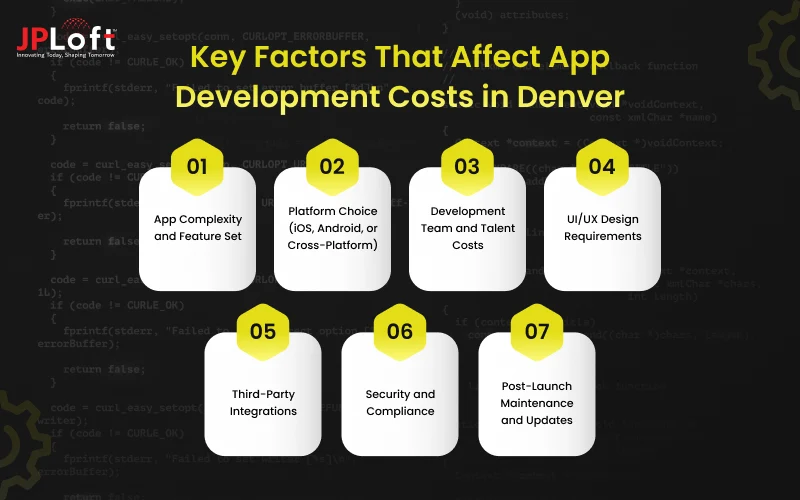
Below are the key factors that influence overall app development pricing Denver for businesses planning to build a mobile application.
Factor 1: App Complexity and Feature Set
App complexity is one of the biggest drivers of development costs. A simple application with limited functionality requires fewer development hours. On the other hand, advanced platforms with real-time features, automation, or AI in mobile app demand more efforts.
The number of features, workflows, and integrations directly impacts both the project timeline and the budget.
Cost Impact by App Complexity:
|
Complexity Level |
Typical Features |
Estimated Cost Impact |
|
Basic App |
Login, basic UI, simple database |
$20,000 – $50,000 |
|
Standard App |
APIs, dashboards, payment integration |
$50,000 – $120,000 |
|
Advanced App |
Real-time features, AI, automation |
$120,000 – $220,000+ |
Factor 2: Platform Choice (iOS, Android, or Cross-Platform)
Choosing the right platform also affects the overall development investment. Businesses may build apps for iOS, Android, or both platforms.
Developing separate native apps increases development time, while cross-platform frameworks can reduce initial costs. However, platform decisions should also consider performance, scalability, and long-term product strategy.
Cost Impact by Platform:
|
Platform Type |
Development Approach |
Cost Impact |
|
Single Platform |
iOS or Android only |
Lower initial development cost |
|
Cross-Platform |
Flutter / React Native |
Moderate cost with wider reach |
|
Native Both Platforms |
Separate iOS and Android apps |
Higher development investment |
Factor 3: Development Team and Talent Costs
The expertise of the development team significantly influences project pricing. The cost to create a mobile app in Denver often varies depending on developer experience, technical specialization, and team size.
Businesses planning to hire mobile app developers should evaluate portfolios, technical skills, and industry expertise before selecting a development partner.
Cost Impact by Team Type:
|
Team Type |
Hourly Rate Range |
Cost Impact |
|
Freelancers |
$30 – $80/hour |
Lower cost but limited scalability |
|
Offshore Agency |
$40 – $120/hour |
Moderate cost with remote collaboration |
|
Denver-Based Agency |
$120 – $200+/hour |
Higher cost with strategic expertise |
Factor 4: UI/UX Design Requirements
User interface and experience design play a major role in app success. Applications with custom animations, personalized dashboards, and intuitive navigation require additional design and development effort.
While high-quality design improves user engagement and retention, it also increases development hours and the overall project investment.
Cost Impact by Design Complexity:
|
Design Type |
Features |
Cost Impact |
|
Basic UI |
Standard layouts and templates |
Lower design cost |
|
Custom UI |
Branded visuals and animations |
Medium design cost |
|
Advanced UX |
Interactive flows and personalization |
Higher design investment |
Factor 5: Third-Party Integrations
Most modern applications rely on external integrations such as payment gateways, cloud services, analytics tools, and social logins.
Each integration requires configuration, testing, and ongoing maintenance. As the number of external services increases, development complexity grows, which can significantly impact the total project budget.
Cost Impact by Integrations:
|
Integration Type |
Examples |
Cost Impact |
|
Basic APIs |
Maps, email services |
Low integration cost |
|
Payment Systems |
Stripe, PayPal |
Moderate integration cost |
|
Advanced Integrations |
AI APIs, analytics platforms |
Higher development cost |
Factor 6: Security and Compliance
Security requirements can also influence development costs. Applications handling financial transactions, healthcare data, or sensitive user information must follow strict security protocols.
Implementing encryption, authentication systems, and regulatory compliance frameworks increases development effort but ensures long-term data protection and platform reliability.
Cost Impact by Security Level:
|
Security Level |
Requirements |
Cost Impact |
|
Standard Security |
Basic authentication and encryption |
Lower cost |
|
Advanced Security |
Multi-factor authentication, secure APIs |
Medium cost |
|
Compliance Security |
HIPAA, GDPR, financial security standards |
Higher cost |
Factor 7: Post-Launch Maintenance and Updates
Development costs continue even after an app launches. Ongoing maintenance includes bug fixes, performance improvements, compatibility updates, and new feature releases.
Businesses should allocate long-term resources for product updates. Reviewing a checklist before hiring a mobile app development company can help plan maintenance and scaling strategies effectively.
Post-Launch Cost Impact:
|
Maintenance Type |
Activities |
Annual Cost Estimate |
|
Basic Maintenance |
Bug fixes and monitoring |
10–15% of the development cost |
|
Feature Updates |
New features and improvements |
15–20% of the development cost |
|
Continuous Optimization |
Performance upgrades and scaling |
20–25% of the development cost |
Understanding these factors helps businesses estimate how much does it cost to create an app in Denver and build a realistic development budget.
Hidden Cost To Develop An App In Denver
Many businesses focus only on initial development pricing when estimating the cost of mobile app development Denver.
However, the total investment often includes several hidden expenses that appear during or after development. These costs are essential for maintaining performance, security, and long-term scalability.

Therefore, understanding these additional expenses helps businesses better estimate how much does it cost to build an app in Denver? Also, they can avoid budget surprises during the product lifecycle.
1. App Maintenance and Updates
App maintenance is one of the most common hidden expenses after launch. Since, regular updates are necessary to fix bugs, improve performance, and maintain compatibility with new operating system versions. On average, businesses typically spend 15–20% of the original development cost annually on maintenance.
2. Cloud Infrastructure and Hosting
Most modern applications rely on cloud infrastructure to store data and handle traffic. Services such as AWS, Google Cloud, or Azure require monthly or usage-based payments. Therefore, as your user base grows, server capacity, storage, and bandwidth requirements increase, which adds to overall operating expenses.
3. App Store Fees and Compliance
Launching a mobile app also involves platform-specific fees. For example, Apple charges $99 per year for its developer program, while Google Play requires a one-time $25 registration fee. Additionally, apps must comply with platform guidelines, which may require periodic updates and testing.
4. Quality Assurance and Testing
Testing ensures the app performs reliably across different devices, screen sizes, and operating systems. Therefore, development teams conduct mobile app testing to detect performance issues, usability challenges, and bugs before launch. This ongoing testing during updates and feature enhancements also adds to the long-term cost of app development.
5. Security Enhancements
Cybersecurity has become a major priority for mobile applications handling sensitive user data. Implementing encryption, secure authentication, and regular security audits adds additional development effort. All in all, following mobile app security best practices helps protect user data but also increases the overall project investment.
6. Marketing and User Acquisition
Even a well-built app requires marketing to attract users. Businesses often invest in app store optimization, digital advertising, influencer marketing, and social media campaigns. These marketing efforts are critical for user growth but are often overlooked when estimating app costs in Denver.
Recognizing these hidden costs allows businesses to calculate the mobile app development cost in Denver more accurately and build a sustainable long-term product strategy.
Denver vs Global Agency: Which Hiring Model Makes Sense?
When planning a mobile application, businesses often compare local development agencies with global or offshore teams.
This decision directly influences the cost to create a mobile app in Denver, as hiring models vary widely in pricing, communication efficiency, and development quality.
Many founders also evaluate the cost to hire mobile app developers in Denver when deciding whether a local agency or an offshore development team offers better long-term value.
Denver-based agencies typically offer strong collaboration, easier communication, and a better understanding of local business needs.

On the other hand, global development teams may provide lower hourly rates but sometimes introduce challenges related to time zones, coordination, and project management.
► Denver Agency vs Global Development Team
|
Factor |
Hiring a Denver-Based Agency |
Hiring a Global or Offshore Team |
|
Communication |
Real-time collaboration with easier communication |
Time zone differences may delay responses |
|
Market Understanding |
Strong understanding of local business and user needs |
Limited knowledge of Denver market trends |
|
Development Cost |
Higher hourly rates but strategic guidance |
Lower hourly rates and reduced upfront cost |
|
Project Coordination |
Faster meetings, easier collaboration |
Requires structured remote coordination |
|
Talent Access |
Skilled local professionals and agencies |
Large global talent pool |
|
Scalability |
Stable long-term partnerships |
Flexible team scaling options |
► Hiring a Denver-Based Agency
Working with a local development agency offers several advantages for startups and businesses operating in the region.
Key benefits include:
-
Easier communication and real-time collaboration
-
Strong understanding of local market trends
-
Better alignment with business goals
-
Faster project coordination and decision-making
The local agencies may charge higher hourly rates, but they often deliver more strategic guidance and product expertise.
This can help businesses better manage the app development cost Denver by reducing delays, miscommunication, and development rework.
► Hiring a Global or Offshore Team
Global development teams are often chosen by businesses looking to reduce upfront development costs.
Developers in regions such as Eastern Europe, Asia, and Latin America typically offer lower hourly rates compared to U.S.-based teams.
Common advantages include:
-
Lower development rates
-
Access to large talent pools
-
Flexible team scaling
However, managing offshore teams requires strong project management processes.
Businesses planning to hire dedicated developers should ensure clear communication channels, detailed documentation, and structured workflows to maintain product quality.
► Choosing the Right Hiring Model
The best hiring approach depends on your project scope, budget, and collaboration needs.
Businesses building complex products with long-term growth plans often prefer local agencies, while startups working with limited budgets may explore global teams.
Additionally, companies deciding between digital product strategies often evaluate Web app vs mobile app development options before finalizing their hiring model and technology approach.
Ultimately, selecting the right team helps businesses control development costs while ensuring the final product meets performance, scalability, and user experience expectations.
Practical Tips for Denver Founders to Control the Cost
Building a mobile application can be a significant investment, especially for startups and growing businesses.
However, the answer to their question, how much does it cost to develop an app in Denver, varies depending on complexity and features. Still, founders can take several strategic steps to control expenses without compromising product quality.

Below are practical strategies that help reduce development risks and manage the app development pricing Denver effectively.
1. Start with a Minimum Viable Product (MVP)
Instead of building a feature-heavy application from the beginning, startups should focus on launching a Minimum Viable Product. An MVP includes only the essential features required to validate a business idea.
This approach helps businesses test market demand quickly while minimizing the app development cost Denver during the early stages of development.
2. Prioritize Features Strategically
Feature prioritization plays a crucial role in controlling development budgets. Businesses should categorize features into core features for launch, secondary features for later updates, and future enhancements.
Focusing on high-impact functionality first helps founders avoid unnecessary development work and reduce the overall project scope.
3. Invest in Proper Planning and Wireframing
Clear planning significantly reduces development errors and rework. Creating wireframes helps define the app’s structure, navigation flow, and user journey before development begins.
Many development teams use mobile app wireframing during early product planning to visualize the application and identify potential usability issues before writing code.
4. Choose the Right Technology Stack
Selecting the right technology stack reduces development time and maintenance costs
Many teams evaluate top development frameworks and adopt cross-platform technologies like Flutter, React Native, or Xamarin to build apps for multiple platforms efficiently.
This approach helps businesses better manage the average cost to develop an app in Denver.
5. Plan Monetization Early
Monetization should be considered during the planning phase rather than after launch.
Early planning helps businesses design features that support revenue generation, such as subscriptions, in-app purchases, or advertising models.
Many startups incorporate mobile app monetization strategies early to ensure the product generates sustainable revenue over time.
6. Work with an Experienced Development Partner
Choosing the right development team can significantly impact project efficiency. Experienced developers can recommend scalable architecture, optimize development workflows, and avoid costly technical mistakes.
With the right strategy and development partner, businesses can control the cost of developing an app in Denver while building a scalable and competitive digital product.

Why Denver Businesses Choose JPLoft for Mobile App Development
Denver’s growing tech ecosystem requires development partners who understand both modern technology and local market dynamics.
As a trusted mobile app development company in Denver, JPLoft helps startups and enterprises build scalable, high-performance applications tailored to their business goals.
Our experienced team focuses on delivering reliable solutions while helping businesses manage the cost to develop a mobile app in Denver through efficient development processes and strategic planning.
From product discovery and UI/UX design to development, testing, and post-launch support, JPLoft offers end-to-end services that simplify the entire development journey.
Our experts analyze project requirements carefully to provide transparent estimates and optimize the mobile app development cost in Denver without compromising quality.
With a strong portfolio, experienced developers, and a focus on long-term scalability, JPLoft enables businesses to launch powerful digital products while controlling the app development Denver cost effectively.
Conclusion
Building a mobile application requires careful planning, budgeting, and the right development strategy.
As discussed throughout this guide, the key query, how much does it cost to build an app in Denver? The price typically ranges from $20,000 to $220,000+, depending on factors such as app complexity, features, development team, and long-term maintenance requirements.
Understanding these cost drivers helps businesses estimate the average cost to develop an app in Denver more accurately and plan their development roadmap effectively.
From choosing the right hiring model to prioritizing essential features and planning for hidden expenses, every decision influences the final investment.
By approaching development strategically and partnering with experienced professionals, businesses can manage the cost of developing an app in Denver while building a scalable, high-quality digital product that supports long-term growth.
FAQs
The cost to develop a mobile app in Denver typically ranges between $20,000 and $220,000+. The final price depends on factors such as app complexity, feature requirements, platform choice (iOS, Android, or both), design quality, and the experience of the development team.
The app development Denver cost is affected by several factors, including app complexity, UI/UX design, development platform, third-party integrations, backend infrastructure, and security requirements. Additionally, the experience level of developers and the size of the development team can significantly impact the overall budget.
The development timeline depends on the scope of the project. A basic app may take 2–3 months, while a standard application typically requires 3–6 months. More advanced apps with complex features or integrations can take 6–12 months or longer to complete.
Yes, startups can control the cost to build an app in Denver by launching an MVP first, prioritizing essential features, choosing cross-platform development when appropriate, and working with experienced developers who follow efficient development practices.
Both options have advantages. Local Denver agencies offer better communication, market understanding, and collaboration, while offshore teams may provide lower hourly rates. Businesses should evaluate project complexity, budget, and long-term product goals before choosing the most suitable development partner.

Priyanka Sukhwal is the Managing Director and Business Head of JPLoft, a results-driven leader with 10+ years of experience steering technology ventures and business growth. Her strategic acumen and deep understanding of digital markets and on-demand solutions have consistently translated into innovations that help businesses scale, evolve, and lead in competitive landscapes.



Share this blog