



Key Takeaways
AI agents for stock trading automate the trading process by analyzing real-time data, identifying patterns, and executing trades without manual intervention.
The process to make an AI agent for stock trading follows a structured flow, from strategy and data setup to model training, execution, and continuous optimization.
Core technologies like machine learning, deep learning, and NLP improve prediction accuracy and decision quality.
Businesses can choose from different agent types, such as rule-based bots, reinforcement learning agents, or multi-agent systems.
The cost to build an AI agent for trading stocks typically ranges between $40,000 to $200,000+, based on complexity and features.
Stock trading is no longer limited to manual analysis and delayed decisions. With the rise of AI agents, investors can now get systems that analyze market data in real time, identify patterns, and execute trades with speed and accuracy.
This shift is also changing how modern trading platforms operate and scale, also presenting a modern-day solution for entrepreneurs to create an AI agent for stock trading.
The global AI agent market is projected to grow at 45.8% CAGR from 2025 to 2030, reflecting a vast opportunity for businesses to leverage such tech trends to optimize operations.
For businesses planning to build an intelligent trading solution, understanding how stock trading AI agents work, from data processing and model training to execution and optimization, is the first step.
The development process starts with defining a trading strategy, collecting data, preparing data, integrating NLPs, planning the decision engine, trade execution layers, testing, and final launch.
In this blog, you will learn how to build an AI agent for stock trading, key features to include, costs involved, and how a trusted stock trading app development company can help you bring it to market successfully.
What Are AI Agents?
AI agents are autonomous software systems that analyze data, make decisions, and execute actions without continuous human control.
In stock trading, these software systems are not just stock trading app trends. But they monitor real-time market data, price movements, and external signals such as financial news or sentiment. Based on this input, they identify patterns and trigger trades aligned with predefined or learned strategies.
However, the planning to build an AI agent goes beyond simply adding basic rule-based automation. They use machine learning, deep learning, and natural language processing to improve decision accuracy over time.
In 2026, these systems support multi-step reasoning, adapt to changing market conditions, and execute trades with low latency, making them a core element of advanced stock trading apps.
Here is how an AI agent's stock trading works:
-
The system gathers real-time market data, historical prices, and external signals, then cleans and structures this data for analysis.
-
Machine learning models identify patterns and trends, deep learning handles complex price movements and market signals, while NLP analyzes financial news, reports, and sentiment to add context to predictions.
-
The agent evaluates multiple signals, assigns probability scores to trade opportunities, and selects actions based on predefined strategies, risk limits, and portfolio goals.
-
Once a decision is made, the system executes trades through integrated APIs and continuously learns from outcomes to improve future performance.
How AI Agents Benefit Stock Trading?
For businesses planning to build AI agent for stock trading, understanding the potential benefits of such advancements is essential.
AI agent trends enhance trading systems by improving speed, accuracy, and decision quality. The core benefit of such solutions is that they can operate with minimal manual effort while handling complex market scenarios.
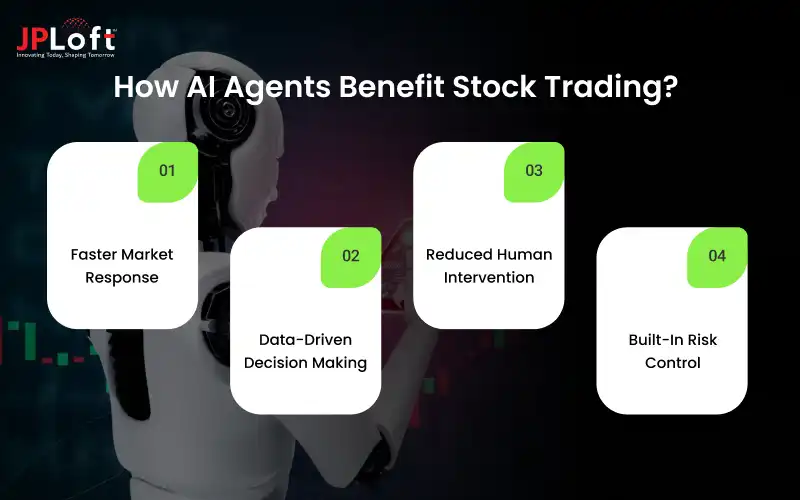
Here are the key benefits of AI agents for stock trading platforms:
1. Faster Market Response
The best AI agents for stock trading process live market data and react to price changes instantly without waiting for manual intervention. This allows the investors to capture short-term opportunities that manual trading often misses.
2. Data-Driven Decision Making
Any decision made by AI trading agents is not random or based on assumptions. These systems analyze both historical and real-time data to guide trading actions. This reduces guesswork and improves the consistency of outcomes.
3. Reduced Human Intervention
The key purpose of AI stock trading agent development is to reduce manual intervention. Hence, the system is able to handle monitoring, analysis, and execution without constant supervision. This lowers operational effort and allows teams to focus on strategy.
4. Built-In Risk Control
AI stock trading agents not only assist in automated trade settlement, but they also track volatility, set risk limits, and adjust positions based on market conditions. This helps reduce the associated risk and protects the investors from unexpected losses.

AI Agent Trading vs Human Trading
Agentic AI stock trading and human trading differ in how decisions are made, how trades are executed, and how consistently strategies are followed.
While human traders rely on experience and intuition, AI agents depend on data, models, and predefined logic to drive actions.
Here are the key differences to consider between the two approaches.
|
Aspects |
AI Agent Trading |
Human Trading |
|
Speed and execution |
Executes trades in milliseconds based on real-time data |
Takes more time to analyze and act on market changes |
|
Decision approach |
Uses data-driven models and predefined strategies |
Relies on experience, intuition, and market judgment |
|
Emotional influence |
No emotional bias, follows logic strictly |
Can be influenced by fear, greed, or overconfidence |
|
Data handling capacity |
Processes large volumes of structured and unstructured data efficiently |
Limited ability to analyze large-scale data simultaneously |
|
Consistency in strategy |
Applies the same strategy across all trades without deviation |
May shift strategies based on market pressure or sentiment |
|
Adaptability |
Learns from data and improves through model updates |
Adapts based on experience, which takes more time |
Based on such differences, it can be justified that using agentic AI for stock trading is not just a stock trading app feature, but is reshaping the entire trading landscape.
Key Features of a Successful AI Trading Agent
A successful stock trading agentic AI is defined by its ability to process data, make accurate decisions, and execute trades efficiently while managing risk.
Before focusing on how to develop an AI agent for stock trading, you should plan for the features to include in your platform.
The following features ensure strong performance and scalability:
A. Real-Time Market Data Processing
When planning to create a stock trading app by integrating AI agent capabilities, ensure the agent must handle live data streams, including price movements, order books, and external signals, to ensure timely decision-making.
B. Predictive Analytics And Forecasting
Another feature to include when planning for an agentic AI stock trading is that it should use advanced models to identify patterns and forecast price trends, helping improve trade accuracy.
C. Risk Management And Portfolio Optimization
The developed system must apply risk rules, diversify assets, and adjust positions to maintain a balanced and secure portfolio.
D. Automated Trade Execution
When planning to create AI agent for stock trading, ensure it seamlessly integrates with trading APIs, allowing the agent to execute trades instantly with minimal latency and high precision.
E. Backtesting And Performance Tracking
The decision relevance is the key aspect to be focused on when planning to develop AI agent for stock trading. The agent should test strategies on historical data and continuously track performance metrics to refine its approach.
Step-by-Step Process To Build An AI Agent For Stock Trading
AI agents perform effectively only if they have been planned thoroughly. The process of how to build an AI agent for stock trading involves more than just model training.
The process involves designing a complete system that can handle data, generate insights, and execute trades in a controlled and scalable way. Each stage contributes to how accurately and efficiently the agent performs in real market conditions.
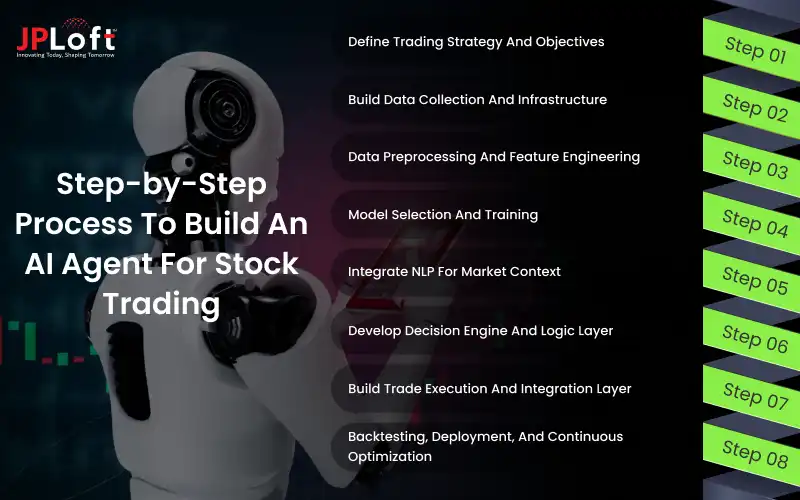
Let’s take a look at the step-by-step approach to develop AI agents for trading stocks:
Step 1: Define Trading Strategy And Objectives
The process of AI trading agent development starts with a clearly defined strategy. This step sets the direction for how the system will behave under different market conditions.
It also ensures that every model and rule aligns with business goals and risk appetite. Without this clarity, even advanced models can produce inconsistent results.
In this step, first of all, hire AI developers and then:
-
Choose a trading approach such as intraday, swing, or long-term.
-
Define asset classes and target markets.
-
Set risk limits, capital allocation, and performance benchmarks.
Step 2: Build Data Collection And Infrastructure
Once the strategy and agent objectives have been defined, the next step focuses on collecting and managing large volumes of real-time and historical data. A well-structured infrastructure ensures low latency and smooth data flow across the system.
The performance of an AI trading system depends heavily on the quality and reliability of its data pipeline.
In this step, focus on:
-
Integrating APIs for live market data and historical datasets.
-
Including external data such as news, sentiment, and macro signals.
-
Storing data in scalable and query-efficient databases.
Step 3: Data Preprocessing And Feature Engineering
Simply collecting and storing data is not enough when planning to build the best AI agents for stock trading.
This stage transforms unstructured and raw data into meaningful inputs that improve prediction accuracy. Strong agenic AI stock trading app feature engineering directly impacts how well the AI agent identifies trading opportunities.
Perform the following before moving to the next step:
-
Clean missing values and remove inconsistencies.
-
Create features like moving averages, RSI, and volatility indicators.
-
Normalize and structure data for model training.
Step 4: Model Selection And Training
Selecting the right models is critical for how well the AI stock trading agent understands market behavior.
Different trading strategies require different model types, especially when dealing with time-series data and dynamic price movements. Hence, this step focuses on selecting AI agent frameworks and training models that can generalize well and avoid overfitting.
At this step, the developer should:
-
Use machine learning models for pattern recognition and trend analysis.
-
Apply deep learning models like LSTM or transformers for time-series forecasting.
-
Train models on historical data and validate using test datasets.
-
Tune hyperparameters to improve accuracy and stability.
Step 5: Integrate NLP For Market Context
The next step involves ensuring that the AI agents for the stock trading understand the key factors influencing Market movements, including news, events, and sentiment.
Integrating NLP with the help of experts at an NLP development company helps the AI agent understand these external signals and improve prediction quality. This layer brings context that pure price-based models may miss, hence improving the AI agents’ efficiency.
Post this step, the stock trading agentic AI should be able to:
-
Analyze financial news, earnings reports, and social media signals.
-
Extract sentiment scores and key market-moving events.
-
Combine sentiment data with technical indicators for better insights.
Step 6: Develop Decision Engine And Logic Layer
The purpose of AI agents in trading is to automate decisions based on real-time market conditions. To make this possible, a well-defined decision engine is required that can translate insights into clear actions.
The decision engine acts as the core of the AI trading system. It takes outputs from trained models and converts them into executable trade decisions. At the same time, it ensures every action follows predefined strategies and risk controls, maintaining consistency and discipline across all trades.
Hence, at this stage, it is important to:
-
Define rules based on model predictions and trading strategy.
-
Apply risk management logic, such as stop-loss and position sizing.
-
Rank and filter trade opportunities before execution.
Step 7: Build Trade Execution And Integration Layer
The next step in building an AI trading agent is integrating the system with brokers or exchanges to enable seamless trade execution. This ensures that once a decision is generated, the system can place orders instantly without manual intervention.
Once decisions are finalized, the AI agent executes trades with high precision and minimal delay. Efficient execution plays a critical role in capturing the right market price, especially during volatile conditions where even small delays can impact profitability.
Hire dedicated developers at this stage and plan to:
-
Integrate with broker or exchange APIs for order placement.
-
Support multiple order types such as market, limit, and stop-loss.
-
Optimize latency and handle slippage during trade execution.
-
Track order status and manage failed or partial executions.
Step 8: Backtesting, Deployment, And Continuous Optimization
Before making the AI agent for stock trading live, the system must be tested and refined to ensure reliability.
This step validates how the AI agent performs under different market conditions, and potential performance gaps can be identified, which makes it ready for real-world use. Continuous monitoring and improvement keep the system aligned with changing markets.
Partnering with an experienced AI agent development company is important at this stage to:
-
Run backtesting on historical data to evaluate strategy performance
-
Deploy in paper trading or live environments with monitoring tools
-
Track metrics such as drawdown, win rate, and returns
-
Retrain models and update strategies based on new data and performance insights
The above-mentioned steps can help you build a successful AI Agent that can automate your stock trading activities. But before that, you should be aware of diverse types of agentic AI for stock trading, so that you can decide what to build as per your requirements.
Types of AI Trading Agents You Can Build
The entrepreneurs planning to develop an AI Agent for stock trading can focus on diverse agent types to enhance their platform's competitiveness.
Different types of stock AI agents are designed based on how they process data, make decisions, and adapt to market conditions.
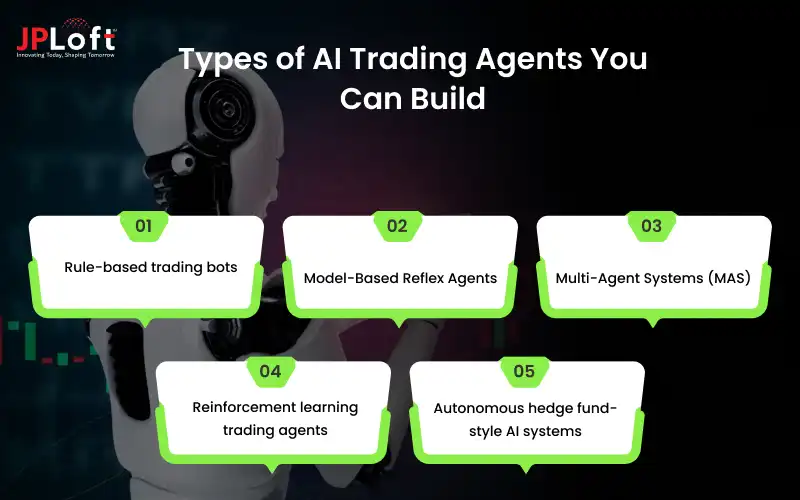
Here are some of the common types that you can plan with the help of an AI development company:
Type 1: Rule-based trading bots
These agents operate on predefined rules and conditions such as price thresholds or technical indicators. They are simple to build and suitable for predictable strategies, but lack adaptability to changing market conditions.
Type 2: Model-Based Reflex Agents
These agents maintain an internal model of the market state and update it based on new data. They do not rely only on current inputs but also consider past information, which helps improve decision accuracy in dynamic environments.
Type 3: Multi-Agent Systems (MAS)
In this setup, multiple AI agents work together, each handling a specific task such as data analysis, risk management, or execution. This distributed approach improves scalability and allows more complex trading strategies.
Type 4: Reinforcement learning trading agents
These agents learn by interacting with the market environment. They take actions, receive feedback in the form of rewards or losses, and adjust strategies over time to maximize returns. This makes them well-suited to adaptive, evolving markets.
Type 5: Autonomous hedge fund-style AI systems
These are advanced systems that combine multiple models, strategies, and data sources into a single ecosystem. They manage portfolios, optimize risk, and execute trades autonomously, much like hedge funds, but with minimal human intervention.
Cost to Build an AI Stock Trading Agent
The average cost to build an AI trading agent ranges anywhere from $40,000-$200,000+, which varies based on the system’s complexity, data requirements, and level of automation.
The cost to build an AI agent with a simple rule-based approach is far less than a fully autonomous system with advanced AI models, real-time execution, and risk controls.
|
Development Level |
Estimated Cost |
What’s Included |
|
Basic AI Trading Agent |
$40,000 – $70,000 |
Rule-based logic, basic data integration, simple execution system |
|
Mid-Level AI Trading System |
$70,000 – $120,000 |
Machine learning models, real-time data processing, and basic risk management |
|
Advanced AI Trading Agent |
$120,000 – $170,000+ |
Deep learning models, NLP integration, predictive analytics, automated execution |
|
Enterprise-Grade AI Platform |
$170,000- $200,000+ |
Multi-agent systems, reinforcement learning, portfolio optimization, high scalability |
Challenges in Building AI Trading Agents
Building a reliable agentic AI for stock trading involves handling complex market behavior, large-scale data, and real-time execution.
Each challenge in building AI Agents affects how well the system performs in real market conditions, so it is important to address them with the right technical approach.
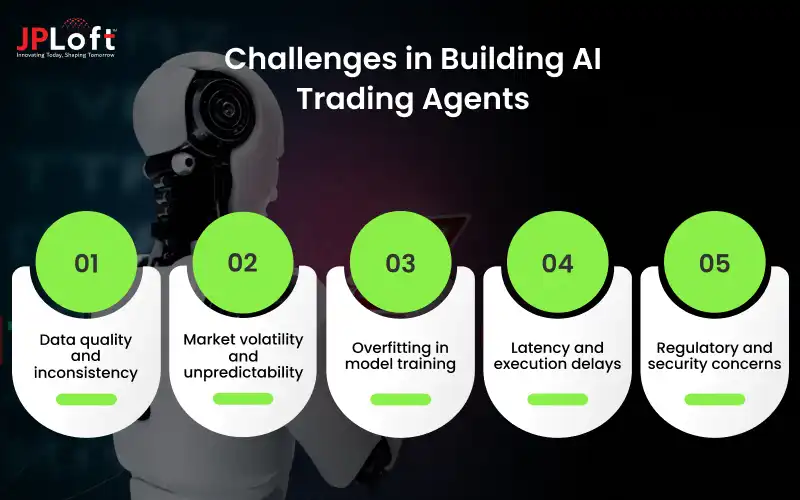
Here are the common challenges in developing AI stock trading agents and potential solutions.
Challenge 1: Data quality and inconsistency
Data used by an AI agent in the stock market often comes from multiple sources and may contain missing values, delays, or inconsistencies.
If the data is not handled properly, this can lead to incorrect model training and poor trading decisions.
Solution: Build strong data pipelines with validation, normalization, and error handling. Use multiple data sources to cross-check and improve data reliability.
Challenge 2: Market volatility and unpredictability
Stock markets are influenced by sudden events such as economic updates, policy changes, or global news.
These shifts can break patterns that AI models rely on, making predictions less reliable. Static models often fail to adjust to such rapid changes.
Solution: To overcome such a threat, it is important to use adaptive models that update frequently and include real-time signals like news and sentiment to improve responsiveness.
Challenge 3: Overfitting in model training
AI models in stock trading have been proven to be worthy when dealing with historical data, but they often fail when exposed to live market conditions.
Such a failure majorly happens when the model learns noise instead of actual patterns, reducing its ability to generalize. It can lead to inconsistent trading performance.
Solution: The developers should focus on integrating proper validation techniques, using diverse datasets, and testing models in simulation before deploying them in live environments.
Challenge 4: Latency and execution delays
Latency is a key challenge in stock trading apps or associated platforms. In trading, even a small delay in execution can impact the final trade price and reduce profitability.
High latency systems struggle to respond to fast market movements, especially in high-frequency scenarios.
Solution: The potential solution is to partner with experts and optimize system architecture, use low-latency APIs, and ensure fast data processing to reduce delays in execution.
Challenge 5: Regulatory and security concerns
If you are planning to develop AI agent for stock trading, ensure it complies with financial regulations and ensures secure handling of sensitive data.
Any gaps in compliance or security can lead to legal issues and loss of user trust. This becomes more critical as systems scale.
Solution: Follow regulatory standards, implement strong encryption using Agentic AI in cybersecurity, and use secure authentication methods to protect data and transactions.
How JPLoft Can Help With AI Stock Trading Agent Development?
AI agents for stock trading are complicated systems, and building them requires deep expertise in AI, data systems, and scalable architecture.
With 15+ years of experience and 98% client retention rate, JPLoft stands as a trusted stock trading app development company. We combine advanced technologies with strong engineering practices to deliver high-performance trading solutions.
The developers leverage machine learning, deep learning, and NLP to build intelligent trading agents that can analyze data and adapt to market changes.
Further, our expertise in IoT and real-time data processing enables low-latency systems that handle high-frequency trading scenarios efficiently.
The team at JPLoft has delivered 1100+ successful apps, also focuses on cloud-native architecture, secure API integrations, and scalable backend systems to support growing user demands.
From system design to deployment and optimization, JPLoft ensures seamless integration across all components. This approach helps businesses build secure, scalable, and future-ready stock trading app development solutions powered by advanced AI capabilities.
Conclusion
AI agents are reshaping how modern trading systems operate by combining data analysis, automation, and intelligent decision-making.
From understanding how these agents work to exploring their benefits, features, and types, it is clear that they offer a more structured and scalable approach to trading.
Building an AI trading agent involves a step-by-step process that includes strategy design, data setup, model development, execution, and continuous improvement.
While the cost typically ranges between $40,000 to $200,000+, the value lies in long-term efficiency and performance.
Partnering with experts ensures the solution is secure, scalable, and aligned with evolving market demands.
FAQs
An AI agent in stock trading is a software system that analyzes market data, identifies patterns, and executes trades automatically. It uses machine learning and real-time data to make decisions without constant human involvement.
To create AI agent for stock trading, you need to define a trading strategy, set up data pipelines, and train machine learning models. The process also includes building a decision engine, integrating APIs for trade execution, and continuously optimizing the system based on performance.
AI trading systems use machine learning, deep learning, and natural language processing. They also rely on cloud infrastructure, APIs, and real-time data processing to ensure fast and accurate performance.
The cost to make an AI agent for stock trading usually ranges from $40,000 to $200,000+. The final cost depends on features, complexity, data integration, and the level of automation required.
Businesses invest in stock trading agentic AI to improve decision accuracy, reduce manual effort, and scale trading operations. These systems help achieve faster execution, better risk control, and consistent performance over time.

Savannah Bustos is a technology professional with experience across financial platforms, mobility solutions, and on-demand digital products. Her areas of expertise include FinTech, digital banking, eWallets, lending, BNPL, stock trading, fuel delivery, and taxi-booking platforms. She combines a strong understanding of business requirements with practical technology insight, helping companies evaluate challenges, define product needs, and make informed decisions about scalable digital solutions.


Share this blog