


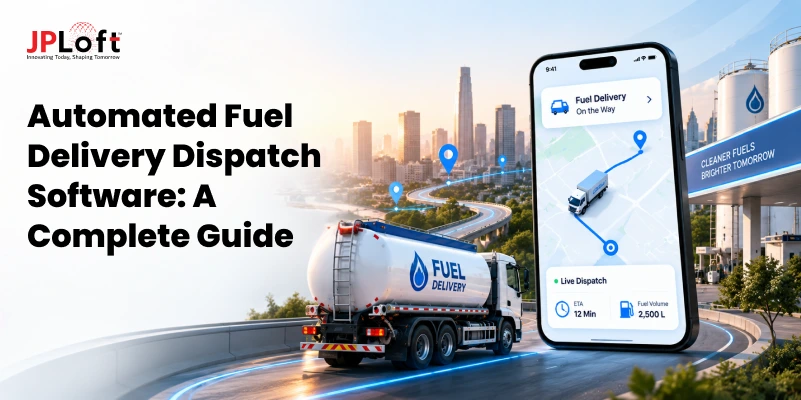
Running a fuel delivery business today means juggling dozens of moving parts such as driver schedules, fluctuating fuel prices, customer orders, and tight delivery windows, all at once.
For years, dispatchers relied on spreadsheets, phone calls, and gut instinct to keep operations running smoothly. But as customer expectations rise and margins tighten, that manual approach simply can't keep up anymore.
The numbers back this shift: the global fuel delivery software market was valued at approx. $12 billion by 2035.
This is where automated fuel delivery dispatch software changes the game, automating route planning, order assignment, and real-time tracking to eliminate guesswork from daily operations.
Dispatchers can assign the right driver to the right job in seconds, cut fuel wastage, and respond instantly to last-minute changes, all while keeping customers informed.
In this blog, we’ll explore how automated fuel delivery dispatch software works, the features that matter most, and why more businesses are switching to stay competitive.
What Is Automated Fuel Delivery Dispatch Software?
Automated fuel delivery dispatch software is a centralized platform that manages the entire fuel delivery workflow, from the moment an order comes in to the moment it's completed, without relying on manual coordination.
Instead of dispatchers juggling spreadsheets, phone calls, and paper logs, everything happens through one connected system.
At its core, this software brings together order management, driver assignment, vehicle tracking, and delivery scheduling into a single dashboard.
When a customer places an order, the system automatically matches it with the nearest available driver and vehicle, calculates the most efficient route, and updates the status in real time as the delivery progresses.
For businesses looking to modernize operations, many are choosing to create a fuel delivery app that integrates directly with this dispatch software.
This gives customers a seamless way to order fuel from their phones. At the same time, it gives dispatchers complete visibility and control—all from a single system.
Why Fuel Delivery Businesses Are Moving to Automated Dispatch?
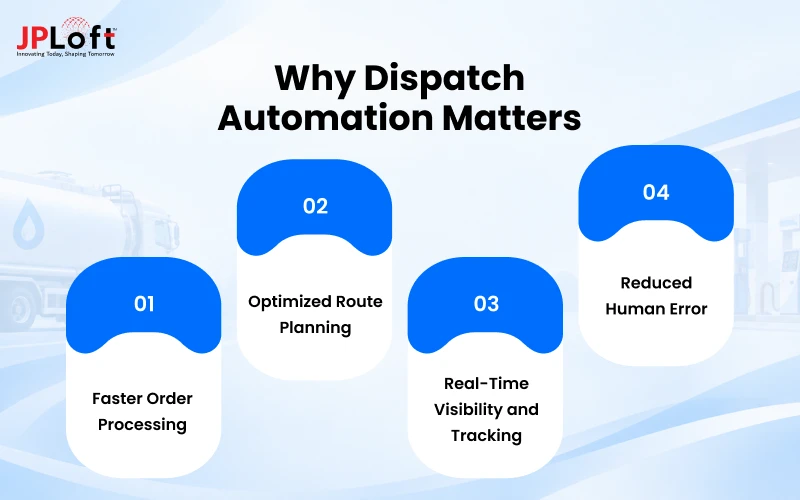
Why Dispatch Automation Matters
Manual dispatching worked fine when businesses were small. But growth changes everything.
More orders. More drivers. More things that can go wrong.
That's why smart fuel companies are switching gears.
The benefits of automated fuel delivery dispatch software go far beyond convenience; they directly impact revenue, safety, and customer trust. Let's break down exactly why.
1. Faster Order Processing
Speed matters in fuel delivery. Customers don't want to wait around wondering when their order will arrive.
With automated dispatch, orders get assigned in seconds—not minutes.
The system instantly checks driver availability, vehicle capacity, and location. Then it makes the smartest match. No back-and-forth phone calls. No manual checking of spreadsheets. No delays caused by human error.
This means dispatchers spend less time coordinating and more time managing the bigger picture. Drivers get clear instructions the moment an order comes in. And customers? They get their fuel faster, without the guesswork.
In an industry where timing can make or break customer satisfaction, this speed isn't just nice to have. It's a competitive edge that keeps businesses ahead of slower, manual-driven competitors.
2. Optimized Route Planning
Every wrong turn costs money. Every unnecessary mile burns fuel and eats into profit.
Automated dispatch software solves this with smart route optimization.
The system analyzes traffic, distance, delivery windows, and driver locations using GPS tracking, all at once.
Then it builds the most efficient route possible. Not the shortest route. The smartest one.
This means drivers spend less time stuck in traffic and more time actually delivering. Fewer miles driven means lower fuel costs for the business itself—which is ironic, considering it's a fuel company saving on fuel.
It also means more deliveries per shift. More deliveries mean more revenue, without adding extra vehicles or drivers to the fleet.
For fuel delivery businesses managing dozens of daily deliveries, this isn't a small win. It's an operational advantage that compounds over time.
3. Real-Time Visibility and Tracking
Not knowing where your driver is? That's a problem. A big one.
Automated dispatch software fixes this with real-time GPS tracking built right in.
Dispatchers can see every vehicle's exact location, at any moment. No guessing. No waiting for a driver to call in with an update. The system shows it all on one live map.
This visibility helps in more ways than one. If a delivery is running late, dispatchers know immediately—and can notify the customer before they even ask. If a driver needs support, help can be sent right away.
Customers benefit too. Many systems offer live tracking links, so customers can watch their delivery approach in real time.
It builds trust. It reduces anxious phone calls. And it makes the entire operation feel more professional and reliable.
4. Reduced Human Error
Manual dispatching relies on people. And people make mistakes—it's just human nature.
Wrong addresses. Missed orders. Double-booked drivers. These errors cost time, money, and customer trust.
Automated dispatch removes much of that risk. The system pulls order details directly from customer input, eliminating the need for manual data entry. It cross-checks driver schedules automatically, so double-booking becomes nearly impossible.
Even fuel inventory gets tracked accurately using IoT-based monitoring, reducing the risk of running a truck dry mid-route
The result? Fewer costly mistakes. Fewer frustrated customers. Fewer emergency phone calls trying to fix problems that shouldn't have happened in the first place.
For a business handling hundreds of deliveries weekly, even small errors add up fast. Automation doesn't just reduce mistakes—it builds a more dependable, professional operation from the ground up.
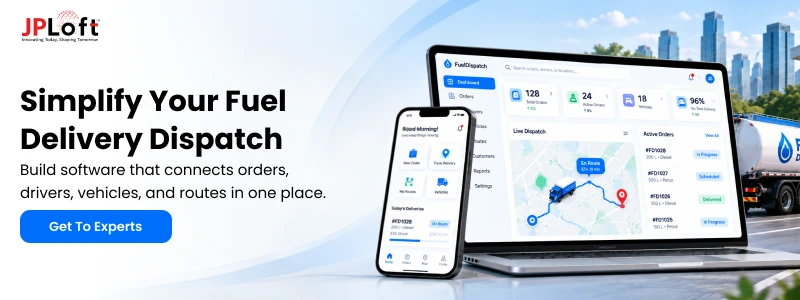
How Does Automated Fuel Delivery Dispatch Software Work?
How Fuel Dispatch Automation Works
Order Received → Driver Assigned → Route Planned → Delivery Tracked → Order Completed
Ever wondered what happens behind the scenes the moment you place a fuel order?
It's not magic. It's a well-oiled system working in the background.
Understanding how fuel delivery works becomes easier when you see how each step connects, from receiving an order to confirming delivery.
The process connects every piece automatically, with no manual juggling or guesswork — just a smart system working step by step.
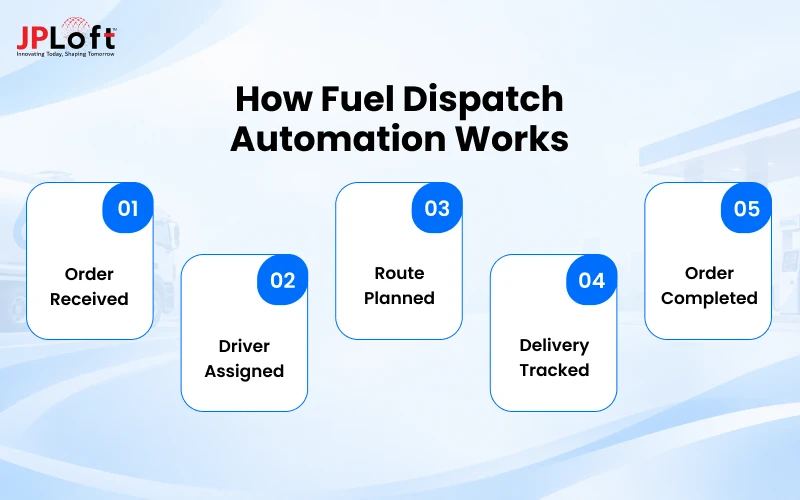
Here's how it actually works.
Step 1: Order Comes In
It all starts with a request. A customer places an order—through an app, website, or call center.
The fuel delivery dispatch software instantly captures every detail. Fuel type. Quantity. Delivery location. Preferred time window.
No paper forms. No manual note-taking. Just clean, accurate data—ready to move to the next step.
Step 2: Smart Driver Matching
Here's where things get interesting.
The system scans all active drivers in real time. It checks who's nearby. Who's available. Who has the right vehicle capacity for the job.
Then it makes the match automatically, powered by AI in fuel delivery apps. The best driver for the job, picked in seconds. Not by a person scrambling through a list. By a system built for precision.
Step 3: Route Optimization
Once a driver is assigned, the fuel delivery dispatch system doesn't stop there.
It calculates the smartest possible route using predictive fuel delivery models. Traffic conditions. Distance. Delivery deadlines. All factored in, instantly.
The goal? Fewer miles. Less wasted fuel. Faster deliveries.
Step 4: Real-Time Tracking
As the driver heads out, tracking kicks in.
Dispatchers watch the delivery live on a map. Customers get updates too—sometimes even a live tracking link.
Nothing feels like a black box anymore. Everyone knows exactly where things stand.
Step 5: Delivery Confirmation & Reporting
Once fuel is delivered, the automated fuel dispatch system logs everything.
Delivery time. Quantity dispensed. Digital signatures, if needed. All stored automatically—no paperwork, no missing records.
This data doesn't just sit there either. Through API integration for fuel delivery apps, it feeds into reports that help businesses spot patterns, improve efficiency, and make smarter decisions over time
Core Capabilities of Fuel Delivery Dispatch Software
Key Dispatch Capabilities
Not all dispatch software is built the same. Some just track orders. Others run the entire operation.
The best fuel delivery dispatch software goes far beyond basic scheduling. It brings together a full set of tools designed to handle every moving part of the business—automatically.
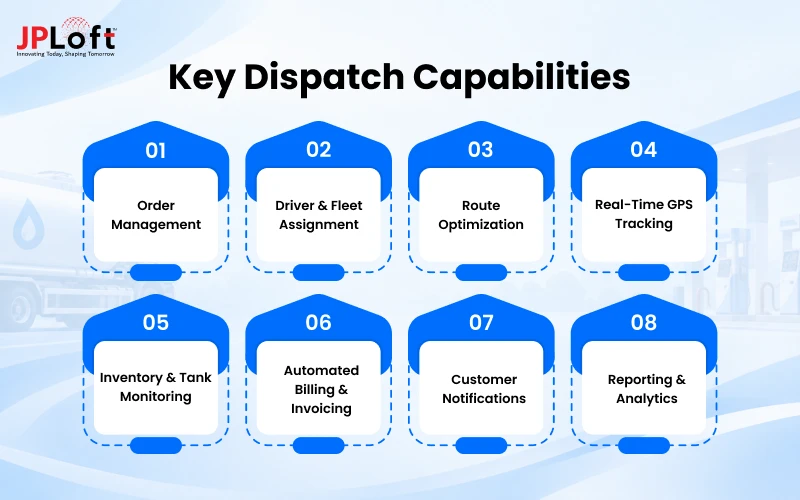
Here's what a truly capable system should offer:
1. Order Management: Every delivery starts with an order. The software should capture it cleanly—fuel type, quantity, location, timing—all in one place. No scattered spreadsheets. No missed details.
2. Driver & Fleet Assignment: The system matches orders to the right driver and vehicle automatically. It checks availability, location, and capacity, then assigns the job in seconds.
3. Route Optimization: Smart algorithms, part of the key features of a fuel delivery app, calculate the fastest, most fuel-efficient path.
4. Real-Time GPS Tracking: Dispatchers see every vehicle live on a map. No more guessing where a driver is. No more waiting for a check-in call.
5. Inventory & Tank Monitoring: Some systems track fuel levels in storage tanks too. This helps businesses know exactly when to reorder—before they run dry.
6. Automated Billing & Invoicing: Once a delivery is complete, invoices generate automatically. No manual paperwork. No delayed billing cycles.
7. Customer Notifications: Automated alerts keep customers in the loop—order confirmed, driver en route, delivery complete. It builds trust without extra effort.
8. Reporting & Analytics: Every delivery generates data. Good software turns that data into insights—helping businesses spot trends, cut costs, and improve efficiency over time.
Automated Dispatch Software vs. Manual Fuel Delivery Management
Automated vs. Manual Dispatch
Old habits are hard to break, especially in an industry built on routine. But when it comes to fuel delivery, sticking to manual methods can slow a business down without anyone noticing.
Manual management relies on people juggling phone calls, paperwork, and memory. It works, until it doesn't. One missed call or double-booked driver, and the whole day's schedule falls apart.
A modern fleet fuel management system takes a different approach. It replaces guesswork with automation—matching orders, tracking vehicles, and managing drivers through one connected platform. Nothing gets lost in translation. Nothing depends on someone remembering a detail correctly.
The difference isn't just speed. It's accuracy, visibility, and control—all working together instead of against each other.
Here's how the two approaches really stack up:
|
Aspect |
Manual Fuel Delivery Management |
Automated Dispatch Software |
|
Order Processing |
Phone calls, paper forms, manual entry |
Instant digital capture, zero paperwork |
|
Driver Assignment |
Based on memory or guesswork |
Automatic matching by location & availability |
|
Route Planning |
Fixed or experience-based routes |
Real-time, traffic-optimized routes |
|
Tracking |
Check-in calls, no live visibility |
Live GPS tracking on a dashboard |
|
Error Rate |
High (double bookings, missed orders) |
Minimal, system-checked accuracy |
|
Customer Updates |
Manual calls or no updates at all |
Automated notifications & tracking links |
|
Billing & Invoicing |
Manual, often delayed |
Automatic, generated instantly post-delivery |
|
Scalability |
Difficult as order volume grows |
Easily scales with business growth |
|
Data & Reporting |
Little to no historical insight |
Detailed analytics and performance reports |
|
Response to Issues |
Slow, reactive |
Fast, proactive (real-time alerts) |
What Should You Look for in Fuel Delivery Dispatch Software?
Not every dispatch tool fits every business. Some are built for small operations. Others handle large, complex fleets.
So how do you pick the right one?
The best fuel dispatch management software isn't just about flashy features. It's about finding a system that fits how your business actually runs. Here are the factors worth checking before you commit.
1. Business-Specific Dispatch Rules
Every fuel business runs differently. Some prioritize urgent orders. Others follow strict delivery zones.
Good software should adapt to your rules—not force you into theirs. Look for customizable dispatch logic that matches your exact workflow.
2. GPS and Mapping Support
Real-time location tracking isn't optional anymore. It's essential.
Strong fuel delivery route planning software should offer live GPS integration, accurate maps, and traffic-aware routing, so drivers always take the smartest path, not just the shortest one.
3. Integration Options
Your dispatch software shouldn't work in isolation.
Check if it connects easily with your existing tools, accounting systems, inventory platforms, or customer apps. Good fuel delivery scheduling software should fit into your tech stack, not replace it entirely.
4. Scalability
What works for 10 deliveries a day might break down at 100.
Choose software that grows with you—one that handles more orders, more drivers, and more vehicles without slowing down or requiring a complete overhaul.
5. Reporting
Data means nothing if you can't use it.
Look for built-in analytics, delivery times, driver performance, and fuel usage trends. The right reports help you make smarter decisions, not just store numbers.
6. Security and Access Control
Fuel businesses handle sensitive data, customer details, payment info, and delivery records.
Make sure the software offers role-based access control, encrypted data storage, and secure login protocols. Not everyone on your team needs to see everything.
How Much Does Automated Fuel Delivery Dispatch Software Cost?
Cost can be affected by different elements such as how much automation, integration, and scale you need.
Here's a realistic breakdown across three tiers.
1. Basic Dispatch System
Typical range: $50–$300/month per user, or $5,000+/year for smaller fleets
These are entry-level tools built mainly for scheduling and route creation, with limited automation:
-
Manual or semi-automated route planning
-
Basic customer and order management
-
Simple invoicing
-
Mobile app for drivers (delivery confirmation, e-signatures)
-
Little to no tank monitoring or predictive delivery
Some vendors price per vehicle or per user rather than flat monthly fees, and custom quotes based on fleet size and modules typically start at $5,000+ annually for basic fuel dispatch, with on-premises licenses also available from some providers.
Free or freemium tiers also exist for very small operations, though they usually cap out quickly on features or delivery volume.
2. Mid-Level Platform
Typical range: $300–$1,500/month, or roughly $20–$40 per vehicle/month plus hardware
This tier adds real automation and better visibility into operations:
-
Automated route optimization (not just planning)
-
Tank monitoring integration (telemetry-based reordering)
-
Degree-day forecasting for heating oil/propane demand
-
Driver telematics and GPS tracking
-
Accounting and fuel tax reporting integrations
-
Real-time invoicing from the truck
One pricing model found in the market runs custom quote-based, typically $20–$40 per vehicle/month plus one-time hardware costs of around $100–200 per device for telematics-driven dispatch tools.
This tier is where most mid-size fuel or propane distributors land, since it balances cost against real operational gains (fewer runouts, better route density).
3. Advanced Software with Automation & Integrations
Typical range: $1,500–$10,000+/month, sometimes $10,000+/month for enterprise deployments
At the top end, you're paying for AI-driven optimization and deep system integration rather than just dispatch tools:
-
AI/ML-based predictive dispatch (demand forecasting, dynamic rerouting)
-
Full ERP integration (accounting, inventory, procurement)
-
Wireless IoT tank sensor networks across the entire customer base
-
Multi-terminal or multi-depot coordination
-
Advanced analytics dashboards and reporting
-
API access for custom integrations
Enterprise-grade platforms aimed at large terminals or distributors can run $10,000+/month with custom quotes required.
When the software incorporates machine learning and reinforcement learning to process real-time inventory levels, demand forecasts, driver availability, and terminal constraints.
Vendors in this category claim automation can meaningfully cut costs — one platform advertises reducing dispatch costs by up to 20-30% through AI-driven optimization.
Factors That Affect Cost
-
Fleet size: Most platforms price per vehicle or per user, so costs scale roughly linearly with truck count.
-
Build vs. buy: Comparing fuel delivery app development cost against subscription pricing matters if you're considering a custom solution instead of an off-the-shelf platform.
-
Hardware: Tank monitors and telematics devices are often billed separately (upfront or amortized), typically $100–200 per device.
-
Contract terms: Annual contracts are usually cheaper per month than month-to-month, and on-premises licensing (less common now) can shift costs from subscription to upfront capital expense.
One useful data point on ROI: some vendors claim businesses can save $10,000-$40,000 per vehicle annually through efficiency gains from automated dispatch.
This is often the justification for moving up a tier.
How to Develop Fuel Delivery Dispatch Software?
Building Fuel Delivery Dispatch Software: Key Steps to Follow
Building an automated fuel delivery dispatch system isn't just about writing code — it's about understanding how fuel actually moves from terminal to tank.
The right development process blends operational knowledge (routing, tank levels, driver scheduling) with solid engineering (real-time data, integrations, scalability).
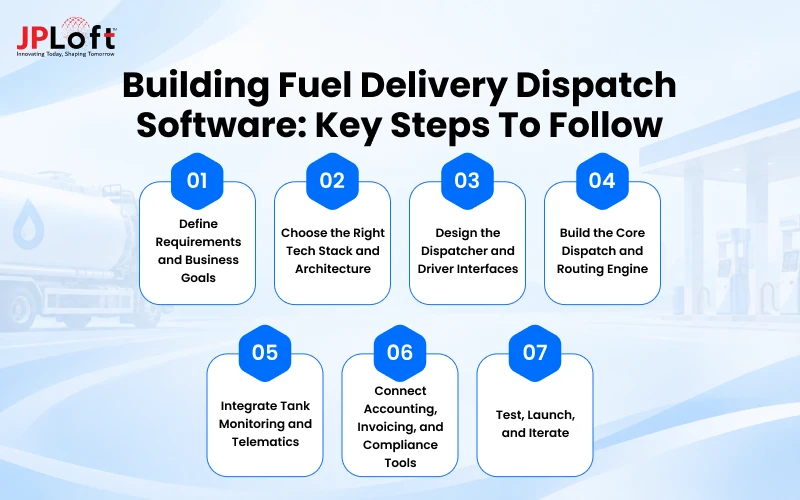
Here's how the process typically unfolds, step by step.
1. Define Requirements and Business Goals
Before a single line of code is written, map out what your dispatch system actually needs to solve.
Are you managing propane routes, diesel delivery, or a mixed fleet? Do you need degree-day forecasting, tank telemetry, or just better route planning?
This stage involves talking to dispatchers and drivers, not just executives, since the people on the ground know where the real bottlenecks live.
Skipping this step is the fastest way to build something nobody on your team actually wants to use.
2. Choose the Right Tech Stack and Architecture
Your automated fuel delivery dispatch system needs to handle real-time data, GPS pings, tank sensor readings, and order updates without lag. This means picking a cloud-based, scalable architecture from day one, not bolting it on later.
Decisions here include database structure, API design, and whether you'll support offline mode for drivers in dead zones.
Getting architecture wrong early is expensive to fix later, so this stage deserves as much attention as the visible features.
3. Design the Dispatcher and Driver Interfaces
A dispatch board that's cluttered or confusing defeats the purpose of automation.
Design should prioritize clarity: color-coded routes, drag-and-drop rescheduling, and at-a-glance tank status.
The driver-facing mobile app needs to work with gloves on, in bad weather, with spotty signal — so simplicity beats flashiness every time.
Prototype early and test with actual dispatchers and drivers before committing to a final design, since their daily friction points reveal what really matters.
4. Build the Core Dispatch and Routing Engine
This is the heart of the system — the logic that decides which truck goes where, in what order, and why.
A modern automated fuel delivery dispatch system uses route optimization algorithms that factor in tank levels, delivery windows, truck capacity, and driver location simultaneously.
This stage often takes the longest, since small logic errors here ripple into missed deliveries and wasted fuel later.
Rigorous testing against real-world delivery scenarios is non-negotiable at this point.
5. Integrate Tank Monitoring and Telematics
Automation only works if the system knows what's happening in the field.
Wireless tank sensors feed real-time fuel levels into the platform, triggering automatic reorder alerts before a customer ever notices a low gauge.
Pairing this with GPS telematics lets the system reroute trucks dynamically when priorities shift.
This integration layer is what separates a true automated fuel delivery dispatch system from a glorified scheduling calendar.
6. Connect Accounting, Invoicing, and Compliance Tools
Delivery isn't complete until the paperwork catches up.
Integrating with accounting software, fuel tax reporting tools, and invoicing systems means drivers can generate tickets on-site and get paid faster.
This stage also covers compliance features like automated tax calculations for different jurisdictions.
Without this integration, dispatch and billing stay disconnected, creating exactly the kind of manual bottleneck the software was built to eliminate in the first place.
7. Test, Launch, and Iterate
Before going live, run the system through real-world stress tests: cold-snap demand spikes, driver call-outs, last-minute route changes.
Launch with a small group of drivers first, gather feedback, and fix friction points before a full rollout.
Post-launch, keep iterating — an automated fuel delivery dispatch system should evolve as your fleet grows and your delivery patterns change, not stay frozen at version one.
How Can JPLoft Help You With Automated Fuel Dispatch Software?
Building a reliable dispatch platform takes more than good intentions — it takes a team that understands both software and the fuel delivery business itself.
JPLoft brings that combination through its fuel delivery app development services, helping distributors move from spreadsheets and phone calls to fully automated, data-driven dispatch operations.
The team works closely with clients to map real operational needs — route optimization, tank monitoring integration, degree-day forecasting, and driver-friendly mobile apps — before writing a single line of code.
Whether you need a lightweight MVP to test automation or a full enterprise-grade platform with ERP and telematics integration, JPLoft tailors the build around your fleet size and growth plans rather than pushing a one-size-fits-all product.
Beyond development, ongoing support ensures the system evolves as your delivery volume and customer base grow, keeping your dispatch operation efficient long after launch.
Conclusion
Fuel delivery businesses that stick with outdated, manual processes are stretching their operations thinner than they realize.
Automated fuel delivery dispatch software fixes the core problems that manual coordination can’t: slow order processing, wasted miles, blind spots on driver location, and costly human error.
Whether you start with a basic dispatch system or move straight to an advanced, AI-driven platform, the goal stays the same: connect orders, drivers, vehicles, and routes into one system that runs itself.
If you’re ready to move past manual dispatching, partnering with a team experienced in fuel services, one that understands both the tech and the industry, makes the difference between a system that looks good on paper and one that actually works on the road.
FAQs
Automated fuel delivery dispatch software is a platform that manages orders, assigns drivers, plans routes, tracks vehicles, and records deliveries. It helps fuel businesses reduce manual work and manage daily operations from one dashboard.
Yes, most modern platforms offer API-based integrations with ERP, accounting, and telematics systems, ensuring smooth data flow, fewer manual entries, and accurate real-time reporting.
Off-the-shelf software is faster and cheaper to deploy, while custom-built platforms cost more upfront but offer tailored workflows, deeper integrations, and long-term scalability advantages.
It works for both. Small fleets benefit from simplified scheduling and reduced errors, while large fleets gain advanced routing, analytics, and multi-driver coordination capabilities.
It tracks driver certifications, hazmat documentation, delivery records, and hours of service, helping fuel businesses meet DOT regulations and maintain safer, audit-ready operations.

Savannah is a passionate tech enthusiast with a sharp understanding of client needs across diverse digital domains. With expertise spanning financial platforms, on-demand solutions, and emerging technologies, she brings a unique blend of analytical insight and interpersonal skills, helping businesses decode complexities and make informed decisions in today's rapidly evolving digital world.


Share this blog