


Key Takeaways:
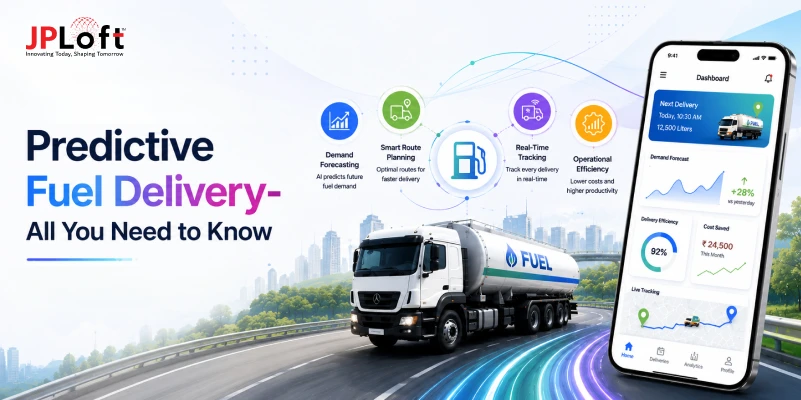
Predictive fuel delivery uses AI, IoT, and real-time data to forecast fuel demand before shortages occur.
AI-powered forecasting analyzes consumption patterns, tank levels, weather, traffic, and other external signals.
Businesses can reduce emergency deliveries, empty miles, fuel costs, and operational delays with predictive analytics.
Different AI models, including moving averages, exponential smoothing, and neural networks, can support different demand patterns.
A successful predictive fuel delivery app can combine demand forecasting, route optimization, vehicle tracking, price alerts, and real-time dashboards.
JPLoft can help businesses build custom fuel delivery solutions powered by AI, IoT, and predictive analytics.
Fuel delivery operations lose millions every year to empty miles, stockouts, and emergency runs that predictive analytics can remove before they happen.
Traditional fuel delivery relies on fixed schedules and emergency dispatches, an expensive, reactive model built for a past era.
Predictive analytics changes the whole scenario.
Sensors inside fuel tanks track levels in real time, while smart software studies past usage and traffic patterns to predict exact refueling times before a tank ever runs dry.
By combining real-time IoT tank telemetry, machine learning consumption models, and hyper-local traffic data, platforms forecast next fueling windows before a shortage occurs.
For investors, this isn't just a small operational fix; it's a way to make more money by fixing an old, outdated supply chain.
If you are looking to understand the whole aspect of predictive fuel delivery, this blog will help you learn all about it.
What is a Predictive Fuel Delivery App?
A predictive fuel delivery app uses AI and real-time data to forecast exactly when a customer's tank will run low, instead of waiting for them to place an order.
It pulls in historical consumption patterns, live sensor readings, weather conditions, and traffic data to predict demand before it happens, then automatically schedules deliveries at the right time.
For businesses looking to create a fuel delivery app that stands out, this predictive layer is what separates a modern platform from a traditional booking system.
It doesn't just process orders; it forecasts them, helping companies cut emergency deliveries, reduce fleet mileage, and keep customers from ever running dry.
From Reactive to Predictive: Why the Old Model Is Breaking Down
For decades, fuel delivery ran on a simple loop: a customer notices their tank is low, they make a call, and a truck gets dispatched.
It worked well enough when demand was predictable, and margins had room to breathe. Neither of those is true anymore.
Fuel prices swing more than they used to.
Weather patterns are less predictable. Customers expect the same convenience they get from every other on-demand app, not a phone call and a wait.
And every time a driver has to rush out for an emergency delivery, it eats into fuel, time, and profit that a planned route wouldn’t have cost.
The old model isn’t breaking because the trucks got slower or the drivers got worse. It’s breaking because it was never built to predict anything.
This is why the era of estimation is fading, replaced by predictive fuel analytics.
Inside the Engine: How AI Actually Forecasts Fuel Demand
Forecasting isn’t uncertainty dressed up as technology.
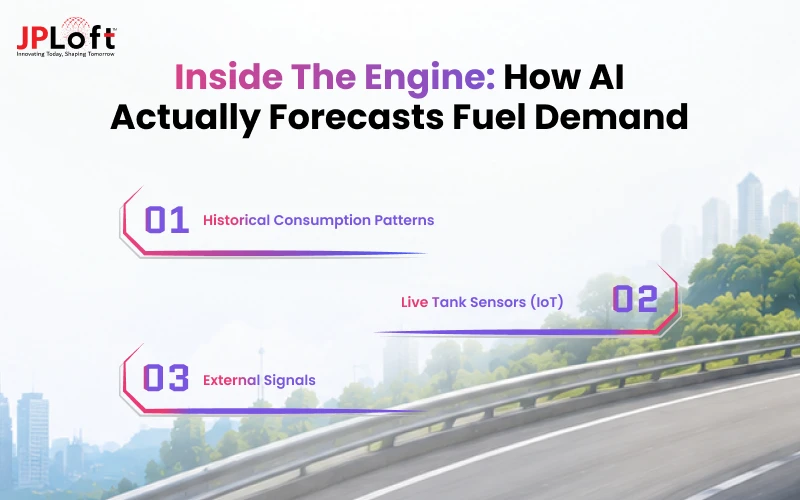
Predictive analytics in fuel delivery works by pulling together three layers of data and running them through algorithms that spot patterns no human dispatcher could catch on their own.
What are those three layers fueling predictive fuel analytics? Let’s find out below:
Here’s what actually feeds the prediction:
1. Historical Consumption Patterns
Every customer has a usage rhythm.
A construction site burns more diesel during the foundation phase than the finishing phase. Digital tank monitors continuously send live fuel level, temperature, and usage velocity data to the cloud.
If an enterprise customer suddenly starts running generators at full capacity, the system detects the abnormal drawdown immediately rather than waiting for a frantic phone call.
2. Live Tank Sensors (IoT)
Past habits are helpful, but real-time updates are better. Small digital sensors attached to fuel tanks constantly send live updates about exact fuel levels.
If a customer suddenly starts using more fuel than usual, the system catches it quickly, so nobody has to panic when the tank runs empty.
3. External Signals
Fuel use changes with the world around it. The software tracks local weather, traffic, and upcoming work plans.
Rather than sticking to a fixed schedule, the system continuously adjusts delivery timing and priority based on what’s actually happening in the world outside the tank.
AI Models Behind the Prediction
Not every fuel forecast needs the same level of complexity.
Some customers have steady, predictable usage, while others swing based on season, weather, or business activity.
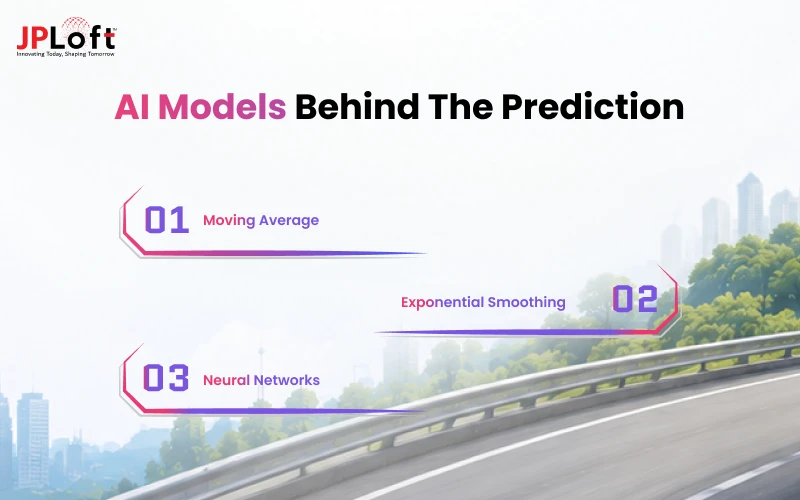
That’s why fuel delivery platforms typically rely on a mix of models rather than a single algorithm doing all the work.
A. Moving Average
It is best for stable, low-variation demand, like backup generators that use roughly the same amount of fuel month to month.
It’s simple, fast, and doesn't need much data to get started.
B. Exponential Smoothing
It handles patterns that shift with the seasons, such as heating oil usage that climbs every winter and drops every summer.
It gives more weight to recent data, so the forecast adjusts quickly when consumption starts to change.
C. Neural Networks
They step in when demand depends on multiple, constantly shifting variables: weather, traffic, local events, and customer behavior all at once.
These models take longer to train and need more data, but they catch patterns simpler methods would miss entirely.
Most fuel delivery platforms don’t pick just one.
They start with simpler models to establish a baseline, then layer AI on top to catch anomalies and fine-tune predictions as more data comes in.
The goal isn’t to use the most advanced model possible; it’s to use the right one for each customer’s demand pattern.
Fleet Fueling vs. On-Demand Delivery: Two Different Prediction Games
Every fuel delivery business is solving a slightly different problem, which means predictive fuel analytics doesn’t work the same way for all of them either.
A company fueling its own or a client’s fleet optimizes for uptime and route efficiency, while a business serving residential or small commercial customers optimizes for timing and customer experience.
Same technology, very different use case.
|
Factor |
Fleet Fueling |
On-Demand Delivery |
|
Who's being served |
Owned or contracted fleet vehicles |
Residential and small commercial customers |
|
What's predicted |
When each truck will need fuel based on route and capacity |
When a customer is likely to place their next order |
|
Key data used |
Vehicle mileage, fuel capacity, upcoming routes |
Past order history, weather, seasonal demand |
|
Main goal |
Avoid mid-route refueling stops that eat into operational hours |
Reach the customer before a competitor does |
|
Example prediction |
"Truck #45 is at 30% capacity with a long haul tomorrow — refill at the depot at 6 AM" |
"Temperatures are dropping — this customer usually orders heating oil around now" |
|
Business impact |
Less downtime, tighter route efficiency |
Higher retention, faster response than competitors |
Understanding which game your business is actually playing matters more than the technology itself.
Fleet-focused platforms need tight integration with route and vehicle data, while on-demand platforms need stronger customer behavior modeling.
Getting that distinction right from the start shapes everything else you build.
Building it Step-by-Step: Your Predictive Fuel Delivery Roadmap
Every reliable system starts with a clear foundation.
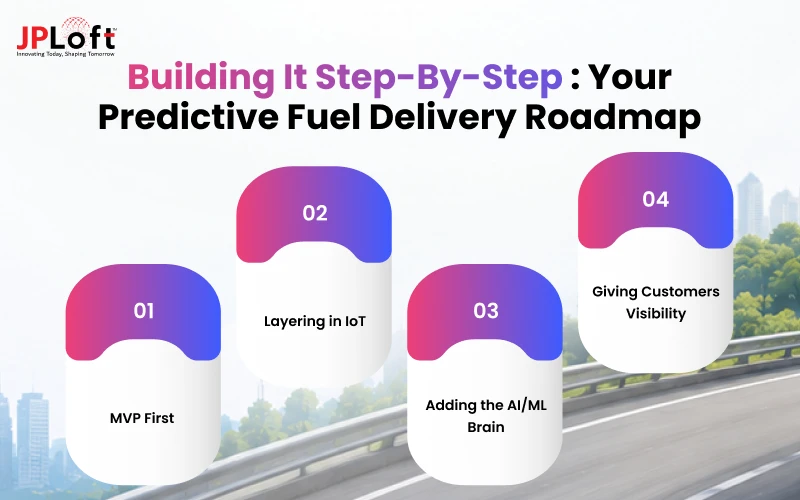
Predictive fuel analytics forms the core of smarter fuel delivery, turning raw data into forecasts that keep tanks full, routes efficient, and operations running smoothly.
Here are some key stages to take your platform from a simple ordering app to an intelligent, automated energy network:
► MVP First
Approach your app idea with a minimum viable product to get vehicles moving and orders flowing.
Focus exclusively on essential features such as customer order placement, real-time driver GPS dispatch, basic payment processing, and an admin dashboard.
Launching a streamlined MVP keeps early investment manageable, typically keeping the initial cost to develop a fuel app focused on proving market demand.
► Layering in IoT
Once basic operations run smoothly, upgrade the system with hardware connectivity.
Attach digital IoT sensors to customer fuel tanks and delivery trucks.
Instead of guessing when a tank needs a refill, live sensors transmit exact fuel levels, flow rates, and local tank conditions back to your dashboard 24/7.
► Adding the AI/ML Brain
With continuous live data streaming in, integrate machine learning algorithms to drive predictive analytics in fuel delivery.
The system processes historical usage patterns, weather updates, and live traffic conditions to deliver accurate fuel demand prediction.
Instead of reacting to empty tanks, these analytics automatically forecast exact restocking schedules and optimize driver routes before shortages happen.
► Giving Customers Visibility
Turn your background intelligence into an engaging customer experience.
Give clients live access to automated consumption reports, instant refill notifications, and accurate delivery arrival times.
Showing customers their real-time fuel usage builds trust and locks them into long-term subscriptions.
What Could Go Wrong: Real Challenges Businesses Face
Many companies struggle with fuel delivery app development challenges that slow growth and raise costs.
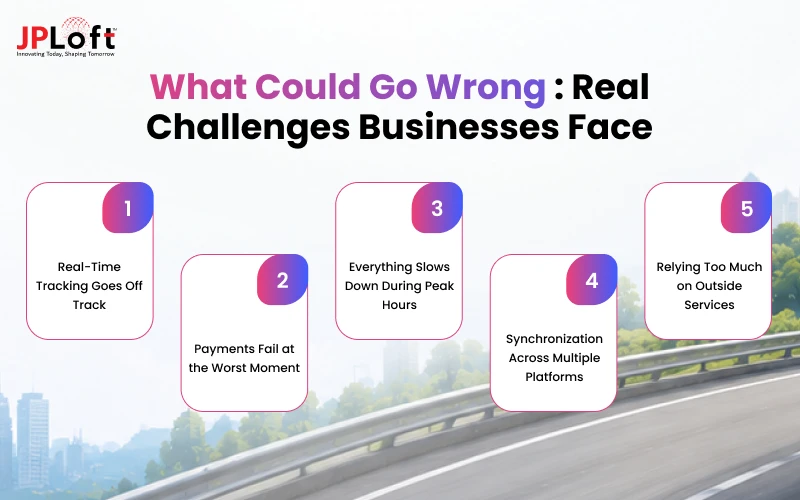
These problems stay hidden until they start affecting daily work. Here are some issues:
1. Real-Time Tracking Goes Off Track
Challenge: GPS signals drop in low-network areas, and driver location stops updating live. Customers keep refreshing the app, wondering where their fuel truck is.
Solution: The app switches to smart offline caching and syncs data the moment the signal returns. Last known location and ETA are shown so users stay informed either way.
2. Payments Fail at the Worst Moment
Challenge: High-value fuel orders sometimes hit payment gateway errors or timeouts. This leaves both the customer and driver unsure if the order is confirmed.
Solution: A reliable retry and rollback system is built into the payment flow. Failed transactions are auto-reversed, and users get instant status updates, leaving no confusion.
3. Everything Slows Down During Peak Hours
Challenge: When too many orders come in at once, servers struggle to keep up. Pages load slowly and some requests even time out completely.
Solution: The backend is built to scale automatically as demand rises. Cloud infrastructure adds resources on the fly, so performance stays smooth even during rush hours.
4. Synchronization Across Multiple Platforms
Challenge: Customer app, driver app, and admin dashboard all need to stay in sync. A single mismatch in order status can confuse everyone involved.
Solution: A centralized backend keeps all three platforms updated in real time. One update reflects instantly everywhere, keeping every side on the same page.
5. Relying Too Much on Outside Services
Challenge: Maps, fuel pricing, and payment APIs are all third-party tools outside direct control. When one of them goes down, the whole app experience suffers.
Solution: Backup APIs and fallback systems are kept ready for critical services. If one provider fails, the app quietly switches to an alternate, keeping things running.
How Can JPLoft Use Predictive Analytics in Fuel Delivery?
As a trusted fuel delivery app development company, JPLoft helps businesses turn fuel delivery from reactive to smart and planned. With predictive analytics, the system studies past data, current usage, and outside factors to show what is likely to happen next.
Here’s how JPLoft makes it work in a simple way:
-
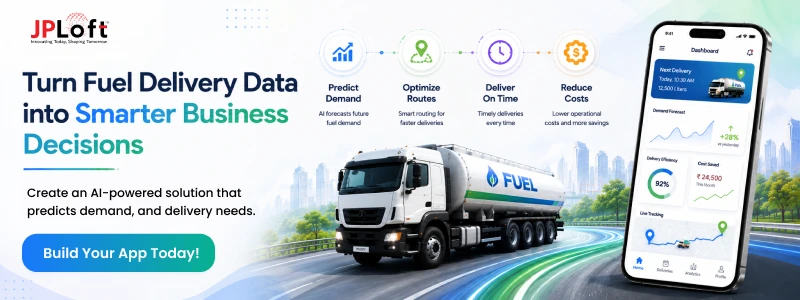
Demand prediction: The system looks at past orders, seasons, and local trends. It tells you how much fuel will be needed in each area before the demand rises.
-
Smarter route planning: It checks traffic patterns, delivery history, and vehicle status. Drivers get the best path in advance, saving time and fuel.
-
Vehicle performance tracking: Every vehicle’s fuel use is compared automatically. You quickly see which ones are using more fuel so timely action can be taken.
-
Price and budget alerts: The tools watch fuel price changes and give early warnings. Teams can plan purchases better and avoid sudden budget pressure.
-
Clear and easy dashboards: All insights appear on simple screens. Managers and teams understand the numbers fast and make confident decisions without guesswork.
With these features, JPLoft builds a fuel delivery system that stays one step ahead, cuts unnecessary costs, and keeps operations smooth every day.
Conclusion
Predictive fuel delivery is no longer a future idea; it is a practical way for businesses to stop reacting and start planning. By combining real-time tank data, smart algorithms, and clear insights, companies can cut empty miles, avoid sudden stockouts, and keep customers satisfied without last-minute rushes.
The shift from fixed schedules to intelligent forecasting improves efficiency, protects margins, and builds long-term trust.
If you are ready to move beyond the old reactive model, the right technology partner can help you build a system that stays one step ahead.
FAQs
Predictive fuel delivery uses AI and real-time data to forecast when a tank will need refueling before it runs low. Instead of waiting for a customer to place an order, the system schedules deliveries in advance based on usage patterns and live sensor readings.
AI studies historical consumption, live tank levels from IoT sensors, weather, traffic, and other external factors. It then applies the right forecasting model (simple averages for steady use or advanced neural networks for complex patterns) to predict the next refueling window.
Businesses reduce emergency deliveries, lower fuel and labor costs, improve route efficiency, and keep customers from ever running dry. It also gives managers clear visibility so decisions are based on data instead of guesswork.
No. It works for both fleet fueling and on-demand residential or commercial deliveries. Fleet operators focus on uptime and route efficiency, while on-demand businesses use it to reach customers before competitors and improve retention.
JPLoft builds custom platforms that combine IoT sensors, machine learning models, and easy-to-use dashboards. From MVP development to full predictive systems, they help businesses turn raw data into reliable forecasts and smoother daily operations.

Savannah Bustos is a technology professional with experience across financial platforms, mobility solutions, and on-demand digital products. Her areas of expertise include FinTech, digital banking, eWallets, lending, BNPL, stock trading, fuel delivery, and taxi-booking platforms. She combines a strong understanding of business requirements with practical technology insight, helping companies evaluate challenges, define product needs, and make informed decisions about scalable digital solutions.



Share this blog