



Key Takeaways:
AI in mobile apps enables smarter experiences, automation, and data-driven decision-making for businesses.
Personalization, predictive analytics, and chatbots are among the top AI features in mobile apps in Denver that help improve user engagement.
Industries like healthcare, retail, finance, and education are rapidly adopting AI-powered mobile applications.
Development costs range from $20,000 to $250,000+, depending on complexity, features, and AI integration level.
Addressing challenges like data quality, integration, and scalability is essential for successful AI implementation.
Partnering with an experienced team like JPLoft ensures scalable, innovative, and high-performing AI mobile applications.
Mobile apps are no longer just digital tools; they’re becoming intelligent experiences, especially in fast-growing tech hubs like Denver. Yet, many local businesses still struggle to deliver personalization and stay competitive in this evolving digital landscape. That’s where AI in mobile apps in Denver is making a real impact.
In fact, the greater Denver area leads the U.S. in AI adoption, with around 27% of businesses already using AI and 34% planning to adopt it soon.
From startups to enterprises in the Denver Tech Center, companies are using AI for smarter recommendations and predictive insights. So, if you are planning to build a new solution or upgrade an existing one, leveraging an AI mobile app in Denver can unlock new levels of efficiency and user satisfaction.
In this blog, we’ll discuss how AI is reshaping mobile apps, its key use cases, costs, and how businesses in Denver can make the most of it.
Why Do Denver Businesses Need AI-Powered Mobile Apps?
In current times, competition among Denver businesses is quite high, and they are striving to deliver smarter, faster, and more personalized experiences to their app users. This is where AI in mobile apps in Denver plays a crucial role in driving innovation, efficiency, and user satisfaction.
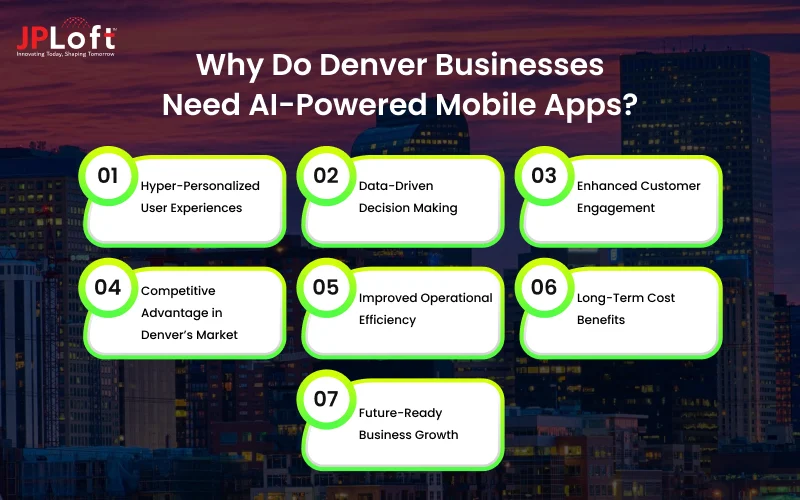
Here are the key reasons why Denver businesses are actively adopting AI-powered mobile apps:
1. Hyper-Personalized User Experiences
AI enables apps to analyze user behavior and preferences in real time, delivering tailored content and recommendations. This clearly demonstrates how can AI enhance the user experience in mobile apps effectively.
2. Data-Driven Decision Making
Businesses can leverage AI to process vast amounts of data quickly, uncovering actionable insights. This strengthens AI in business, helping organizations make smarter, faster, and more informed strategic decisions.
3. Enhanced Customer Engagement
With features like chatbots, push notifications, and predictive analytics, businesses can understand user behavior better. This highlights how AI enhances user engagement in mobile apps in Denver across different industries.
4. Competitive Advantage in Denver’s Market
Companies exploring AI mobile app ideas in Denver can build innovative solutions that stand out. These ideas become even more impactful when aligned with the top AI business ideas shaping modern digital innovation.
Leveraging advanced capabilities gives businesses a strong edge in Denver’s rapidly growing tech ecosystem.
5. Improved Operational Efficiency
AI automates repetitive processes like customer support and data management. As AI in product development becomes essential, businesses adopting an AI mobile app can reduce manual workload and improve overall operational efficiency.
6. Long-Term Cost Benefits
Although initial investment may seem high, AI reduces operational costs over time. Businesses planning how to use AI in a mobile apps in Denver can achieve better ROI through automation and intelligent insights.
7. Future-Ready Business Growth
Adopting AI prepares businesses for evolving technologies and changing user expectations. Staying aligned with emerging innovations ensures scalability, adaptability, and long-term growth in an increasingly digital-first environment.
AI adoption is no longer optional; it’s a strategic move for businesses aiming to launch their business idea in Denver.

Key Use Cases of AI in Mobile Apps in Denver
AI is no longer a futuristic concept; it’s actively transforming how mobile apps function, interact, and deliver value. From personalization to automation, AI in mobile apps in Denver is enabling businesses to create smarter, more intuitive digital experiences.
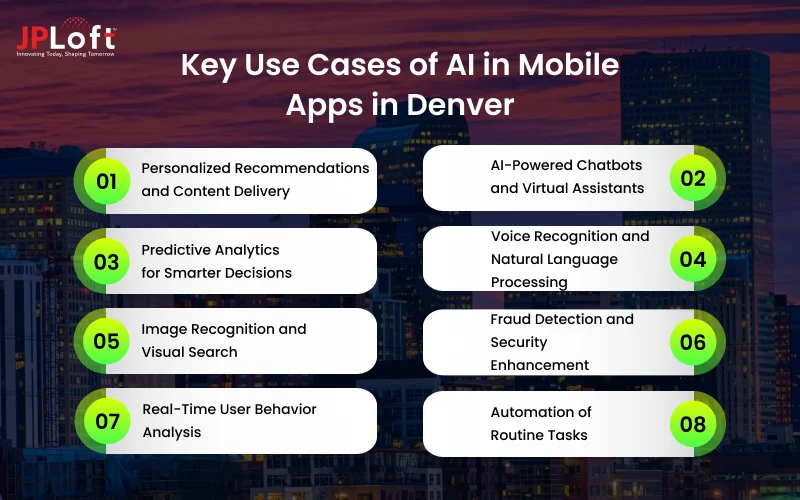
Here are the key use cases of AI in mobile apps that are driving innovation across industries:
Case 1: Personalized Recommendations and Content Delivery
AI analyzes user behavior, preferences, and interactions to deliver highly personalized recommendations. This is one of the best AI features in mobile apps in Denver, helping businesses improve engagement, retention, and conversions while supporting innovative, personalized digital products.
Case 2: AI-Powered Chatbots and Virtual Assistants
AI chatbots provide instant customer support, handle queries, and guide users throughout their journey. Businesses exploring how to build an AI app often prioritize chatbot integration to enhance responsiveness, reduce support costs, and ensure seamless communication.
Case 3: Predictive Analytics for Smarter Decisions
AI-driven predictive analytics helps businesses forecast user behavior, trends, and demand patterns. This capability is among the top AI features in mobile apps in Denver, enabling companies to make proactive decisions and optimize strategies effectively.
Case 4: Voice Recognition and Natural Language Processing
Voice-enabled features allow users to interact with apps more naturally using speech commands. Businesses focusing on AI mobile app design in Denver are integrating NLP and voice recognition to improve accessibility, convenience, and user interaction.
Case 5: Image Recognition and Visual Search
AI-powered image recognition enables features like facial detection, object identification, and visual search. These capabilities are widely used in retail and social apps, enhancing functionality in AI-based mobile apps in Denver with smarter visual experiences.
Case 6: Fraud Detection and Security Enhancement
AI strengthens app security by identifying unusual patterns, detecting fraud, and preventing unauthorized access. Businesses investing in AI development company solutions use machine learning models to ensure safer and more reliable mobile app environments.
Case 7: Real-Time User Behavior Analysis
AI continuously tracks and analyzes user interactions to optimize app performance and experience. This helps businesses understand how can AI enhance the user experience in mobile apps, enabling real-time improvements and smarter feature enhancements.
Case 8: Automation of Routine Tasks
AI automates repetitive processes such as data entry, scheduling, and notifications. Businesses looking at AI in mobile apps can significantly improve efficiency by reducing manual work and enabling faster, more streamlined operations.
These use cases clearly show how AI is transforming mobile apps into intelligent, user-centric platforms that drive real business value.
Industry-wise Application of AI in Mobile Apps in Denver
AI is transforming industries by enabling smarter operations, deeper insights, and highly personalized user experiences. With the rapid adoption of AI in mobile apps in Denver, businesses across sectors are leveraging intelligent technologies to innovate and stay competitive.
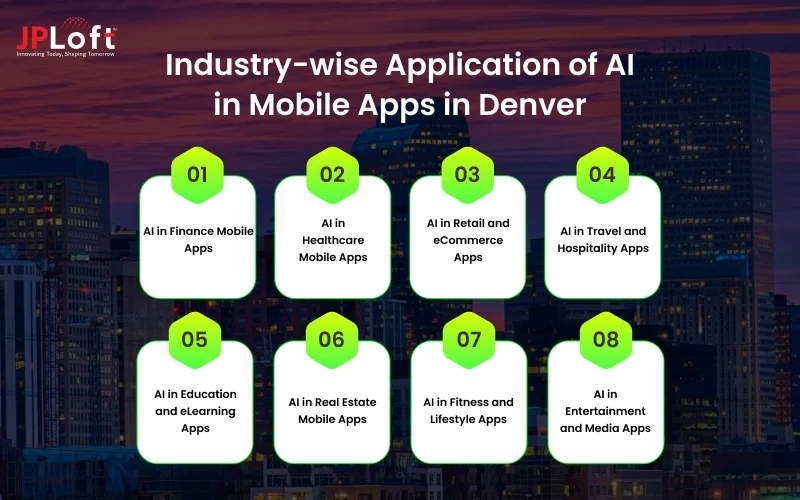
Here are the key industry-wise applications of AI in mobile apps in Denver:
1. AI in Finance Mobile Apps
AI in finance is revolutionizing mobile apps through fraud detection, risk assessment, and personalized financial planning. Many AI mobile app ideas in Denver focus on fintech innovation that enables secure transactions, predictive analytics, and smarter financial decision-making for users.
2. AI in Healthcare Mobile Apps
Mobile apps now support symptom checking, virtual consultations, and real-time patient monitoring with advanced intelligence. This shift is largely driven by AI in healthcare, which helps improve diagnostics and enhance decision-making.
3. AI in Retail and eCommerce Apps
AI in retail powers personalized recommendations, smart inventory management, and customer behavior analysis. These innovations help businesses create engaging shopping experiences, boost conversions, and deliver more effective, data-driven marketing strategies.
4. AI in Travel and Hospitality Apps
AI in travel enhances mobile apps with dynamic pricing, AI chatbots, and personalized travel recommendations. Businesses can improve booking experiences while optimizing operations and delivering seamless customer journeys.
5. AI in Education and eLearning Apps
Adaptive learning, personalized content delivery, and intelligent tutoring systems are transforming modern education. AI in education enables these capabilities, demonstrating how to integrate AI in mobile apps in Denver to create engaging, scalable, and effective digital learning environments.
6. AI in Real Estate Mobile Apps
AI in real estate helps mobile apps provide property recommendations, price predictions, and virtual tours. By leveraging AI-based mobile apps in Denver, businesses can offer data-driven insights and enhance decision-making for buyers, sellers, and investors.
7. AI in Fitness and Lifestyle Apps
AI in fitness supports personalized workout plans, health tracking, and real-time coaching. This showcases how to build AI in mobile apps in Denver solutions that improve engagement, encourage healthier habits, and deliver tailored user experiences.
8. AI in Entertainment and Media Apps
AI in entertainment enables content recommendations, user behavior tracking, and engagement optimization. As the future of AI continues to evolve, these apps are becoming more immersive, intuitive, and capable of delivering hyper-personalized content experiences.
AI is clearly redefining how industries innovate and deliver value through mobile apps. Businesses in Denver that embrace these AI-driven solutions can unlock new growth opportunities and stay ahead of the competition.
Core AI Technologies Powering Mobile Apps in Denver
Behind every intelligent mobile experience lies a set of powerful AI technologies. These technologies enable apps to learn, adapt, and deliver personalized interactions.
Today, AI in mobile apps in Denver is driven by advanced systems that turn data into meaningful user experiences.
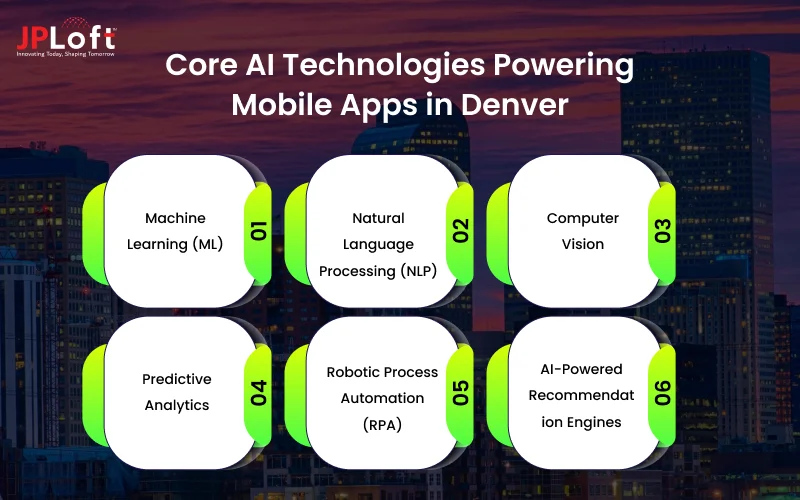
Here are the core AI technologies powering modern mobile apps in Denver:
1. Machine Learning (ML)
Machine learning helps apps learn from user behavior and improve over time. It enables personalization, recommendations, and predictions. Businesses use ML to create smarter and more adaptive user experiences.
2. Natural Language Processing (NLP)
NLP allows apps to understand and process human language. It powers chatbots, voice assistants, and search features. Companies exploring top AI trends often prioritize NLP to improve communication and deliver seamless conversational experiences.
3. Computer Vision
Analyzing images and videos is one of the computer vision use cases. This use case supports facial recognition, object detection, and visual search. Many AI-based mobile apps in Denver use this technology to enhance security, retail experiences, and content interactions.
4. Predictive Analytics
Predictive analytics uses historical data to forecast future outcomes. It helps businesses make proactive decisions. This shows how AI enhances user engagement in mobile apps in Denver by delivering timely suggestions and personalized content.
5. Robotic Process Automation (RPA)
RPA automates repetitive tasks and workflows within mobile apps. It reduces manual effort and improves efficiency. Businesses planning how to integrate AI in mobile apps in Denver often combine RPA with AI to streamline operations.
6. AI-Powered Recommendation Engines
Recommendation engines analyze user data to suggest relevant products or content. These are among the best AI features in mobile apps in Denver, helping businesses boost engagement, retention, and overall user satisfaction effectively.
These technologies form the foundation of intelligent mobile applications. They enable businesses to build scalable, efficient, and user-focused solutions.
To implement them effectively, companies often choose to hire dedicated developers with expertise in AI and mobile technologies.
Cost of Developing AI-Powered Mobile Apps in Denver
The cost typically ranges from $20,000 to $250,000+. Overall, the cost to develop an app in Denver can change as per complexity, features, and AI capabilities.
Building AI in mobile apps in Denver requires clear planning, the right tools, and experienced developers.
Cost Breakdown by App Complexity:
|
App Type |
Estimated Cost |
|
Basic AI App |
$20,000 – $50,000 |
|
Mid-Level AI App |
$50,000 – $120,000 |
|
Advanced AI App |
$120,000 – $250,000+ |
Basic apps include limited automation and simple AI features. Advanced apps include predictive analytics, NLP, and personalization. Businesses planning an AI mobile app in Denver should align features with clear business goals.
Key Cost Factors:
|
Factor |
Impact on Cost |
|
AI Features & Complexity |
High |
|
UI/UX & App Design |
Medium to High |
|
Development Team Location |
Medium |
|
Data & Integration Needs |
High |
Development costs also depend on team expertise and project scope. The cost to hire AI developers varies based on experience, project requirements, and the complexity of AI integration.
Understanding how to use AI in mobile apps in Denver helps avoid unnecessary features and reduces long-term costs. This ensures better ROI and scalable app performance.
Overall, the cost depends on your app’s vision, features, and execution strategy.
Challenges in AI Implementation in Mobile Apps in Denver
While AI offers powerful capabilities, implementing it in mobile apps comes with practical challenges.
Businesses adopting AI in mobile apps in Denver must address technical, operational, and strategic hurdles to ensure successful and scalable solutions.
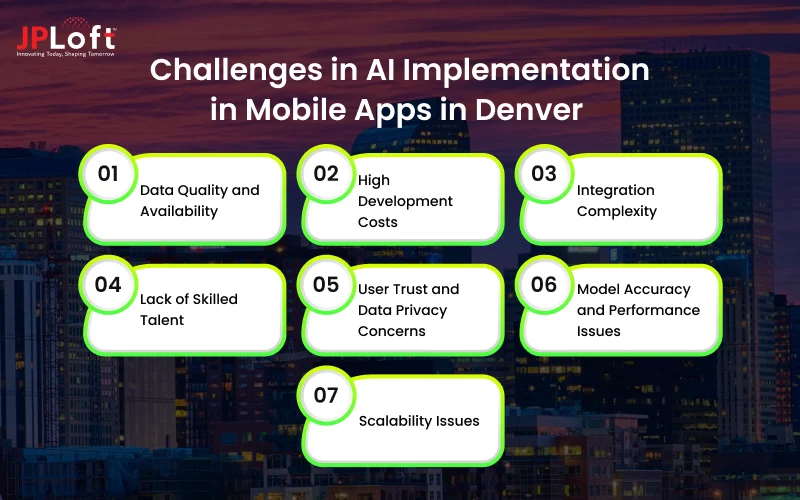
Here are the key challenges in AI implementation along with their practical solutions:
Challenge 1: Data Quality and Availability
Poor or insufficient data limits AI performance and accuracy.
Many businesses struggle to collect, clean, and structure relevant datasets, which directly impacts the effectiveness of AI-based mobile apps in Denver and their decision-making capabilities.
Solution: Focus on building strong data pipelines and validation processes. Businesses should invest in data collection tools, ensure data consistency, and use reliable sources to improve model accuracy and overall AI performance.
Challenge 2: High Development Costs
Developing AI-powered apps can be expensive due to advanced technologies and skilled resources.
Businesses planning how to build AI in mobile app in Denver often face challenges in managing overall app development cost, especially during initial development stages.
Solution: Start with a minimum viable product and scale gradually. Prioritize essential features, optimize resources, and plan budgets carefully to balance cost and functionality while ensuring long-term scalability.
Challenge 3: Integration Complexity
Integrating AI into existing systems can be technically challenging. Businesses exploring how to integrate AI in mobile apps in Denver often face compatibility issues with legacy systems, APIs, and infrastructure.
Solution: Use modular architectures and scalable APIs for smoother integration. Collaborating with experienced teams helps simplify deployment and ensures seamless connectivity between AI models and existing app systems.
Challenge 4: Lack of Skilled Talent
Finding experienced AI developers can be difficult and time-consuming. This creates delays in development and impacts quality, especially when building an AI mobile app in Denver with advanced features and capabilities.
Solution: Businesses can hire mobile app developers with AI expertise to accelerate development. Partnering with skilled professionals ensures better implementation, faster delivery, and high-quality results.
Challenge 5: User Trust and Data Privacy Concerns
Users often worry about how their data is collected and used. This affects adoption rates and trust in apps, especially when implementing features related to how can AI enhance the user experience in mobile apps.
Solution: Implement strong security measures and transparent privacy policies. Clearly communicate how data is used, follow compliance standards, and prioritize user consent to build trust and credibility.
Challenge 6: Model Accuracy and Performance Issues
AI models may produce inaccurate results if not trained properly. This affects reliability and user satisfaction, especially in apps focusing on how AI enhances user engagement in mobile apps in Denver.
Solution: Continuously train and optimize AI models using updated datasets. Regular testing and monitoring help improve accuracy, ensuring consistent performance and better user experiences over time.
Challenge 7: Scalability Issues
As user demand grows, AI systems must handle increased data and interactions. Businesses working on AI in mobile apps may struggle to scale infrastructure efficiently without affecting performance.
Solution: Adopt cloud-based infrastructure and scalable AI models. This ensures flexibility, handles growing workloads efficiently, and supports long-term app performance without compromising speed or user experience.
Overcoming these challenges requires the right strategy, tools, and expertise. Businesses that address these issues effectively can unlock the full potential of AI-powered mobile applications.
Best Practices to Follow When Planning for AI in Mobile Apps in Denver
Planning is the foundation of building successful AI-powered mobile applications. Businesses adopting AI in mobile apps must focus on strategy, scalability, and user needs to ensure long-term success and meaningful outcomes.

Here are the best practices to follow when planning AI-powered mobile apps:
1. Define Clear Objectives and Use Cases
Start with clear goals and identify specific use cases before development. This helps businesses align AI mobile app ideas in Denver with real user needs and measurable outcomes, ensuring focused and efficient implementation.
2. Prioritize User Experience and Design
A seamless user experience is critical for AI-driven apps. Investing in AI mobile app design in Denver ensures intuitive navigation, personalization, and accessibility, which directly improves engagement, satisfaction, and long-term user retention.
3. Choose the Right Technology Stack
Selecting the right mobile app tech stack is essential for performance.
Businesses planning to build a mobile app in Denver should adopt scalable technologies that support AI integration and enable future enhancements without major technical limitations.
4. Focus on Data Quality and Management
AI systems rely heavily on high-quality data for accuracy. Businesses implementing AI mobile app in Denver solutions must ensure proper data collection, storage, and processing to deliver reliable insights and improve overall performance.
5. Plan for Scalable and Flexible Architecture
Building scalable systems ensures long-term growth and adaptability. Businesses learning how to integrate AI in mobile apps in Denver should design flexible architectures that support increasing users, evolving features, and future AI advancements.
6. Partner with Experienced Development Teams
Working with experts improves implementation quality and speed. Choosing reliable mobile app development services helps businesses efficiently build, deploy, and scale AI-powered applications while minimizing risks and ensuring better outcomes.
Following these best practices helps businesses build AI-powered mobile apps that are efficient, scalable, and user-focused. This ensures long-term success in Denver’s competitive digital landscape.

Why Choose JPLoft to Build an AI App in Denver?
Choosing the right development partner is critical for building successful AI solutions. As a trusted mobile app development company in Denver, JPLoft delivers innovative and scalable digital products tailored to businesses' needs. Our team combines technical expertise with deep industry knowledge to create impactful applications.
With strong experience in AI in mobile apps in Denver, JPLoft builds intelligent solutions that enhance performance, engagement, and user satisfaction. We follow a structured development approach to ensure quality, transparency, and timely delivery across every project.
From idea validation to deployment, JPLoft offers end-to-end support. Our focus on innovation and user-centric design helps businesses stay ahead in a competitive market.
If you’re planning an AI mobile app in Denver, partnering with JPLoft ensures reliable development, scalable architecture, and long-term success.
Conclusion
AI is transforming how businesses create smarter and more engaging digital solutions. From automation to personalization, AI in mobile apps in Denver is helping companies deliver better experiences and improve operational efficiency.
By understanding use cases, technologies, costs, and challenges, businesses can make informed decisions. A well-planned strategy ensures scalability, better performance, and long-term success in a competitive market.
If you’re planning an AI mobile app in Denver, now is the perfect time to embrace innovation. With the right approach and expert support, AI-powered apps can unlock new opportunities, drive growth, and create lasting value for your business.
FAQs
AI helps mobile apps deliver personalized experiences, automate tasks, and improve decision-making. Businesses using AI in mobile apps can enhance user engagement, optimize operations, and gain valuable insights from user data.
The cost typically ranges between $20,000 and $250,000+, depending on features, complexity, and AI integration. Advanced apps with machine learning, NLP, and real-time analytics require higher investment and skilled development teams.
AI improves user experience through personalization, smart recommendations, chatbots, and predictive insights. It helps apps understand user behavior and deliver more relevant, engaging, and seamless interactions.
Some of the best AI features include chatbots, voice assistants, recommendation engines, predictive analytics, and image recognition. These features improve engagement, efficiency, and overall app performance.
To integrate AI, businesses need to define clear use cases, choose the right technologies, and collaborate with experienced developers. This approach ensures smoother implementation and better long-term results.

Priyanka Sukhwal is the Managing Director and Business Head of JPLoft, a results-driven leader with 10+ years of experience steering technology ventures and business growth. Her strategic acumen and deep understanding of digital markets and on-demand solutions have consistently translated into innovations that help businesses scale, evolve, and lead in competitive landscapes.



Share this blog