



Key Takeaways
AI in travel apps drives personalization, smarter planning, and seamless user experiences.
It helps businesses improve accuracy, efficiency, and real-time decision-making.
AI applications from itinerary planning to pricing deliver measurable value to travelers and brands.
Understanding data quality, AI training, and implementation challenges prevents common pitfalls.
Future trends like AI trip planners, AR/VR previews, and voice assistants define next-gen travel apps.
Studying top AI-powered apps like Expedia, Skyscanner, and Tripadvisor helps businesses outperform competitors.
Integrating AI requires the right tech stack, UX design, and ongoing maintenance strategy.
Partnering with expert teams like JPLoft ensures smooth execution, smarter features, and faster delivery.
Travelers today expect more than just basic search and booking options; they want apps that understand their needs. That’s exactly where AI in travel apps is transforming the experience.
From predicting the best times to travel to creating hyper-personalized itineraries, AI quietly works in the background to make every journey smoother and smarter. Its growing influence is reshaping how travel apps guide decisions, simplify planning, and anticipate preferences long before the user even asks.
As digital travel behavior evolves, the role of AI in travel apps becomes not just useful but essential. This blog explores how artificial intelligence elevates convenience, enhances user experience, and sets a new benchmark for modern travel applications.
Understanding AI in Travel Apps
Artificial intelligence has become the engine behind today’s smarter, faster, and more intuitive travel applications. Why AI in travel apps matters today: it plays a crucial role in delivering experiences that feel adaptive, personalized, and context-aware.
The role of AI is no longer limited to simple recommendations; it now powers real-time personalization, predictive assistance, and seamless end-to-end trip planning.
As the importance of intelligent travel technology continues to rise, platforms increasingly rely on machine learning, NLP, and automation to deliver experiences that feel proactive rather than reactive.
AI analyzes user behavior, travel patterns, pricing fluctuations, and contextual signals (like weather or location) to enhance decision-making.
This explains the growing demand for smarter features such as conversational assistants, itinerary automation, and AI-powered search, all contributing to the evolving impact of AI-powered travel solutions across the industry. By exploring these technologies, companies gain clarity on which features deliver the strongest user value.
Key Data Insights You Should Know
78% travellers globally want to use AI at some point during their accommodation journey.
-
52% of travelers trust generative AI for personalized travel recommendations and planning.
-
67% of travelers prefer AI-powered chatbots for customer service enquiries.
-
AI-driven personalization increases conversion rates by 20-30% in travel bookings.
As brands continue to explore the expanding applications of AI in travel apps, one essential consideration for innovators is understanding the strategic aspect, including the cost to develop a travel app and how AI involvement influences it.
AI capabilities are evolving quickly, and companies aiming to build long-lasting digital products must anticipate future needs. This includes preparing for scaling requirements, personalization models, and integrations that support advanced intelligence.
Teams planning to modernize or transform existing platforms often explore how to create a travel app, ensuring the architecture supports AI-first features from the ground up.
Benefits of AI in Travel Apps and Where AI Adds Real Value
Benefits of AI in Travel Apps and Where AI Adds Real Value
Artificial intelligence is revolutionizing the travel industry, creating smarter apps that enhance experiences for both travelers and travel businesses.
Understanding the benefits of AI-powered travel solutions and where AI truly adds value is crucial for staying ahead in the competitive travel tech space.
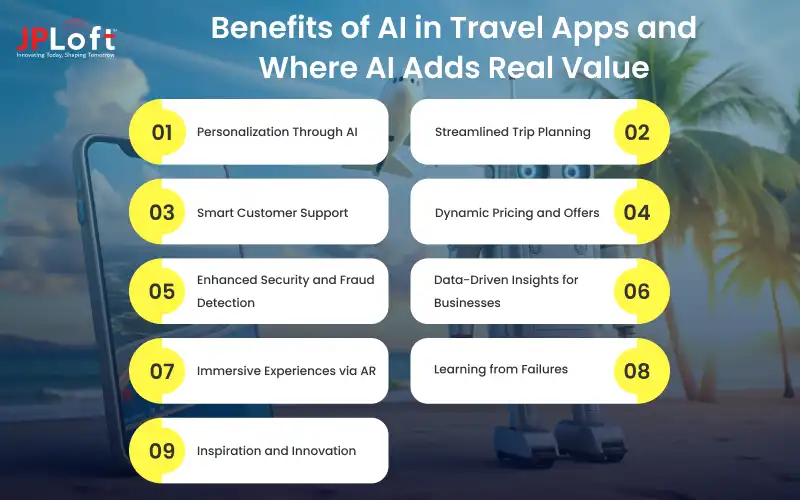
Why AI Matters Today: It defines how quickly a travel platform can adapt to personalization needs, real-time data, and user expectations.
1. Personalization Through AI
One of the strongest advantages is personalization. AI analyzes user behavior, preferences, past bookings, and even social media activity to deliver tailored recommendations for flights, hotels, and activities.
Personalized suggestions not only improve engagement but also increase booking conversion rates.
2. Streamlined Trip Planning
AI simplifies complex travel planning by optimizing routes, itineraries, and schedules. By predicting traffic patterns, weather changes, and flight delays, intelligent travel technology ensures travelers can make decisions faster and with confidence.
This functionality saves users time and reduces planning stress while improving overall trip satisfaction.
3. Smart Customer Support
AI-powered chatbots and virtual assistants provide instant solutions to queries, help with booking modifications, and offer real-time travel updates.
Integrating AI in hospitality services within apps ensures seamless customer support, keeping travelers informed and satisfied.
4. Dynamic Pricing and Offers
Using AI, travel apps can monitor competitor pricing and market demand to offer dynamic deals.
This ensures travelers always get competitive rates, and businesses maximize revenue. Personalized promotions can also increase repeat bookings and app loyalty.
5. Enhanced Security and Fraud Detection
Security is paramount in travel apps. AI identifies suspicious activity and prevents fraud, protecting sensitive user data.
Apps that follow strong travel app security practices and integrate AI security measures can gain greater trust from users.
6. Data-Driven Insights for Businesses
Beyond user experience, AI provides actionable insights for travel companies.
By analyzing booking trends, user preferences, and seasonal patterns, businesses can optimize resources, improve marketing strategies, and forecast demand more accurately.
7. Immersive Experiences via AR
AI combined with AR in travel apps can provide interactive tours, virtual previews of destinations, and guided city explorations. This immersive technology enhances user engagement and makes the app feel intelligent and forward-thinking.
8. Learning from Failures
Many travel apps fail due to poor user experience, lack of personalization, or inefficient operations.
Understanding why online travel apps fail and leveraging AI helps businesses address these gaps, offering smarter, more intuitive solutions.
9. Inspiration and Innovation
AI also powers innovative features that inspire travelers. By analyzing trends and user preferences, apps can suggest new destinations or unique experiences, reflecting the top travel app ideas that are shaping modern travel.
By analyzing booking trends, user preferences, and seasonal patterns, businesses can optimize resources and forecast demand more accurately. These capabilities highlight some of the Best Uses of AI in Travel Apps, helping brands leverage intelligence for both user satisfaction and operational efficiency.

AI Features That Make Travel Apps Feel Truly Intelligent
AI is redefining the way travelers interact with digital platforms, turning standard travel apps into intuitive, decision-making assistants. These intelligent features not only enhance user experience but also give app owners a strong competitive advantage.
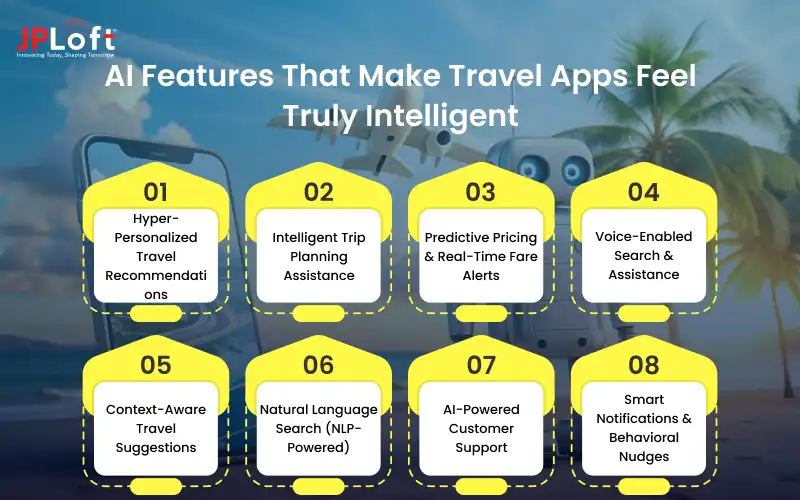
Below are the AI-powered features that make travel apps truly smart, seamless, and future-ready.
1. Hyper-Personalized Travel Recommendations
AI studies user interests, search history, and behavioral patterns to curate tailor-made suggestions for destinations, hotels, routes, and experiences.
This feature forms the core of personalization and helps travelers discover options that perfectly match their travel style.
It also sets a strong foundation for teams exploring how to create an app like Hopper, where personalization plays a key role in user retention.
2. Intelligent Trip Planning Assistance
AI automates the entire planning workflow, right from suggesting itineraries to adjusting routes in real time.
Whether a user wants a relaxed holiday or a packed adventure schedule, AI can design an itinerary aligned with personal preferences and time constraints.
Most of the top travel app features emerging today include AI-powered smart planners because they reduce the traveler’s effort significantly.
3. Predictive Pricing & Real-Time Fare Alerts
Price prediction models help travelers book at the optimal moment and avoid unnecessary costs.
AI analyzes historical fare trends, user behavior, peak travel seasons, and competitor pricing to forecast whether rates will rise or fall.
This capability empowers users to make confident booking decisions while ensuring travel apps deliver timely and highly accurate pricing insights.
4. Voice-Enabled Search & Assistance
AI-driven voice interaction allows travelers to search, book, and modify trips without typing.
It speeds up navigation and enhances accessibility, especially for users on the go.
This feature is increasingly popular among companies exploring how to develop an app like Kayak because voice assistants reduce friction during travel planning.
5. Context-Aware Travel Suggestions
AI improves relevance by analyzing real-time conditions such as weather, traffic, crowd levels, and local events.
It helps users choose the best time to visit attractions and adjust plans instantly.
Integrating these capabilities is a major consideration for teams studying how to design a travel app that feels user-centric and intelligent.
6. Natural Language Search (NLP-Powered)
Instead of strict keyword searches, AI allows users to type naturally, like, “Show me budget hotels near the Eiffel Tower with free breakfast.”
NLP understands user intent and delivers accurate results, enhancing usability and reducing search fatigue.
7. AI-Powered Customer Support
24/7 chatbots resolve queries instantly, managing cancellations, providing trip updates, and guiding users during emergencies.
Their speed and accuracy make them a must-have feature for any modern travel app looking to scale user satisfaction.
8. Smart Notifications & Behavioral Nudges
AI identifies when a user should be notified, before price drops, during gate changes, or near check-in deadlines.
These smart nudges help travelers avoid missed flights, manage time better, and stay informed throughout their journey.
How the Role of AI in Travel Apps Creates Smarter Travel Experiences
Artificial intelligence plays a pivotal role in travel apps by transforming traditional trip planning into a smarter, more intuitive experience.
With AI, travelers gain personalized recommendations, seamless itineraries, and real-time updates, making every journey smoother and more enjoyable.
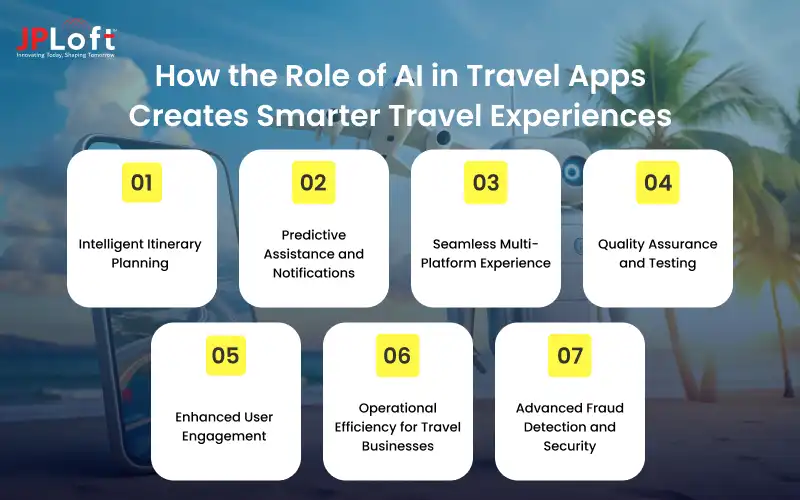
Here’s how AI contributes to a smarter travel experience:
► Intelligent Itinerary Planning
AI-driven apps can analyze multiple data points like flight timings, hotel check-ins, local attractions, and user preferences to create optimized travel plans.
How does AI in travel apps enhance trip planning? It allows travelers to save time and enjoy hassle-free experiences. Businesses looking to replicate this can explore how to develop a travel planner app like TripIt.
► Predictive Assistance and Notifications
From weather alerts to gate changes, AI proactively provides essential updates. Travelers are kept informed throughout their journey, reducing anxiety and enhancing satisfaction.
► Seamless Multi-Platform Experience
Modern travelers expect consistency across devices. AI ensures synchronization between mobile apps, web platforms, and wearable devices, making sure every update or suggestion is instantly available.
► Quality Assurance and Testing
AI can be leveraged to automate testing for app performance, usability, and security. Comprehensive travel app testing ensures the AI-powered features work flawlessly, leading to a superior user experience.
► Enhanced User Engagement
AI personalizes content based on previous searches, bookings, and behavioral patterns.
From recommending local events to suggesting restaurants, the app becomes a proactive travel companion rather than just a booking tool.
Businesses can bring this to life by hiring dedicated developers experienced in AI integration for travel apps.
► Operational Efficiency for Travel Businesses
AI insights allow companies to predict demand, optimize staffing, and enhance resource allocation.
By understanding traveler preferences and patterns, businesses can refine services, improve satisfaction, and increase revenue.
► Advanced Fraud Detection and Security
AI helps travel apps identify suspicious activity, prevent fraud, and protect sensitive user data in real time.
By analyzing transaction patterns and user behavior, AI enhances security, ensuring travelers can book and pay with confidence.
Integrating robust AI-based security measures not only builds trust but also reduces potential financial and reputational risks for travel businesses.
Real-World Examples of AI in Travel Apps
AI is reshaping the travel industry, powering smarter personalization, dynamic pricing, intelligent search, and predictive trip planning.
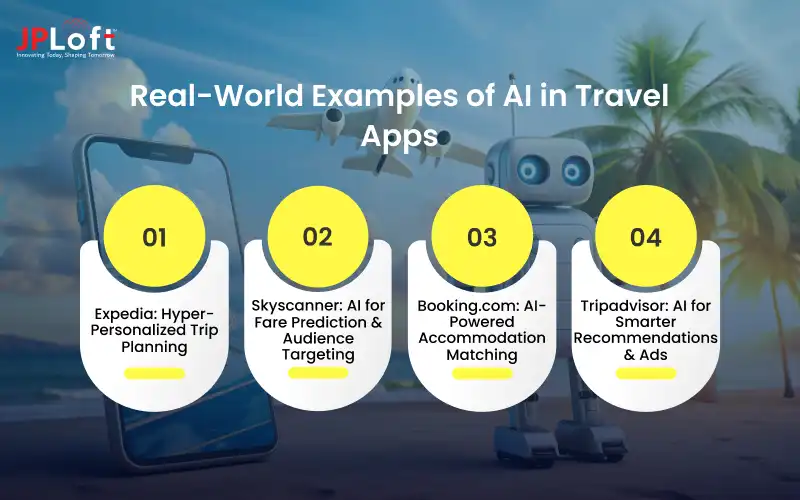
Here are real-world case studies showing how top travel brands are using AI to elevate the user experience and maximize revenue opportunities.
1] Expedia: Hyper-Personalized Trip Planning
Expedia uses machine learning models to analyze millions of user interactions and deliver hyper-personalized hotel, flight, and activity recommendations. Its AI-driven “virtual travel assistant” helps users plan trips faster while improving booking conversions.
This level of personalization is a benchmark for businesses exploring how to develop an app like Expedia, especially for boosting user engagement and customer lifetime value.
2] Skyscanner: AI for Fare Prediction & Audience Targeting
Skyscanner applies predictive AI algorithms to forecast flight price fluctuations, helping users find the best deals. Its AI also segments audiences based on behavior patterns and interests, enabling targeted campaigns that reduce acquisition costs.
Companies looking to develop a travel app like Skyscanner often study its dynamic pricing engine, which contributes significantly to higher booking revenue.
3] Booking.com: AI-Powered Accommodation Matching
Booking.com uses AI to match travelers with accommodations that align with their preferences, budgets, and travel histories. Its review summarization engine uses NLP to condense thousands of reviews into easy insights, improving decision-making and trust.
This approach showcases why many businesses want to develop a hotel booking app like Booking.com, particularly for maximizing conversions through data-driven personalization.
4] Tripadvisor: AI for Smarter Recommendations & Ads
Tripadvisor leverages AI to analyze traveler behavior, interests, and real-time intent signals to recommend hotels, attractions, and restaurants with high relevance. Its AI-driven ad targeting helps businesses reach the right travelers at the right moment, significantly boosting ad revenue.
Startups aiming to learn how to make an app like Tripadvisor often replicate its recommendation engine to improve user engagement and monetization.
A Practical Path to Add AI in Existing Travel Apps
Integrating AI into an existing travel app requires a strategic approach that balances user experience, technical feasibility, and business goals.
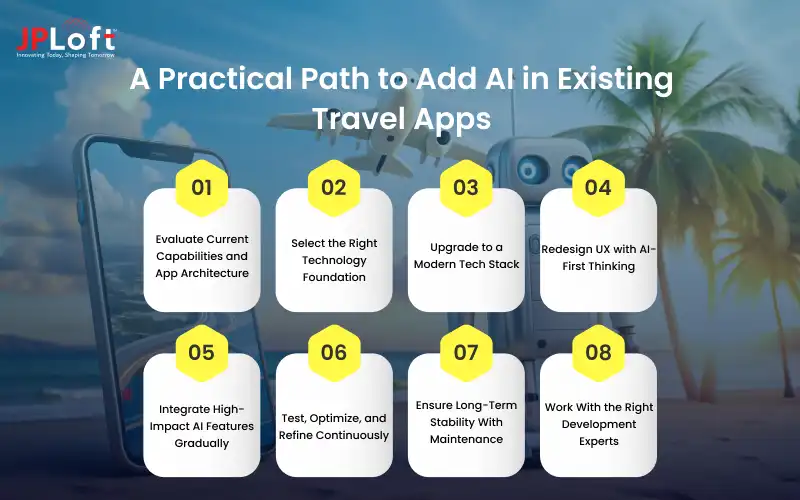
Whether enhancing personalization, automating workflows, or improving security, here’s a practical path to make your travel app smarter and future-ready.
A] Evaluate Current Capabilities and App Architecture
Begin by assessing your app’s existing infrastructure and identifying gaps that AI can fill. Understanding the role of AI in travel apps helps pinpoint which features can enhance usability and deliver real value. This evaluation phase ensures that AI is implemented where it genuinely improves the travel experience.
B] Select the Right Technology Foundation
Choosing a strong travel app tech stack determines what type of AI models, APIs, or machine learning engines you can integrate. From cloud hosting to data pipelines, the right stack ensures seamless AI execution and long-term scalability.
C] Upgrade to a Modern Tech Stack
Many older apps struggle with performance when AI features are added. Updating to a reliable mobile app tech stack enables faster processing, better data handling, and smooth integration of AI-driven personalization, predictions, and automation.
D] Redesign UX with AI-First Thinking
Introducing AI should enhance, not complicate, the user journey. Smart recommendations, conversational search, and automated trip planning require thoughtful mobile app design to ensure clarity, ease of use, and visual balance. The smarter the design foundation, the more intuitive the AI feels.
E] Integrate High-Impact AI Features Gradually
Instead of overhauling the entire app at once, introduce AI capabilities step-by-step: chatbots, intelligent suggestions, fare predictions, itinerary automation, or fraud detection. This reduces risk and ensures high adoption.
F] Test, Optimize, and Refine Continuously
AI-driven apps perform best when models are trained and improved regularly. Continuous testing ensures the importance of AI in travel apps translates directly into real-world user satisfaction and retention.
G] Ensure Long-Term Stability With Maintenance
AI features require ongoing updates, model retraining, and system monitoring. Partnering with reliable mobile app maintenance services ensures your AI remains accurate, fast, and relevant as user behavior evolves.
H] Work With the Right Development Experts
Successful AI adoption often requires specialized expertise. Collaborating with a trusted mobile app development company in Denver or experienced AI-focused teams ensures smoother integration, optimized performance, and scalable architecture.
Challenges in Implementing AI in Travel Apps
Implementing AI in travel apps unlocks powerful opportunities, but it also introduces a unique set of challenges. Understanding these challenges helps businesses plan better, avoid common pitfalls, and ensure successful AI integration.
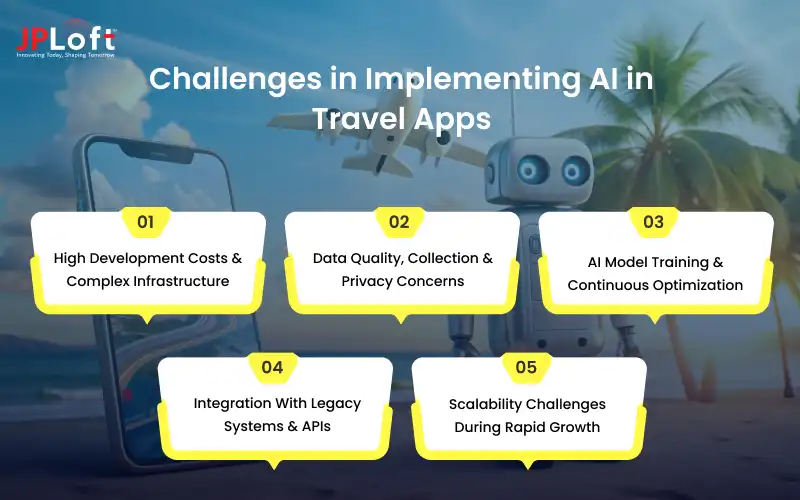
Here are the major challenges to implementing AI in travel apps and what developers must navigate:
Challenge 1: High Development Costs & Complex Infrastructure
AI requires robust infrastructure, advanced models, and scalable environments, making it cost-intensive. Travel companies often struggle to justify early investment unless they have a clear roadmap.
Understanding successful platforms can help developers determine the type of architecture and optimization needed for intelligent and scalable AI features.
Challenge 2: Data Quality, Collection & Privacy Concerns
AI needs large amounts of structured, real-time, and reliable data. However, travel platforms deal with scattered information from airlines, hotels, maps, events, and user profiles.
Ensuring accuracy and privacy while training AI models becomes challenging. This is one of the biggest travel app development challenges, especially for apps looking to automate personalization and predictive analytics.
Challenge 3: AI Model Training & Continuous Optimization
AI systems do not remain accurate forever. They require ongoing refinement, retraining, and performance checks.
This demands a skilled development team and constant monitoring to ensure features like recommendations, itinerary suggestions, and fare predictions remain reliable over time.
Businesses planning to build rich, AI-powered travel experiences must understand these complexities before scaling features like how to build a tour guide app that relies extensively on contextual AI.
Challenge 4: Integration With Legacy Systems & APIs
Travel apps rely heavily on third-party APIs, hotel engines, flight data, mapping systems, weather sources, and more. Integrating AI models into old or inconsistent data structures becomes complex.
This integration becomes even more demanding for developers planning features similar to cost to create an app like Agoda, where booking engines and pricing algorithms must work seamlessly with AI-driven dynamic recommendations.
Challenge 5: Scalability Challenges During Rapid Growth
As more users interact with AI features, the system must scale efficiently without compromising speed or accuracy. Handling peak-season traffic becomes even more demanding for apps that offer real-time assistance or predictive insights.
Companies aiming for a global travel app reach must prepare financially and technically, especially when building apps aligned with the cost to develop a travel app like Visit Dubai, which includes advanced AI personalization and large user-base support.
Future Trends Shaping AI in Travel Apps
AI is rapidly evolving, and its integration into travel apps is creating smarter, faster, and more intuitive travel experiences.
The future trends shaping AI in travel apps reflect how innovation will redefine everything, from planning and booking to on-trip assistance.
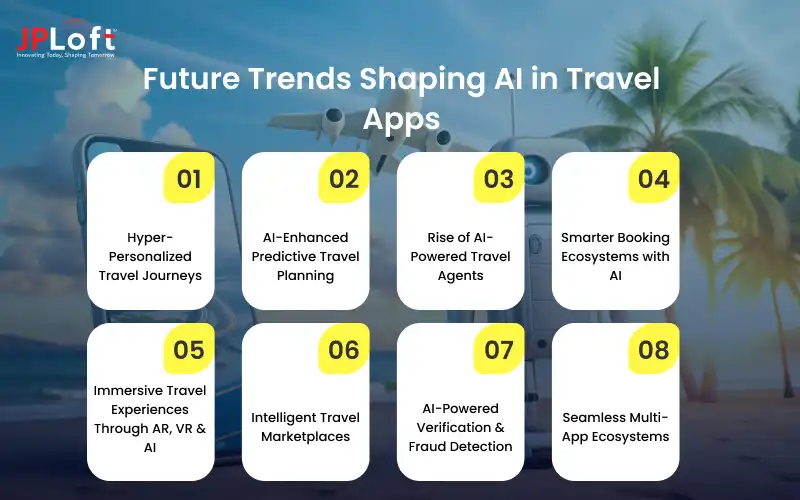
Understanding these trends is essential for businesses aiming to stay competitive.
1. Hyper-Personalized Travel Journeys
AI will deliver deeply customized itineraries based on interests, habits, budget, and real-time behavior.
This level of personalization strengthens brand loyalty and elevates the importance of AI in travel apps for modern travelers.
2. AI-Enhanced Predictive Travel Planning
Predictive algorithms will forecast prices, delays, demand shifts, and traveler needs.
As AI grows more accurate, apps will confidently answer how AI in travel apps improves user experience. With a predictive layer that feels almost human.
3. Rise of AI-Powered Travel Agents
Digital travel assistants will evolve into conversational, human-like agents capable of handling complex queries.
Developers wanting to build such solutions can explore how to build an AI trip planner app to integrate conversational intelligence seamlessly.
4. Smarter Booking Ecosystems with AI
AI analyzes millions of fare trends, demand shifts, and historical patterns to present travelers with the most cost-efficient booking options.
It enables apps to deliver smarter price predictions, optimized combinations, and real-time deal alerts that make trip planning faster and more reliable.
5. Immersive Travel Experiences Through AR, VR & AI
The merging of immersive tech with AI will let users preview destinations, understand routes, and make choices based on interactive guidance.
Companies planning futuristic experiences can look into developing a 360 VR app for tourism to integrate virtual exploration with AI.
6. Intelligent Travel Marketplaces
Future apps will unify hotels, flights, local experiences, community reviews, and real-time guidance. AI will dynamically curate offerings, enhancing both user engagement and app revenue.
7. AI-Powered Verification & Fraud Detection
As digital threats rise, AI will strengthen identity verification, secure transactions, and ensure safer booking environments. This increases the impact of AI in travel apps on reliability and trust.
8. Seamless Multi-App Ecosystems
The next wave of travel platforms will interconnect AI systems across airlines, hotels, OTAs, and ride-sharing apps. Developers planning such integrated experiences can evaluate how to develop a travel booking app like Wego for multi-platform interoperability.
These trends reflect how AI in travel apps is shaping modern travel, paving the way for a fully guided, intelligent, and personalized digital travel ecosystem.

Talk to the Experts of JPLoft and Build Your Travel App
Ready to turn your travel app idea into a real, scalable, and future-ready product?
The experts at JPLoft, a trusted travel app development company, bring deep industry experience and cutting-edge AI capabilities to help you build smarter, high-performing travel applications.
Whether you want to enhance personalization, integrate AI-driven features, or improve overall user experience, our team delivers custom solutions that align with your business goals.
We ensure seamless development, modern UI/UX, robust security, and long-term maintenance support for your travel app.
Let’s create an intelligent travel app that your users will love, efficient, innovative, and built for the future.
Conclusion
AI is redefining the future of travel by making apps smarter, faster, and deeply intuitive. From hyper-personalized recommendations to predictive insights and seamless trip planning, the role of AI in travel apps continues to expand as user expectations evolve.
As businesses embrace innovation, the impact of AI in travel apps becomes even more visible, enhancing convenience, improving satisfaction, and elevating the overall journey.
The importance of AI in travel apps is clear: it empowers companies to deliver meaningful, efficient, and future-ready travel experiences. Whether building new platforms or upgrading existing ones, AI stands at the core of modern travel intelligence.
FAQs
AI enhances user experience by offering personalized recommendations, smart itineraries, predictive alerts, and real-time updates. Travelers get relevant suggestions, faster planning, and smoother journeys, making the overall experience more satisfying and efficient.
AI is essential because modern travelers expect speed, accuracy, and personalization. AI helps travel apps deliver tailored results, automate customer support, optimize pricing, and provide predictive insights that enhance decision-making.
AI is transforming travel through dynamic itineraries, predictive pricing, smart assistance, automated planning, and hyper-personalized suggestions. It enables more intuitive, efficient, and enjoyable journeys, raising customer expectations across the industry.
Businesses gain improved customer engagement, higher retention, reduced operational load, better fraud detection, accurate forecasting, and stronger personalization. AI helps companies optimize resources and deliver smarter services.
AI is used in itinerary creation, chatbot assistance, flight and hotel predictions, personalization engines, fraud detection, route optimization, sentiment analysis, and customer service automation.
Key challenges include high development costs, data privacy concerns, model training complexities, integration with existing systems, and the need for ongoing optimization to maintain accuracy and performance.

Kris Jacobs brings 20+ years of experience solving complex digital product challenges through strategic thinking and user-centric design. With deep exposure to on-demand services, entertainment, travel, and interactive platforms, she collaborates across teams to shape scalable, engaging solutions that align business goals with intuitive user experiences across evolving digital landscapes.



Share this blog