


Key Takeaways:
Artificial intelligence is expected to become one of the most influential technologies shaping industries over the next decade.
AI adoption is accelerating due to advances in machine learning, cloud computing, and data availability.
Emerging trends such as generative AI, autonomous systems, and hyper-personalization will redefine digital experiences.
Let’s get to know all about the upcoming trends and changes in the upcoming time.
- Let’s learn about the trends and changes ahead.
Artificial intelligence has evolved from a futuristic concept into a powerful technology that is reshaping how businesses operate and how people interact with digital systems.
From smart assistants and recommendation engines to autonomous vehicles and advanced data analytics, AI is already influencing nearly every major industry.
Companies around the world are investing heavily in intelligent technologies to improve efficiency, automate complex tasks, and deliver highly personalized user experiences.
As innovation continues to accelerate, many experts and businesses are asking an important question: How will AI continue to Grow in 10 Years?
The next decade is expected to bring major breakthroughs in areas like generative AI, autonomous systems, predictive analytics, and AI-powered applications.
These advancements will not only transform existing industries but also create entirely new business opportunities.
Understanding the future of AI can help organizations prepare for upcoming technological shifts and stay competitive in a rapidly evolving digital landscape.
Let’s get to know all about the upcoming trends and changes in the upcoming time.
Why AI Growth Is Accelerating Worldwide?
Artificial intelligence is no longer just a futuristic concept; it’s quickly becoming a core part of how modern businesses operate.
From smarter recommendations on apps to automated customer support and predictive analytics, AI is helping companies work faster, make better decisions, and deliver more personalized experiences to users.
Organizations around the world are realizing that adopting AI is not just an advantage anymore, but a necessity to stay competitive in the digital era.
According to industry estimates, nearly 80% of companies are already exploring or implementing AI in at least one business function, showing how quickly the technology is moving from experimentation to real-world adoption.
At the same time, rapid advancements in machine learning, cloud computing, and data processing are making AI more powerful and accessible than ever before.
These innovations are shaping the future of artificial intelligence in the next 10 years, where intelligent systems will support everything from business strategy to everyday digital interactions.
For companies looking to stay ahead of this technological shift, it may be the right moment to develop an AI app that brings innovation and smarter experiences to users.
How Big Will the AI Market Be in the Next 10 Years?
Artificial Intelligence is expected to become one of the largest and fastest-growing technology markets in the world over the next decade.
The growing adoption across industries such as AI in healthcare, finance, retail, and transportation is driving huge global investments in AI solutions and infrastructure.
-
In 2025, North America dominated the global artificial intelligence market, accounting for the highest revenue share of 35.5%.
-
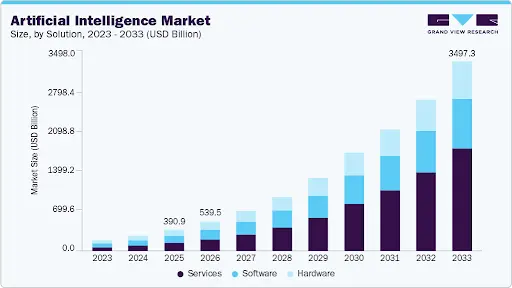
Overall, the global artificial intelligence market was valued at USD 390.91 billion in 2025 and is projected to reach USD 3,497.26 billion by 2033, growing at a CAGR of 30.6% between 2026 and 2033.
-
Based on component type, the services segment generated the highest revenue, capturing 36.3% of the market share in 2025.
-
When analyzed by technology, deep learning led the market, securing a significant 25.3% revenue share during the same year.
-
Machine Learning (ML) emerged as the leading technology segment, securing a 43.5% share of the market.
-
China currently leads global AI adoption, with 58% of companies already using AI technologies, while an additional 30% are actively evaluating AI integration.
AI takeover: Share of frontier tech market could quadruple by 2033
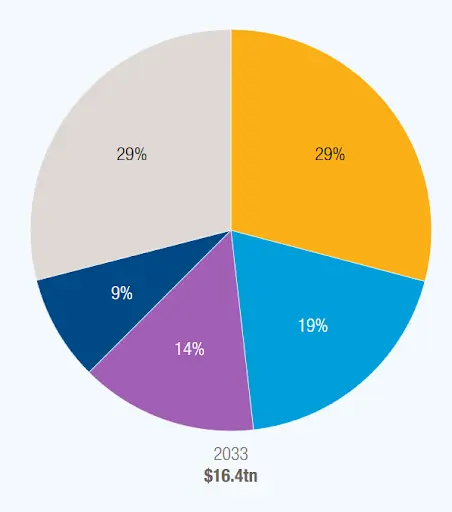
Estimated frontier technology market size and share of selected technologies, 2023 and 2033
-
The current AI landscape is largely driven by global technology leaders. Companies like Apple, Nvidia, and Microsoft each hold a market valuation of nearly $3 trillion, a figure comparable to the combined GDP of the entire African continent.
-
In terms of AI governance, only the G7 nations are actively participating in all major global AI policy initiatives, while 118 countries, primarily developing nations, are not involved in any major AI governance frameworks.
With that in mind, it is clear that the future of AI is promising and will bring remarkable advancements across industries.
Key Factors Driving AI Growth in the Next Decade
AI is becoming a core driver of innovation as businesses adopt smarter technologies and data-driven solutions.
Advancements in computing power, machine learning models, and global investments are pushing AI into new industries and applications.
As these development grows, many experts asking important questions: what is the future of ai and how artificial intelligence will evolve in the future.
Let’s get to know how it will grow:
1. Explosive Growth of Data
Every day, billions of devices, apps, and digital platforms generate enormous amounts of data.
This data is the fuel that powers modern AI systems, helping them learn patterns, make predictions, and improve decision making.
As businesses continue to digitize their operations, the availability of high-quality data will keep increasing.
This massive data ecosystem will play a critical role in answering the question: How will AI continue to grow in 10 years?
2. Breakthroughs in Machine Learning and Deep Learning
Artificial intelligence is evolving rapidly because machine learning and deep learning models are becoming more powerful and sophisticated.
New algorithms can analyze complex datasets, understand patterns, and deliver smarter insights than ever before.
From voice assistants to recommendation engines, these technologies continue to improve digital experiences and clearly reflect the future of AI across industries and everyday life.
Over the next decade, advancements in AI models will unlock new capabilities that businesses and developers can leverage.
3. Rising Global Investments in AI
Governments, technology companies, and startups are investing billions of dollars into artificial intelligence research and development.
Major tech giants are competing to build advanced AI infrastructure, while startups are creating innovative AI-powered products.
This massive financial support is accelerating innovation and pushing the boundaries of what AI can achieve.
As investments continue to rise, AI will expand into new industries and transform how businesses operate.
At the same time, many organizations are evaluating the cost to develop an AI app as they plan long-term AI strategies and digital transformation initiatives.
3. Expansion of Cloud and Edge Computing
Cloud computing has made AI more accessible by providing scalable infrastructure and powerful computing resources.
Businesses no longer need expensive hardware to build or deploy AI systems.
At the same time, edge computing allows data to be processed closer to devices, enabling faster and more efficient AI applications.
Together, cloud and edge technologies are creating the foundation for the next generation of intelligent applications and services, enabling groundbreaking future developments in artificial intelligence.
4. Growing Demand for AI-Powered Automation
Businesses across industries are constantly looking for ways to improve efficiency and reduce operational costs.
AI-powered automation helps companies streamline repetitive tasks, analyze data faster, and improve productivity.
From automated customer service to intelligent workflow management, AI is transforming everyday business operations.
As companies prioritize efficiency and innovation, the demand for automation will continue to drive AI growth worldwide.
Top AI Trends That Will Shape the Next 10 Years
Artificial Intelligence is moving far beyond simple automation and is now shaping how businesses innovate, compete, and serve customers.
But, AI is not stopping here.
The time is already shifting with new advancements on one side, where Claude launched Opus 4.6, and on the other side, China is taking over the Physical AI race.
Let’s closely watch the top AI trends that are making the waves in the market:
#1: Generative AI Expansion
Generative AI is no longer just a futuristic idea.
Today it writes content, designs images, generates code, and even assists with decision making across industries.
Businesses are using it to speed up creativity, automate tasks, and build smarter digital products.
With the market expected to grow at 24.4 percent between 2023 and 2030, the demand for generative ai development services is rising fast as companies look to create intelligent systems that continuously learn and improve.
#2: AI Agents and Autonomous Systems
The global AI agents market is expected to grow to around USD 182.97 billion by 2033.
AI agents are moving beyond simple automation and stepping into decision-making roles.
These intelligent systems can analyze data, perform tasks, and adapt to changing situations without constant human input.
Businesses now use them for customer support, workflow management, and predictive operations.
As organizations aim to automate complex processes, the demand for AI agent development services is growing rapidly to build systems that act, learn, and improve on their own.
#3: Hyper Personalization with AI
AI is changing how businesses understand their customers.
Instead of broad targeting, companies can now deliver highly tailored experiences based on user behavior, preferences, and real-time data.
AI analyzes browsing patterns, purchase history, and interaction signals to predict what a user needs next.
This allows brands to show relevant content, smarter recommendations, and personalized communication that make digital experiences feel more human and engaging.
#4: Use of AI in Cybersecurity
Today, AI in cybersecurity helps organizations detect threats faster by analyzing massive amounts of data and identifying unusual patterns in real time.
Security systems can now flag suspicious activity, prevent fraud, and reduce response time during cyber attacks.
In the future, AI will play a bigger role by predicting threats before they happen, automatically responding to attacks, and strengthening digital defenses across complex enterprise networks.
#5: Increase Use of AI Chatbots
From customer service to sales assistance, businesses are using AI chatbots to handle conversations faster and more efficiently.
Many companies now partner with an AI chatbot development company to build intelligent bots that answer queries instantly and reduce response time.
This also helps brands deliver smoother and more responsive digital experiences for their customers.
Now, let’s take a closer look at the key industries where AI is driving major transformation and innovation.
How AI Will Transform Major Industries in the Next Decade?
As businesses adopt smarter technologies, the role of artificial intelligence will expand across almost every sector.
When experts ask how AI will continue to grow in 10 years, the answer often points to deeper automation, better decision-making, and intelligent systems that reshape how industries operate and serve customers.
Let’s get to know it all:
1. Automotive
The automotive industry is shifting from mechanical engineering to software-driven experiences.
We are seeing a move away from internal combustion towards connected, electric ecosystems where the car is an extension of our digital lives.
Performance is no longer just about horsepower; it is about the intelligence of the cockpit and the safety of the sensors.
-
The Future: AI in Automotive will lead us to Level 5 autonomy, where steering wheels become optional.
Cars will communicate with each other (V2V) to eliminate accidents entirely, turning your morning commute into a mobile office or a private cinema where the "driver" can finally relax.
2. Banking
Banking has evolved from physical vaults and ledgers to invisible, embedded finance.
Today, it’s about speed, mobile accessibility, and global connectivity.
However, the backend still struggles with legacy systems and slow verification processes that frustrate the modern user.
The focus is now shifting toward a frictionless, "bank-less" experience where transactions happen in the background of daily life.
-
The Future: AI in Banking will eliminate fraud through biometric behavioral patterns and provide hyper-personalized financial advice.
Imagine an assistant that automatically moves your money into high-yield assets the second your paycheck hits, ensuring your wealth grows without you lifting a finger.
3. eCommerce
We have moved past simple online catalogs into an era of social commerce and instant gratification.
Browsing is no longer a chore but a curated entertainment experience.
However, the "return rate" remains a massive hurdle because customers often find that products don't look the same in person as they did on a screen.
-
The Future: AI in Ecommerce will bridge this gap using predictive logistics and advanced AR.
It won't just suggest what you might like; it will predict when you’re about to run out of coffee and have it delivered before you even realize the jar is empty.
4. Education
Education is breaking the barriers of geography and the rigid "industrial age" classroom.
We are seeing a rise in micro-learning and digital credentials that value skills over degrees.
Yet, the challenge remains: how do we keep students engaged in a world full of digital distractions? The answer lies in making learning as addictive as a video game.
-
The Future: AI in Education will create "Digital Twin" tutors for every student.
These mentors will understand exactly when a child is confused by a math problem and pivot the explanation to use a metaphor they love, such as sports or music, ensuring no student is ever left behind.
5. Finance
The world of finance is moving faster than human traders can blink.
It’s a high-stakes environment of global markets, crypto-assets, and complex derivatives.
Efficiency is the name of the game, and the margin for error is shrinking to zero as data volumes explode beyond human comprehension.
-
The Future: AI in Finance will act as a global stabilizer. Algorithms will be able to detect market bubbles before they burst and automate complex tax and compliance filings instantly.
This will democratize high-level hedge fund strategies, making sophisticated wealth-building tools available to the average person on the street.
6. Healthcare
Healthcare is transitioning from "reactive" to "proactive."
For decades, we only went to the doctor when something was already broken. Now, wearable tech is giving us a 24/7 look at our vitals.
The goal is to create a world where "sick care" becomes true "health care," focusing on longevity and prevention rather than just curing.
-
The Future: AI in Healthcare will enable robotic surgeries with zero margin for error and discover new life-saving drugs in weeks instead of decades.
We will see "Digital Biology," where your unique genetic code allows for a custom-tailored pill designed specifically for your body’s unique chemical makeup.
7. Insurance
Insurance has traditionally been a "grudge purchase", something you pay for but hope you never use.
The industry is often criticized for being slow and opaque.
However, data is changing the game, allowing companies to understand risk at an individual level rather than grouping everyone into broad, unfair demographic buckets.
-
The Future: AI in Insurance will shift the model to "Prevention-as-a-Service." Your smart home sensors will detect a leaky pipe and alert the insurer, who then sends a plumber before your floor is ruined.
Claims will be settled in seconds via photo recognition, making the entire process painless and transparent.
8. Logistics
Logistics is the invisible circulatory system of the world. It’s a massive puzzle of ships, planes, and trucks trying to beat the clock.
Currently, the industry faces challenges with the "last mile"—the most expensive and inefficient part of the journey from the local hub to your front door.
-
The Future: AI in Logistics will synchronize the global supply chain into a single, intelligent entity.
We will see autonomous drone swarms and underground delivery tubes, while predictive algorithms ensure that products are moved to your city even before you've clicked the "buy" button.
9. Transportation
Mass transit and urban mobility are being redesigned for a greener, more crowded world. We are moving away from private car ownership toward "Mobility as a Service" (MaaS).
The focus is on reducing the carbon footprint while increasing the speed and reliability of how we move through our growing mega-cities.
-
The Future: AI in Transportation will manage "Smart Cities" where traffic lights don't have timers but instead react to real-time flow.
It will coordinate high-speed hyperloops and air taxis, ensuring that your journey across a city is a seamless transition between different modes of transport without any waiting time.
10. Retail
The physical retail store is far from dead; it’s just being reborn as an interactive playground.
Retailers are focusing on "omnichannel" strategies where the convenience of online shopping meets the tactile joy of the physical world.
The goal is to turn "shopping" into an "experience" that can't be replicated on a smartphone.
-
The Future: AI in Retail will personalize the physical store in real-time. As you walk through an aisle, digital displays will change to show you products based on your preferences.
Mirrors will show you how a dress looks in different lighting, and "Just Walk Out" technology will make traditional cashiers a thing of the past.
11. Manufacturing
Manufacturing is undergoing the "Fourth Industrial Revolution."
Factories are becoming "dark", meaning they can operate without lights because they are fully automated by robots.
The focus is shifting from mass production (making millions of the same thing) to mass customization (making a million different things at the same high speed).
-
The Future: AI in Manufacturing will enable "Self-Healing Factories." Machines will sense their own wear and tear and 3D-print their own replacement parts.
This will lead to a localized production model where products are printed in your neighborhood rather than being shipped across the ocean, drastically reducing environmental impact.
How AI Will Impact Jobs and Workforce Skills?
The workforce is currently standing on the edge of a "Great Re-skilling" era, where the traditional career ladder is being replaced by a dynamic lattice of human-machine collaboration.
We are moving toward what many call a post-labor curiosity age, where the role of human work is beginning to shift.
Dario Amodei, CEO of Anthropic, believes AI models will cut half of entry-level jobs by 2030.
The workforce is standing on the edge of a "Great Re-skilling" era, where the traditional career ladder is being replaced by a dynamic lattice of human-machine collaboration.
We are moving toward what many call a post-labor curiosity age, where the role of human work is beginning to shift from "doing" to "directing."
Dario Amodei, CEO of Anthropic, believes AI models will cut half of entry-level jobs by 2030, suggesting that AI is rapidly reaching "Ph.D. level" capabilities.
As we navigate the future of artificial intelligence in the next 10 years, the job market will prioritize "Human-in-the-loop" skills:
-
The Prompt Architect: Coding and writing become secondary to the ability to "engineer" complex solutions through AI.
-
The Empathy Economy: As AI masters logic, "soft skills" like conflict resolution and genuine human connection will become the highest-paid assets.
-
Hyper-Specialization: Deep domain expertise combined with AI-fluency will create "Super-Employees" who can do the work of entire departments.
Ultimately, we aren't just looking at job displacement; we are looking at job enhancement. The future belongs to the "Adaptive Worker" who treats AI as a co-pilot, letting technology handle the data-heavy "work" so they can focus on "innovation."
Future Predictions: What AI Could Look Like in 2035
The next decade could redefine how businesses operate.
Studies suggest that AI could contribute $15.7 trillion to the global economy by 2030, and its impact will grow even stronger by 2035.
In many industries, AI in business is evolving beyond simple automation to become a strategic partner that enables leaders to make faster and smarter decisions.
By 2035, companies may use AI systems that predict market shifts, design products with minimal human input, and manage global supply chains in real time.
AI assistants could analyze millions of data points within seconds and recommend the best actions for growth.
The most interesting shift will be collaboration. Humans will focus on creativity, strategy, and innovation, while AI handles complex data processing and operational decisions behind the scenes.

How JPLoft Can Help Your Business to Leverage Wave of AI Innovation?
Artificial intelligence is no longer a future concept. It is already transforming how businesses build products, serve customers, and make decisions.
The challenge many companies face is not understanding AI, but knowing how to implement it effectively. That is where JPLoft steps in.
As a trusted AI app development company, JPLoft helps businesses turn complex AI ideas into practical digital solutions.
From intelligent chatbots and predictive analytics tools to AI-powered mobile apps and automation systems, the team builds solutions that improve efficiency and customer engagement.
JPLoft focuses on creating scalable AI systems that integrate smoothly with existing platforms. This means businesses can adopt AI without disrupting their current operations.
By combining technical expertise with real business insight, JPLoft enables organizations to unlock new opportunities, streamline workflows, and stay competitive in an AI-driven world.
Conclusion
Artificial intelligence is entering a phase of rapid transformation that will reshape how businesses operate and how people interact with technology.
Over the next decade, advancements in generative models, intelligent automation, and autonomous systems will redefine industries and create new opportunities for innovation.
From healthcare and finance to retail and logistics, AI will drive smarter decisions, faster operations, and highly personalized digital experiences.
At the same time, organizations must prepare for this shift by adopting intelligent technologies and building AI-driven strategies.
Businesses that embrace innovation early will be better positioned to compete in the evolving digital economy.
As the pace of change accelerates, understanding how will AI continue to grow in 10 years will help companies adapt, innovate, and unlock new growth opportunities in an AI-powered future.
FAQs
AI will grow through advancements in machine learning, generative models, automation, and data analytics. These technologies will enable smarter decision-making systems and transform industries such as healthcare, finance, transportation, and retail.
Industries such as healthcare, finance, logistics, retail, manufacturing, and education will see major transformation as AI improves efficiency, predictive analysis, and customer experiences.
AI is more likely to change jobs rather than eliminate them completely. Many roles will shift toward collaboration with AI systems, focusing on creativity, strategic thinking, and problem-solving.
Businesses can start by identifying areas where automation or predictive insights can improve operations. Partnering with experienced development teams helps implement AI solutions that align with business goals.
AI will act as a powerful decision-support system by analyzing large datasets, identifying trends, and providing real-time insights that help companies make faster and more informed strategic decisions.

Rahul Sukhwal is the CEO and Founder of JPLoft, a visionary technologist with 18+ years at the forefront of emerging tech innovation and software engineering. He channels deep software engineering and AI expertise into building smarter, scalable solutions that shape how forward-thinking businesses worldwide harness the true power of AI.




Share this blog