



Key Takeaways:
ROI (%) = (Net Revenue - Investment Cost / Total Cost of Investment) × 100
A true ROI figure needs every cost counted, from planning and design to marketing and yearly maintenance.
The payback period is total investment divided by average monthly profit, and it shows when the app breaks even.
An app can still deliver strong returns without direct revenue when savings, saved time, and retention are given dollar values.
Denver businesses can raise app returns by starting with key features, using data, automating tasks, and tracking ROI every month.
Spending money on an app without knowing what it will earn back is a risky bet. Yet many Denver business owners approve app budgets on instinct, then wonder months later if it was worth it.
The good news is that you do not need to guess. To calculate the ROI of mobile app development for Denver businesses, subtract the total cost from total benefits, divide by total cost, and multiply by 100. With the right numbers, you can calculate the ROI of mobile app development for Denver businesses that teams can rely on before development even begins.
ROI simply compares what an app costs with what it brings in each year. That means new sales, saved staff hours, and loyal repeat customers.
From aerospace to healthcare, Denver companies are going mobile to grow faster. Growth only counts when the math supports it.
This guide explains the full process step by step in simple words, so every dollar you invest has a clear purpose and a measurable result for your team.
Why Should Denver Businesses Calculate Mobile App Development ROI?
Many app projects fail because nobody checked the numbers first. Looking at return early helps Denver businesses spend with confidence and avoid costly surprises. Let us discuss this in detail below.

1. Protects Your Budget
A clear mobile app ROI calculation shows if the money worth investing. It helps you set a realistic budget and stop spending on features that will not pay off.
2. Builds Trust With Investors
Founders and CTOs in Denver often pitch to investors. Hard numbers on expected returns strengthen your case and show the plan is well thought out.
3. Guides Smarter Decisions
ROI figures help you compare options, such as building a new app or improving an old one. They also show which features bring the fastest payback.
4. Tracks Growth Over Time
After launch, your first ROI estimate becomes a benchmark. You can check real results against it and fix problems early.

What Costs Should Be Included in Mobile App ROI Calculation?
To calculate ROI for a mobile app correctly, you must count every cost, not just development. Missing even one expense can make your returns look better than they really are.

1. App Planning and Research Costs
This stage covers market research, competitor study, and defining features. Denver teams often skip it, but good planning prevents rework later. Count the hours spent here, because they form the base of every later cost.
2. UI/UX Design Costs
Design shapes how users feel about your app. Costs include app wireframes, screen layouts, and user testing. Strong UI/UX design services raise sign-ups and repeat use, so include it as a real investment, not just an extra expense.
3. Development and Testing Costs
The cost to build a mobile app in Denver is usually the biggest factor. It includes developer pay, backend work, and quality checks on different devices. Always add testing too, since fixing bugs after launch costs far more money than catching them early.
4. Third-Party Integration Costs
Apps often rely on payment gateways, maps, analytics, and cloud services. These tools often charge setup fees or monthly rates. List each one, since small monthly charges add up quickly over a full business year.
5. App Launch and Marketing Costs
A great app still needs users. Budget for app store fees, ads, social media, and launch events. In a busy market like Denver, marketing spend often decides how fast your app earns its first returns.
6. Maintenance and Update Costs
Launch is not the finish line. Yearly app maintenance services cover bug fixes, security patches, server fees, and updates for new phone systems. Leaving this cost out makes your final ROI look higher than it truly is.
How to Calculate the ROI of Mobile App Development for Denver Business?
The answer to how to calculate the ROI of a mobile app is easier when you follow clear steps. Use the seven steps below, with simple numbers from your own Denver business records.
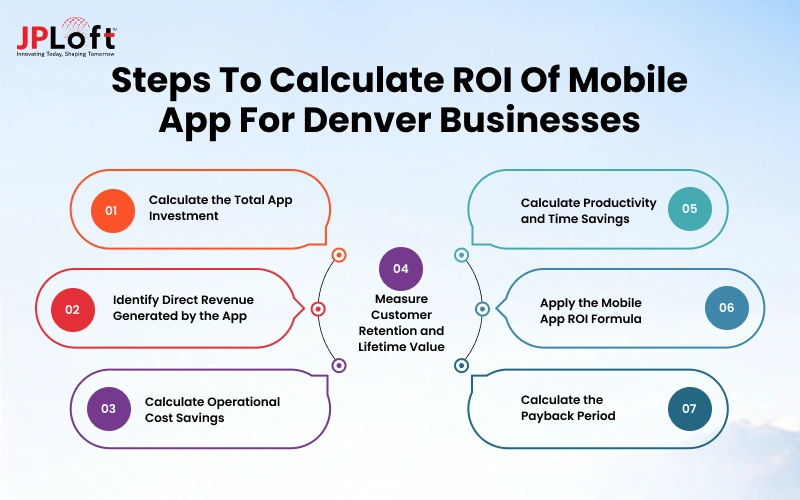
Step 1: Calculate the Total App Investment
Start by adding up everything you will spend on the app. This gives you the cost side of your ROI.
- Development Cost Breakdown: List developer pay, backend work, and server setup. Split the total by app features, so you can see which parts cost the most and which can wait for a later release.
- Design and Testing Costs: Add the cost of screen design, user testing, and quality checks. These steps lower the risk of bugs and poor reviews, so they clearly belong in your total investment figure.
- Maintenance and Marketing Costs: To calculate the ROI of a mobile app in Denver, include yearly upkeep and ad spend. Updates, fixes, and promotion keep the app useful and help bring in new users.
Step 2: Identify Direct Revenue Generated by the App
Next, find the money the app earns on its own. Track every sale or fee that comes straight from users.
- In-App Purchase Revenue: Add up all that users spend on premium items, extra features, or digital goods. Check the monthly totals, since steady purchases show that users find real value in your app.
- Booking and Service Revenue: Count all the income from bookings, appointments, and paid services made through the app. This is very common for Denver service businesses, such as salons, clinics, and outdoor tour companies.
- Subscription and Upgrade Revenue: Include monthly plans and paid upgrades. For the ROI of custom mobile app development in Denver, recurring income matters most, because it grows steadily and is easy to plan around.
Step 3: Calculate Operational Cost Savings
Apps can save money by cutting daily work. Look at the tasks the app reduces and add a dollar value.
- Automated Process Savings: Note the manual jobs the app now does for you, such as order entry, reminders, or simple reports. Multiply the hours saved by the average hourly pay of your staff.
- Reduced Support Expenses: Self-service features like chat, FAQs, and order tracking lower the total number of calls and emails. Fewer support tickets mean you can spend less on extra staff and phone costs.
- Lower Administrative Costs: Paperless forms, digital records, and quick approvals cut office work and extra expenses. Add up the savings on printing, paper, data entry, and the time your team spends on paperwork.
Step 4: Measure Customer Retention and Lifetime Value
Learn how to calculate mobile app ROI over time by tracking loyal users. Repeat customers spend more, so count them.
- Customer Retention Rate: This is the share of users who keep using your app after a set time. Divide returning users by total users to find your rate, then compare it each month.
- Average Customer Lifetime: Check how long a customer stays active with your app. A longer lifetime means more purchases from each user, which raises the return you earn on the same build cost.
- Customer Lifetime Value: Multiply spend per order by orders per year and by customer lifetime. The result shows what one user is worth, which you can compare against the cost of winning them.
Step 5: Calculate Productivity and Time Savings
Time saved is money saved. Measure how the app helps your team get more done in the same working hours.
- Employee Time Savings: When calculating mobile app development for Denver businesses, check how many work hours your staff saves on calls, paperwork, and travel. Then multiply those hours by each worker's hourly pay.
- Faster Task Completion: Mobile tools help staff finish jobs sooner, like field visits, approvals, and sales updates. Compare the old time per task with the new time, then convert the gain into dollars.
- Improved Team Productivity: Look at output per employee, such as more orders handled or more clients served each day. Higher output without hiring more people is a clear financial gain you can count.
Step 6: Apply the Mobile App ROI Formula
Now bring all your numbers together. Put your gains and costs into one simple formula to see your real return.
- Total Financial Benefits: Add your direct revenue, your cost savings, and the full value of time saved. This total is the key part of your mobile app ROI calculation, so count every benefit.
- Net App Profit: Subtract your total app investment from your total benefits. The answer is your net profit. If it is above zero, the app has earned more than it cost so far.
- ROI Percentage Calculation: Divide net profit by total investment, then multiply by 100. For example, a $50,000 profit on a $100,000 investment gives a 50 percent ROI, which shows strong returns for you.
Step 7: Calculate the Payback Period
ROI shows how much you earn, while payback shows how fast. Find out when the app earns back its cost.
- Monthly Investment Recovery: Divide total cost by average monthly profit. This shows how many months you need to recover your spend, helping you calculate mobile app development ROI Denver owners can trust.
- Break-Even Timeline: Break-even is the point where your total earnings equal your total spending. Mark this date on your project plan, since every month after it adds pure profit to your business.
- Long-Term ROI Projection: Estimate returns over three to five years, using steady growth and yearly costs. Long-term views show the app's full value, since returns often grow as more users join.
Key Metrics Denver Businesses Should Track to Measure Mobile App ROI
Tracking the right numbers turns a guess into a clear picture. These eight metrics help Denver businesses see if an app is earning its cost and where it needs fixing.

1. Customer Acquisition Cost (CAC)
CAC is the money you spend to win one new app user. Add ad costs, offers, and team time, then divide by new users. A lower CAC means faster payback and more profit per user.
2. Customer Lifetime Value (CLV)
To understand how to calculate mobile app ROI, compare CLV with CAC. CLV shows the total money one user brings during their time with your app. If CLV is higher, then growth clearly pays off.
3. Conversion Rate
Conversion rate is the share of users who take a wanted action, like buying, booking, or signing up. Divide actions by total app visitors. Low rates often point to weak design or confusing user steps.
4. Retention Rate
Retention rate shows how many users return after a set time, such as 30 days. High retention means people find the app useful, which steadily raises revenue without extra ad spend or new user costs.
5. Cost Savings
Cost savings are the money saved when the app replaces manual work. Count fewer support calls, fewer paper forms, and saved staff hours. These savings often cover a large part of the total build cost.
6. User Engagement
User engagement tracks how often and how long people use the app. Watch daily active users, session length, and feature use. Highly active users are more likely to buy, renew, and recommend it.
7. App-Generated Revenue
App-generated revenue is every single dollar the business earns directly through the mobile app alone. To judge the ROI of custom mobile app development in Denver, compare this with total costs. Steady growth proves it works.
Factors That Can Affect Mobile App ROI in Denver
Even a well-built app can miss its targets if key factors are ignored. Knowing what moves your returns helps Denver businesses plan better and protect their overall investment.
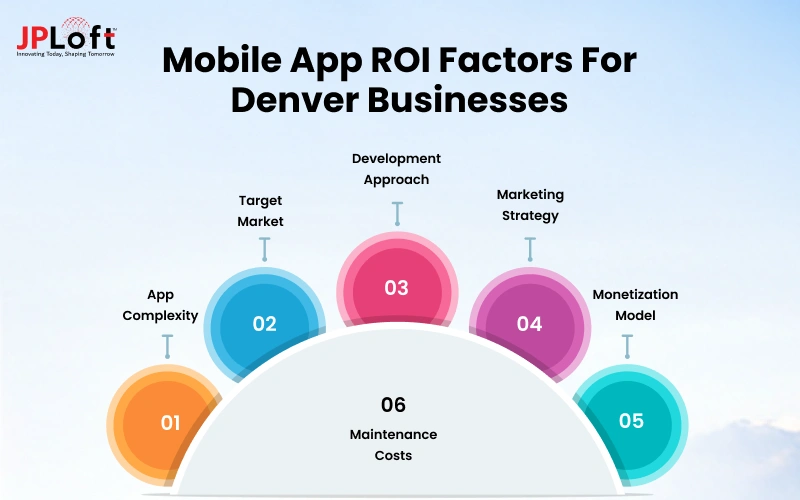
1. App Complexity
Simple apps cost less and launch faster, while complex apps with many features need more time and money. Keep the first version simple and focused, then add features as real user demand and revenue grow.
2. Target Market
Local users shape your results. Their age, daily habits, and income affect downloads and spending, so study them early. A clear audience also helps you calculate the ROI of a Mobile App in Denver more accurately.
3. Development Approach
Native, cross-platform, and no-code builds differ in cost, speed, and quality. Native apps feel much smoother but cost more, while cross-platform saves money. Choose the approach that best matches your budget, timeline, and users' needs.
4. Marketing Strategy
A great app still needs smart promotion to get found. Use app store optimization, local ads, and referral offers to reach Denver users. Better marketing lowers your cost per user and speeds up your returns.
5. Monetization Model
Your app monetization model decides how fast money comes in. Subscriptions, in-app sales, ads, and paid downloads all work differently, and each one suits a different kind of user. When calculating mobile app development for Denver businesses, choose the model that fits your buyers.
6. Maintenance Costs
Updates, bug fixes, security checks, and app maintenance continue every year after launch. These costs add up over time, so plan for them early. Ignoring them can quietly shrink your profit and lower your final ROI.
How Denver Businesses Can Improve Mobile App ROI?
A strong return does not happen by chance. With a few smart steps, Denver businesses can get more value from the same budget and see results sooner after your launch.

1. Start With High-Value Features
Begin with the features users need most, such as booking, payments, or order tracking. A smaller first build costs less and earns sooner, which makes it easier to calculate mobile app development ROI Denver businesses can trust.
2. Use Data to Improve User Experience
Study app data like drop-off points, slow screens, and most-used tools. Small fixes based on real behavior keep users happy, lift conversion, and raise revenue without a big new spend.
3. Automate Repetitive Business Processes
Let the app handle repeat tasks like reminders, invoices, and order updates. Your staff then spend time on higher-value work, and your cost savings grow every month the app stays in use.
4. Improve Customer Retention
Retaining a user costs less than finding a new one. Use push alerts, loyalty rewards, and personal offers to bring people back. Higher retention lifts lifetime value and makes every ad dollar work harder.
5. Control Development and Maintenance Costs
A tight budget improves every mobile app ROI calculation, so plan costs in phases and use cross-platform tools where they fit. Regular code cleanups also cut long-term repair bills.
6. Track ROI Continuously
Review your numbers every month, not just once. Compare actual returns with your first estimate, spot problems early, and adjust your plan. Steady tracking keeps the app profitable as the market changes.

How Does JPLoft Help Denver Businesses Build ROI-Focused Mobile Apps?
Choosing the right partner can decide whether your app earns or just costs. As a trusted mobile app development company in Denver, JPLoft builds apps with clear business goals and measurable returns from day one.
JPLoft starts with your goals, budget, and target users. The team then plans a lean MVP with high-value features, so you spend less and start earning sooner.
Here is what Denver businesses can get:
-
Clear cost planning and honest estimates
-
Experienced developers for iOS, Android, and cross-platform apps
-
Built-in analytics to track revenue, retention, and savings
-
Ongoing support and updates after launch
From startups to growing enterprises, businesses across Denver rely on JPLoft to turn app ideas into steady profit. Share your idea today, and get a clear plan that shows what your app can earn. Partner with a team that always measures success by your real business returns.
Conclusion
Knowing your return is no longer a guess. By learning how to calculate the ROI of a mobile app, Denver business owners can see costs, gains, and payback before investing a single dollar.
Start by adding every cost, from planning to maintenance. Then count revenue, savings, and time saved, and apply the ROI formula. Track key metrics like CAC, CLV, and retention to see the full picture.
Factors like app complexity, user adoption, and marketing will shape your results, so review your numbers often and adjust early. Small, steady fixes can raise returns and protect your profit over time.
A skilled partner keeps your budget on track. If you are ready to build an app that pays for itself, connect with the JPLoft team today and turn your idea into steady, measurable growth for your Denver business this year.
FAQs
To learn how to calculate mobile app ROI, subtract total app cost from total benefits, divide by total cost, then multiply by 100. The common benefits of calculating the ROI include revenue, savings, and time saved.
Include planning and research, design, development and testing, third-party integrations, launch and marketing, and yearly maintenance. Counting every cost gives you a true ROI and avoids overly inflated, misleading results.
Timing depends on app cost, user growth, and monthly profit. Divide total investment by average monthly profit to find your payback period, and mark the break-even point on your project plan.
Yes. To calculate ROI for a mobile app without direct revenue, add dollar values for cost savings, faster work, fewer support calls, and better retention. Include them in the formula.
Start with high-value features, use data to improve user experience, and automate repeat tasks. Track ROI every month, control costs, and improve retention to keep returns growing steadily over time.

Priyanka Sukhwal is the Managing Director and Business Head of JPLoft, with 10+ years of experience in technology, digital product strategy, and business growth. She has worked closely with businesses building mobile applications, custom software, marketplaces, and on-demand platforms across mobility, automotive, consumer services, and startup ecosystems. At JPLoft, she focuses on understanding business models, identifying product opportunities, and helping companies plan digital solutions that can scale with changing market needs.





Share this blog