



Key Takeaway
Validating your idea and building an MVP are key steps to securing mobile app startup funding in UK.
The amount of funding depends on your app’s complexity and long-term goals.
Choosing the right funding option for app depends on your startup stage and needs.
Strong networking and a clear business model help you attract the right investors.
Working with experts like JPLoft helps you build a strong MVP and improve funding chances.
Building a mobile app is exciting, but funding is often the biggest challenge for founders. Many startups struggle with mobile app startup funding in UK because they are unsure where to begin or what investors expect.
However, the opportunity is huge. The UK mobile app market is already worth over £10,585 million ($14,205M) and is expected to reach £24,486 million ($32,860M) in 2030.
However, this growth means more investors are actively looking for strong app ideas with real potential. But they don’t invest in ideas alone. They invest in execution, traction, and scalable technology.
If you are wondering how to raise money for app startup in UK, you are not alone. Many founders face this challenge early in their journey.
In this blog, you will learn practical strategies that actually work and help you move forward with confidence.
How Much Does it Cost to Develop a Mobile App in the UK?
Understanding development cost is a key step before you plan UK mobile app startup funding. Without a clear budget, it becomes harder to approach investors with confidence.
The cost to build a mobile app in UK can vary based on features and complexity. A simple app with basic functions may cost around £10,000 to £30,000. Mid-level apps with custom design and integrations can range between £30,000 and £70,000.
For complex apps with advanced features, AI, or real-time systems, the cost can go beyond £150,000. These apps require strong backend systems and higher development effort.
Knowing these costs helps you plan better, avoid overspending, and present realistic funding needs to potential investors.

Types of Funding Options for Mobile App Startups in the UK
Choosing the right funding option is a key step in funding for startup in UK.
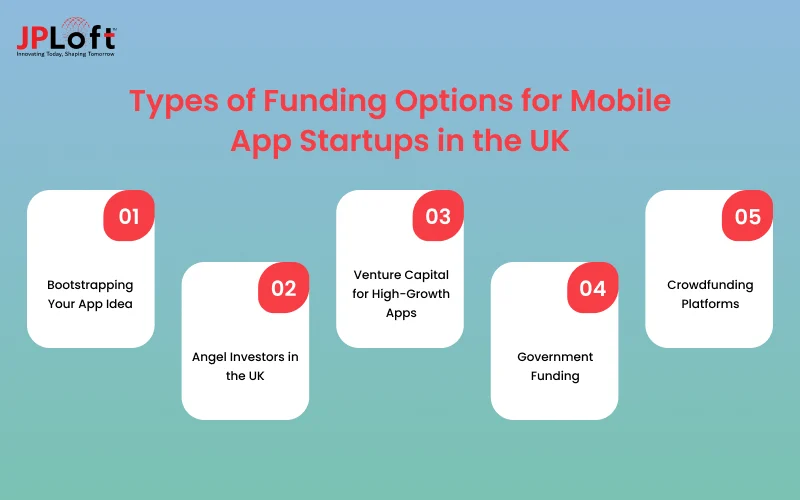
Each option offers different benefits, so startups must choose based on their stage, goals, and how much control they want to keep.
Type 1: Bootstrapping Your App Idea
Bootstrapping means using personal savings or early revenue to build a mobile app. It is a common way to raise money for startup in United Kingdom without giving away equity.
Pros
-
Full control over business decisions and ownership
-
No pressure from external investors
Cons
-
Limited funds can slow down growth and development
Type 2: Angel Investors in the UK
Angel investors support early-stage startups to secure a place in the market. They are ideal if you are exploring how to get investors for an app in United Kingdom and need both capital and mentorship to grow your mobile app idea.
Pros
-
Access to funding and expert guidance
-
Strong network and industry connections
Cons
-
Requires giving away a share of your equity
Type 3: Venture Capital for High-Growth Apps
Venture capital firms invest in startups with strong growth potential and scalable models. If you are planning how to raise money for app startup in UK, this option can provide large funding, but you must be ready to share equity.
Pros
-
Large funding for fast growth and scaling
-
Strategic support and business expertise
Cons
-
High expectations and loss of partial control
Type 4: Government Funding
Government schemes like SEIS, EIS, and Innovate UK help startups with grants and tax benefits. These programs support funding for mobile app development in UK and reduce financial pressure during the early stages of product development.
Pros
-
Non-dilutive funding with tax benefits
-
Lower financial risk for startups
Cons
-
Strict eligibility criteria and longer approval time
Type 5: Crowdfunding Platforms
Crowdfunding helps you collect small investments from many people through online platforms. It is useful if you are exploring how to get funding for an app in UK while also testing your idea and building early user interest.
Pros
-
Helps validate your idea with real users
-
Builds early community and brand awareness
Cons
-
Requires a strong marketing effort to succeed
What Investors Look for in a Mobile App Startup?
Before investing, investors carefully evaluate key factors that reduce risk and show growth potential.
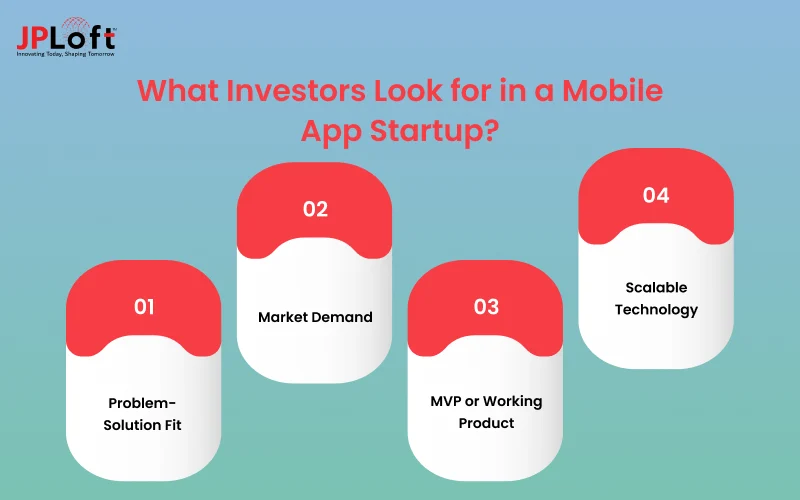
Understanding these points can improve your chances of securing mobile app startup funding in UK and help you prepare your app in the right way.
1. Problem-Solution Fit
Investors first check if your app solves a real and clear problem. If the problem is weak or unclear, your chances of getting funding for an app in UK become very low.
Your solution should be simple, useful, and easy to explain. A strong problem-solution fit shows that users actually need your app and are likely to use it regularly.
2. Market Demand
Investors want to see if there is a real market for your app. Strong demand increases your chances when exploring how to find investors for mobile apps in United Kingdom.
You can prove demand through research, surveys, or early user interest. Showing real data builds trust and helps investors feel confident about your app’s future growth.
3. MVP or Working Product
A working product or MVP makes your idea more real and reduces risk for investors. It plays a key role in UK mobile app startup funding because it shows you can execute your idea.
Even a simple version of your app can help you collect feedback and improve features. Investors prefer startups that have already tested their product with real users.
4. Scalable Technology
Investors look for apps that can grow without major technical issues. Scalable systems are important when planning funding for mobile app development in UK.
Your app should handle more users, data, and features over time. A strong app tech stack base shows that your product is ready for growth and long-term success.
Why Building an MVP is Critical to Raise App Funding?
Building an MVP is one of the smartest steps before applying for mobile app startup funding in UK.
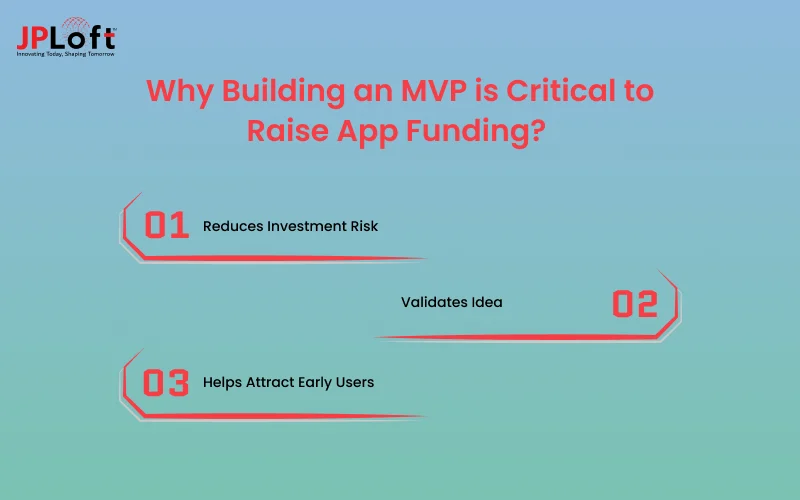
Here we will discuss what makes investing in an MVP is critical for app funding.
[A] Reduces Investment Risk
An MVP shows investors that you have taken action and not just planned an idea. This makes a big difference when thinking about how much funding should I raise, as it brings more clarity.
With a basic version of your app, investors can see how it works and what value it offers. This reduces their risk and increases your chances of getting funded faster.
It also helps you avoid building unnecessary features early. By focusing on core functionality, you save cost and reduce the chances of failure during the initial stages.
[B] Validates Idea
An MVP helps you test whether your idea actually solves a real problem. This is important when planning how to pitch an app idea in UK to investors.
By collecting user feedback, you can improve your app before scaling it further. Validation gives investors confidence that your idea has real potential in the market.
You can also track user behavior and understand what features matter most. This insight helps you make better decisions and build a stronger product over time.
[C] Helps Attract Early Users
An MVP allows you to launch early and start gaining users quickly. This is useful when exploring how to get investors for an app in United Kingdom.
Early users provide feedback and help you understand what works best. Their engagement also shows traction, which is a strong signal for investors looking to fund your app.
Having early users also builds trust and credibility. It shows that people are interested in your app, which makes your startup more attractive to potential investors.
Step-by-Step Process to Raise Mobile App Startup Funding in UK
If you are planning to raise money for startup in United Kingdom, having a clear roadmap and strong execution strategy becomes very important for success.
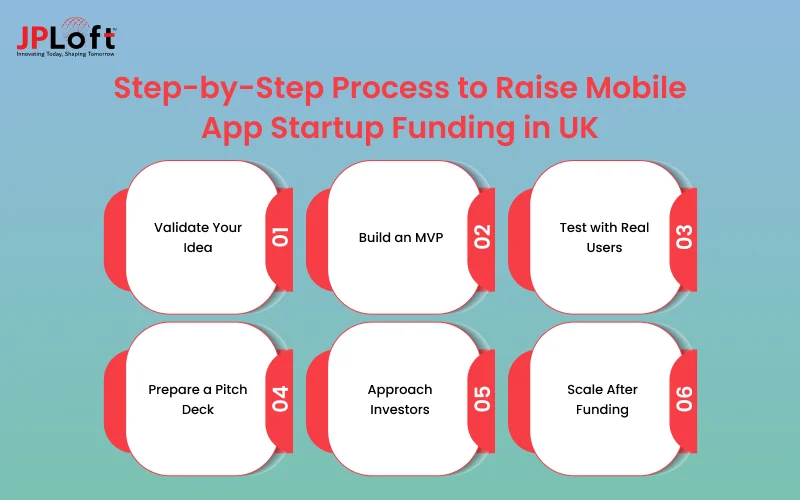
However, a step-by-step plan helps you avoid mistakes and improves your chances of securing funding successfully.
Step 1: Validate Your Idea
Before building anything, it is important to focus on the app market research. This is the first step in how to raise money for app startup in UK and helps you avoid wasting time and resources.
► Understand User Problems
Talk to potential users and identify their real challenges. However, considering app development challenges along with this can help you build a platform that people actually need.
► Analyze Competitors
Study existing apps in your niche to find gaps and opportunities. This helps you improve your idea and create a better and more competitive solution in the market.
Step 2: Build an MVP
Creating an MVP helps you turn your idea into a working product. It plays a key role in app startup funding in UK as it shows investors your ability to execute.
► Focus on Core Features
Build only the essential features that solve the main problem. This helps you save time, reduce costs, and launch your app faster without unnecessary complexity.
► Keep Development Cost-Effective
Avoid adding too many features in the early stage. A simple and functional MVP is enough to test your idea and move forward with confidence.
Step 3: Test with Real Users
Testing your app with real users helps you understand its performance and usability. This step is important when exploring how to get funding for an app in UK.
► Collect User Feedback
Ask users about their experience and gather useful insights. Hence, app testing helps you improve features, fix issues, and make your app more user-friendly over time.
► Improve Performance
Fix bugs and enhance speed and usability. A well-performing app creates a better experience for users and builds trust with potential investors.
Step 4: Prepare a Pitch Deck
A strong pitch deck helps you explain your idea clearly to investors. It is essential when working on how to pitch an app idea in UK effectively.
► Highlight Key Business Points
Clearly present your problem, solution, market size, and revenue model. This helps investors quickly understand your business and its growth potential.
► Show Growth and Traction
Include user data, early results, or feedback. This builds trust and shows that your app has demand and real potential in the market.
Step 5: Approach Investors
Once your app and pitch are ready, you can start reaching out to investors. This is a key step in how to find investors for mobile apps in United Kingdom.
► Target the Right Investors
You can also connect with app funding companies that actively invest in promising mobile app startups. This increases your chances of getting better responses and faster funding opportunities.
► Use Networking Opportunities
Attend startup events and use online platforms to connect. Strong networking helps you build relationships and find investors who match your business goals.
Step 6: Scale After Funding
After securing funds, focus on growing your app and user base. This stage is important for long-term funding for mobile app development in UK success.
► Enhance App Features
Improve your app based on user feedback and add useful mobile app features. This helps you keep users engaged and improve overall satisfaction.
► Invest in Growth
Use funding for marketing, hiring, and scaling your technology. This ensures your app can handle more users and grow smoothly without performance issues.
Common Mistakes UK Startups Make While Raising Funds
Many founders make simple mistakes that reduce their chances of getting funding and becomes the reason why apps in UK fail. Avoiding these errors can save time, money, and improve your chances of success.
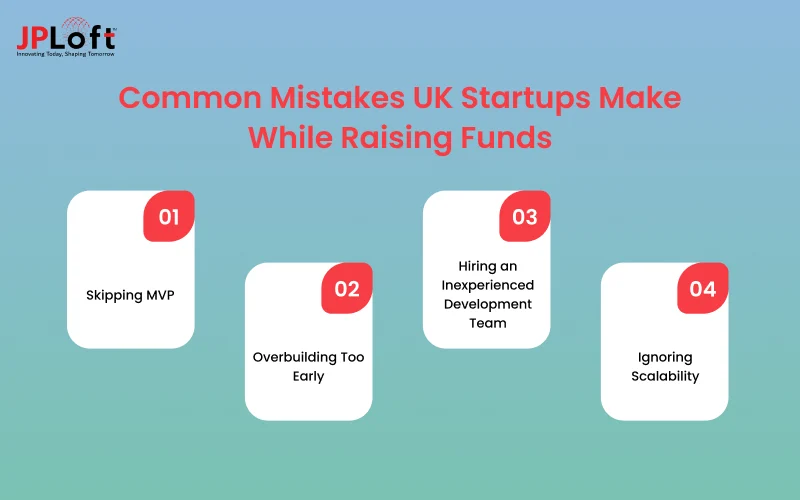
Let’s discuss such common mistakes in detail.
1. Skipping MVP
Some startups try to raise funds without building an MVP. This makes it harder for investors to trust your idea, especially when working on how to get funding for an app in UK.
Without a working product, it is difficult to prove your concept. Investors prefer startups that show effort, validation, and early results through a basic version of the app.
2. Overbuilding Too Early
Many founders spend too much time and money adding features in the beginning. This is a common issue in app startup funding in UK, where early-stage focus should be on testing ideas.
Overbuilding increases cost and delays launch. It is better to start small, test your idea, and then improve based on real user feedback.
3. Hiring an Inexperienced Development Team
Choosing the inexperienced team can affect your app quality and timeline. This becomes a major problem when planning funding for mobile app development in UK.
An inexperienced team may lead to poor performance and delays. However, you must hire app developers from an experienced partner to enhance investor confidence and chances of securing funding.
4. Ignoring Scalability
Some startups focus only on launching quickly and ignore future growth. This can create problems when thinking about how much funding should I raise for long-term success.
If your app cannot handle more users, it may fail after growth. Investors look for apps that are ready to scale and perform well as demand increases.

Why UK Startups Prefer JPLoft to Build a Mobile App?
UK startups often choose JPLoft when planning a mobile app startup funding in UK. This is because they understand both modern technology and business growth.
JPLoft is a trusted mobile app development company in UK that uses the latest technologies like AI, machine learning, and generative AI to build smart and scalable apps.
Their solutions include AI chatbots, predictive analytics, and real-time data processing. Hence, this helps businesses create more engaging and intelligent user experiences.
They also work with modern frameworks like React Native and Flutter, along with cloud platforms such as AWS, Microsoft Azure, and Google Cloud. This helps startups launch faster and scale smoothly without technical limitations.
JPLoft focuses on reducing technical risks by using AI-powered security systems, real-time monitoring, and scalable architecture. Their expertise in LLMs, computer vision, and NLP ensures apps are future-ready and investor-friendly.
This combination of advanced tech and business understanding makes them a strong choice for long-term growth.
Conclusion
Raising funds for a mobile app is not just about finding investors. It is about building a strong foundation that gives them confidence in your idea. This is why understanding UK mobile app startup funding becomes important for every founder planning to enter this space.
From validating your idea to building an MVP and testing it with real users, each step plays a key role in your journey. Investors look for clear problem-solving, market demand, and a product that is ready to grow.
Avoiding common mistakes and choosing the right strategy can improve your chances of success. At the same time, having the right development partner makes a big difference.
A skilled team helps you build a scalable and reliable product that attracts investors faster. With the right approach, planning, and execution, you can turn your app idea into a funded and successful business.
FAQs
To raise funds, start by validating your idea and building an MVP. Then prepare a strong pitch deck and approach angel investors, venture capital firms, or apply for government schemes.
The funding amount depends on your app’s complexity and goals. A simple app may need £10,000-£30,000, while complex apps can require £150,000 or more for development, scaling, and updates.
Popular options include bootstrapping, angel investors, venture capital, government schemes like SEIS and EIS, and crowdfunding platforms. However, each option suits different stages of a startup.
You can find investors through networking events, startup platforms, and investor communities. Researching reliable app funding companies can help you find the right investment partner for your app journey.
An MVP helps test your idea, attract early users, and show real progress. It reduces investor risk and increases trust in your startup.

Priyanka Sukhwal is the Managing Director and Business Head of JPLoft, with 10+ years of experience in technology, digital product strategy, and business growth. She has worked closely with businesses building mobile applications, custom software, marketplaces, and on-demand platforms across mobility, automotive, consumer services, and startup ecosystems. At JPLoft, she focuses on understanding business models, identifying product opportunities, and helping companies plan digital solutions that can scale with changing market needs.





Share this blog