


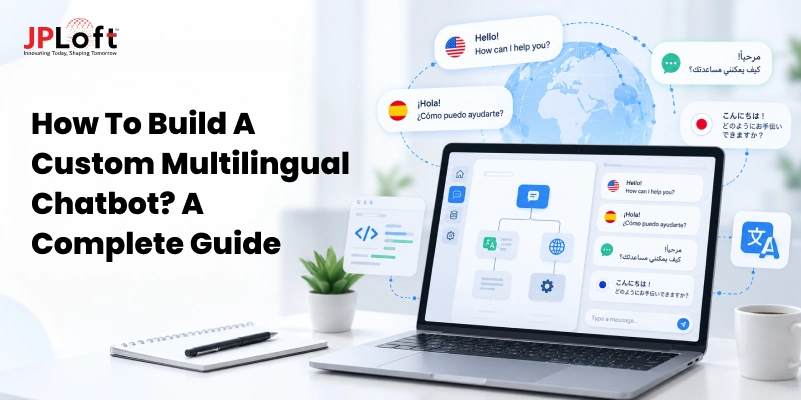
Expanding into new markets means communicating with customers in the languages they understand best. When language becomes a barrier, businesses risk losing potential customers, delaying support, and creating friction at critical points in the customer journey.
Multilingual AI chatbot development helps businesses bridge this gap with conversational systems that understand user intent, respond in different languages, and retrieve relevant information based on customer needs. Beyond translation, these chatbots can maintain context, support customer interactions, and connect with business systems to deliver more consistent experiences across markets.
However, building an effective multilingual chatbot requires more than choosing an AI model. Businesses must consider language coverage, data quality, knowledge retrieval, backend integrations, and response accuracy to ensure the solution meets real-world needs.
This guide covers how multilingual chatbots work, their essential features, the process of “how to create a multilingual AI chatbot”, technology stack, costs, and industry applications to help you make informed decisions and plan a solution that supports your business goals.
QUICK ANSWER
How To Build A Multilingual Chatbot?
To build a multilingual chatbot, choose your target languages, select an AI model, prepare multilingual data, integrate business systems, and test responses for accuracy and context before deployment. Development costs typically range from $15,000 to $450,000, depending on language coverage, AI complexity, integrations, and customization.
What Is a Multilingual Chatbot?
A multilingual chatbot is an AI-powered conversational system that understands and responds to users in multiple languages. Businesses planning to build an AI chatbot with multilingual capabilities can serve diverse audiences through a single interface without building a separate chatbot for each language.
These chatbots use technologies such as natural language processing (NLP), multilingual large language models (LLMs), and machine translation to interpret queries and generate relevant responses. Depending on their architecture, they can process different languages directly or translate queries before retrieving information and responding.
For example, a US healthcare provider could use a multilingual chatbot to help English- and Spanish-speaking patients access appointment details and understand available services. Beyond translation, an effective chatbot must preserve context, handle regional language variations, and deliver consistent, accurate information across supported languages.
Market Overview of Multilingual Chatbots
Growing investment in conversational AI and increasing language diversity are creating opportunities for multilingual chatbot development.
The global multilingual LLM market is projected to reach USD 57 billion by 2035, at 27.30% CAGR.
According to Statista, English has approximately 1.493 billion speakers worldwide, followed by Mandarin Chinese (1.183 billion), Hindi (611 million), and Spanish (561 million). This linguistic diversity highlights the importance of multilingual chatbots in helping businesses communicate with wider audiences and expand into global markets.
-2026-Statista.webp)
Industries Driving Demand
Businesses across industries are adopting AI chatbots to improve customer interactions and serve audiences across languages. Key examples include:
-
Healthcare: The healthcare chatbot market is projected to reach USD 12.63 billion by 2034, growing at a 23% CAGR. Multilingual chatbots can help patients access appointment information, navigate services, and understand routine healthcare guidance in their preferred languages.
-
Retail and E-commerce: Retailers use conversational AI to answer product questions, recommend items, track orders, and manage returns. Brands such as Amazon, Walmart, and Sephora use digital shopping assistants and AI-powered customer experiences, creating opportunities for multilingual support across markets.
-
Banking and Financial Services: US banks are using AI-powered assistants to make digital banking more accessible across language preferences. For example, TD Bank U.S. introduced a Spanish-language mobile banking experience using GenAI and human review, helping customers access digital banking services in their preferred language.
-
Travel and Hospitality: Airlines and hotels serve international customers who need help with bookings, baggage policies, and itinerary updates. Ryanair's AI customer service assistant handles around 120,000 chat interactions daily across seven languages, with an 80% containment rate.
How Do Multilingual Chatbots Work? Core Components
Supporting multiple languages requires more than translating messages. The system must interpret user intent, retrieve relevant information, and generate accurate responses while preserving meaning across languages.
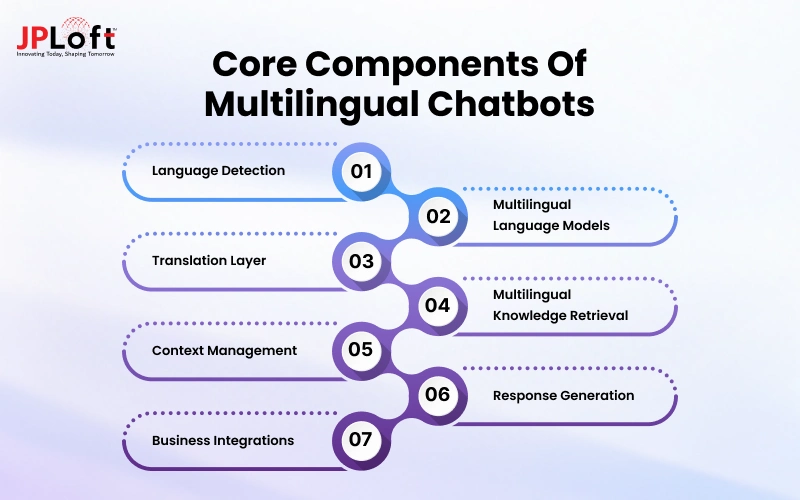
These core components work together to deliver that experience:
-
Language Detection: Identifies the language of incoming messages and detects language changes during conversations.
-
Multilingual Language Models: Interpret intent, context, and regional expressions across supported languages.
-
Translation Layer: Translates queries or responses when direct multilingual processing is insufficient.
-
Multilingual Knowledge Retrieval: Finds relevant information across documents in different languages, even when the query uses another language.
-
Context Management: Maintains conversation history and user intent across follow-up questions and language switches.
-
Response Generation: Produces natural, relevant answers in the user's preferred language.
-
Business Integrations: Connects with CRMs, knowledge bases, and support platforms to retrieve information and complete tasks.
These components can follow a direct multilingual, translation-based, or hybrid architecture. The best fit depends on language coverage, data availability, accuracy requirements, and business needs.
How to Build a Multilingual Chatbot: Step-by-Step
Building a multilingual chatbot involves more than choosing an AI model and connecting it to a chat interface. At JPLoft, our work on AI-powered products has shown how language selection, data quality, retrieval accuracy, and conversation handling shape the user experience.
Each decision affects how well a chatbot understands users across languages and delivers reliable answers.
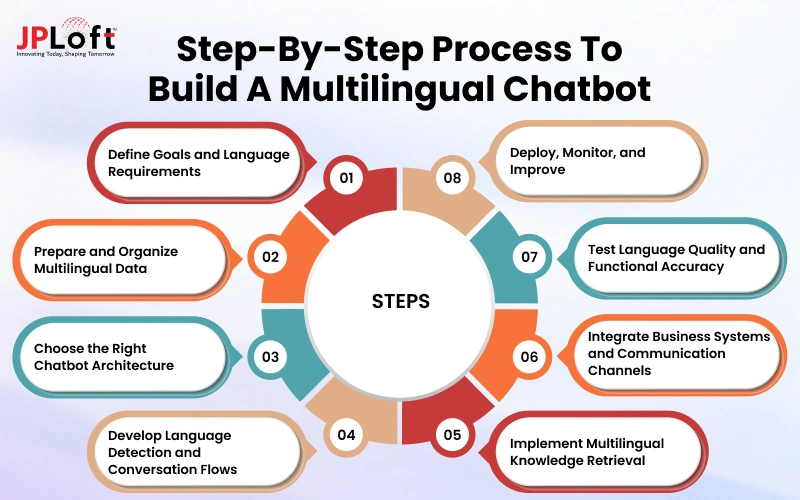
Here’s the step-by-step process to build multilingual chatbots and the key considerations businesses should address at each stage.
Step 1: Define Business Goals and Language Requirements
Start with the problem the multilingual chatbot needs to solve or the benefit of an AI chatbot for the business. A customer support chatbot has different requirements from one that assists with healthcare inquiries or product recommendations.
Identify the target audience, primary use cases, communication channels, and languages users prefer. Prioritize languages using customer demand, expected conversation volume, and expansion plans. Also, account for regional variations and mixed-language conversations.
Supporting more languages from day one can increase development and testing effort, so start with the languages that matter most to your users.
Step 2: Prepare and Organize Multilingual Data
A chatbot is only as useful as the information it can access. Gather relevant FAQs, product documentation, policies, and support content, then review them for outdated details, inconsistent terminology, and missing translations.
One challenge is keeping information consistent across languages. If your English policy changes but the Spanish version does not, users may receive conflicting answers.
When planning how to make a multilingual chatbot, also establish a process for updating language versions together. For multilingual knowledge retrieval, decide whether to use translated documents, original-language content, or a combination of both.
Step 3: Choose the Right Chatbot Architecture
The architecture should match your language requirements, available data, and accuracy expectations.
A multilingual LLM can process queries and generate responses directly in supported languages, while a translation-based approach converts queries into a primary language before processing and translates answers back. A hybrid approach combines both methods, using direct multilingual processing where it performs well and translation for specific languages or tasks.
Rather than relying on advertised language coverage alone, test representative queries in your target languages and compare response quality, latency, and operating costs before selecting the architecture.
Step 4: Develop Language Detection and Conversation Flows
The chatbot needs to identify the user's language and route each message through the appropriate workflow. Configure how it handles greetings, follow-up questions, clarification requests, and transitions to human support.
Language switching deserves particular attention. A user might begin in English and continue in Spanish without repeating the original question.
The chatbot should preserve the conversation history and intent rather than treating the new message as an unrelated request. Test short messages and mixed-language inputs because these can make language detection less reliable.
Step 5: Implement Multilingual Knowledge Retrieval
When a chatbot answers questions using company documents, it must retrieve the right information before generating a response. This becomes more complex when queries and source documents use different languages.
Choose an embedding model and retrieval method that support your target languages. For example, an English query may need to retrieve an answer from a Spanish-language support document.
Test whether the system finds the correct source and preserves its meaning in the final response. Where accuracy matters, use approved knowledge sources and verify retrieved information rather than relying solely on the model's general knowledge.
Step 6: Integrate Business Systems and Communication Channels
Connect the chatbot to the systems it needs to complete its tasks, such as CRM platforms, customer support tools, order management systems, and appointment software.
Choose website, mobile app, and messaging integrations based on where your audience already interacts with the business. For a step-by-step guide, explore how to integrate an AI chatbot into your app.
Multilingual behavior must remain consistent across these connections. Store language preferences where appropriate, preserve context when transferring conversations, and apply suitable access controls.
If the chatbot handles sensitive customer information, review how data moves between the model, third-party services, and internal systems.
Step 7: Test Language Quality and Functional Accuracy
Testing should go beyond confirming that the chatbot can respond in every supported language.
Evaluate whether it understands intent, handles regional expressions, retrieves accurate information, and maintains context throughout a conversation.
Build test scenarios for each language, including common questions, ambiguous wording, language switching, and unsupported requests.
Native speakers can help identify unnatural phrasing or changes in meaning that automated tests may miss. Track errors by language so weaker performance does not get hidden by strong overall results.
Step 8: Deploy, Monitor, and Improve
Launch with a controlled group of users before expanding to a wider audience. Monitor response accuracy, resolution rates, fallback frequency, latency, and customer feedback separately for each language.
Use real conversations to identify missing knowledge, recurring translation issues, and queries the chatbot cannot resolve.
Update content and workflows as needed, and retest after model or architecture changes. Treat multilingual support as an ongoing development responsibility, not a one-time feature delivered at launch.
Essential Features of a Multilingual Chatbot
The right features help a multilingual chatbot deliver consistent and relevant experiences across languages.
Beyond basic translation, businesses need capabilities that preserve meaning, maintain conversation context, and provide reliable information to users with different language preferences.
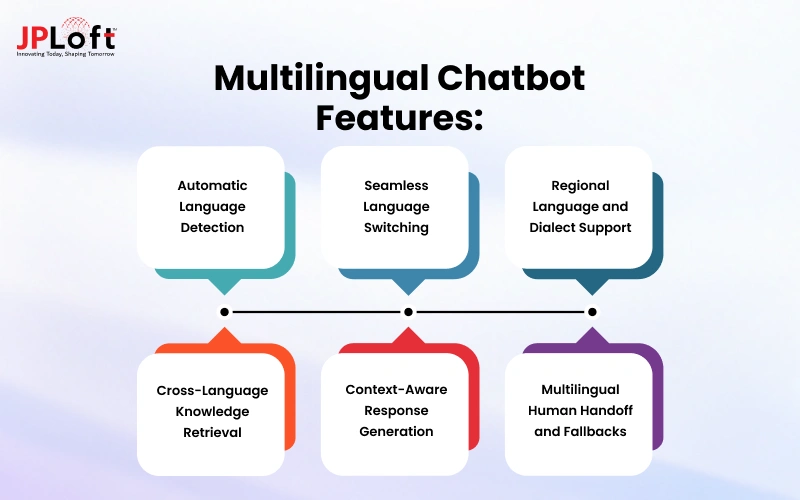
1. Automatic Language Detection
The chatbot should identify a user's language from the first message and respond accordingly. Automatic detection reduces friction by removing the need for users to select their preferred language manually. It should also recognize when users switch languages during a conversation.
2. Seamless Language Switching
Users may switch languages when discussing technical details, clarifying a request, or using familiar expressions. The chatbot should retain conversation history and intent during these transitions instead of restarting the interaction or losing important context.
3. Regional Language and Dialect Support
People who speak the same language may use different expressions, spellings, and regional phrases. Supporting these variations helps the chatbot interpret requests more accurately and generate responses that feel natural to the intended audience.
4. Cross-Language Knowledge Retrieval
A chatbot should retrieve relevant information even when a user's query and the source documents use different languages. For example, an English query could retrieve an answer from a Spanish-language support document. This capability is especially valuable for businesses managing multilingual knowledge bases.
5. Context-Aware Response Generation
The chatbot should consider previous messages, user intent, and the conversation's language when generating responses. This helps it answer follow-up questions accurately and avoid repeating information unnecessarily.
6. Multilingual Human Handoff and Fallbacks
When the chatbot cannot resolve a request, it should provide a clear alternative or connect the user with an appropriate support agent. Passing along conversation history and language preferences helps prevent users from repeating their concerns and supports smoother service transitions.
Which Technology Stack Is Best for Multilingual Chatbot Development?
The right technology stack depends on supported languages, conversation complexity, data sources, and integration requirements. The following table outlines the core technologies used to develop multilingual chatbots.
|
Technology Component |
Tools and Technologies |
Purpose |
|
Multilingual LLMs |
GPT, Gemini, Claude |
Understand user intent and generate responses across supported languages. |
|
Language Detection and Translation |
Google Cloud Translation, Azure AI Translator, Amazon Translate |
Detect languages and translate queries or responses when required. |
|
Multilingual Embeddings |
Multilingual E5, BGE-M3 |
Convert text into representations that support semantic search across languages. |
|
Vector Databases |
Pinecone, Weaviate, Qdrant |
Store and retrieve relevant information from multilingual knowledge sources. |
|
Backend Development |
Python, FastAPI, Node.js, Express |
Manage APIs, conversation flows, authentication, and business integrations. |
|
AI Orchestration |
LangChain, LlamaIndex |
Coordinate LLM calls, knowledge retrieval, and chatbot workflows. |
|
Cloud Infrastructure |
AWS, Microsoft Azure, Google Cloud |
Deploy, scale, monitor, and secure chatbot services. |
For a chatbot that answers questions from company documents, a practical starting point is a multilingual LLM, cross-language retrieval, a vector database, and a backend connected to approved knowledge sources. Translation services can be added where testing identifies gaps in direct language support.
How Much Does It Cost to Build a Custom Multilingual Chatbot?
The cost to build a custom multilingual chatbot ranges from $15,000 to $450,000, depending on the number of supported languages, AI architecture, integration requirements, and conversation complexity.
|
Chatbot Complexity |
Estimated Cost |
Typical Scope |
|
Basic |
$15,000–$40,000 |
2–3 languages, basic FAQs, language detection, and limited integrations |
|
Mid-Level |
$40,000–$120,000 |
Multiple languages, LLM-powered responses, knowledge base integration, and conversation context |
|
Advanced |
$120,000–$250,000 |
Multilingual RAG, complex workflows, CRM integration, and language-specific testing |
|
Enterprise |
$250,000–$450,000 |
Extensive language coverage, multiple business integrations, advanced security, custom workflows, and large-scale deployment |
Factors Affecting the Development Cost For Multilingual Chatbots
These cost ranges are indicative estimates based on JPLoft's AI chatbot development experience. Actual costs to develop chatbots with multilingual abilities depend on project scope, language coverage, integrations, testing requirements, and ongoing infrastructure needs.
But the exact cost varies depending on several factors, including:
-
Number of Languages: Supporting additional languages can increase development costs by approximately 10–25% due to localization, content preparation, and language-specific testing.
-
AI Architecture: Choosing a hybrid or more complex AI architecture can add around 15–30% to development costs, depending on model requirements and processing workflows.
-
Data and Knowledge Retrieval: Preparing multilingual documents and implementing cross-language search can account for an additional 15–25% in development effort.
-
Integrations and Features: Connecting CRM platforms, authentication systems, and human handoff workflows can increase costs by approximately 10–25%, depending on integration complexity.
-
Testing and Maintenance: Language-specific quality assurance, native-speaker reviews, and ongoing improvements can add around 10–20% to project costs, with recurring maintenance expenses continuing after launch.
Best Practices for Implementing a Multilingual Chatbot
Implementing a multilingual chatbot requires more than adding languages to an existing system. Businesses need to account for language accuracy, localized content, knowledge retrieval, and consistent performance across supported markets.
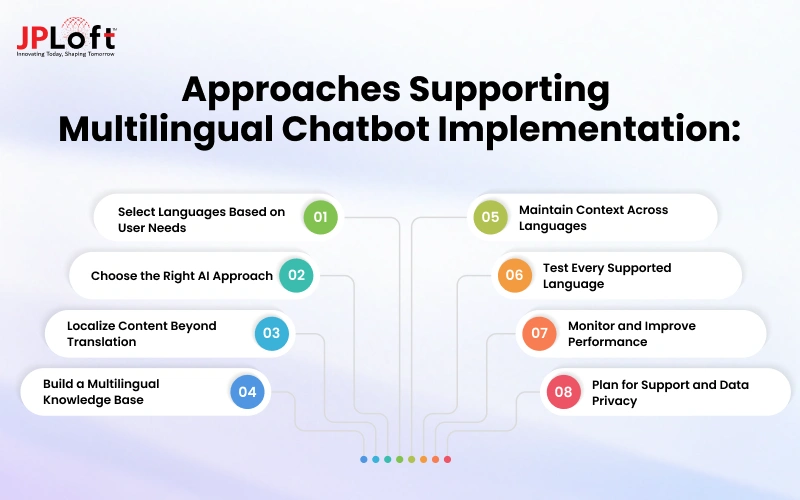
1. Select Languages Based on User Needs
Prioritize languages based on customer locations, support requests, and business expansion plans. Start with the languages your audience uses most, then expand as demand grows.
2. Choose the Right Translation and AI Approach
Evaluate multilingual LLMs, machine translation, and hybrid workflows against your target languages. Test real customer queries to determine which approach delivers the most accurate and natural responses.
3. Localize Content Beyond Translation
Adapt terminology, cultural references, date formats, currencies, and tone for each target audience. Have native speakers review important customer-facing content to identify awkward wording and differences in meaning.
4. Build a Multilingual Knowledge Base
Organize product information, FAQs, policies, and support documents by language. Use multilingual search or cross-language retrieval to find relevant information when the user's query and source documents are written in different languages.
5. Maintain Context Across Languages
Configure the chatbot to recognize language changes without losing conversation history or user intent. Test mixed-language messages, follow-up questions, and common regional expressions.
6. Test Every Supported Language
Evaluate language detection, response accuracy, translation quality, and fallback behavior separately for each language. Include native speakers in testing to identify errors that automated checks may miss.
7. Monitor and Improve Performance
Track resolution rates, customer satisfaction, fallback frequency, and response accuracy by language. Use customer feedback and failed conversations to identify gaps and prioritize improvements.
8. Plan for Human Support and Data Privacy
Provide clear escalation paths when the chatbot cannot resolve a request. Ensure the receiving support team can assist in the user's language, and apply appropriate privacy, access-control, and data-retention measures.
Real-World Examples of Popular Multilingual Chatbots
Global brands use multilingual chatbots to handle customer inquiries, simplify service workflows, and support customers across markets. These examples show how language capabilities translate into practical business outcomes.
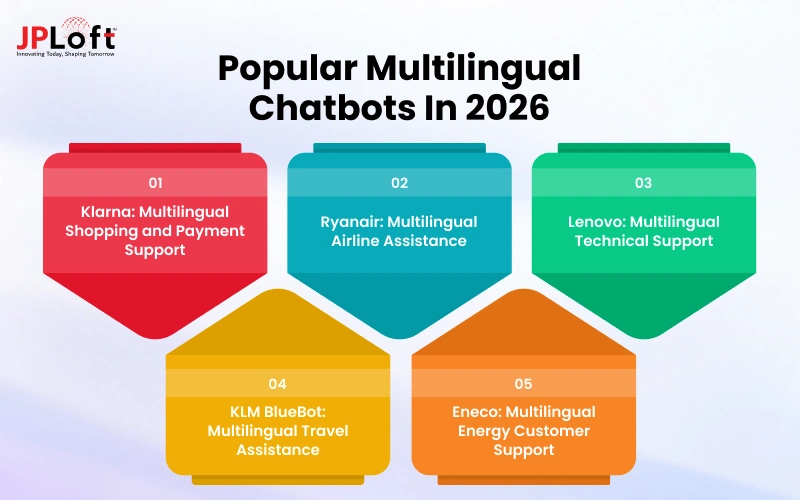
1. Klarna: Multilingual Shopping and Payment Support
Klarna's AI assistant supports customer service across 23 markets and more than 35 languages. In its first month, it handled 2.3 million conversations, equivalent to two-thirds of customer service chats, and reduced repeat inquiries by 25%. It helps customers resolve common payment and shopping questions.
2. Ryanair: Multilingual Airline Assistance
Ryanair's AI customer service assistant supports seven languages and handles questions about bookings, baggage, refunds, and flight information. According to AWS, it processes around 120,000 customer chat interactions daily, with an 80% containment rate. Its approach combines conversational AI with translation to support travelers across markets.
3. Lenovo: Multilingual Technical Support
Lenovo's AI-powered support chatbot provides round-the-clock assistance in nine languages. The company reports a 10% increase in customer satisfaction, a 20% reduction in average handling time, and a 15% improvement in agent productivity. The deployment demonstrates how multilingual automation can help technical support teams manage recurring customer questions.
4. KLM BlueBot: Multilingual Travel Assistance
KLM introduced BlueBot to help customers book flights through conversational interfaces. Its digital customer-service channels support multiple languages, helping travelers access booking information and travel assistance. KLM's social channels receive more than 130,000 mentions weekly, although this figure reflects overall social activity rather than BlueBot usage.
5. Eneco: Multilingual Energy Customer Support
Belgian energy provider Eneco uses a multilingual AI agent to support customers with service inquiries. The chatbot handles approximately 24,000 chats per month, recognizes customer intent with over 95% accuracy, and resolves 67% of conversations without human assistance. These results illustrate how multilingual automation can improve support efficiency.
How to Test and Measure Multilingual Chatbot Performance
Testing is essential to ensure a multilingual chatbot performs reliably across supported languages. The testing process must ensure that the chatbot understands user intent, retrieves accurate information, and maintains conversation quality across languages.
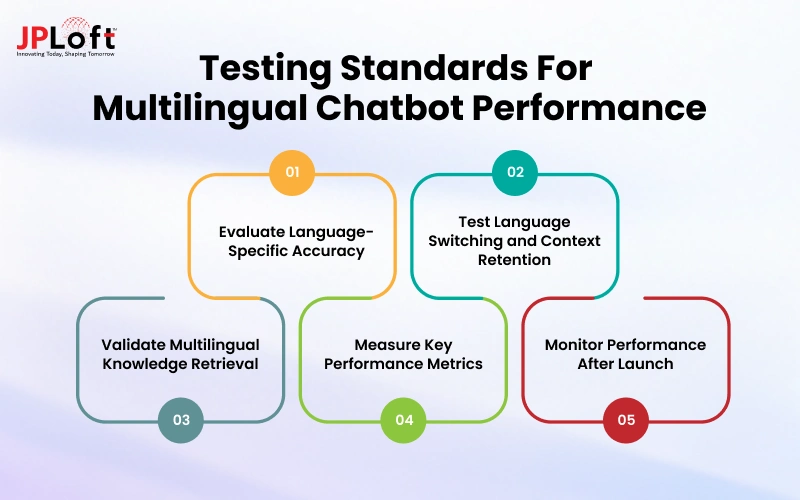
A structured testing process helps identify gaps before launch and maintain consistent performance as usage grows.
1. Evaluate Language-Specific Accuracy
Test each supported language using realistic customer questions, regional expressions, slang, and spelling variations.
Check whether the chatbot identifies intent correctly and generates natural, accurate responses. Native-speaker reviews can reveal translation errors, awkward phrasing, and cultural nuances that automated testing may overlook.
2. Test Language Switching and Context Retention
Create scenarios where users switch languages mid-conversation, ask follow-up questions, or combine languages in a single message.
Verify that the chatbot preserves conversation history and user intent throughout these transitions. Test whether it continues responding in the preferred language without asking users to repeat information.
3. Validate Multilingual Knowledge Retrieval
Test whether the chatbot retrieves relevant information from documents written in different languages. For example, an English query should retrieve the correct information from a Spanish-language document when cross-language retrieval is supported.
Check source relevance, answer accuracy, and consistency between generated responses and the original content.
4. Measure Key Performance Metrics
Track performance separately for each supported language to identify gaps hidden by overall averages. Measure intent recognition accuracy, conversation resolution rates, fallback frequency, human escalation rates, response latency, and customer satisfaction.
Comparing these metrics across languages helps determine where the chatbot needs better data, improved language processing, or more effective conversation workflows.
5. Monitor Performance After Launch
Review conversation logs, unresolved queries, and customer feedback regularly to identify recurring problems. Use these findings to improve prompts, update multilingual knowledge sources, and refine language-specific workflows.
Repeat testing after significant model, content, or integration changes to ensure improvements in one language do not reduce performance in another.
Key Challenges in Building a Multilingual Chatbot
Building a multilingual chatbot involves more than supporting multiple languages. Differences in regional expressions, response accuracy, knowledge retrieval, and conversation context can affect how well the chatbot serves users.
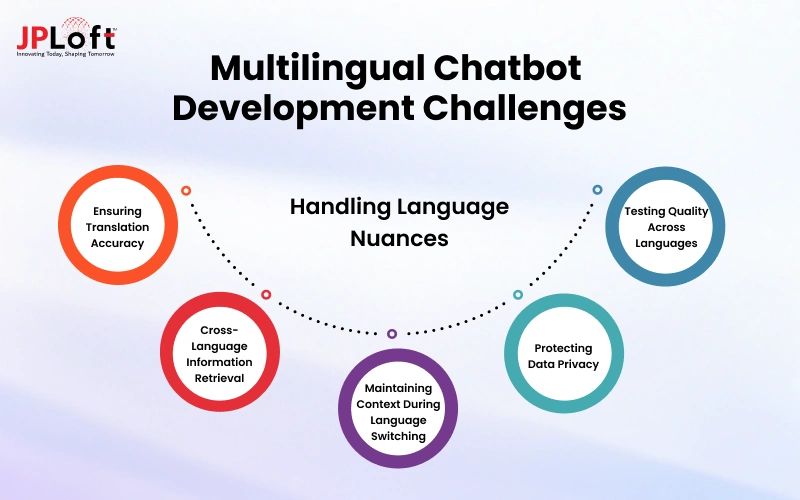
Here are the potential challenges of building AI chatbots that businesses must address during development.
Challenge 1. Handling Language Nuances and Regional Variations
Words, slang, idioms, and sentence structures vary across regions, even within the same language. A multilingual chatbot may misinterpret local expressions or generate responses that sound unnatural to its intended audience.
Solution: Test the chatbot with region-specific queries and involve native speakers to validate language accuracy, tone, and cultural relevance.
Challenge 2. Maintaining Translation Accuracy and Context
Translation can change the meaning of technical terms, idioms, or industry-specific phrases. Inaccurate translations may lead to confusing or misleading responses, particularly in healthcare, finance, and customer support.
Solution: Partner with experienced AI development company and evaluate multilingual models and translation services using real user queries, and validate responses against trusted source content.
Challenge 3. Retrieving Information Across Languages
A chatbot may fail to find relevant information when a user's query and the source documents use different languages. This can limit response accuracy when businesses maintain knowledge bases across multiple markets.
Solution: Implement multilingual embeddings and cross-language retrieval so the chatbot can match queries with relevant information regardless of the source language.
Challenge 4. Preserving Context During Language Switching
Users may switch languages mid-conversation or combine multiple languages in one message. If the chatbot loses conversation history or user intent, it may misunderstand follow-up questions or repeat previous answers.
Solution: Combine reliable language detection with context management to preserve conversation history and maintain the user's preferred language throughout the interaction.
Challenge 5. Managing Data Privacy and Compliance
Multilingual chatbots may process personal information through AI models, translation APIs, and third-party services. These components can introduce data-handling risks and compliance requirements across different markets.
Solution: Hire AI developers and apply encryption, access controls, and clear data-retention policies while reviewing third-party services against relevant privacy and security requirements.
Challenge 6. Testing and Maintaining Quality Across Languages
A chatbot that performs well in one language may deliver weaker responses in another. Differences in intent recognition, retrieval accuracy, and language generation can create inconsistent experiences across supported markets.
Solution: Test each language separately with realistic queries and native-speaker reviews, then monitor performance metrics and refine the chatbot after launch.
Custom Multilingual Chatbot vs. Ready-Made Chatbot Platforms
Choosing between a custom multilingual chatbot and a ready-made platform is an important decision for businesses planning to serve customers across languages and markets.
Ready-made platforms generally offer faster deployment with prebuilt features, while custom development requires more planning and engineering but provides greater control over language processing, knowledge retrieval, and conversational workflows.
Which option best fits your business needs? The following comparison highlights the key differences to help you decide.
|
Comparison Factor |
Custom Multilingual Chatbot |
Ready-Made Chatbot Platform |
|
Language Support |
Tailored to target languages, dialects, and regional expressions |
Depends on the platform's supported languages and capabilities |
|
Customization |
Supports business-specific workflows, responses, and AI behavior |
Limited to available features, templates, and configuration options |
|
Integrations |
Can connect with specific CRMs, databases, and internal systems |
Uses built-in integrations and supported APIs |
|
Knowledge Retrieval |
Can support custom multilingual knowledge bases and cross-language search |
Depends on the platform's retrieval and knowledge management features |
|
Development Time |
Requires planning, development, and testing |
Generally faster to configure and deploy |
|
Initial Cost |
Usually higher due to custom engineering and testing |
Often lower upfront, depending on the subscription and setup |
|
Scalability and Control |
Greater control over architecture, infrastructure, and future enhancements |
Depends on vendor capabilities, pricing tiers, and platform limitations |
|
Maintenance |
Requires ongoing monitoring, updates, and technical support |
The vendor maintains the platform, but chatbot configuration and content still need attention |
A custom multilingual chatbot is often a better fit for enterprises that need specialized language handling, cross-language knowledge retrieval, proprietary data integrations, or greater control over AI behavior and security.
Ready-made platforms may be more suitable for businesses with standard support needs, limited customization requirements, and tighter launch timelines.
Why Choose JPLoft for Multilingual Chatbot Development?
A multilingual chatbot needs to do more than translate messages. It must understand user intent, retrieve accurate information across languages, maintain conversation context, and connect with business systems to help customers complete tasks.
At JPLoft, as a dedicated multilingual chatbot development services provider, we develop custom AI chatbots around these requirements. Our team works with multilingual language models, natural language processing (NLP), retrieval-augmented generation (RAG), and Agentic AI to support context-aware conversations, knowledge retrieval, and automated workflows.
We also integrate multilingual chatbots with existing CRMs, support platforms, and internal databases to deliver relevant responses based on approved business information.
Our client implementations have supported brand expansion across 15+ geographies, reduced communication gaps caused by language barriers, and contributed to conversion improvements of up to 30%.
From selecting the right language architecture to preparing multilingual knowledge sources, integrating business systems, and testing responses across languages, we align development with your operational requirements and customer needs.
Ready to reach more customers across languages? Discuss your multilingual chatbot requirements with JPLoft.
Final Words
In 2026, businesses need more than rule-based chatbots that respond only to predefined questions. They need AI-powered solutions that understand user intent, interpret context, and generate relevant responses based on individual needs.
A multilingual AI chatbot helps businesses meet these expectations while communicating with customers in their preferred languages. However, its effectiveness depends on choosing the right AI architecture, supported languages, knowledge sources, and integrations to match business goals.
Whether a business is entering new markets, expanding customer support across regions, or reducing communication gaps, a well-designed multilingual chatbot can help it serve diverse audiences more effectively while maintaining operational efficiency. The key is to build a solution that goes beyond translation to deliver accurate, context-aware conversations that support both customer needs and business objectives.
FAQs
A multilingual AI chatbot is a conversational system that understands and responds to users in multiple languages. It uses technologies such as natural language processing (NLP), large language models (LLMs), and machine translation to interpret queries and generate relevant responses.
The cost of building a custom multilingual chatbot typically ranges from $15,000 to $450,000. The final cost depends on the number of supported languages, AI architecture, knowledge retrieval requirements, business integrations, security needs, and testing complexity.
A basic multilingual chatbot may take around 2 to 3 months to develop, while an advanced solution can require 4 to 6 months or longer. Timelines depend on language coverage, data preparation, custom workflows, integrations, and testing requirements.
Multilingual chatbot development commonly uses NLP, multilingual LLMs, machine translation APIs, multilingual embeddings, vector databases, and backend frameworks such as Python and Node.js. The right stack depends on language requirements, data sources, integrations, and performance goals.
Yes. With multilingual knowledge retrieval, a chatbot can match a user's query with relevant information from documents written in another language. Multilingual embeddings and retrieval-augmented generation (RAG) help retrieve relevant content and generate answers grounded in approved sources.

Rahul Sukhwal is the CEO and Founder of JPLoft, with 18+ years of experience in software engineering, emerging technologies, and digital product development. His expertise spans artificial intelligence, including AI agents, generative AI, LLMs, chatbots, computer vision, and machine learning, as well as blockchain, IoT, AR/VR, mobile, web, and enterprise software. He focuses on applying these technologies to real business challenges across industries such as healthcare, education, mobility, finance, real estate, and on-demand services.


Share this blog