



Key Takeaways
Many apps fail in the UK because businesses skip proper research and launch products without clearly understanding user needs.
Validating the app idea early helps companies confirm market demand and avoid building products that users may not need.
A strong user experience and smooth app performance are essential to keep users engaged and prevent early uninstallations.
Businesses can reduce the risk of app failure by focusing on scalable technology, strategic marketing, and continuous improvements after launch.
Using AI in developing the app helps improve personalization, automate support, and analyze user data to create better user experiences.
Many businesses launch apps with strong ideas, but the results do not always match expectations. This is one of the main reasons why apps fail in UK, especially in such a competitive market. An app may look good during development, but problems often appear after real users start using it.
Issues such as poor planning, weak user experience, or insufficient testing can gradually reduce user interest. When people look at why apps in UK fail, the reasons are often practical rather than technical.
Some businesses skip proper market research, while others rush the launch without understanding what users actually need. These small mistakes may not seem serious at first, but they often lead to bigger problems after the app goes live. That is why many experts discuss the common reasons for UK apps failure today.
Understanding these challenges helps businesses avoid the same path. In this blog, we will discuss the real reasons UK apps fail, and how they can plan better and improve their chances of long-term success.
Understanding the UK Mobile App Market
The UK mobile app market is large and very active, which creates both opportunity and strong competition for businesses. Most people in the country use smartphones every day, so mobile apps have become a normal part of daily life.
-
The UK mobile application market is expected to generate a revenue of $32,860.0 million by 2030.
-
However, the UK app market is projected to grow at an annual growth rate of around 15.4% between 2025 and 2030.
-
The UK artificial intelligence market size is expected to reach $23.1 billion by 2034.
-
The UK AI apps market is expected to generate a revenue of $1,061.9 million by 2030.
-
The UK fitness app market is expected to reach a revenue of $1,293.4 million by 2033.
8 Top Reasons Why Apps Fail in the UK
Many businesses launch apps with strong expectations, but real results often look different after the product goes live. The reasons UK apps fail are usually connected to planning mistakes, weak strategy, or poor user experience.
When these issues appear together, the chances of UK app startup failure increase quickly.
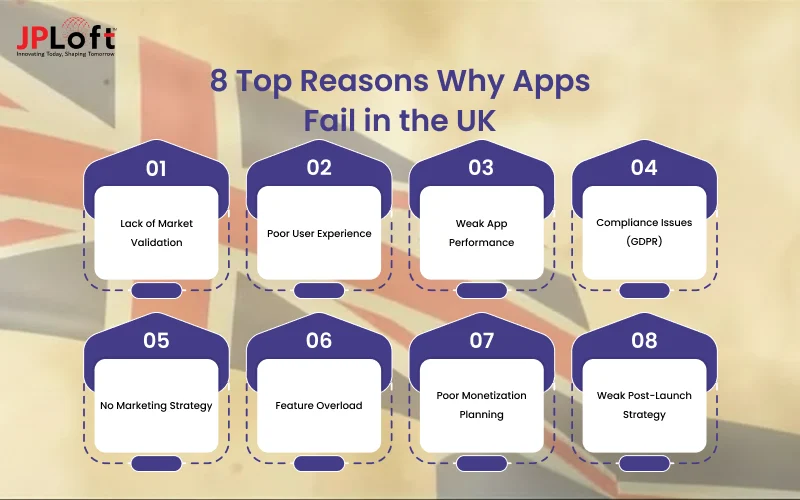
Here, we understand these problems and discuss how businesses can avoid them.
1. Lack of Market Validation
Many businesses build an app before confirming if people truly need it. This is one of the key reasons for UK app failure today. Without proper research, teams often develop features based on assumptions instead of real user needs.
When the app launches, users simply do not find enough value to continue using it. This lack of demand becomes one of the common reasons for UK apps failure in competitive markets.
How to avoid it: Validate the idea early through user research, surveys, and small MVP testing before starting full development.
2. Poor User Experience
User experience plays a huge role in explaining why apps fail in UK market. If an app feels confusing, slow, or difficult to navigate, users quickly move to another option.
Many apps lose users because their design focuses more on features than on usability. When businesses ignore simple navigation, clear layouts, and smooth interactions, the result often leads to app failure and poor long-term engagement.
How to avoid it: Consider UI/UX design services for clear navigation and real user testing to ensure the app feels easy and natural to use.
3. Weak App Performance
Performance issues are another strong reason behind the failure of UK apps. Users expect apps to load quickly and run smoothly on different devices. If an app crashes often or takes too long to respond, people lose trust in the product.
Even a good idea can fail when the technical foundation is weak. Poor optimization and unstable systems are among the common reasons for UK apps failure after launch.
How to avoid it: Build a strong backend, optimize performance early, and conduct app testing across multiple devices before launch.
4. Compliance Issues (GDPR)
Data protection rules are strict in the UK, which means businesses must follow proper privacy practices. Ignoring these rules can lead to serious problems, including legal risks and user distrust.
Many companies underestimate how important compliance is during development. When privacy and security are not handled properly, it becomes one of the key reasons for UK app failure and also damages the reputation of the business.
How to avoid it: Ensure the app follows GDPR rules by implementing secure data handling and clear user consent systems.
5. No Marketing Strategy
Some businesses assume that users will discover their app naturally after launch. In reality, strong marketing plays a major role in preventing UK app startup failure.
Without app store optimization, promotions, or launch campaigns, even a well-built product can remain unnoticed. This lack of visibility explains why UK startups fail when launching apps, because users simply never find the product among thousands of competing apps.
How to avoid it: Plan marketing early with ASO, launch campaigns, and digital promotion strategies to build visibility before release.
6. Feature Overload
Many teams try to include too many mobile app features in the first version of the app. This often makes the product complicated to use. Instead of solving one clear problem, the app tries to do everything at once.
This approach confuses users and slows development progress. Feature overload is often listed among the reasons UK startups fail because it increases cost and delays a proper market launch.
How to avoid it: Start with a simple MVP that solves one key problem and expand features gradually based on user feedback.
7. Poor Monetization Planning
An app may attract users but still struggle financially if there is no clear revenue model. Many businesses launch apps without deciding how the product will generate income.
Whether through subscriptions, in-app purchases, or services, the strategy must be clear from the beginning. When businesses ignore this planning stage, it becomes one of the key reasons for UK app failure in competitive markets.
How to avoid it: Define clear app monetization models early, such as subscriptions, service fees, or in-app purchases.
8. Weak Post-Launch Strategy
Launching an app is only the beginning, yet many teams treat it as the final step. Apps need regular updates, improvements, and user feedback analysis. Without ongoing support, small issues slowly grow into bigger problems.
Over time, users move to better alternatives. This lack of long-term planning explains why apps in UK fail, especially when competitors continue improving their products after launch.
How to avoid it: Invest in app maintenance services, continuous updates, monitor user feedback, and improve the app regularly to keep users engaged.

Hidden Challenges Businesses Face in the UK App Market
Launching an app in the UK may look simple from the outside, but the market has its own challenges. Many businesses only focus on development and forget about the environment in which the app will compete.
This is one of the reasons why apps fail in UK after launch.
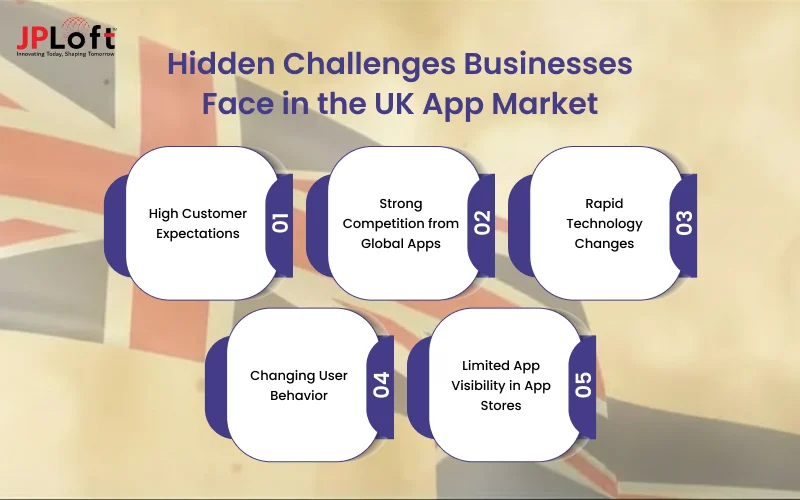
When companies do not prepare for market pressure, the chances of UK apps failure increase even if the idea itself is strong.
Challenge 1: High Customer Expectations
Users in the UK are already familiar with high-quality digital products, so their expectations are naturally high. People expect fast loading, smooth navigation, secure payments, and reliable performance every time they open an app.
If an app fails to meet these expectations even once or twice, users quickly uninstall it. This pressure often contributes to why apps in UK fail soon after launch.
Solution: Focus on quality design, fast performance, and continuous testing before releasing the app to the public.
Challenge 2: Strong Competition from Global Apps
The UK market is open to apps from around the world, which means local startups compete with global tech companies. Large platforms already have strong brand trust, big marketing budgets, and millions of users.
When new apps enter the market without a clear value, they struggle to stand out. This intense competition is one of the common reasons for apps failure today.
Solution: Build a clear value proposition with a trusted software development company and focus on solving a specific problem better than existing platforms.
Challenge 3: Rapid Technology Changes
Technology in the mobile industry changes very quickly. New tools, mobile app tech stack, and features appear every year, and users expect apps to keep up with them. Businesses that ignore these changes often fall behind competitors.
When an app feels outdated or lacks modern functionality, users lose interest. This constant evolution is another factor behind the failure of UK apps in competitive markets.
Solution: Use scalable technology and consider updates regularly to keep up with modern digital trends.
Challenge 4: Changing User Behavior
User preferences in the app market change faster than many businesses expect. Features that feel exciting today may become normal within a few months. When companies fail to understand these changes, their apps slowly lose relevance.
This gap between features and user expectations often explains why UK startups fail after launching a promising app idea.
Solution: Study user behavior regularly and improve the app based on real feedback and usage data.
Challenge 5: Limited App Visibility in App Stores
Thousands of apps launch every week in both the Apple App Store and Google Play Store. However, because of this huge volume, new apps often struggle to get noticed by users.
Even a well-designed product can remain invisible without proper optimization. This lack of discoverability is another hidden reason behind UK app startup failure.
Solution: Use strong App Store Optimization (ASO) strategies and targeted marketing to improve visibility and downloads.
How UK Businesses Can Avoid App Failure?
Before considering business ideas in UK, it is important to confirm that the idea actually solves a real problem. Many companies skip this step, and this becomes one of the major reasons UK apps fail after launch.
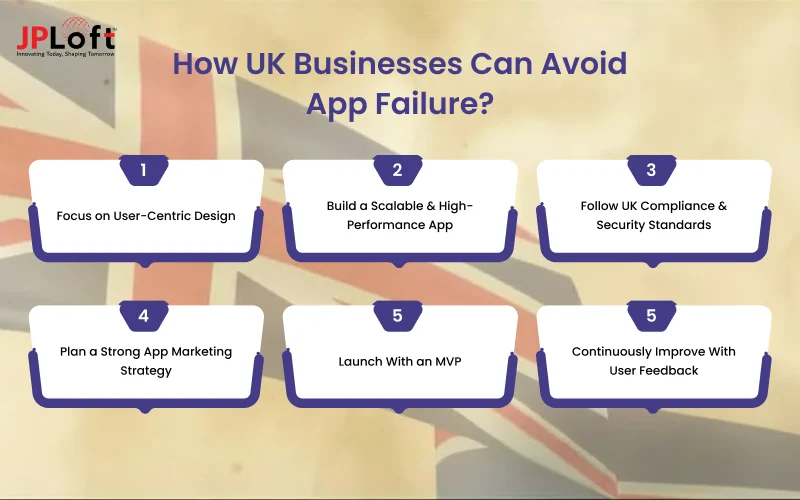
Let’s discuss how UK businesses can avoid app failure.
[A] Focus on User-Centric Design
A successful app is built around user needs rather than business assumptions. Many apps fail because the mobile app design feels confusing or difficult to use. Poor navigation, cluttered screens, and complicated steps often lead to UK apps failure even if the core idea is strong.
Businesses should focus on simple layouts, smooth navigation, and easy onboarding. When users can quickly understand how the app works, they are far more likely to continue using it.
[B] Build a Scalable & High-Performance App
App performance directly affects user trust and engagement. If an app crashes often or loads slowly, users quickly move to other options. Moreover, these technical issues are common factors behind the failure of UK apps in competitive markets.
Building a strong technical foundation from the beginning helps businesses avoid these problems. A scalable architecture ensures the app can handle more users as the business grows.
[C] Follow UK Compliance & Security Standards
Data protection and privacy are extremely important in the UK market. Businesses must follow regulations like GDPR when handling user data. Ignoring these rules can create legal risks and reduce user trust, which often contributes to why apps in UK fail.
A proper mobile app security system, clear privacy policies, and proper data management practices help businesses build credibility and protect user information.
[D] Plan a Strong App Marketing Strategy
Even a well-built app can fail if users never discover it. However, many startups focus only on development and forget about marketing. This lack of visibility is one of the common reasons for apps failure.
Businesses should plan marketing activities before the launch. App Store Optimization, social media promotion, and targeted campaigns can help attract early users and build momentum.
[E] Launch With an MVP
Trying to build an app at the start often leads to delays, higher costs, and complicated products. Many teams attempt to add too many features at once, which becomes one of the reasons UK startups fail.
Launching with a Minimum Viable Product, often called an MVP, allows businesses to release a simple version first. Hence, this approach helps test the idea in the real market and gather feedback early.
[F] Continuously Improve With User Feedback
An app should not remain the same after launch. However, user expectations change, and new competitors appear regularly. Businesses that ignore feedback often experience declining engagement, which explains why apps fail in UK over time.
Regular updates, performance improvements, and new features based on user input help keep the app relevant. Continuous improvement ensures the product grows along with user needs and market trends.
Role of AI in Building Successful Apps
AI is helping businesses build smarter apps that understand users, automate tasks, and improve decision-making. Companies that adopt modern AI tools can reduce mistakes and create products that stay useful for users over time.
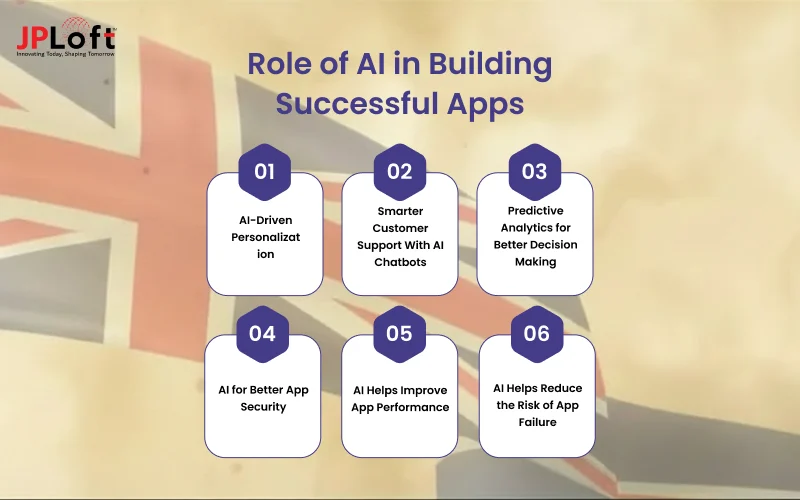
Let us discuss more about the role of AI in mobile app development below.
1. AI-Driven Personalization
AI studies user behavior and preferences to create personalized experiences inside apps. Businesses using generative AI development services can recommend relevant content, products, or features for each user. This personalized approach increases engagement and helps reduce the risk of apps failure.
2. Smarter Customer Support With AI Chatbots
Customer support strongly affects user satisfaction in mobile apps. By using AI chatbot development services, businesses can provide instant responses and 24/7 support. This quick assistance solves user problems faster and helps prevent frustration that often leads to UK app startup failure.
3. Predictive Analytics for Better Decision Making
Predictive analytics helps businesses understand future user behavior by analyzing existing data patterns. Companies that adopt AI consulting services can forecast user trends, feature demand, and engagement changes. This proactive approach helps businesses avoid several reasons UK apps fail.
4. AI for Better App Security
Security problems can damage user trust and quickly lead to the failure of UK apps. Businesses using AI services can detect unusual activity, prevent fraud, and protect sensitive data. Strong security systems help build trust and keep users confident in the app.
5. AI Helps Improve App Performance
AI tools can monitor app performance and detect technical issues early. Businesses that adopt AI development services can identify bugs, slow processes, and system errors faster. Fixing these issues quickly improves reliability and prevents problems that explain why apps in UK fail.
6. AI Helps Reduce the Risk of App Failure
Many companies now rely on Artificial Intelligence to plan smarter digital products. AI helps analyze market trends, user needs, and product performance. These insights guide better decisions and help businesses avoid many common reasons for apps failure.

Why Businesses Should Choose JPLoft to Achieve Success?
Businesses today need more than basic development support. They need a technology partner that understands modern digital trends and builds scalable digital products. As a trusted mobile app development company in UK, JPLoft focuses on creating powerful mobile and web applications that solve real business problems and improve user experiences.
The team uses modern technologies such as AI, ML, generative AI, cloud computing, and blockchain to build future-ready applications. These technologies help businesses automate processes, understand user behavior, and create smarter digital platforms that grow over time.
JPLoft offers complete development support, from idea validation and UI/UX design to development, testing, and post-launch maintenance. This end-to-end approach helps businesses reduce risks that often explain why apps fail in UK.
By combining modern technology, experienced developers, and strong product strategies, JPLoft helps businesses launch reliable apps that perform well and stay competitive in the UK market.
Conclusion
Building a successful app in the UK market requires more than a good idea. Many businesses face challenges, such as poor planning, weak user experience, and a lack of market validation. When these issues appear together, they often lead to apps failure, even if the concept initially looks promising.
However, these problems can be avoided with the right strategy. Businesses that focus on market research, user-centric design, strong performance, and clear monetization plans have a better chance of long-term success.
Paying attention to changing technology trends, user behavior, and marketing strategies also helps reduce the risk of UK app startup failure.
Modern technologies like artificial intelligence are also playing a big role in improving app performance, personalization, and decision-making. When combined with proper planning and continuous updates, these tools help businesses build stronger digital products.
Working with an experienced development company in the UK can further support businesses in creating reliable apps that meet user expectations and grow successfully.
FAQs
Many apps fail in the UK because of poor market research, weak user experience, slow performance, and a lack of a clear marketing strategy. Businesses often rush development without fully understanding user needs.
The most common reasons include lack of market validation, poor UI/UX design, weak app performance, compliance issues, feature overload, and poor monetization planning.
Market validation helps businesses confirm that users actually need the app. Without this step, companies may build products that solve problems users do not have.
Businesses can reduce risk by validating the idea, focusing on user-centric design, building scalable technology, planning marketing early, and continuously improving the app after launch.
AI helps businesses improve personalization, automate customer support, analyze user data, and detect security issues. These features help apps perform better and improve user engagement.

Priyanka Sukhwal is the Managing Director and Business Head of JPLoft, a results-driven leader with 10+ years of experience steering technology ventures and business growth. Her strategic acumen and deep understanding of digital markets and on-demand solutions have consistently translated into innovations that help businesses scale, evolve, and lead in competitive landscapes.





Share this blog