


Key Takeaways:
The development time for an app like Olio depends on feature depth, with an average timeline of 3 to 11+ months.
The cost to build an app like Olio ranges from £7,500 to £75,000 ($10,000 to $100,000+), varying based on scalability, integrations, and security layers.
A successful Olio-like app requires strong market research, clear MVP prioritisation, and a scalable technical architecture.
Major development challenges include data protection, real-time functionality, and system scalability.
Sustainable monetisation models such as subscriptions, partnerships, and premium features help generate revenue without compromising UX.
Today, food waste is a major concern in the UK. Several people now look for practical digital solutions to solve such issues. Olio is one such app that allows you to share extra food and other items to needy people. However, if you are planning to build an app like Olio as an investor, this is the right time to enter the market.
Platforms like Olio have shown how technology can connect neighbours, local stores, and volunteers to share surplus food and reduce waste simply. Moreover, consumers are becoming more aware of sustainability and community support.
Hence, a well-planned platform can help reduce food waste while also building a strong and trusted local network. Businesses that choose to develop an app like Olio in the UK can benefit from rising demand.
They can choose a reliable partner to begin the development of Olio-like apps through a process involving market research, UI/UX designing, feature selection, backend & frontend development, testing and final launch.
In this blog, we will explain why this idea makes sense and how to create an app like Olio that you can turn into a successful digital platform.
What is the Olio App?
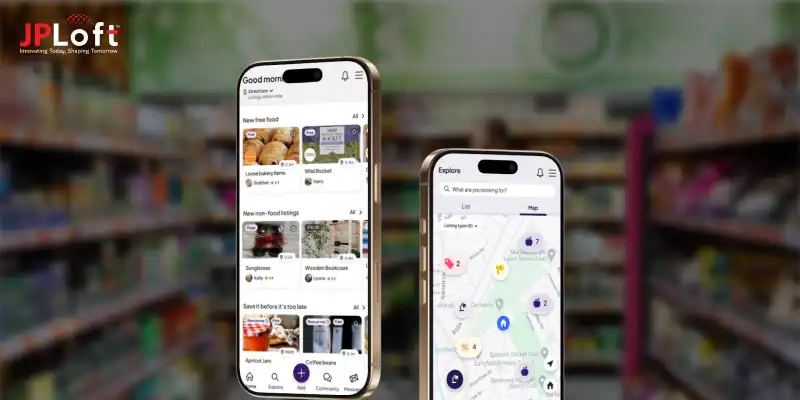
The Olio app is a community food sharing app that connects people with surplus food to others who can use it. It was created to reduce food waste and build stronger local communities.
Users can list food or other items they no longer need, and nearby neighbours can claim them for free. This simple idea has made the app popular in the UK, where sustainability and responsible consumption are gaining more attention.
At its core, the Olio app focuses on reducing waste by giving surplus food a second life. Moreover, individuals, grocery stores, and restaurants can post a listing of edible food that would otherwise go to waste.
Beyond just food, Olio supports sharing everyday items such as clothes, books, and household goods. This is why many businesses and investors are interested in Olio app development as a blueprint for sustainable digital solutions.
Moreover, the app has gathered over 5M downloads on the Play Store with an average rating of 4.7.
For businesses considering how to make an app like Olio, it serves as a strong example of combining social impact with user-centric design.
How Does the Olio App Work?
The working model of Olio is simple and easy to use. Everything from listing an item to chatting and arranging pickup happens inside the app. This smooth process is one of the key reasons why businesses want to make an app like Olio for the UK market.
Here is a step-by-step explanation of how users interact with the app.
-
Users register using email or social login and set their location to see nearby listings.
-
The app shows available food and items shared by people in the same area.
-
If a user has surplus food or goods, they upload a photo, add details, and select a pickup time.
-
Interested users can send a request to collect the listed item.
-
Both users connect through secure in-app messaging to confirm pickup details.
-
The item is collected, and the listing is marked as completed.
-
Users can leave a rating to maintain safety and reliability in the community.
However, this simple user journey makes it easier for businesses planning how to create an app like Olio to understand the basic workflow.
Essential Features for an App Like Olio
The mobile app features play a crucial role in the better performance and future scalability of an app.
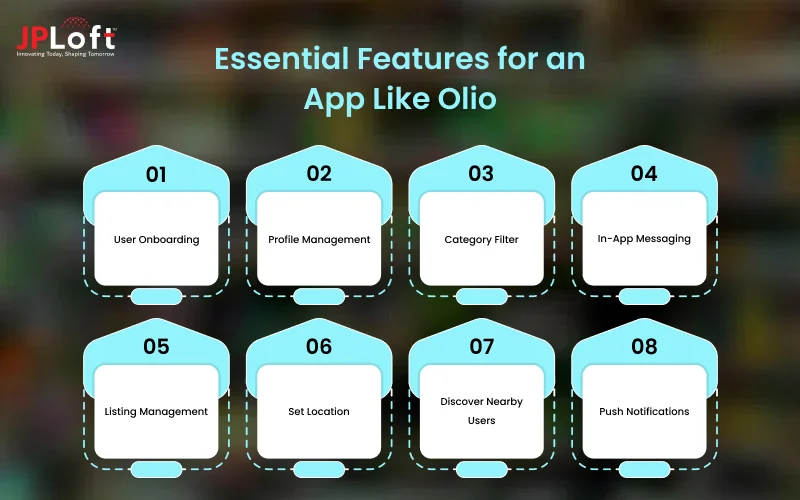
Below are the core features required for smooth food sharing app development in the UK market.
1. User Onboarding
A simple user registration process helps users join quickly. Offer email, phone number, or social login options. Moreover, keep onboarding short and clear so users understand the purpose of the app and how sharing works.
2. Profile Management
Users should be able to create and update their profiles easily. This includes adding a photo, contact details, and preferences. However, a strong profile system builds trust, which is very important in a food-sharing app like Olio.
3. Category Filter
Category filters help users find items quickly. Food, groceries, bakery items, household goods, or clothes can be grouped properly. Thus, clear filters improve user experience and make browsing smooth and organised.
4. In-App Messaging
Secure in-app messaging allows users to communicate safely without sharing personal details. They can confirm pickup time, ask questions, and coordinate easily. Hence, this feature is key in Olio clone app development projects.
5. Listing Management
Users should be able to create, edit, pause, or delete listings easily. Proper listing management helps maintain accuracy and reduces confusion. It also keeps the platform clean and updated with active items only.
6. Set Location
Location settings allow users to see listings near them. GPS or manual location entry ensures accurate results. This is a core feature when you plan to create an app like Olio for a specific city or region.
7. Discover Nearby Users
This feature helps users connect with people in their area. A nearby discovery system improves engagement and makes the app more community-focused, which is important for the app's sustainability.
8. Push Notifications
Push notifications keep users up to date on new listings, requests, and messages. However, real-time alerts increase engagement and ensure items are picked up quickly before they go to waste.
Why Should Businesses Invest in Apps Like Olio?
As the UK moves towards sustainable living and responsible consumption, digital platforms that reduce waste are gaining attention.
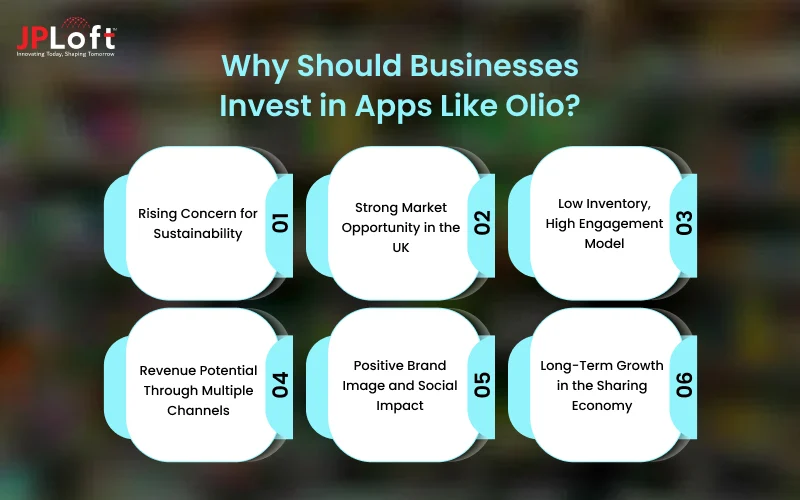
Investing in apps like Olio is about creating real impact while offering long-term business growth.
► Rising Concern for Sustainability
In the UK, around 78% of adults say they are concerned about climate change and recognise the role they play in reducing environmental harm.
Consumers are making more choices based on sustainability, and businesses that offer solutions supporting these values can build stronger customer loyalty.
► Strong Market Opportunity in the UK
The UK produces around 9.5–10 million tonnes of food waste every year, with about 70% coming from households alone.
Much of this food is still edible. This means that a food waste reduction app can divert significant amounts from landfill and bring it to use within the community.
► Low Inventory, High Engagement Model
Apps like Olio follow a sharing economy model. Businesses do not need to manage physical inventory.
Instead, the platform connects users and local stores. This reduces operational costs while increasing user engagement through regular listings and community interaction.
► Revenue Potential Through Multiple Channels
A community platform can generate revenue through premium memberships, brand partnerships, retail collaborations, and sponsored listings.
Businesses that create an app like Olio can build a balanced model that supports growth without affecting user trust.
► Positive Brand Image and Social Impact
Investing in the sustainable development of an application helps companies build a strong brand reputation. Customers trust platforms that contribute to society.
A community-driven mobile app not only generates income but also creates measurable social impact.
► Long-Term Growth in the Sharing Economy
The sharing economy continues to expand across different sectors. Entrepreneurs exploring social impact app ideas can benefit from early entry into this space.
With the right mobile app development company, businesses can launch scalable and secure apps like Olio that serve both profit and purpose.
How to Build an App Like Olio?
To create a mobile app for community-based sustainability requires structured execution, technical clarity, and long-term planning.
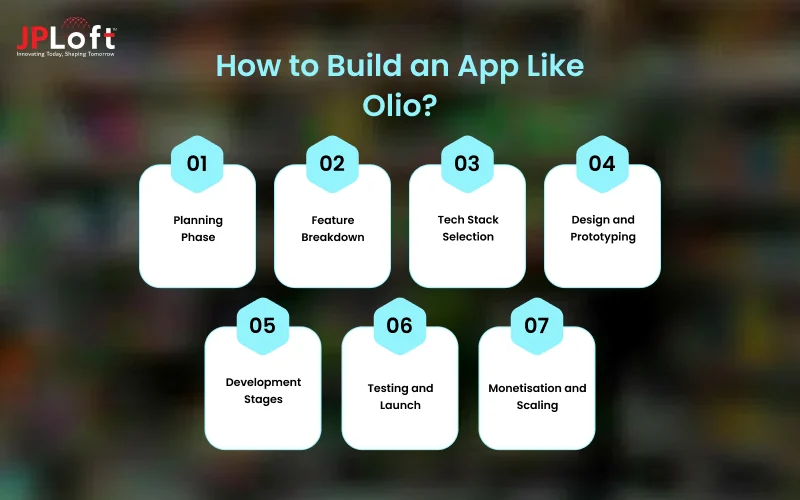
Below are a few steps involved in the development of an app like Olio for the UK market.
Step 1: Planning Phase
This phase establishes the strategic foundation, technical direction, and measurable objectives before any development activities begin.
► Competitor Market Analysis
Study platforms like Olio and other sharing applications to evaluate their features, pricing models, engagement strategies, strengths, and weaknesses. This analysis helps identify market gaps, reduce risks, and define a strong value proposition.
► Target Audience Personas
Define primary user groups such as households, grocery retailers, restaurants, and volunteers. Analyse their needs, digital behaviour, expectations, and challenges to ensure the application delivers practical solutions.
► MVP Feature Prioritisation
Identify essential features required for initial launch, including registration, item listings, messaging, and location services. Prioritising core functionality reduces development time, controls cost, validates the concept early, and creates a scalable base for future improvements.
Step 2: Feature Breakdown
Clear feature structuring ensures balanced functionality for users, business partners, and administrators while maintaining operational efficiency.
► User-Facing Tools
Include secure onboarding, detailed profile management, item uploads, category filters, location-based search, notifications, and real-time chat. These tools ensure smooth navigation, clear communication, and an engaging user experience that supports regular platform usage.
► Seller Management Capabilities
Provide retailers and partners with dashboards to upload surplus items, monitor requests, manage inventory flow, and generate reports. Structured management capabilities improve transparency, simplify coordination, and strengthen business partnerships.
► Admin Control Systems
Develop a powerful admin panel to monitor user activities, approve or remove listings, handle reports, manage disputes, analyse performance metrics, and maintain overall platform integrity through structured moderation and operational control mechanisms.
Step 3: Tech Stack Selection
Selecting a reliable and scalable app tech stack ensures stable performance, faster processing, and long-term maintainability.
► Frontend Framework Options
Use top programming frameworks such as React Native or Flutter to build consistent applications for iOS and Android. This approach reduces development time, ensures uniform design, and supports efficient updates across multiple devices.
► Backend Database Choices
Choose scalable databases like PostgreSQL or MongoDB to manage structured and unstructured data efficiently. A strong database setup ensures secure storage, quick retrieval, and reliable handling of user records and real-time interactions.
► Essential API Integrations
Integrate map services for accurate location tracking, push notification systems for instant updates, analytics tools for performance insights, and secure authentication APIs to ensure stable, secure, and seamless application functionality.
Step 4: Design and Prototyping
Structured UI/UX design services reduce revisions and improve user satisfaction before development investment increases.
► Intuitive Wireframe Flows
Design logical app wireframes that clearly map user journeys from onboarding to item collection confirmation. Well-planned flows reduce confusion, simplify navigation, and ensure every interaction follows a structured and user-friendly path.
► Interactive Prototypes
Develop interactive app prototypes that replicate final interface layouts, colour schemes, and user interactions. This enables stakeholders to review functionality visually and approve designs before coding begins, reducing future modification costs.
► Early User Testing
Conduct early usability testing with selected users to gather real feedback, identify navigation issues, validate feature usefulness, and refine workflows before full-scale development investment begins.
Step 5: Development Stages
This phase converts approved designs and strategies into a functional and secure application.
► Responsive Frontend Build
Develop a fast, responsive interface that adapts smoothly across devices and screen sizes. Clean coding practices and performance optimisation ensure stable usability and consistent experience across operating systems.
► Secure Backend APIs
Build secure APIs to manage authentication, listings, messaging, and data exchange. Implement encrypted communication protocols and structured validation processes to ensure data privacy and compliance with regulations.
► Third-Party Integrations
Integrate payment gateways, cloud hosting services, mapping APIs, and analytics platforms carefully. Proper integration ensures performance stability, feature reliability, and smooth data flow across connected systems.
Step 6: Testing and Launch
Thorough validation ensures stability, reliability, and market readiness before public release.
► Comprehensive Testing Suite
Perform functional mobile app testing, load testing, security audits, and compatibility checks across devices. Comprehensive validation reduces technical risks and ensures consistent performance under real-world usage conditions.
► App Store Optimisation
Prepare structured descriptions, relevant keywords, engaging screenshots, and accurate metadata to improve visibility on app stores. Proper optimisation supports organic downloads and better discoverability in competitive markets.
► Launch Strategy
A soft launch helps monitor performance, collect usage data, identify issues, and refine functionality before a full-scale national rollout. After this, you can publish your app on the Play Store or submit your app to the App Store.
Step 7: Monetisation and Scaling
Sustainable growth depends on revenue planning, operational efficiency, and scalable technical infrastructure.
► Revenue Stream Models
Implement subscription plans, retail partnerships, sponsored placements, and premium feature access. Diversified revenue streams create financial stability while maintaining free access for core community participation.
► Infrastructure Scaling
Use cloud development services to manage traffic growth, ensure uptime reliability, and support geographic expansion. Scalable systems prevent performance disruptions during rapid user acquisition phases.
► Use Maintenance Services
Once the development and launch process is complete, maintaining and updating the app becomes important for future growth. For this, you can choose reliable app maintenance services that help keep your app updated.
Cost to Develop an App Like Olio
The cost to build an app like Olio depends on several factors, and considering each of them is essential. However, an average development cost ranges from £7,500 to £75,000 ($10,000 to $100,000+).
For a better understanding, here we will discuss the mobile app development cost in UK based on the unique business goals of clients.
|
App Type |
Features to Use |
Estimated Cost (in pounds) |
Project Duration |
|
Basic MVP |
User registration, create listings, & location setup |
7,500 - 20,000 |
3 to 5 months |
|
Mid-Level App |
Profile verification, item discovery, & smart category filtering |
20,000 - 50,000 |
6 to 8 months |
|
Advanced App |
Subscription features, smart notifications, & advanced analytics |
50,000 - 75,000+ |
9 to 11+ months |
Once you choose the type of app suitable for your business, the development process can begin. But you must know that this cost is not fixed. However, the cost of development is affected by several factors, and below are some of them described.
-
Feature Complexity - The more advanced features you add, the higher the development cost will be.
-
Third-Party Integrations - Integrating maps, payment gateways, analytics, or APIs increases technical effort and cost.
-
App Scalability Needs - Strong encryption, GDPR compliance, and security testing add to the project cost.
-
Developers’ Expertise - The cost to hire mobile app developers in UK affects overall pricing directly.
-
Platform Choice - Developing for multiple platforms increases the time and overall budget of the project.
Monetisation Strategies for Apps Like Olio
When businesses consider Olio clone app development, they need a clear revenue model that supports growth without affecting user trust.
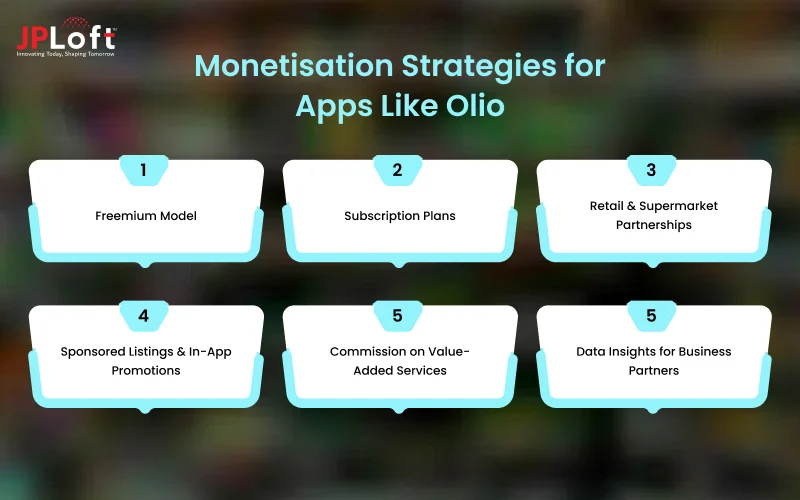
The right mobile app monetisation model helps maintain platform quality, improve features, and ensure long-term success.
1. Freemium Model
A freemium model allows users to access basic features for free while offering premium benefits through paid plans. Advanced filters, early access to listings, or priority visibility can be part of a subscription package. This model works well in community-driven mobile apps because it keeps the platform accessible.
2. Subscription Plans
Monthly or yearly subscription plans can offer added convenience, such as enhanced profile visibility, impact tracking, or an ad-free experience. Businesses that develop an app like Olio often use subscription models to create recurring income without putting pressure on free users.
3. Retail & Supermarket Partnerships
Local grocery stores, bakeries, and restaurants can partner with the platform to list surplus food. Businesses can charge partnership fees or service commissions for managing and promoting these listings. This creates value for retailers while supporting food waste reduction goals.
4. Sponsored Listings & In-App Promotions
Brands focused on sustainability may want to promote their products or services within the app. Sponsored listings, banner placements, or featured partner sections can generate additional income while staying relevant to the app’s purpose.
5. Commission on Value-Added Services
Although food sharing is usually free, the platform can earn revenue from value-added services such as logistics support, bulk surplus management, or business dashboards. This approach works well in structured food sharing app development models targeting enterprises.
6. Data Insights for Business Partners
Aggregated and non-personal data insights about surplus trends, demand patterns, and user engagement can be offered to partner businesses. These insights help stores reduce waste more effectively while creating another income source for the platform.
Challenges To Develop an App Like Olio & Its Solutions
When businesses plan Olio like apps, they must understand that community-based platforms come with technical and operational challenges. Hire mobile app developers that to ensures security, smooth performance, and long-term scalability.
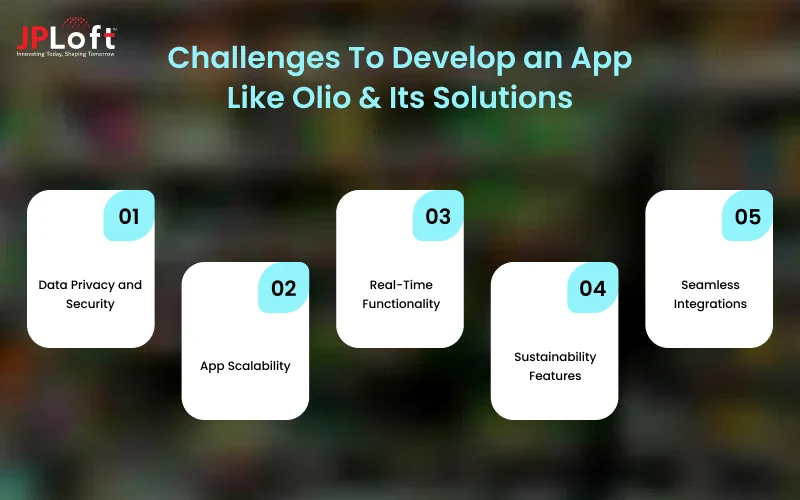
Below are the key challenges and practical solutions to address them.
1. Data Privacy and Security
Challenge: Community apps handle personal details such as location, contact information, and chat messages. Protecting this data is critical, especially in the UK, where strict data rules apply.
Solution: Developers must implement secure authentication, encrypted messaging, and GDPR-compliant data storage.
2. App Scalability
Challenge: As user numbers grow, the platform must handle increased traffic without slowing down. Many startups underestimate this challenge when they create an app like Olio.
Solution: Use cloud-based infrastructure and a scalable backend architecture. This allows the app to expand smoothly without performance issues.
3. Real-Time Functionality
Challenge: A food sharing platform depends heavily on real-time updates. Listings, requests, and messages must appear instantly to avoid confusion.
Solution: Building strong real-time features requires reliable APIs, push notifications, and fast server response time.
4. Sustainability Features
Challenge: Since the platform focuses on waste reduction, features such as impact tracking, carbon savings data, and reporting dashboards are important. However, building these tools accurately can be complex.
Solution: Developers must design simple tracking systems that clearly show measurable results without overloading the app interface.
5. Seamless Integrations
Challenge: An app like this often requires integration with maps, notifications, payment systems, and analytics tools. Poor integration can cause technical issues and user frustration.
Solution: Working with experienced developers ensures smooth API integration, proper testing, and stable performance across devices.
Why Choose JPLoft to Build an App Like Olio?
If you are planning Olio like app development, choosing a trusted mobile app development company in UK is the most important step. At JPLoft, we combine industry experience with the latest technologies to deliver scalable and secure mobile applications tailored to your business goals.
Our team focuses on modern tech stacks such as React Native, Flutter, Node.js, and cloud-based infrastructure to ensure high performance and smooth scalability.
We also integrate advanced tools like AI-powered insights, smart analytics, and secure real-time messaging systems to enhance user experience.
Security and compliance remain a priority, especially for UK-based platforms that require strong data protection standards.
From idea validation and UI/UX design to development, testing, and launch, we provide complete support throughout the process. Whether you want to create an MVP or a fully featured platform, JPLoft ensures your app is future-ready, user-friendly, and built for long-term growth.
Conclusion
Building a community-based platform focused on sustainability is not just a trend; it is a strong business opportunity in the UK market. As discussed above, the demand for waste reduction solutions is rising, and platforms like Olio have already shown how powerful this model can be.
From understanding essential features and monetisation strategies to managing technical challenges, every step requires careful planning and the right development approach.
If you want to make an app like Olio, you must focus on user trust, smooth performance, scalability, and long-term sustainability. With the right technology stack and a clear business model, your platform can create both social impact and steady revenue. Hence, resolve your query on how to make an app like Olio.
Partnering with an experienced app development company ensures your idea is turned into a secure, scalable, and user-friendly solution that meets UK market needs and supports long-term growth.
FAQs
The development time depends on the app type and feature complexity. A basic MVP may take 3–5 months, a mid-level app around 6–8 months, and an advanced platform with smart features may require 9–11+ months.
The cost to build an app like Olio typically ranges between £7,500 and £75,000 ($10,000 - $100,000+), depending on features, platform choice, integrations, scalability requirements, and the expertise of the development team in the UK.
Start with market research, define your target audience, prioritise MVP features, choose a scalable tech stack, and ensure strong security. Partnering with an experienced development company helps ensure structured execution and long-term scalability.
Key challenges include data privacy compliance, scalability, real-time functionality, sustainability tracking features, and smooth third-party integrations. These can be managed with secure architecture, cloud infrastructure, and proper testing.
Common monetisation models for apps like Olio include freemium access, subscription plans, retail partnerships, sponsored listings, value-added services, and data insights for business partners, ensuring revenue without affecting core community features.

Priyanka Sukhwal is the Managing Director and Business Head of JPLoft, with 10+ years of experience in technology, digital product strategy, and business growth. She has worked closely with businesses building mobile applications, custom software, marketplaces, and on-demand platforms across mobility, automotive, consumer services, and startup ecosystems. At JPLoft, she focuses on understanding business models, identifying product opportunities, and helping companies plan digital solutions that can scale with changing market needs.



Share this blog