


Key Takeaways:
Building an app in Saudi Arabia typically costs SAR 75,000 to SAR 375,000, depending on complexity, features, and the platforms you target.
Arabic localization, CITC compliance, and local payment integrations like Mada and STC Pay significantly influence overall development costs.
Choosing a clear scope, smart feature prioritization, and a well-planned app tech stack can reduce unnecessary development hours and save up to 40% of your budget.
Cross-platform development, pre-built components, and a focused MVP are the fastest ways to lower your cost to develop a mobile app in Saudi Arabia without sacrificing quality.
Working with an experienced company in Saudi Arabia such as JPLoft gives you better compliance support, accurate budgeting, and long-term cost control.
Building a mobile app in Saudi Arabia isn't just about having a great idea; it's about understanding what that idea will actually cost to bring to life.
The country is booming under Saudi Vision 2030, and businesses are racing to establish their mobile presence. The cost of app development in Saudi Arabia is one of the most frequently asked questions among entrepreneurs.
Here's the reality: app development costs in the Kingdom of Saudi Arabia range dramatically from SAR 75,000 for basic applications to over SAR 375,000 for complex, feature-rich platforms. But here's what most people don't realize: these numbers tell only part of the story.
The actual investment depends on dozens of factors: your app's complexity, the features you need, whether you're building for iOS or Android (or both), design requirements, and the development team you choose. Understanding these cost drivers before you start can mean the difference between a successful launch and a budget disaster.
How Much Does Mobile App Development Cost in Saudi Arabia?
The price for developing a feature-rich and custom app in Saudi Arabia can range from SAR 75,000 to SAR 375,000 on average, depending on the app’s scope and complexity.
Simple apps may fall between SAR 25,000 and SAR 60,000, medium-complexity apps generally range from SAR 75,000 to SAR 300,000, and highly complex apps can exceed SAR 350,000 or more.
Similar to any mobile app development cost, final pricing depends on factors like features, design quality, security, tech stack, and the expertise of the development team.
Here are the Estimated Costs by Complexity in Saudi Arabia:
- Simple Apps: Usually costs SAR 25,000 to SAR 60,000. These include basic features such as login, profiles, and simple form-based functionality.
- Medium Complexity Apps: Typically range from SAR 75,000 to SAR 300,000. These apps involve multiple user roles, smoother UI, API integrations, dashboards, and structured workflows.
- Complex Apps: Costs can exceed SAR 350,000 and go up to SAR 375,000+ based on features. These apps include advanced UI/UX, real-time systems, AI modules, payment systems, IoT features, and deep backend architecture.
Understanding the cost to develop a mobile app in Saudi Arabia isn’t just about numbers; it’s about knowing how each feature, integration, and design choice adds to your overall investment.
So, we believe you have knowledge about the cost, time to talk about different factors affecting cost to make your dream mobile app idea a reality.
What Are Some Factors Affecting the Cost to Make an App in Saudi Arabia?
As we repeatedly said, several factors affect the overall Saudi mobile app development cost in 2026.
The Saudi market presents unique considerations, local compliance requirements, Arabic localization needs, and integration with regional payment systems, all play crucial roles in shaping development costs.
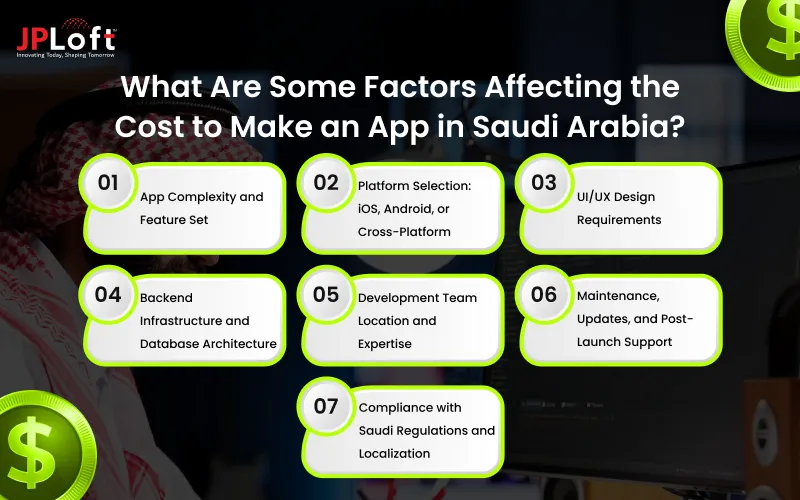
Let's break down the seven key factors that will directly impact your app development investment in Saudi Arabia.
1. App Complexity and Feature Set
When calculating the overall cost to build a mobile app in Saudi Arabia, you must consider what your app actually does.
A simple informational app with basic functionality costs dramatically less than a feature-rich platform with complex capabilities.
Think of it this way: building a basic calculator app versus creating a full-fledged e-commerce platform with AI recommendations—the difference in cost can be 5x or more.
► Basic Features vs. Advanced Functionality
Basic apps typically include essential features like user registration, profile management, and generally cost between SAR 75,000 to SAR 112,500 ($20,000 $30,000).
However, advanced functionality, such as artificial intelligence integration, machine learning algorithms, can push costs to SAR 262,500 to SAR 337,500 ($70,000 to $90,000) or higher.
For example, a simple restaurant menu app might cost SAR 90,000 ($24,000), while a food delivery app with AI-powered recommendations and predictive ordering could reach SAR 300,000 ($80,000).
► Integration Requirements (Payment Gateways, APIs, Third-Party Services)
Every third-party integration adds complexity and cost to your project.
Saudi-specific payment gateways like Mada, STC Pay, or HyperPay typically require SAR 11,250-18,750 ($3,000-$5,000) per integration.
Social media logins, Google Maps API, SMS verification services, and CRM integrations each add SAR 3,750-11,250 ($1,000-$3,000) to your budget.
If your app needs to connect with multiple external services, say, payment processing, shipping APIs, inventory management systems, and analytics platforms, you're looking at an additional SAR 37,500–56,250 ($10,000–$15,000) just for integration work.
Your mobile app tech stack also influences pricing because different technologies require different levels of effort, optimization, and long-term maintenance planning.
► Real-Time Features and Data Synchronization
Real-time functionality is expensive to implement and maintain.
Features like live chat, real-time tracking (essential for delivery apps), require sophisticated backend architecture and ongoing server costs.
Implementing real-time features typically adds SAR 26,250-48,750 ($7,000-$13,000) to development costs, plus increased monthly hosting expenses of SAR 750-3,750 ($200-$1,000).
A ride-hailing app, for instance, needs real-time GPS tracking, driver-passenger matching algorithms, and instant notifications—all contributing significantly to the overall app development cost in Saudi Arabia.
Cost Breakdown by Feature Complexity:
|
Feature Type |
Cost Range (SAR) |
Cost Range (USD) |
Examples |
|
Basic Features |
SAR 75,000 - 112,500 |
$20,000 - $30,000 |
User login, profile, simple content display |
|
Standard Integrations |
SAR 3,750 - 11,250 per integration |
$1,000 - $3,000 per integration |
Social media, maps, analytics |
|
Payment Gateways |
SAR 11,250 - 18,750 per gateway |
$3,000 - $5,000 per gateway |
Mada, STC Pay, credit cards |
|
Real-Time Features |
SAR 26,250 - 48,750 |
$7,000 - $13,000 |
Live chat, GPS tracking, streaming |
|
Advanced AI/ML |
SAR 56,250 - 93,750 |
$15,000 - $25,000 |
Recommendations, predictions, image recognition |
2. Platform Selection: iOS, Android, or Cross-Platform
One of the first decisions you'll make, and one that dramatically affects your cost to build an app in Saudi Arabia, is which platform(s) to build for.
In Saudi Arabia, where both iOS and Android have substantial market share, this choice becomes even more critical to your app's success and your budget allocation.
► Native Development Costs
Going native means crafting two platform-specific apps, but it rewards you with unmatched speed, smoother interactions, and a user experience that feels instantly familiar.
Native iOS development using Swift generally costs SAR 112,500–187,500 ($30,000–$50,000). Businesses that want the best speed and UI precision often choose an iOS app development service for this level of quality.
Native Android development using Kotlin usually ranges from SAR 105,000–180,000 ($28,000–$48,000). Businesses rely on a professional Android app development company to handle device diversity, testing, and performance tuning.
If you need both platforms, expect a combined cost of SAR 217,500–367,500 ($58,000–$98,000), almost double the cost of building a single platform.
Native development is the right choice for high-performance apps such as gaming platforms, heavy animation experiences, or products requiring deep hardware access
► Cross-Platform Framework Cost
Cross-platform frameworks like Flutter or React Native allow developers to write code once and deploy to both iOS and Android, potentially saving 30-40% on development costs.
A cross-platform app might cost SAR 131,250-225,000 ($35,000-$60,000) compared to SAR 217,500+ ($58,000+) for separate native apps.
However, there are trade-offs: slightly reduced performance, occasional platform-specific bugs, and limited access to the latest native features.
For most business applications, e-commerce platforms, and content apps, cross-platform development offers an excellent cost-to-quality ratio.
► Multi-Platform Maintenance Cost
Don't forget about ongoing app maintenance costs when making your platform decision.
Maintaining two native apps requires updates for both iOS and Android whenever Apple or Google releases new OS versions, effectively doubling your maintenance workload.
Cross-platform apps require SAR 2,250-5,625 ($600-$1,500) monthly for maintenance, while dual native apps might need SAR 4,500-9,375 ($1,200-$2,500) monthly.
Over a three-year period, this difference can add up to SAR 81,000-135,000 ($21,600-$36,000) in additional costs for native development.
Platform Cost Comparison:
|
Platform Strategy |
Initial Cost (SAR) |
Initial Cost (USD) |
Monthly Maintenance (SAR) |
Monthly Maintenance (USD) |
Best For |
|
iOS Only (Native) |
SAR 112,500 - 187,500 |
$30,000 - $50,000 |
SAR 2,250 - 4,500 |
$600 - $1,200 |
Premium iOS-focused audience |
|
Android Only (Native) |
SAR 105,000 - 180,000 |
$28,000 - $48,000 |
SAR 2,250 - 4,500 |
$600 - $1,200 |
Android-dominant markets |
|
Both Native Apps |
SAR 217,500 - 367,500 |
$58,000 - $98,000 |
SAR 4,500 - 9,375 |
$1,200 - $2,500 |
High-performance apps, gaming |
|
Cross-Platform |
SAR 131,250 - 225,000 |
$35,000 - $60,000 |
SAR 2,250 - 5,625 |
$600 - $1,500 |
Most business apps, startups |
|
Progressive Web App |
SAR 56,250 - 112,500 |
$15,000 - $30,000 |
SAR 1,500 - 3,750 |
$400 - $1,000 |
Content-focused, limited features |
3. UI/UX Design Requirements
How your app looks and feels isn’t just about aesthetics; it shapes user engagement, retention, and ultimately determines how well your app performs in the market.
Design complexity is one of the biggest cost drivers in Saudi Arabian app development, and cutting corners here often results in weak user adoption.
►Custom Design vs. Template-Based Approach
Template-based designs using pre-made UI kits can cost as little as SAR 11,250–22,500 ($3,000–$6,000) and can speed up development. The trade-off is a generic appearance that blends in with countless other apps.
Custom UI/UX work tailored to your brand and audience typically ranges from SAR 33,750–67,500 ($9,000–$18,000).
Businesses that invest in professional UI/UX Design Services unlock stronger differentiation, better usability, and the ability to integrate cultural elements like Arabic calligraphy and Saudi-centric visual patterns.
Premium apps targeting high-end users may allocate SAR 75,000–93,750 ($20,000–$25,000) purely for design to deliver a polished, luxury-grade experience.
►Animation and Interactive Elements
Modern users expect smooth, engaging interactions.
Micro-animations, transition effects, gesture-based controls, and interactive elements make apps feel polished and professional.
-
Basic animations add SAR 7,500-15,000 ($2,000-$4,000) to your project, while complex animation systems with custom illustrations and motion graphics can cost SAR 26,250-37,500 ($7,000-$10,000).
-
Consider a fintech app animated charts, smooth card transitions, and satisfying button feedback might add SAR 18,750 ($5,000) to costs, but they dramatically improve user perception and trust in your application.
►User Research and Testing Phases
Professional UX research, including user interviews, usability testing, A/B testing, and iterative design improvements, adds SAR 18,750-37,500 ($5,000-$10,000) to your budget but can increase your app's success rate dramatically.
For the Saudi market, conducting research with local users is crucial to understanding cultural preferences, language considerations, and usage patterns.
App Testing with Saudi users before full launch can reveal critical issues: navigation confusion, inappropriate imagery, or features that don't align with local behavior patterns. This investment prevents costly post-launch redesigns that often cost 2-3x more to fix.
|
Design Component |
Cost Range (SAR) |
Cost Range (USD) |
Impact on User Experience |
ROI Potential |
|
Template-Based Design |
SAR 11,250 - 22,500 |
$3,000 - $6,000 |
Basic, generic look |
Low - High bounce rates |
|
Custom UI/UX Design |
SAR 33,750 - 67,500 |
$9,000 - $18,000 |
Professional, branded experience |
High - Better retention |
|
Basic Animations |
SAR 7,500 - 15,000 |
$2,000 - $4,000 |
Smooth transitions |
Medium - Improved feel |
|
Advanced Animations |
SAR 26,250 - 37,500 |
$7,000 - $10,000 |
Premium, engaging interactions |
High - Increased engagement |
|
User Research & Testing |
SAR 18,750 - 37,500 |
$5,000 - $10,000 |
Validated, user-centered design |
Very High - Reduced failures |
|
Arabic Localization Design |
SAR 15,000 - 30,000 |
$4,000 - $8,000 |
Culturally appropriate |
Critical for the Saudi market |
4. Backend Infrastructure and Database Architecture
While users never see your backend, it's the engine that powers everything your app does.
Backend architecture is where many businesses underestimate costs, leading to scalability issues and emergency rebuilds down the line.
► Server Setup and Cloud Hosting Costs
Initial server setup and configuration typically costs SAR 15,000-30,000 ($4,000-$8,000), depending on complexity.
Monthly cloud hosting with providers like AWS, Google Cloud, or Microsoft Azure ranges from SAR 750 ($200) for small apps to SAR 5,625+ ($1,500+) for high-traffic applications.
For Saudi-based apps, hosting data within Saudi Arabia or nearby regions (to comply with data localization requirements) may cost 15-20% more than global hosting options.
► Scalability Requirements
Building an app that can scale from 100 users to 100,000 users requires thoughtful architecture planning.
Scalable backend systems with load balancing, database optimization, and microservices architecture cost 30-50% more upfront (adding SAR 33,750-56,250 or $9,000-$15,000) but prevent expensive emergency rebuilds later.
Many startups make the mistake of building for current needs only, then face SAR 112,500-187,500 ($30,000-$50,000) in rebuild costs when sudden growth overwhelms their infrastructure.
Planning for scalability from day one is almost always more cost-effective than retrofitting later.
► Data Security and Compliance Standards
Security isn't optional; it's mandatory, especially for apps handling sensitive user data, financial transactions, or personal information.
Implementing robust security measures, including data encryption, secure API authentication, penetration testing, and compliance with Saudi data protection regulations, adds SAR 26,250-48,750 ($7,000-$13,000) to development costs.
For fintech, healthcare, or e-commerce apps, budget an additional SAR 11,250-18,750 ($3,000-$5,000) annually for security audits and updates.
The cost of a data breach, both financial and reputational, far exceeds these preventive investments.
Backend Infrastructure Cost Analysis:
|
Infrastructure Component |
Initial Setup (SAR) |
Initial Setup (USD) |
Monthly Cost (SAR) |
Monthly Cost (USD) |
Recommended For |
|
Basic Server Setup |
SAR 15,000 - 22,500 |
$4,000 - $6,000 |
SAR 750 - 1,500 |
$200 - $400 |
Simple apps, <1K users |
|
Standard Cloud Hosting |
SAR 22,500 - 30,000 |
$6,000 - $8,000 |
SAR 1,875 - 3,750 |
$500 - $1,000 |
Medium apps, <10K users |
|
Scalable Architecture |
SAR 37,500 - 56,250 |
$10,000 - $15,000 |
SAR 3,750 - 5,625 |
$1,000 - $1,500 |
Growth-focused apps |
|
Saudi Data Localization |
SAR 26,250 - 37,500 |
$7,000 - $10,000 |
SAR 2,625 - 4,500 |
$700 - $1,200 |
Compliance-required apps |
|
Security Implementation |
SAR 26,250 - 48,750 |
$7,000 - $13,000 |
SAR 937 - 1,562 |
$250 - $417 |
All apps (mandatory) |
|
Enterprise-Grade Backend |
SAR 67,500 - 93,750 |
$18,000 - $25,000 |
SAR 7,500 - 11,250 |
$2,000 - $3,000 |
Large-scale platforms |
5. Development Team Location and Expertise
Who builds your app matters as much as what they build.
When you hire mobile app developers, their location, expertise, and structure create massive cost variations in Saudi mobile app development pricing.
► Local Saudi Developers vs. Outsourcing Options
-
Saudi-based development agencies: SAR 112–262 ($30–$70) per hour, offering local market alignment, timezone convenience, and cultural understanding.
-
South Asian outsourcing: SAR 37–75 ($10–$20) per hour.
-
Eastern European developers: SAR 75–150 ($20–$40) per hour.
However, hourly rates don't tell the full story: local developers understand Saudi market nuances, compliance requirements, and user preferences, potentially reducing revisions and miscommunication.
► Experience Level and Specialization
-
Junior developers: SAR 56–112 ($15–$30) per hour
-
Mid-level developers: SAR 112–187 ($30–$50) per hour
-
Senior specialists: SAR 187–300 ($50–$80) per hour
While hiring junior developers seems cost-effective, they may take 2-3x longer to build the same features, ultimately costing more.
Specialized expertise like blockchain developers, AI/ML engineers, or AR/VR specialists, command premium rates of SAR 225-375 ($60-$100) per hour but deliver capabilities that generalist developers simply cannot.
For complex apps, investing in experienced specialists typically results in better code quality, fewer bugs, and faster time-to-market.
► Agency vs. Freelancer vs. In-House Team
-
Saudi development agencies: Charge SAR 150,000–375,000 ($40,000–$100,000) for a full project. They handle everything end-to-end, offering structured project management, quality assurance, and full accountability.
-
Freelancers: Usually quote SAR 75,000–187,500 ($20,000–$50,000) but come with risks such as limited availability, weaker accountability, and no backup support, issues that often push businesses to hire dedicated developers instead.
-
In-house team: Costs SAR 18,750–37,500 ($5,000–$10,000) per developer monthly, and is only practical for ongoing or multiple projects. Many companies consider this route when exploring the cost to create a mobile app in Saudi Arabia.
What’s the best choice? For most businesses, agencies offer the best balance of quality, reliability, and reduced cost to build a mobile app in Saudi Arabia.
|
Team Type |
Hourly Rate (SAR) |
Hourly Rate (USD) |
Project Cost (SAR) |
Project Cost (USD) |
Pros |
Cons |
|
Saudi Agency |
SAR 112 - 262 |
$30 - $70 |
SAR 150,000 - 375,000 |
$40,000 - $100,000 |
Local expertise, accountability, full-service |
Higher cost |
|
Freelancers (Local) |
SAR 75 - 187 |
$20 - $50 |
SAR 75,000 - 187,500 |
$20,000 - $50,000 |
Lower cost, flexibility |
Risk, limited availability |
|
Eastern European |
SAR 75 - 150 |
$20 - $40 |
SAR 93,750 - 168,750 |
$25,000 - $45,000 |
Good quality, reasonable cost |
Timezone differences |
|
In-House Team |
SAR 18,750 - 37,500/month |
$5,000 - $10,000/month |
Variable (ongoing) |
Variable (ongoing) |
Full control, dedicated |
High overhead, ongoing cost |
|
Hybrid (Agency + Freelancers) |
Mixed rates |
Mixed rates |
SAR 112,500 - 225,000 |
$30,000 - $60,000 |
Balanced cost and quality |
Coordination complexity |
6. Maintenance, Updates, and Post-Launch Support
App development doesn't end at launch; it's just the beginning of a new phase, “Mobile app maintenance services.”
Ongoing costs for maintenance, updates, and support typically run 15-25% of initial development costs annually, and many businesses fail to budget adequately for this phase.
► Ongoing Bug Fixes and Performance Optimization
Even thoroughly tested apps encounter bugs after launch when exposed to diverse devices, network conditions, and user behaviors.
Monthly maintenance retainers typically cost SAR 3,750-11,250 ($1,000-$3,000), covering bug fixes, performance monitoring, crash analytics, and minor improvements.
Critical bugs require immediate attention, and emergency fixes can cost SAR 1,875-5,625 ($500-$1,500) per incident if you don't have a maintenance contract.
Regular performance optimization ensures your app stays fast as your user base grows; neglecting this leads to poor reviews, user churn, and eventually, expensive rebuilds.
► Feature Updates and OS Compatibility
Apple and Google release major OS updates annually, and your app must stay compatible or risk becoming obsolete.
-
Annual OS compatibility updates: SAR 15,000–37,500 ($4,000–$10,000), depending on app complexity.
-
Feature updates to stay competitive: Budget SAR 26,250–67,500 ($7,000–$18,000) annually for new features, user-requested improvements, and emerging technology integrations.
-
Risk of no updates: Apps that stop evolving lose users quickly to more innovative competitors.
► Technical Support and User Management
User support infrastructure—including help desk systems, user feedback management, push notification systems, and analytics platforms—requires ongoing investment.
-
Basic support systems: SAR 1,125–3,000 ($300–$800) per month.
-
Comprehensive support (24/7, multi-channel, analytics): SAR 5,625–13,125 ($1,500–$3,500) per month.
-
Dedicated support staff for large or complex apps: SAR 3,750–7,500 ($1,000–$2,000) per month.
Strong support improves user retention and boosts app store ratings—crucial for long-term success.
Annual Maintenance Cost Breakdown:
|
Maintenance Type |
Monthly Cost (SAR) |
Monthly Cost (USD) |
Annual Cost (SAR) |
Annual Cost (USD) |
What's Included |
|
Basic Maintenance |
SAR 3,750 - 5,625 |
$1,000 - $1,500 |
SAR 45,000 - 67,500 |
$12,000 - $18,000 |
Bug fixes, monitoring, minor updates |
|
Standard Support |
SAR 5,625 - 9,375 |
$1,500 - $2,500 |
SAR 67,500 - 112,500 |
$18,000 - $30,000 |
+ Feature updates, OS compatibility |
|
Premium Support |
SAR 9,375 - 15,000 |
$2,500 - $4,000 |
SAR 112,500 - 180,000 |
$30,000 - $48,000 |
+ 24/7 support, dedicated team |
|
OS Compatibility Updates |
One-time annual |
One-time annual |
SAR 15,000 - 37,500 |
$4,000 - $10,000 |
iOS/Android version updates |
|
Feature Enhancements |
Project-based |
Project-based |
SAR 26,250 - 67,500 |
$7,000 - $18,000 |
New features, improvements |
|
Emergency Bug Fixes |
SAR 1,875 - 5,625/incident |
$500 - $1,500/incident |
Variable |
Variable |
Critical issue resolution |
7. Compliance with Saudi Regulations and Localization
The Saudi market presents unique requirements that international developers often overlook, leading to costly delays, rejections, or legal issues.
Understanding and implementing local compliance requirements is non-negotiable for successful app launches in Saudi Arabia.
► CITC (Communications and Information Technology Commission) Requirements
The Communications and Information Technology Commission regulates digital services in Saudi Arabia, requiring specific licenses for certain app categories (fintech, telehealth, e-commerce).
-
Compliance consultation and implementation: SAR 11,250–30,000 ($3,000–$8,000), with licensing fees varying by category.
-
Stricter regulations for sensitive apps: Payment, personal data, and telecom-related apps require legal review costing SAR 7,500–18,750 ($2,000–$5,000).
-
Technical compliance requirements: Implementing measures like data localization adds SAR 18,750–33,750 ($5,000–$9,000) to infrastructure costs.
- Risk of non-compliance: Failing to meet CITC guidelines can cause app store rejection or removal, delaying launch by months and increasing expenses.
► Arabic Language Integration and RTL Support
-
Arabic localization (not just translation): Professional cultural adaptation costs SAR 15,000–30,000 ($4,000–$8,000) for medium-complexity apps.
-
RTL implementation effort: Adds 15–25% to development time, roughly SAR 18,750–37,500 ($5,000–$10,000) in extra cost.
-
What RTL affects: Buttons, navigation, animations, layout structure, and gesture controls must all be rebuilt to work smoothly in right-to-left format.
Often, many developers make a common mistake: they underestimate RTL complexity, leading to flawed design and poor user experience.
Low-quality Arabic implementation signals poor standards to Saudi users and reduces app adoption significantly.
Use native Arabic speakers for testing; machine translation or non-native execution is instantly noticeable to users.
►Local Payment Gateway Integration (Mada, STC Pay)
Saudi users prefer local options; credit cards alone negatively impact conversions and increase friction.
-
Mada integration: Costs SAR 11,250–18,750 ($3,000–$5,000) and requires banking partnerships plus regulatory compliance.
-
Local wallet integrations: Adding STC Pay, Urpay, or HyperPay costs SAR 7,500–11,250 ($2,000–$3,000) per wallet.
-
International payment options: Apple Pay and Google Pay each add SAR 7,500–11,250 ($2,000–$3,000).
These integrations form a significant part of the overall app development cost in Saudi Arabia.
► Saudi Localization & Compliance Costs:
|
Compliance Requirement |
Cost Range (SAR) |
Cost Range (USD) |
Time Impact |
Business Impact |
|
CITC Consultation |
SAR 11,250 - 30,000 |
$3,000 - $8,000 |
2-4 weeks |
Mandatory for launch |
|
Legal Review & Licensing |
SAR 7,500 - 18,750 |
$2,000 - $5,000 |
3-6 weeks |
Category-dependent |
|
Data Localization Setup |
SAR 18,750 - 33,750 |
$5,000 - $9,000 |
2-3 weeks |
Required for sensitive data |
|
Arabic Translation |
SAR 7,500 - 15,000 |
$2,000 - $4,000 |
1-2 weeks |
Essential for Saudi users |
|
RTL UI Implementation |
SAR 18,750 - 37,500 |
$5,000 - $10,000 |
3-4 weeks |
Critical for user experience |
|
Mada Payment Integration |
SAR 11,250 - 18,750 |
$3,000 - $5,000 |
2-3 weeks |
High conversion impact |
|
Local Wallets (each) |
SAR 7,500 - 11,250 |
$2,000 - $3,000 |
1-2 weeks per wallet |
Increases payment options |
|
Cultural Adaptation |
SAR 5,625 - 11,250 |
$1,500 - $3,000 |
Ongoing |
Improves local acceptance |
Now that you know what influences pricing but let’s check out how you can lower the total app development cost with the help of an experienced mobile app development company.
How to Reduce the Overall App Development Cost in Riyadh, Saudi Arabia?
Seeing so many numbers and factors can scare anyone, but with the right strategies, you can efficiently reduce the overall cost to develop an app in Saudi Arabia without compromising on quality.
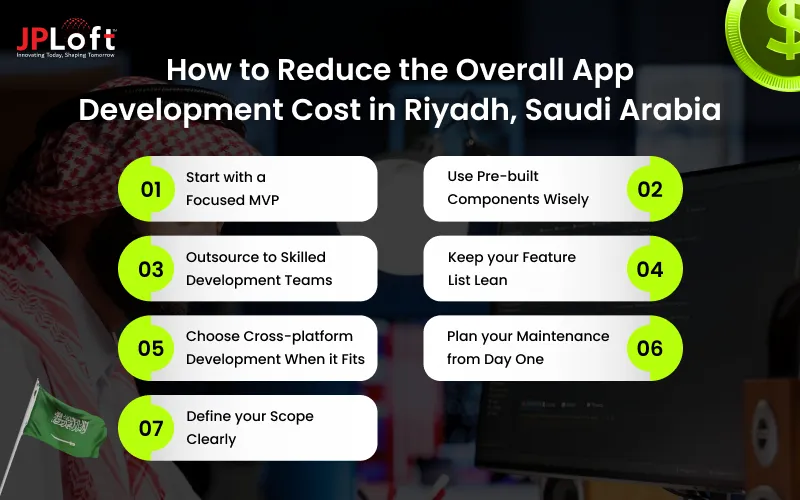
Let’s get to know about it:
1. Start with a Focused MVP
If you want to keep the cost to build a mobile app in Saudi Arabia manageable, begin with an MVP.
Launching with only core features can cut your initial spend by 25–35 percent.
You learn what users actually want, avoid wasted development, and add the right features later, with confidence and control.
2. Use Pre-built Components Wisely
You can reduce your Saudi Arabia app development cost instantly by reusing battle-tested components.
Think login systems, maps, dashboards, notifications, no need to build those from scratch.
Using pre-built modules can reduce your total development time by 20–30 percent, helping you launch faster and at a much more reasonable budget.
3. Outsource to Skilled Development Teams
Working with an experienced team protects you from costly mistakes.
No matter if you hire dedicated developers or choose a development company, what matters most is partnering with a team that has expertise.
Strong code, clear communication, and reliable delivery save you far more than you spend upfront.
Businesses that outsource wisely often reduce their overall project cost by 15–25 percent, simply because they avoid rework and technical debt later.
4. Keep your Feature List Lean
Every extra feature adds more design, testing, and development hours.
Staying lean early can bring down the cost to make an app in Saudi Arabia by 20–40 percent.
When you focus on what your users actually need, you move faster, spend less, and deliver a much cleaner experience that they enjoy using.
5. Choose Cross-platform Development When it Fits
If your app doesn’t rely on heavy native animations or device-specific features, cross-platform frameworks can save you a lot.
With one codebase for iOS and Android, you reduce development time by 30–40 percent and maintain everything in one place, making future updates cheaper and easier.
6. Plan your Maintenance from Day One
A well-structured app saves a surprising amount of money long-term.
Clean code and proper documentation can reduce maintenance expenses by 20–30 percent over the first year.
You avoid costly “surprise fixes” and make updates smoother whenever new OS versions or user requests appear.
7. Define your Scope Clearly
A clear scope is your biggest defense against budget overruns.
When developers know exactly what you want, you minimize revisions and reduce wasteful back-and-forth.
This simple step alone can lower your total app development cost by 15–20 percent, because you’re not paying for unnecessary changes or misunderstood requirements.

How to Choose the Right Partner to Build Your Mobile App in Saudi Arabia?
Selecting the right partner requires evaluating technical expertise, local market knowledge, and proven project delivery. JPLoft is a leading mobile app development company in Saudi Arabia, offering comprehensive solutions from concept to post-launch support.
Key Criteria for Choosing a Development Partner:
-
Technical Expertise: JPLoft's team delivers cross-platform and native apps using Flutter, React Native, Swift, and Kotlin, with costs ranging from SAR 75,000 to SAR 375,000 ($20,000-$100,000) depending on complexity
-
Saudi Market Specialization: The company provides CITC compliance consultation, Arabic RTL implementation, and local payment gateway integration (Mada, STC Pay) as standard features in all Saudi projects.
-
Transparent Pricing: JPLoft offers detailed cost breakdowns in both SAR and USD, with maintenance plans starting at SAR 3,750 ($1,000) monthly.
-
Post-Launch Support: Ongoing maintenance includes bug fixes, OS compatibility updates, and feature enhancements to keep apps competitive in Saudi Arabia's digital marketplace.
Conclusion
Saudi Arabia's mobile application development costs will help you create realistic plans to develop apps without stress.
A thorough understanding of the costs that drive a mobile application (i.e., feature set, platform choice, complexity of design, requirements for compliance, and expertise of team members) will provide you with an advantage over other companies entering into Saudi Arabia.
With the optimum strategy and the best development partner in place, you can rapidly launch an application while managing your development costs and also generating a product that your users are likely to love.
By focusing on clarity, quality, and long-term value, you will have a much greater probability of success in this rapidly growing digital marketplace in the Middle East.
FAQs
Build a valuable app, target the right audience, optimize monetization, and scale through marketing. Apps earn when they solve real problems better than competitors and keep users returning daily.
You can prototype or use no-code tools for free, but real apps need development, hosting, and maintenance. Free tools help you start, but professional builds require investment.
It’s easy to start but hard to master. Designing, coding, testing, security, and scaling require expertise. With the right team, though, the process becomes smoother and far more manageable.
A simple app usually costs SAR 25,000–60,000, depending on features. Basic login, profiles, and simple screens fit this range, giving startups an affordable entry into the mobile market.
Choose cross-platform development, start with an MVP, reuse components, define your scope clearly, and work with experienced developers. Smart planning alone can reduce total costs by 20–40 percent.

Priyanka Sukhwal is the Managing Director and Business Head of JPLoft, a results-driven leader with 10+ years of experience steering technology ventures and business growth. Her strategic acumen and deep understanding of digital markets and on-demand solutions have consistently translated into innovations that help businesses scale, evolve, and lead in competitive landscapes.


Share this blog