


Key Takeaways
Entertainment app development starts with market research, audience analysis, content planning, and MVP features. A clear development process then covers UX design, technical architecture, development, testing, launch, and scaling.
Essential entertainment app features include user profiles, content discovery, media playback, offline access, push notifications, and social sharing.
Entertainment apps cost around $15,000 to $100,000+ based on app complexity, streaming requirements, and backend infrastructure.
AI-powered recommendations, creator features, and privacy-focused AI are shaping the next generation of entertainment apps.
Partner with JPLoft; the team helps businesses build custom entertainment apps around your audience, content model, features, and budget.
Entertainment apps do more than just stream videos and music; they create an experience for the audience. Whether people are binge-watching their favorite shows, listening to music, or playing games, these platforms have become a regular part of everyday entertainment.
As ORSON WELLES said, “I hate television. I hate it as much as peanuts. But I can't stop eating peanuts”. This perfectly captures people’s growing appetite for entertainment.
This growing demand is creating new opportunities for businesses and startups to enter the entertainment industry. From building streaming platforms to interactive content and creator communities, businesses can explore different ways to engage with audiences.
However, success starts with understanding the target audience's emotions, their content preferences, viewing habits, and expectations from existing platforms.
If you are planning to launch a scalable entertainment platform, this guide covers how to create an entertainment app complete process, cost, common challenges, and beyond.
What is an Entertainment App and How Does It Work?
Entertainment apps provide users with access to a wide range of content, including music and video streaming, games, TV shows, books, and live streaming. These platforms allow users to explore globally available content and enjoy an engaging, convenient, and stress-free experience.
Several popular entertainment applications, such as Netflix, Amazon Prime, Disney+, and YouTube, have already established their strong presence among audiences. So, if you want to understand how to make an entertainment app, first look at how these platforms work.
How Does It Work?
Entertainment apps connect users with digital content through an interactive platform. Here's how the process works:
-
Users create a profile and sign up to access the content library.
-
The app collects users' preferences to understand their interests and suggest personalized recommendations.
-
Through the user panel, different types of content are uploaded, such as games, music, shows, movies, and podcasts, into their respective categories.
-
The user can browse, search, and filter their preferred content.
-
When a user selects something to watch, the app connects with the backend system. The media is then loaded through the streaming system.
-
Users can also interact with the app through likes, shares, downloading content, or connecting with their favorite creator.
-
If the app includes subscription or paid content, users complete the payment process within the app.
Types of Entertainment Apps You Can Build
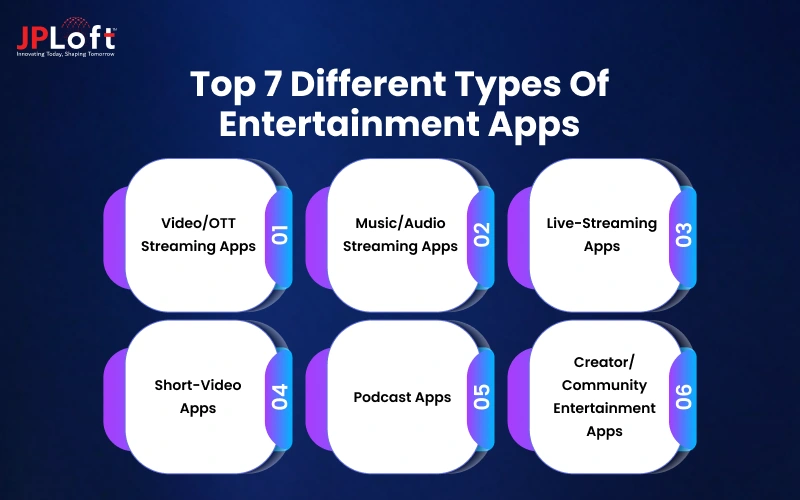
Entertainment apps are not limited to a single platform or content format. They come in different types, catering to different audience interests and content preferences. Here are the different types of entertainment apps you should explore.
Type 1. Video/OTT Streaming Apps
OTT streaming apps offer a wide range of content, including shows, movies, web series, and live streaming. These apps are accessible across multiple devices and platforms. It generates revenue through subscriptions, pay-per-view services, and brand partnerships.
Type 2. Music/Audio Streaming Apps
Music streaming apps like Spotify and Apple Music allow users to listen to licensed music, audiobooks, and podcasts. These platforms generate revenue through paid monthly subscriptions, ad-supported free tiers, and brand partnerships.
Type 3. Live-Streaming Apps
Live streaming apps, such as YouTube, allow users to enjoy live streaming videos in real time. They feature content from creators and influencers and generate revenue through platform commissions, advertising, and viewer tips for creators.
Type 4. Short-Video Apps
Short video apps have gained massive audience interaction by allowing users to interact with short videos often lasting 60 seconds or less. Popular platforms such as YouTube, TikTok, allow creators to produce and share short videos with their audience.
Their massive success generates revenue through in-feed advertising, e-commerce integration, and in-app purchases.
Type 5. Podcast Apps
Podcast apps allow users to listen to episodic content featuring real-life experiences, interviews, and discussions with experts and celebrities. Premium subscriptions, advertisements, and partnerships are the primary revenue sources for these platforms.
Type 6. Creator/Community Entertainment Apps
Creator and community apps are growing as it allows creators to share videos, memes, and other content while building communities around their interests. They can earn revenue through advertising, subscriptions, brand collaborations, and paid content.
Must-Have Features of an Entertainment App
To understand how to make an entertainment app, choosing the right set of features is essential. Your focus should be on simplifying content discovery, improving user engagement, and keeping the audience interested. Here are the key entertainment app features to consider.
|
Features |
Description |
|
User Registration & Profiles |
Users should be able to create their profile in a short time and manage preferred entertainment easily. |
|
Smart Search & Content Discovery |
Update the app with search, filters, categories, and trending sections. Make content discovery easily accessible. |
|
Media Playback |
Resume content at the same time across mobile, laptop, or desktop screens. It helps users pick up where they left off. |
|
Watchlist & Favorites |
Allow users to like, save, and organize their preferred content. This helps them easily find the favorite show they wish to watch. |
|
Offline Access |
Allow users to download audio, video, or any content for offline access as well. Enforce rental integration to rent any show. |
|
Push Notifications |
Allow users to receive notifications when any content is added or when there are any changes in app policies. |
|
Social Sharing |
Allow watchlist sharing and real-time viewing on social media platforms. |
How to Create an Entertainment App: Step-By-Step Process
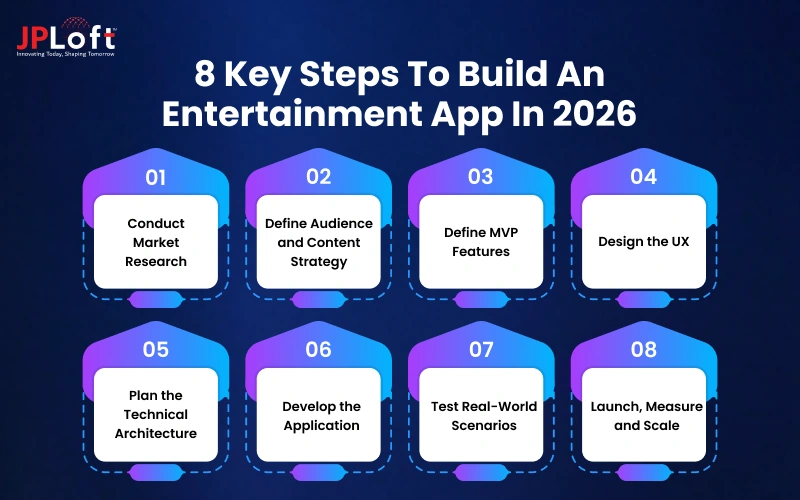
Do you still believe building an entertainment app just requires coding a platform? You are still living in the 2020s. Focus on creating an experience that keeps users engaged and encourages them to return. Here is a step-by-step process to analyze how to develop a media and entertainment app.
Step 1: Conduct Market Research
The entertainment app process is incomplete without conducting thorough market research for the app. It helps you analyze user demand and entertainment market trends.
-
Analyse the Entertainment Market: Observe existing platforms in the market, analyze how they have achieved global popularity, and identify any specific functions that make them popular among users.
-
Research Competitors: Always look for competitors. Several businesses might be working on the same entertainment app ideas that you are planning to pursue. Additionally, check existing platforms in the market, their features, content offerings, pricing structures, and user satisfaction levels.
Step 2: Define Audience and Content Strategy
Before starting the development process, you should have clarity about your target audience. It will help you plan the right user journeys, select features, and create a valuable experience that excites them.
-
Identify your target audience: Identify your users based on their content preferences, regular watch time, and viewing habits. Conduct a market survey to identify user expectations from existing apps and make changes accordingly.
-
Define content strategy: Decide what type of content you will cover. Is it video streaming, music platforms, gaming apps, or something new?
Step 3: Define MVP Features
Now comes the preparation of the foundation for the entertainment app. Choose the core app features, content library, social sharing, notifications, content recommendations, and user profiles.
-
App Features: Plan the set of features around your audience's usage patterns, registration, search, content discovery, media playback, and watchlists.
-
Separate essential and advanced features: Several advanced features, such as AI-powered content recommendations, generative AI, and AR/VR content tools, should be kept separate. For MVP development, focus only on must-have functionalities.
Step 4: Design the UX
When it comes to mobile app design, a smooth and easy-to-navigate interface creates a good first impression. Complex and cluttered navigation can confuse the audience and impact app growth.
-
Design the Wireframe: Creating a simple blueprint helps you plan the user flow properly. For instance, it creates a clear and easy-to-use layout for content browsing, top show recommendations, and a watchlist.
-
Create the Prototype: Before starting development, create an app prototype to test the blueprint's functionality. It helps identify user interface-related issues early and saves costs on rebuilding.
Step 5: Plan the Technical Architecture
Planning the right mobile app tech stack is necessary for successful app development. Think of it this way: if you are planning a video streaming app, the backend structure, strong CDN networks, and cloud network support play crucial roles.
-
Choose the Right Technology Stack: Select programming languages, frameworks, databases, cloud services, and other technologies based on your app requirements.
-
Prepare for Scalability and Security: Design the architecture to handle growing traffic while protecting user accounts, payments, content, and other sensitive data.
Step 6: Develop the Application
Now comes the development planning for the platform. Instead of going for a full-scale build, build an MVP marketplace app. This allows you to test the app with core features and a smaller audience.
-
Third-Party APIs: Connect payment gateways, cloud storage, streaming services, social sharing, and notifications with the app's backend infrastructure.
-
Build the Admin Panel: Create an admin dashboard to manage new content listings, users, payments, and day-to-day platform operations.
Step 7: Test Real-World Scenarios
Run usability testing to ensure the features and app workflow are working properly. An entertainment app that offers easy navigation, registration, and a pleasant content-viewing experience for users will get a good response.
-
Functional Testing: Conduct functional testing to check for bugs, performance issues, loading speed, buffering, and playback quality across different networks.
-
App Testing: Make sure all the app's features are working properly. Additionally, follow the best app security practices to protect user and app data. This includes biometrics, two-factor authentication, and proper encryption.
Step 8: Launch, Measure and Scale
Once you are sure that performance, functionality, and security are working properly, you can plan to upload the platform to the App Store and Google Play Store. Make sure to use the right marketing strategies to promote your product.
-
App Store Submission: Prepare your app for publication on iOS and Android platforms by complying with their app guidelines.
-
Maintain and Scale the App: Maintain your app's performance through early error detection, performance optimization, and regular app feature updates. These solutions help scale it for long-term performance and maintain the platform's value.
Core Layers of Entertainment App Architecture
The entertainment app architecture must include content delivery networks and an easy-to-connect interface to deliver streaming, content browsing, and smooth cross-platform performance. Here are the core layers of entertainment app architecture.
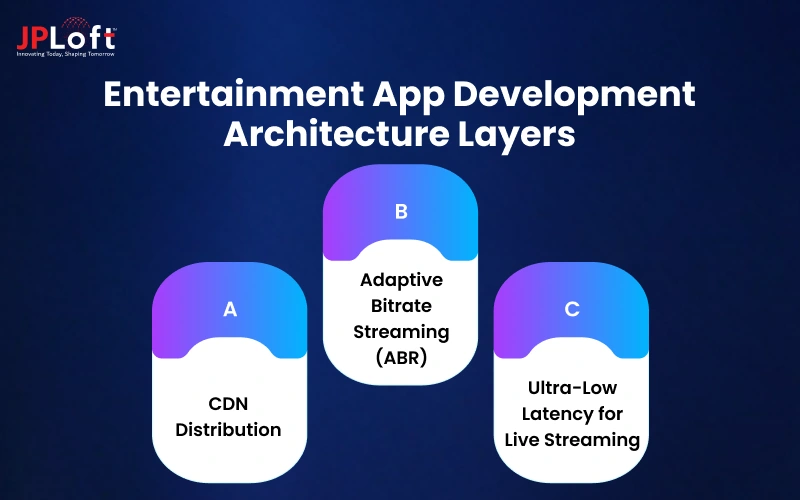
1. CDN Distribution
Content delivery networks play a crucial role in reducing server load, avoiding buffering, and minimizing latency for high-quality content. They work across different networks and enable cross-platform streaming.
When a user clicks “play" to watch a movie, the request goes directly to the CDN. It caches the content, checks whether it is already available, and delivers it to the user.
2. Adaptive Bitrate Streaming (ABR)
The ABR network allows users to enjoy video content by changing the video quality according to network and internet speed. For instance, the movies are pre-uploaded in three segments: 360p, 720p, and 1080p.
When a user clicks on any of these quality levels, the ABR system chooses the appropriate quality and plays the movie accordingly. If the internet is fast, the system automatically switches to high-quality video.
3. Ultra-Low Latency for Live Streaming
It can reduce viewing delay and improve the live streaming connection. It reduces the gap between what is happening in real life and what the video is showing to a delay of 1- 2 seconds.
Imagine a live concert is taking place. If the delay is high, it can create a poor viewing experience, and users might see the performance 20–30 seconds later. With ultra-low latency, this delay can be reduced to 2–3 seconds. In entertainment apps, this works by storing, processing, and delivering live streams through CDNs.
How Much Does It Cost to Develop an Entertainment App?
The cost to build an entertainment app usually ranges between $15,000 and $100,000+. The final price depends on features, complexity, and platform choice.
Whether you are exploring how to create an entertainment app for a startup or updating premium features, understanding the cost range helps you plan better and avoid unexpected expenses.
Let’s understand the cost breakdown with the table below:
|
App Type |
Features |
Estimated Cost |
|
Basic App |
Includes core features like user login, content browsing, and simple streaming. Best for testing ideas with limited investment. |
$15,000 – $30,000 |
|
Mid-Level app |
Comes with features like recommendations, push notifications, and better UI. Suitable for growing platforms. |
$30,000 – $70,000 |
|
Advanced App |
Includes AI recommendations, live streaming, and scalable backend systems. Ideal for large-scale platforms. |
$70,000 – $100,000+ |
How Do Entertainment Apps Make Money?
Now that you know how to build an entertainment app. The next step is finding its revenue-generating strategies. Here are the different ways how entertainment apps make money.
|
Model |
Suitable for |
Revenue Source |
|
Subscription-Based Model |
Video Streaming, music, and audio streaming. Video game services, creator platforms. |
Monthly or annual recurring fees paid by customers. |
|
Advertising-Based Model |
Social media platforms, streaming, media, and publishing platforms. |
Brands or advertisers. |
|
Freemium Model |
Video gaming, music and audio streaming, reading apps, live streaming platforms. |
Paid subscriptions, in-app purchases, and in-app advertising. |
|
Pay-Per-View |
Live Sports, Music and live entertainment, digital events, Digital conferences, and Concerts. |
Event-based pricing and transactions over on-demand video. |
|
Creator Commission |
E-commerce and D2C brands |
Advertisers, brands, physical products, Subscriptions, views, and watch time. |
|
Sponsorship & Brand Partnerships |
Concert Tours, Music and Film Festivals, Gaming and Esports, and Streaming Productions |
Affiliate commission, content licensing, and performance bonuses. |
Major Entertainment App Challenges & Solutions
Planning to build an entertainment app can be rewarding, but it also comes with common development challenges. These issues can impact your app’s performance, engagement, and user experience. Here are a few common entertainment app development challenges and solutions.
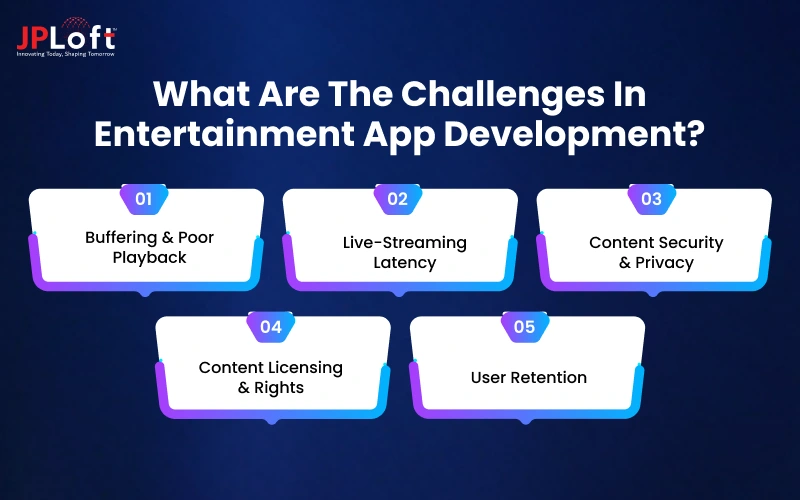
Challenge 1: Buffering & Poor Playback
Buffering, slow speed, or poor playback quality can frustrate users and disrupt their viewing experience. These issues can occur during peak traffic, due to weak content delivery, or large media files.
Solution: Use a strong CDN network and optimized video formats to ensure smooth playback quality across different network speeds.
Challenge 2: Live-Streaming Latency
Latency challenges occur while viewers experience a delay between live streaming of any show. During live sports, concerts, or events, a few seconds of delay can create a major turnoff. High latency can make live chats, polls, and syncing feel disconnected.
Solution: Switch to low-latency live streaming for shorter chunks. Connect with a mobile app development company in the USA to implement reliable live streaming solutions.
Challenge 3: Content Security & Privacy
The entertainment platform collects several pieces of personal information, such as payment details and content preferences; this creates a major risk of data being leaked. Without strong security measures, hacking and pictures leaking to unsecured third parties affect both the app's reputation and trust.
Solution: Use robust security measures to protect data from breaches. Complying with GDPR and CCPA regulations is necessary to prevent unauthorised access.
Challenge 4: Content Licensing & Rights
Several entertainment application need several legal rights, licenses, and copyrights to stream the latest movies or shows on their platform. Without these rights, businesses may face legal issues, including content removal and financial losses.
Solution: Secure the necessary content rights before publishing content. Further, clarify the content agreements with creators, distributors, and copyright holders for using their movies, games, or any type of content.
Challenge 5: User Retention
With so many entertainment application available, it is challenging for businesses to maintain user retention; users can quickly move to the next platform if they lose interest. The real challenge is to update the app with engaging features to increase user retention.
Solution: Use machine learning and behavioral recommendations to analyse user behavior and optimize content tailored to the user viewing experience and expectations.
What Are the Latest Trends in Entertainment App
New technologies are already revolutionizing the entertainment industry. Several trends are improving user experience, smooth app functioning, and creating a distinct identity. Here are several media and entertainment trends you should explore to deliver a better experience.
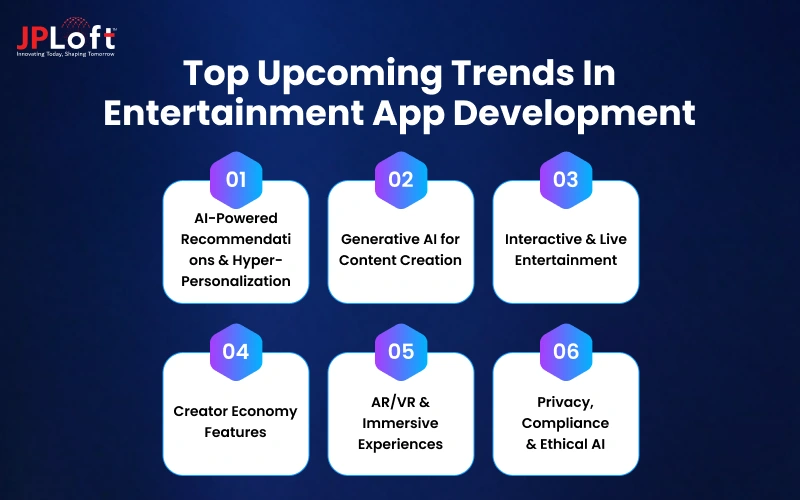
1. AI-Powered Recommendations & Hyper-Personalization
AI in entertainment apps is analysing content recommendations, personalizing the user experience, and helping improve user retention. By analysing mood, watch history, engagement patterns, and timing, apps like Spotify and TikTok already deliver hyper-personalized content recommendations at scale and increase session duration.
2. Generative AI for Content Creation
Generative AI creates and adapts entertainment content based on users' preferences and interests. It can generate personalized playlists based on a user’s current mood, create short videos tailored to their interests, and help content creators develop creative scripts.
3. Interactive & Live Entertainment
Users do not want to just watch the content; they want to engage. Therefore, enabling real-time content interaction through live sports, events, concerts, and interactive shows online improves binge-watching time. Several apps like TikTok and YouTube have created live broadcasting channels where millions of fans interact with their preferred creators or celebs.
4. Creator Economy Features
The creator economy since the 2020s has created a massive growth opportunity among audiences. Several individual producers, creators, and storytellers can join an app and connect with their audience.
5. AR/VR & Immersive Experiences
Merging content with digital experiences is one of the most effective trends in entertainment application. Major businesses are already analysing this trend for attractive storytelling, gaming, and social interactions. By replacing physical surroundings with interactive 3D digitalization, a hectic day can feel like the best part of the day.
6. Privacy, Compliance & Ethical AI
As entertainment platforms collect several pieces of private information using AI, maintaining privacy and security becomes more crucial. Businesses need to implement several privacy measures and follow compliance requirements to ensure users' data is safe and secure.
How Can JPLoft Help You Build Your Entertainment App?
Your entertainment app needs more than attractive screens. It needs the right content experience, monetization strategy, and technology to keep users coming back.
JPLoft, a media and entertainment app development company, helps businesses turn entertainment ideas into custom apps built around their audience and business goals.
Whether you want to launch an OTT platform, music app, live-streaming service, podcast platform, or creator community, we build the experience around your requirements.
From personalized content discovery and smooth streaming to subscriptions, payments, social features, and admin controls, you decide which features you need for the app. Our team can also help you balance customization with your budget, without adding features that your business does not need.
With JPLoft, you get an entertainment application designed for your market, built to handle growing audiences, and ready to support your revenue goals.
Conclusion
Creating an entertainment app starts with more than choosing a content format. You need to understand your audience, define the right business model, select useful features, and plan for reliable content delivery.
From OTT and music platforms to live streaming and creator communities, learning how to create an entertainment app involves choosing the right user experience, monetization strategy, and technology for your platform.
Your decisions around streaming quality, personalization, security, scalability, and platform support can directly affect how users experience your app's functions. Planning these areas early can also help control development costs and avoid expensive changes later.
As entertainment trends continue to change, businesses can explore AI, immersive experiences, creator features, and flexible monetization models to stay relevant. With the right development strategy, you can turn an entertainment app idea into a scalable digital business.
FAQs
Developing an entertainment app requires a clear understanding of the app type, target audience, market demand, and revenue model. Select key features, design the UI/UX interface, develop, test, and launch the app.
The cost to develop an entertainment app starts from $15,000 to $100,000. The cost depends on features, project complexity, backend infrastructure, and customised design changes.
An entertainment app includes cross-device compatibility, user registration, offline download, social media sharing, and real-time notifications.
Entertainment apps make money through subscriptions, in-app advertising, premium features, pay-per-view model, and brand partnerships.
Generative AI for content creation, AI-powered content recommendations, hyper-personalized feeds, AR/VR for interactive entertainment, and cloud gaming for a stable connection are the latest trends in entertainment platforms.

Kris Jacobs brings 20+ years of experience in digital product strategy, user-focused design, and solving complex product challenges. She has worked across on-demand services, travel, entertainment, sports, insurance, education, and service marketplaces, including handyman, dog-walking, courier, event-management, and equine platforms. Her focus is on shaping practical, scalable digital experiences that align user needs with business goals and long-term product growth.


Share this blog