


Key Takeaways:
Custom AI chatbot development costs range from $15,000 to $220,000+, depending on the project's scope and complexity.
AI models, integrations, features, and security are the biggest factors influencing development costs.
Hidden expenses like LLM APIs, cloud hosting, and maintenance should be included in your long-term budget.
An MVP-first approach, RAG, and phased development can significantly optimize the cost to create an AI chatbot.
Choose between a custom or ready-made AI chatbot based on your budget, scalability needs, and business goals.
Artificial intelligence is transforming the way businesses engage with customers, automate operations, and deliver personalized experiences.
From answering customer queries around the clock to streamlining internal workflows, AI chatbots have become a valuable asset across industries.
However, before adopting this technology, one of the biggest questions businesses ask is: How much does it cost to develop an AI chatbot?
The answer isn't one-size-fits-all. Development costs vary based on factors such as chatbot complexity, AI models, features, integrations, security, and scalability requirements.
In this guide, we'll explore the cost to build an AI chatbot, the factors influencing your investment, hidden expenses to consider, and practical strategies for building a scalable, future-ready solution.
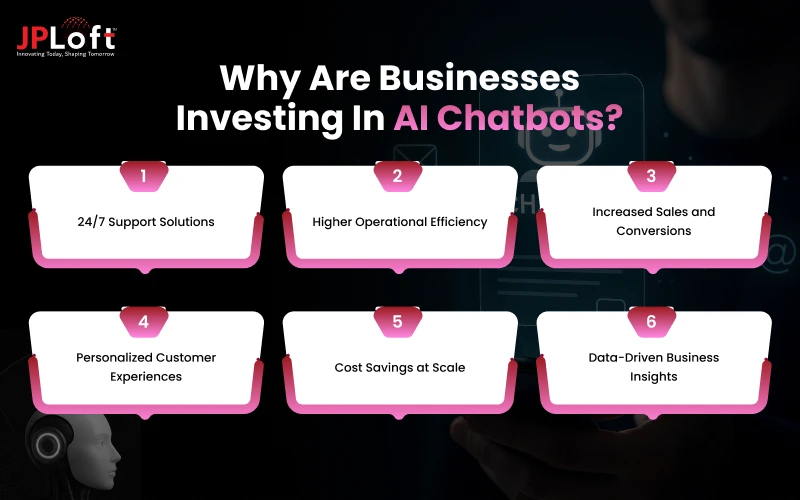
Why Are Businesses Investing In AI Chatbots?
Businesses across industries are planning to build AI chatbots so that they can deliver faster customer support, automate repetitive tasks, and improve operational efficiency.
As adoption continues to grow, understanding the cost to build an AI chatbot has become a key consideration for organizations planning their AI strategy. Apart from this, several other reasons exist that are driving their growing adoption.
1. 24/7 Support Solutions
Investing in AI chatbots is beneficial as they can provide 24/7 assistance, ensuring customers receive timely responses without relying solely on human agents. This improves customer satisfaction while reducing support workloads and operational costs.
2. Higher Operational Efficiency
By automating repetitive tasks such as answering FAQs, booking appointments, processing orders, and collecting customer information, AI chatbots enable teams to focus on complex, high-value responsibilities.
3. Increased Sales and Conversions
AI chatbots engage website visitors in real time, recommend relevant products or services, qualify leads, and guide users through the buying journey. These capabilities help businesses improve conversion rates and reduce abandoned inquiries.
4. Personalized Customer Experiences
Using customer data and conversation history, AI chatbots deliver tailored recommendations, personalized responses, and proactive assistance. This creates more meaningful interactions and strengthens customer loyalty.
5. Cost Savings at Scale
Handling thousands of conversations simultaneously allows AI chatbots to reduce staffing requirements and minimize support expenses. Businesses can leverage such AI chatbot benefits to scale customer interactions without proportionally increasing operational costs.
6. Data-Driven Business Insights
Every customer interaction generates valuable information about user preferences, common issues, and purchasing behavior. Businesses can analyze these insights to refine products, improve services, and make more informed decisions.
How Much Does It Cost to Create an AI Chatbot?
The cost to build an AI chatbot typically ranges from $15,000 to $220,000+, with development and deployment taking around 1–9+ months, depending on project complexity.
The final investment depends on the chatbot's complexity, AI capabilities, integrations, deployment platform, and level of customization.
A basic chatbot with predefined workflows and limited functionality requires a lower investment. In contrast, enterprise-grade solutions powered by LLMs, advanced automation, RAG, and custom integrations require significantly more development time and resources.
|
AI Chatbot Complexity |
Estimated Cost |
Development Timeline |
|
Basic AI Chatbot (MVP) |
$15,000-$35,000 |
1-2 Months |
|
Mid-Level AI Chatbot |
$35,000-$70,000 |
2-4 Months |
|
Advanced AI Chatbot |
$70,000-$120,000 |
4-6 Months |
|
Enterprise AI Chatbot |
$120,000-$220,000+ |
6-9+ Months |
Development Cost of an AI Chatbot As Per Type
Not all AI chatbots require the same level of investment. Their functionality, AI capabilities, integrations, and business requirements directly shape how much does an AI chatbot costs.
While some chatbots are designed to handle simple customer queries, others leverage advanced AI models to automate complex workflows, generate content, and support enterprise operations.
Below is a breakdown of the estimated development cost for different types of AI chatbots.
|
AI Chatbot Type |
Key Features |
Estimated Development Cost |
|
Rule-Based AI Chatbot |
Uses predefined conversation flows and decision trees to answer FAQs and automate simple tasks. |
$15,000 to $50,000+ |
|
Conversational AI Chatbot |
Leverages NLP and machine learning to understand user intent and deliver context-aware conversation. |
$25,000 to $60,000+ |
|
Generative AI Chatbot |
Powered by LLMs such as GPT, Gemini, Claude, or Llama to generate contextual responses, summarize information, and assist with complex tasks. |
$60,000 to $150,000+ |
|
AI Voice Chatbot |
Supports voice-based interactions using speech recognition and text-to-speech for virtual assistants and call automation. |
$70,000 to $160,000+ |
|
Agentic AI Chatbot |
Performs multi-step tasks, reasons through workflows, uses tools, and integrates with enterprise systems to automate business processes. |
$120,000 to $200,000+ |
|
Enterprise AI Chatbot |
Custom-built solution with advanced integrations, security, analytics, multilingual support, and enterprise-grade scalability. |
$150,000 to $220,000+ |
Factors Affecting AI Chatbot Development Cost
From AI capabilities and integrations to deployment and security, several factors affecting AI Chatbot cost need to be considered so that businesses can make informed investment decisions.
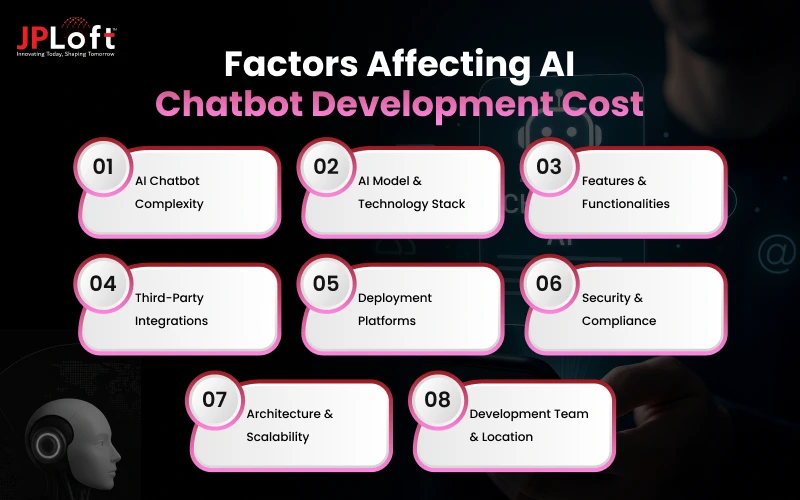
Factor 1: AI Chatbot Complexity
The complexity of an AI chatbot directly impacts development time and resources. While basic chatbots handle predefined queries, advanced solutions support contextual conversations and multi-step task execution, requiring significantly more development effort.
What Increases the Cost?
-
Context-aware conversations
-
AI reasoning and decision-making
-
Multi-step workflow automation
-
Custom business logic
Estimated Cost Impact: $20,000 to $80,000+
Factor 2: AI Model & Technology Stack
The AI model and supporting technology stack determine your chatbot's capabilities and performance. Choosing advanced LLMs and modern AI frameworks increases implementation complexity but enables more accurate, scalable, and intelligent conversational experiences.
What Increases the Cost?
-
GPT, Gemini, Claude, or Llama
-
RAG implementation
-
Vector databases
-
AI orchestration frameworks
Estimated Cost Impact: $10,000 to $50,000+
Factor 3: Features & Functionalities
Every additional feature expands the chatbot's capabilities while increasing development and testing efforts. The final cost depends on the number of advanced functionalities required to support customer engagement, automation, and business operations.
What Increases the Cost?
-
Voice interactions
-
Multilingual support
-
Document processing
-
Sentiment analysis
-
Analytics dashboard
Estimated Cost Impact: $3,000 to $15,000+ per feature
Factor 4: Third-Party Integrations
Business chatbots often connect with external systems to automate workflows and improve data accessibility. Each integration requires API development, secure data exchange, and compatibility testing, adding to the overall development effort.
What Increases the Cost?
-
CRM and ERP systems
-
Payment gateways
-
Helpdesk software
-
Messaging platforms
-
Business APIs
Estimated Cost Impact: $2,000 to $10,000+ per integration
Factor 5: Deployment Platforms
Deploying an AI chatbot across multiple platforms increases complexity. Each platform requires dedicated optimization, testing, and maintenance to deliver a consistent user experience across all customer touchpoints.
What Increases the Cost?
-
Websites
-
Mobile applications
-
WhatsApp
-
Slack or Microsoft Teams
-
Voice assistants
Estimated Cost Impact: $5,000 to $20,000+ per platform
Factor 6: Security & Compliance
Businesses handling sensitive customer data must implement strong security controls and comply with industry regulations. These requirements involve additional development, testing, and documentation, increasing the overall project investment.
What Increases the Cost?
-
Data encryption
-
Multi-factor authentication
-
GDPR, HIPAA, or PCI DSS compliance
-
Audit logs and access controls
Estimated Cost Impact: $8,000 to $40,000+
Factor 7: Architecture & Scalability
A scalable architecture ensures the chatbot performs reliably as user demand grows. Building enterprise-ready infrastructure requires additional planning, cloud resources, and performance optimization to support future business expansion.
What Increases the Cost?
-
Auto-scaling infrastructure
-
Load balancing
-
High availability
-
Performance optimization
Estimated Cost Impact: $15,000 to $60,000+
Factor 8: Development Team & Location
The expertise and location of your development partner significantly influence project pricing. Experienced AI specialists from a mobile app development company in USA may charge higher rates, but they often deliver faster development, better quality, and lower long-term maintenance costs.
What Increases the Cost?
-
Senior AI engineers
-
Dedicated development team
-
Enterprise AI expertise
-
Regional hourly rates
Estimated Cost Impact: Development costs may vary by 30% to 60% based on the team's location and experience.
Hidden Costs of Building an AI Chatbot
The quoted development cost is only part of the overall investment. Modern AI chatbots incur several ongoing expenses that businesses often overlook during planning.
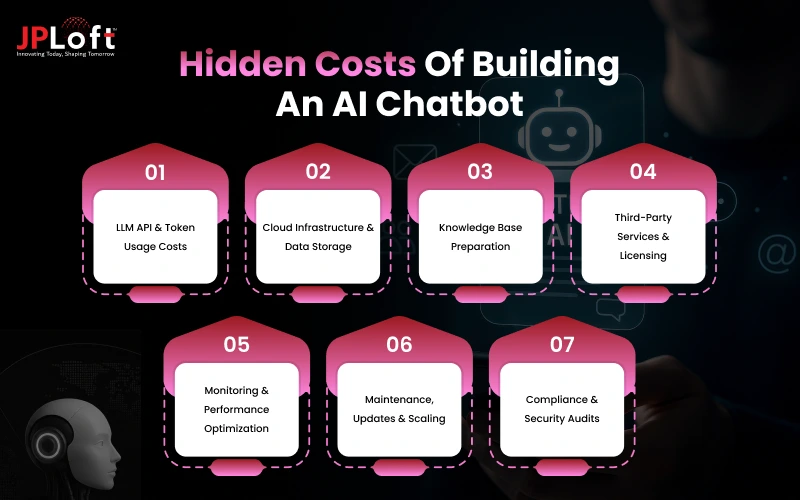
Accounting for these hidden costs from the beginning helps prevent unexpected budget increases and ensures long-term performance, scalability, and reliability.
1. LLM API & Token Usage Costs
Most AI chatbots rely on commercial Large Language Models (LLMs) that charge based on token usage or API requests. As conversation volumes increase, these recurring costs can become a significant part of the overall operating budget.
2. Cloud Infrastructure & Data Storage
AI chatbots require cloud infrastructure to process requests, store conversations, manage databases, and support AI workloads. Businesses should also consider costs for compute resources, vector databases, file storage, and backup services.
3. Knowledge Base Preparation
An AI chatbot is only as effective as the information it can access. Preparing documents, organizing business data, creating embeddings, and maintaining a RAG knowledge base can add both initial implementation and ongoing operational costs.
4. Third-Party Services & Licensing
Many AI chatbots depend on external platforms for analytics, CRM integration, automation, speech recognition, translation, or messaging. Subscription fees and licensing costs for these services contribute to the chatbot's long-term ownership cost.
5. Monitoring & Performance Optimization
Continuous monitoring helps identify performance bottlenecks, inaccurate responses, and changing user behavior. Regular analysis, AI quality improvements, and infrastructure optimization ensure the chatbot continues to deliver reliable and efficient interactions.
6. Maintenance, Updates & Scaling
After deployment, AI chatbots require ongoing software maintenance services to fix bugs, introduce new features, update APIs and SDKs, and scale infrastructure as user demand grows. Planning for these recurring expenses helps maintain long-term performance.
7. Compliance & Security Audits
Businesses operating in regulated industries should budget for periodic security assessments, compliance audits, vulnerability testing, and regulatory updates. These activities help protect sensitive data and ensure the chatbot remains compliant with evolving industry standards.
How Much Does It Cost to Create an AI Chatbot Across Industries?
If you are wondering, “How much would it cost to build an AI chatbot solution?” then you should start by prioritizing your industry requirements.
Each industry has unique workflows, compliance requirements, security standards, the need to integrate an AI chatbot into an existing app, and other operational requirements that directly impact the overall development effort.
For example, a healthcare chatbot must comply with strict data privacy regulations, while an eCommerce chatbot may require AI-powered product recommendations and payment gateway integrations. Below is an estimated cost breakdown across major industries.
|
Industry |
Primary Cost Drivers |
Estimated Development Cost |
|
Healthcare |
HIPAA/GDPR compliance, EHR integration, patient support, clinical information retrieval |
$50,000–$180,000+ |
|
Finance & Banking |
KYC, fraud detection, PCI DSS compliance, secure payment systems |
$60,000–$200,000+ |
|
Insurance |
Claims automation, policy management, document processing, compliance |
$50,000–$180,000+ |
|
Retail & eCommerce |
AI recommendations, payment gateways, inventory sync, omnichannel support |
$30,000–$120,000+ |
|
Education |
LMS integration, multilingual learning, personalized tutoring |
$25,000–$100,000+ |
|
Travel & Hospitality |
Booking engines, CRM, itinerary management, multilingual assistance |
$30,000–$120,000+ |
|
Real Estate |
CRM integration, property search, virtual tours, lead qualification |
$25,000–$90,000+ |
|
Logistics & Supply Chain |
ERP integration, shipment tracking, warehouse automation |
$40,000–$150,000+ |
|
HR & Recruitment |
ATS integration, employee onboarding, internal knowledge base |
$35,000–$120,000+ |
|
SaaS & Enterprise |
Workflow automation, enterprise integrations, advanced security, analytics |
$70,000–$220,000+ |
How to Reduce the Cost to Develop An AI Chatbot
Reducing the AI chatbot development cost doesn't mean compromising on quality or functionality.
The key is to make strategic decisions throughout the development process, from selecting the right AI model to prioritizing features and leveraging existing technologies.
Here are some practical ways to optimize your investment.
1. Start with an MVP
Begin with a chatbot that includes only the core features needed to solve your primary business challenge. Once the solution is validated, you can gradually introduce advanced capabilities based on user feedback and business growth.
2. Choose the Right AI Model for Your Use Case
Not every chatbot requires the most advanced or expensive LLM. Selecting an AI model based on your use case, performance requirements, and budget helps reduce both development costs and ongoing API expenses.
3. Leverage Existing AI Components
Accelerate development by using proven AI APIs, orchestration frameworks, authentication systems, and pre-built integrations. Reusing existing components minimizes custom development, shortens project timelines, and lowers implementation costs.
4. Optimize AI Usage with RAG
Instead of relying solely on expensive model fine-tuning, implement RAG to connect your chatbot with business documents and knowledge bases. This approach can improve response accuracy while reducing the need for costly model fine-tuning and helping control ongoing AI usage costs.
5. Prioritize Essential Features & Integrations
Hire AI developers and focus on features and integrations that deliver immediate business value. Avoid adding low-priority functionalities during the initial release, as every additional feature increases development complexity, testing efforts, and overall project costs.
6. Adopt a Phased Development Approach
Break the project into multiple development phases rather than building every capability at once. This allows businesses to distribute costs over time, validate ROI, and make informed decisions before expanding the chatbot.
7. Partner with an Experienced AI Partner
An experienced AI development company can recommend the right architecture, technology stack, and implementation strategy from the outset. This reduces costly rework, shortens development time, and helps maximize your long-term return on investment.
Custom AI Chatbots vs Ready-Made Solutions
Businesses planning to implement an AI chatbot often face a critical decision: Should you invest in a custom AI chatbot or opt for a ready-made solution?
While ready-made platforms offer faster deployment and lower upfront costs, custom AI chatbots provide greater flexibility, scalability, and long-term value.
The right choice depends on your business goals, budget, and customization requirements.
|
Factor |
Custom AI Chatbot |
Ready-Made Solution |
|
Pricing Model |
One-time development investment of $15,000 to $220,000+ |
Monthly subscription starting from $50 to $5,000+ |
|
Customization |
Fully tailored to your workflows, branding, and business processes |
Limited to templates, configurations, and platform capabilities |
|
AI Capabilities |
Supports custom LLMs, RAG, AI agents, and advanced automation |
Limited to platform-supported AI models and predefined features |
|
Integrations |
Custom integration with CRM, ERP, payment gateways, and internal systems |
Limited to available connectors and marketplace integrations |
|
Scalability |
Easily scales with evolving business requirements |
Scaling depends on subscription plans and platform limitations |
|
Data Ownership |
Full ownership of application, business logic, and data |
Data governance and storage depend on the platform provider |
|
Vendor Lock-in |
No dependency on a specific platform |
Higher dependency on the platform ecosystem |
|
Long-Term Cost |
Higher upfront investment with greater long-term flexibility |
Lower initial investment but recurring subscription and licensing costs |
|
Deployment Timeline |
1 to 9+ months, depending on complexity |
A few days to several weeks |
How Can JPLoft Help Build A Cost-Effective AI Chatbot For Your Business?
The success of an AI chatbot isn't determined by how much you spend on building it, but by the value it delivers over time.
The right technology choices, scalable architecture, and strategic planning can significantly improve ROI while keeping unnecessary expenses under control.
That's where partnering with an experienced AI chatbot development company makes a real difference.
At JPLoft, we combine expertise in LLMs, RAG, conversational AI, and AI agents to deliver secure, scalable, and integration-ready chatbot solutions tailored to your business goals.
Our team helps you prioritize the right features, streamline implementation, and optimize long-term operational costs without compromising performance.
From strategy and deployment to continuous optimization, we ensure your AI chatbot is built to support sustainable business growth and lasting value.
Final Words
AI chatbots have become a strategic asset for businesses looking to automate operations, enhance customer experiences, and improve overall efficiency.
However, achieving these outcomes requires more than choosing the latest AI technologies. Success depends on defining clear objectives, selecting the right features, planning for scalability, and partnering with an experienced development team.
By understanding the factors that influence development, long-term operational requirements, and the best implementation approach, businesses can make informed decisions with confidence.
Whether you're launching your first AI chatbot or expanding an existing solution, a well-planned strategy lays the foundation for sustainable growth, stronger customer engagement, and lasting business value.
FAQs
Building a custom AI chatbot typically costs $15,000–$220,000+, depending on complexity, AI models, features, integrations, security, and scalability requirements.
Chatbot complexity is the biggest cost driver. Advanced LLMs, AI agents, custom workflows, integrations, multilingual support, and enterprise security can significantly increase development costs.
Yes. Ongoing expenses can include LLM API usage, cloud hosting, data storage, third-party services, knowledge-base updates, maintenance, monitoring, and security audits.
Custom chatbots offer greater flexibility, integration options, and scalability, while ready-made solutions provide faster deployment and lower upfront costs. The right choice depends on your business requirements and budget.
Businesses can optimize costs by starting with an MVP, selecting the right AI model, leveraging existing AI components, implementing RAG, prioritizing essential features, and partnering with an experienced AI chatbot development company to avoid costly rework.

Rahul Sukhwal is the CEO and Founder of JPLoft, a visionary technologist with 18+ years at the forefront of emerging tech innovation and software engineering. He channels deep software engineering and AI expertise into building smarter, scalable solutions that shape how forward-thinking businesses worldwide harness the true power of AI.


Share this blog