



Key Takeaways
AI chatbot development is not just about deploying intelligent models but requires careful planning around data quality, context management, and system integration.
Common AI chatbot development challenges include poor language understanding, limited training data, lack of context awareness, security risks, and scalability issues.
Modern AI chatbots perform best when built using hybrid architectures that combine AI models with deterministic logic, rule engines, and workflow orchestration.
Scalability, performance optimization, and infrastructure design are critical to ensure chatbots can handle high traffic without latency or rising operational costs.
Continuous testing, monitoring, and retraining are essential, as chatbot performance can degrade over time due to changing user behavior and intent drift.
Conversational UX plays a major role in chatbot success; structured responses, guided interactions, and clear recovery paths improve user engagement and trust.
Partnering with experts helps businesses overcome these challenges and build secure, scalable, and future-ready chatbot solutions.
AI chatbots have taken over the industry with their exceptional capabilities and never-ending innovation.
From in-app product support to addressing customer concerns, AI chatbots are transforming how brands deal with their audiences. As of current statistics, more than 70% of companies believe that AI chatbots are one of the key differentiators in creating customer experiences.
However, simply following the industry hype is not enough; a generic chatbot is equal to having no chatbot at all. Hence, it is important to plan for an advanced AI chatbot that can align with your vision and boost your customer experiences.
Along with such advanced AI chatbot planning, several AI chatbot development challenges emerge that need to be focused on. These include poor natural language understanding, limited training data, lack of context awareness, integration complexity, security risks, and scalability issues.
In this blog, we will discuss more about the challenges while developing an AI chatbot and how to overcome them.
Why Opt For AI Chatbot Development?
AI chatbots are not just about following trends but are more about offering a better experience to your customers. Let’s take a look at some key industry statistics that can justify the need for an AI chatbot for your business goals.
-
The global AI chatbot market is projected to surge to around $47 billion by 2029. That’s a compound annual growth rate in the 24–30 percent range.
-
Some forecasts push the conversational AI market even further, from about $17 billion in 2025 to nearly $50 billion by 2031, with approximately 20% CAGR.
-
Around 80% of companies are reported to either use or plan to use AI-powered chatbots for customer support by 2025.
-
AI chatbots can deflect around 70 percent of routine customer inquiries, reducing the load on human teams.
-
Automated chatbots and self-service helpers can cut service costs by up to 30% and resolve 11–30% of support volume without human intervention.
-
31% of B2B marketers use chatbots in their campaigns, and roughly one-third of consumers have engaged with a chatbot to learn about or even buy a product.
-
Approximately 88% of the companies are using AI in any one of their business operations, reflecting a strong and positive business focus towards AI adoption.
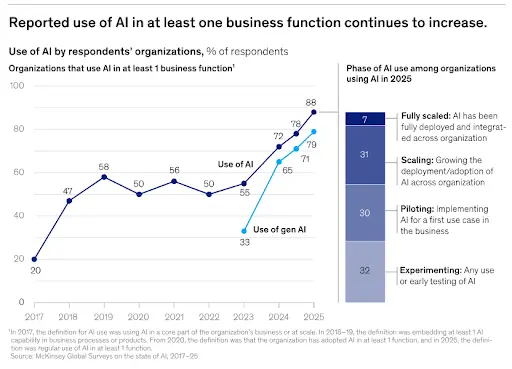
These data reflect and justify why you need to plan for an AI chatbot and focus on the associated challenges while creating an AI chatbot.

Common AI Chatbot Development Challenges & Their Solutions
Building an AI chatbot looks simple from the outside: start by training a model, connect an API, and launch it.
Here’s the thing: the reality involves layered technical, design, and operational hurdles. This is where the key challenges in building AI chatbots arise.
Understanding those development challenges of AI chatbots early can help develop a high-performing digital assistant. Let’s explore the potential challenges and the solutions to overcome them.
1. Accurate Natural Language Understanding and Intent Classification
The success of every AI chatbot is its ability to understand what the user actually wants. This is far more complex than keyword matching, which happens in developing traditional chatbots.
When interacting with chatbots, users mix intents, use incomplete sentences, switch topics mid-conversation, and rely heavily on implied context. Hence, ensuring such intent understanding is one of the key AI chatbot development challenges.
From a technical standpoint, AI chatbot development often struggles with:
-
Intent overlap across similar user queries
-
Ambiguous phrasing that maps to multiple actions
-
Out-of-distribution inputs not present in training data
-
Long-tail queries that occur infrequently but still matter
Solution:
Modern chatbot systems rely on transformer-based NLP architectures trained on domain-specific datasets.
Instead of treating intent recognition as a single-label classification problem, advanced implementations use:
-
Multi-intent classification for compound queries
-
Confidence thresholding to trigger clarifications
-
Named Entity Recognition pipelines to extract actionable parameters
-
Semantic embeddings to understand intent similarity rather than exact phrasing
Further, investing in NLP development services can ensure continuous retraining using real conversation logs, which is essential. Production chatbots improve over time by learning from failed conversations and human corrections.
2. Training Data Scarcity and Data Quality Issues
AI chatbots are only as good as the data used to train them. The absence of data can lead to ineffective training and, hence, impact the AI chatbot's performance.
Many organizations underestimate how difficult it is to prepare high-quality conversational datasets. Raw data is often noisy, inconsistent, and biased toward edge cases or historical processes that no longer exist.
As a result, key problems in AI chatbot development include:
-
Sparse datasets for new chatbot use cases
-
Inconsistent labeling of intents and entities
-
Outdated knowledge sources feed incorrect responses
-
Bias introduced through incomplete or skewed data samples
Poor data quality also leads to hallucinations, inaccurate answers, and unpredictable behavior as common problems in AI chatbot development.
Solution:
High-performing chatbots are built on structured data pipelines rather than ad hoc datasets. Best practices include:
-
Data normalization and deduplication before training
-
Human-in-the-loop annotation for critical intents
-
Synthetic data generation to simulate realistic conversations
-
Version-controlled training datasets tied to model releases
Many teams now integrate knowledge bases directly into chatbot systems, separating factual information from generative responses to maintain accuracy.
3. Context Management and Multi-Turn Conversation Handling
The modern-day customer doesn’t want to reiterate information again and again when communicating with a chatbot. They expect the chatbot to remember previous messages, reference earlier choices, and maintain logical flow across multiple turns.
Stateless chatbot interactions feel robotic. Hence, a potential AI chatbot challenge is to communicate with the user naturally so that it can feel more human. Technically, this is difficult because most NLP models process each message independently.
Common challenges of AI-powered chatbot development include:
-
Loss of context across turns
-
Incorrect entity references
-
Conflicting answers when users change direction
-
Inability to resume interrupted conversations
Without context management, even intelligent models fail in real-world conversations.
Solution:
To overcome the identified development challenge in an AI chatbot, it is important to understand the context-aware chatbot architecture and its dependency on explicit state management layers.
Instead of relying solely on the language model, developers at an AI development company implement:
-
Session memory storing extracted entities
-
Conversation state machines for task-based flows
-
Vector databases for retrieving relevant historical context
-
Context windows optimized to avoid token overload
Retrieval-augmented generation has become a standard approach, allowing chatbots to reference both short-term memory and long-term knowledge efficiently.
4. Integration with Enterprise Systems and APIs
AI chatbots are not meant to exist in isolation. They must interact with CRMs, ERPs, ticketing systems, databases, and third-party APIs. Such interactions are important as they provide the AI chatbots with the required data to respond to users’ queries.
Initially, integration is simple, but the complexity increases when AI chatbots are not designed with conversational interfaces in mind.
Technical bottlenecks include:
-
Legacy systems lacking RESTful APIs
-
Data format mismatches across platforms
-
Authentication and permission management
-
Latency issues during real-time responses
Poor integration design turns chatbots into static FAQ tools instead of functional assistants, highlighting the potential AI chatbot development challenge.
Solution:
Scalable chatbot systems use middleware and orchestration layers to manage integrations. This approach allows the chatbot to:
-
Call APIs asynchronously
-
Transform data formats dynamically
-
Handle retries and failure states gracefully
-
Decouple conversational logic from backend systems
Furthermore, businesses can plan to hire dedicated developers to plan for a microservices architecture that allows integrations to evolve without rewriting the chatbot logic.
5. Security, Compliance, and Data Privacy
Another challenge while building an AI chatbot is handling the platform security, compliance, and data privacy.
Chatbots often process sensitive user data, including personal information, transaction details, and internal business data.
Such data needs can be identified when planning for AI chatbots for dating apps. This creates significant security and compliance risk if not handled properly.
The potential security challenges in an AI chatbot that developers face are:
-
Unencrypted message storage
-
Unauthorized access to backend systems
-
Logging of sensitive information
-
Model exposure through prompt injection attacks
A single vulnerability can compromise both user trust and regulatory compliance.
Solution:
The businesses should plan to partner with experts who can handle these security and data compliance needs and build an AI chatbot that is secure and scalable.
Secure chatbot development requires defense-in-depth strategies, including
-
End-to-end encryption for all conversations
-
Role-based access control for system integrations
-
Data masking and tokenization in logs
-
Prompt sanitization and input validation
-
Regular security audits and penetration testing
Many modern deployments also limit model access to curated knowledge sources rather than allowing unrestricted generation.
6. Handling Complex Queries and Business Logic
The users don’t just ask questions when interacting with AI chatbots. They request comparisons, troubleshooting steps, decision-making guidance, and personalized recommendations.
Hence, potential chatbot development challenges include handling these complex queries and the business logics as they struggle with multiple data points and rules.
Purely generative models struggle with:
-
Logical consistency
-
Multi-step task execution
-
Business rule enforcement
-
Deterministic outputs
Such a performance gap leads to confident but incorrect responses, which impacts the overall user experience.
Solution:
To handle complex queries and business logic effectively, modern AI chatbots use a hybrid architecture that blends AI with deterministic systems, including:
-
Rule engines to enforce business policies, compliance, and decision logic
-
Workflow orchestration for reliable execution of multi-step tasks
-
AI-driven query decomposition to break complex requests into actionable steps
-
Context management to maintain logical consistency across conversations
-
Human escalation for high-risk or sensitive interactions
These approaches are implemented by an experienced Generative AI development company that ensures predictable outputs, reduces incorrect responses, and improves accuracy, reliability, and user trust in operational environments.
7. Multilingual Support and Localization Complexity
Supporting multiple languages is one of the core AI chatbot development challenges. Such goes far beyond basic language translation. Cultural context, sentence structure, idioms, tone, and industry-specific terminology vary widely across regions and user groups.
When chatbots fail to interpret these nuances correctly, intent detection suffers and responses feel unnatural. Training and maintaining separate models for every language quickly becomes expensive, complex, and difficult to scale as chatbot adoption grows.
Key technical challenges while building an AI Chatbot include:
-
Inconsistent intent mapping across languages
-
Understanding voice commands and interpreting them accurately
-
Higher latency is introduced by the translation middleware
-
Reduced accuracy and context retention in low-resource languages
Solution:
Modern AI chatbots rely on multilingual transformer models that share semantic understanding across languages while enabling localization through:
-
Automatic language detection for accurate intent routing
-
Domain-specific translation tuning to preserve meaning
-
Localized response templates aligned with cultural expectations
-
Regional compliance handling for language-specific regulations
-
Investing in speech recognition software development services for better interpretation.
This approach balances accuracy, scalability, and performance without increasing development effort.
8. Scalability and Infrastructure Performance
As AI chatbot adoption increases, the developed system must support thousands of concurrent conversations without compromising response speed or reliability.
Ensuring such scalability turns out to be among the top AI chatbot development challenges because AI inference, especially for large language models, is computationally expensive and resource-intensive.
Without a scalable architecture, chatbots often struggle during traffic spikes, leading to delays, timeouts, and inconsistent user experiences. Key scalability challenges include:
-
High latency during peak usage periods
-
Rapidly escalating cloud infrastructure costs
-
Performance bottlenecks caused by overloaded APIs and inference pipelines
Solution:
Addressing scalability requires designing chatbot infrastructure with performance and future growth in mind, while balancing the cost to build an AI chatbot. Performance-optimized chatbot architectures achieve this through:`
-
Autoscaling cloud environments that dynamically adjust compute resources
-
Model optimization and distillation to reduce inference overhead
-
Caching mechanisms for frequently repeated queries
-
Load balancing across distributed inference endpoints
Additionally, edge computing is increasingly adopted to process high-volume interactions closer to users, reducing latency and improving real-time responsiveness while controlling infrastructure costs.
9. Testing, Monitoring, and Continuous Improvement
The AI chatbot requires constant testing, monitoring, and improvements. Initially, such appears to be feasible for the developers, but turns out to be among the challenges of AI chatbots if not planned thoroughly.
Traditional QA approaches do not translate well to conversational AI systems. Unlike rule-based software, chatbots interact with unpredictable user inputs, evolving language patterns, and changing intents.
Testing every possible conversation path before deployment is unrealistic, and many issues surface only when real users begin interacting at scale. Without ongoing oversight, chatbot performance can quickly degrade over time.
Solution:
Effective chatbot development treats testing and optimization as continuous processes rather than one-time phases. Modern chatbot teams rely on:
-
Automated conversation simulations to test diverse user scenarios.
-
Real-time performance monitoring to track latency, accuracy, and failures.
-
User feedback loops to identify gaps and improve responses.
-
Intent drift detection to catch changes in user behavior.
-
Continuous model retraining to maintain relevance and accuracy.
Conversational analytics provide clear visibility into where users disengage and why improvements are needed.
10. Designing a Conversational User Experience
Even technically advanced AI chatbots can fail if the conversation feels slow, confusing, or unnatural. Users expect chatbots to be intuitive, responsive, and easy to navigate, not overwhelming or experimental.
Designing conversational UX for an AI chatbot is challenging because it requires balancing automation with clear guidance while accounting for varied user intents and interaction styles.
Poorly designed flows often lead to user frustration, abandoned conversations, and reduced trust in the chatbot.
Solution:
Businesses can hire AI developers, who can help build an effective AI chatbot UX that focuses on clarity, predictability, and user control. Strong conversational design includes:
-
Structured responses instead of long, text-heavy replies.
-
Quick replies and buttons to guide user actions.
-
Clear error handling with recovery paths.
-
Predictable conversation patterns that set expectations.
Well-designed chatbots feel intentional and helpful, delivering smooth interactions that encourage continued engagement rather than trial-and-error exploration.

How JPLoft Can Help Build A Successful AI Chatbot?
Building a high-performing AI chatbot goes beyond choosing the right model. It requires a deep understanding of business goals, user behavior, system scalability, and long-term optimization.
As an experienced AI chatbot development company, JPLoft focuses on creating chatbot solutions that are reliable, secure, and purpose-driven, not experimental or generic. The developers at JPLoft follow a structured development approach that starts with intent discovery, data readiness assessment, and use-case mapping.
From there, the team designs task-oriented chatbot architectures that combine AI capabilities with deterministic logic for accuracy and control. Performance, scalability, and compliance are built into the system from day one, ensuring smooth operation even as user demand grows.
Beyond development, JPLoft emphasizes continuous improvement through testing frameworks, monitoring tools, and analytics-driven optimization. This ensures chatbots evolve with user behavior, business rules, and industry changes, delivering consistent value long after deployment.
Conclusion
AI chatbot development involves more than implementing intelligent models. Challenges such as complex query handling, multilingual support, scalability, UX design, and continuous optimization must be addressed to deliver reliable and effective chatbot experiences.
When these areas are overlooked, chatbots often fail to meet user expectations or business goals. By adopting a structured development approach that combines AI with deterministic logic, scalable infrastructure, and ongoing monitoring, businesses can build chatbots that remain accurate, responsive, and adaptable over time.
With the right strategy and execution, AI chatbots evolve into dependable digital assistants that enhance user engagement, streamline operations, and create long-term business value.
FAQs
Common challenges in AI chatbot development include handling complex queries, managing multilingual conversations, ensuring scalability, designing an intuitive conversational UX, and maintaining chatbot accuracy over time through testing and monitoring.
AI chatbots struggle with complex queries because they often require multi-step reasoning, strict business rules, and contextual understanding. Purely generative models may produce confident but incorrect responses without deterministic logic support.
Businesses can ensure scalability by using autoscaling cloud infrastructure, optimizing AI models, caching frequent responses, and distributing workloads across multiple inference endpoints to handle peak traffic efficiently.
Conversational UX design determines how intuitive and engaging a chatbot feels. Clear response structures, guided interactions, predictable flows, and effective error handling significantly improve user satisfaction and adoption.
AI chatbot performance is improved through automated testing, real-time monitoring, conversational analytics, user feedback loops, intent drift detection, and continuous model retraining to adapt to evolving user behavior.

Rahul Sukhwal is the CEO and Founder of JPLoft, with 18+ years of experience in software engineering, emerging technologies, and digital product development. His expertise spans artificial intelligence, including AI agents, generative AI, LLMs, chatbots, computer vision, and machine learning, as well as blockchain, IoT, AR/VR, mobile, web, and enterprise software. He focuses on applying these technologies to real business challenges across industries such as healthcare, education, mobility, finance, real estate, and on-demand services.



Share this blog