



Key Takeaways
Generative AI is transforming travel apps by making planning faster, smarter, and more personalized for users.
It enables features like automated itineraries, real-time suggestions, and conversational support for better experiences.
Businesses can improve engagement, efficiency, and decision-making by using Gen AI in travel apps effectively.
Understanding challenges like data accuracy and privacy is important for building reliable travel platforms.
Future trends like voice planning and autonomous agents will shape next-generation travel experiences.
Partnering with JPLoft can help you build scalable, AI-powered travel solutions with the right strategy and technology.
Planning a trip today can feel overwhelming, with endless choices and scattered information online.
Travelers often struggle to find personalized options without spending hours comparing destinations, prices, and reviews. This is where gen AI technology in travel is making a real difference. It is changing how people plan and experience trips.
According to a report, the global generative AI in travel market is expected to grow from $1,265.18 million in 2026 to around $5,788.55 million by 2035. This reflects a strong CAGR of 18.64 percent during this period.
So, what is driving this rapid shift in the travel industry today?
This growth highlights the increasing impact of generative AI in travel industry trends across modern travel platforms.
Modern tools now use AI to create itineraries, suggest destinations, and generate travel content instantly. From planning to booking, these solutions simplify the entire journey for users.
In this blog, we will explore key use cases, benefits, and future trends shaping this transformation.
What is Generative AI in Travel Apps?
Generative artificial intelligence in travel apps refers to systems that create travel plans, content, and suggestions automatically.
If you ask what is generative AI in travel, it focuses on creating new outputs based on user inputs.
These tools analyze preferences, budget, and behavior to deliver personalized travel experiences in real time.
Businesses use this technology to simplify planning, booking, and customer engagement processes.
Companies looking to build a mobile app now rely on it for smarter and faster solutions.
This approach of adopting generative technology is becoming important across the travel industry for improving user convenience.
How Generative AI Works in Travel Apps?
It works by converting user inputs into personalized travel results through smart processing.
-
Users enter prompts like destination, budget, travel dates, and preferences clearly.
-
The system processes this data using AI models trained on large travel datasets.
-
It identifies patterns and context to understand user needs more accurately.
-
The AI then generates itineraries, hotel options, and activity suggestions quickly.
-
It improves results by learning from user interactions and feedback over time.
This process supports the growing role of AI in developing mobile apps for better user experiences.
Overall, Generative models in travel apps makes trip planning faster, simpler, and more user-friendly.

Generative AI vs Traditional AI in Travel Apps
Travel apps have used AI for years, but the approach has evolved significantly.
Traditional systems analyze past data, while gen AI technology in travel apps creates new and personalized outputs.
Here are the key differences between generative AI and traditional AI to consider:
|
Aspect |
Traditional AI |
Generative AI |
|
Function |
Analyzes and predicts based on past data |
Creates new content, plans, and recommendations |
|
Output Type |
Fixed and rule-based results |
Dynamic and personalized outputs |
|
User Interaction |
Limited and structured |
Conversational and flexible |
|
Personalization |
Basic personalization |
Deep, real-time personalization |
|
Use Cases |
Price prediction, demand forecasting |
Itinerary creation, content generation, chat assistants |
|
Adaptability |
Learns gradually from data updates |
Continuously improves with user interactions |
Where Traditional AI Still Works
Traditional AI is useful for pricing, forecasting, and backend data processing tasks. It performs well in structured environments where predictions rely on historical data.
How Generative AI Is Transforming Travel Apps
Generative models enable real-time planning, dynamic recommendations, and interactive user experiences. This makes generative AI for travel apps more effective for modern, user-focused platforms.
To build such intelligent systems, developers often rely on top programming frameworks for app development.
Overall, generative artificial intelligence in travel apps delivers a more flexible and engaging experience than traditional systems.
How Generative AI is Transforming Travel Apps?
Generative AI is redefining travel apps by enabling faster planning, deeper personalization, and smarter user experiences.
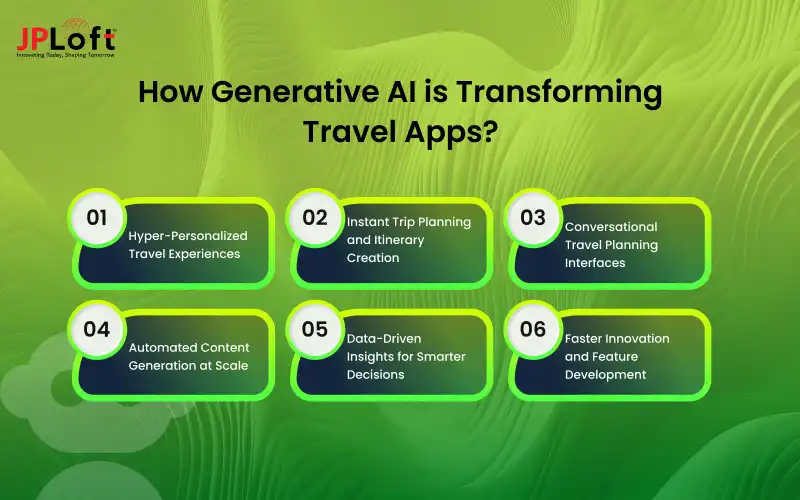
Here are the key ways Generative AI is driving transformation in travel apps:
1. Hyper-Personalized Travel Experiences
Generative technology in travel apps analyzes user behavior, preferences, and intent to deliver highly personalized travel recommendations. This helps users discover destinations, hotels, and activities that match their expectations with minimal effort.
2. Instant Trip Planning and Itinerary Creation
Modern platforms use generative AI for travel apps to create complete itineraries based on simple user prompts. This reduces planning time and allows users to organize trips quickly without manual research or comparisons.
3. Conversational Travel Planning Interfaces
AI-powered assistants enable users to interact with travel apps through natural conversations and guided prompts. These interfaces simplify navigation and improve engagement by making trip planning more intuitive and interactive.
4. Automated Content Generation at Scale
Travel platforms use AI to efficiently generate descriptions, guides, and promotional content for destinations and hotels. Partnering with an AI development company helps ensure consistent quality, faster deployment and scalable content generation across platforms.
5. Data-Driven Insights for Smarter Decisions
Generative AI in travel and hospitality industries processes large datasets to identify trends, preferences, and user behavior patterns. This enables platforms to offer accurate recommendations and improve overall decision-making for travelers and businesses.
6. Faster Innovation and Feature Development
Businesses adopt AI solutions aligned with evolving travel app development trends to build advanced travel applications. This helps them launch new features faster and stay competitive in a rapidly changing digital travel landscape.
Overall, generative technologies in travel apps are transforming how users plan, explore, and experience travel.
Top Generative AI Use Cases in Travel Apps
Generative AI is changing how travel apps deliver faster, smarter, and more personalized user experiences. It helps users plan trips, discover options, and make decisions with minimal effort and time.
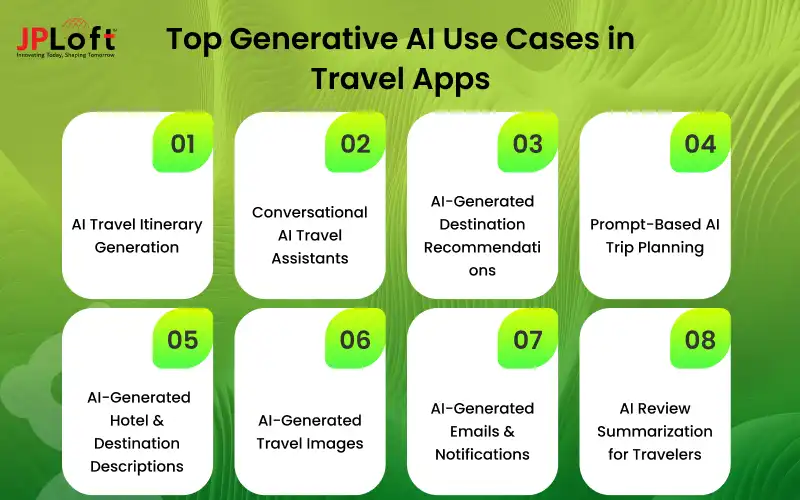
Here are the top Generative AI use cases in travel apps that are transforming modern travel platforms.
[A] AI Travel Itinerary Generation
Generative AI systems in travel apps creates detailed itineraries based on user preferences, travel goals, and budgets. These plans include destinations, activities, and timelines, making this one of the top travel app features today.
[B] Conversational AI Travel Assistants
Modern platforms use generative AI for travel apps to offer chat-based assistants for planning and support. These assistants answer queries, suggest options, and guide users through bookings using simple conversations.
[C] AI-Generated Destination Recommendations
This is one of the most popular use cases of generative AI in travel. Herein, AI systems analyze user behavior and preferences to provide personalized destination suggestions in real time. This improves discovery and helps users find places that match their interests and travel expectations.
[D] Prompt-Based AI Trip Planning
Users can enter simple prompts, and Gen AI instantly generates complete travel plans with relevant recommendations included. This use case simplifies planning and highlights advanced use cases of generative AI in travel today.
[E] AI-Generated Hotel & Destination Descriptions
Travel platforms use gen AI to generate engaging descriptions for hotels, attractions, and travel experiences automatically. This ensures consistent content quality while reducing manual writing efforts for businesses at scale.
[F] AI-Generated Travel Images
Generative AI creates realistic travel visuals, among other generative AI use cases in travel. This helps users explore destinations before making booking decisions. Additionally, these images improve engagement and enhance how travel platforms present locations and experiences online.
[G] AI-Generated Emails & Notifications
Gen AI tools generate personalized emails and notifications based on user behavior, preferences, and booking history data. These updates act as essential mobile app features that keep users engaged throughout their travel planning journey.
[H] AI Review Summarization for Travelers
AI summarizes large volumes of reviews into short insights. This helps users in understanding key feedback quickly. In addition, such a feature improves decision-making and saves time when comparing hotels, destinations, and travel services.
Overall, these use cases show how generative technology in travel market is making trip planning faster, simpler, and more personalized for users.
Benefits of Using Generative AI in Travel Apps
Generative AI helps travel apps deliver faster outcomes and stronger business results. It improves efficiency, decision-making and overall performance for modern travel platforms.
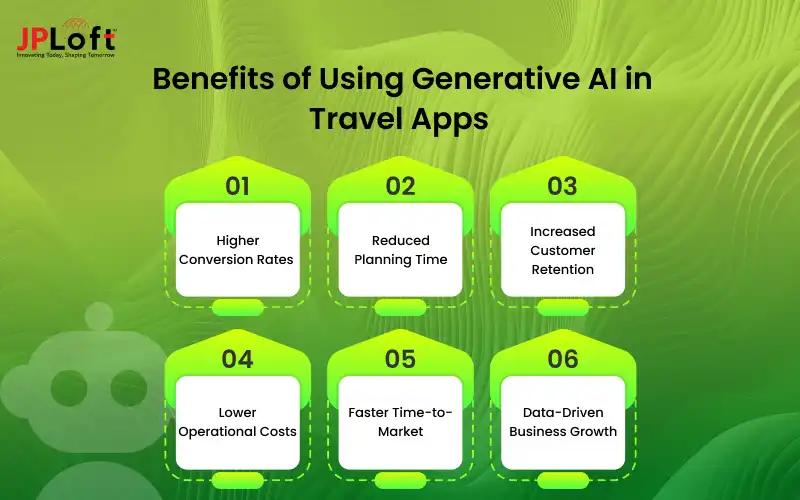
Here are the key benefits of using generative technologies in travel apps for business growth and user value:
► Higher Conversion Rates
Gen AI in travel apps delivers relevant suggestions that match user intent and travel preferences effectively. This reduces confusion and helps users complete bookings faster, improving overall conversion rates significantly.
► Reduced Planning Time
Modern platforms use generative AI for travel apps that simplify planning and reduce manual search efforts. Also, users receive quick results and organized options, which help them plan trips faster and more efficiently.
► Increased Customer Retention
Personalized and seamless experiences encourage users to return and continue using the travel platform regularly. This builds trust and loyalty, which leads to higher retention rates and long-term user engagement.
► Lower Operational Costs
Generative AI in travel industry automates tasks like support, content creation, and data processing efficiently. This reduces manual effort and helps businesses manage the cost to develop a travel app more effectively.
► Faster Time-to-Market
Gen AI tools help businesses develop and launch new features quickly without long development cycles or delays. On the other hand, many companies choose to hire dedicated developers to accelerate development and maintain consistent product quality.
► Data-Driven Business Growth
Gen AI technology in travel apps analyzes user data to identify trends, preferences, and growth opportunities clearly. This enables smarter decisions and helps businesses scale effectively while improving overall platform performance.
Overall, generative artificial intelligence in travel apps delivers measurable value by improving efficiency, growth, and user satisfaction.
Real-World Examples of Generative AI in Travel
Generative AI is already used by leading platforms to improve trip planning and user experience. These real-world tools showcase how innovation is shaping modern generative artificial intelligence in travel industry.
Here are some real-world examples of how gen AI technology in travel apps is applied across travel platforms:
1. AI Trip Planners
There are tools like Tripnotes and Roam Around, which use generative AI systems in travel market to create complete travel plans. They generate personalized itineraries from user prompts. This helps businesses understand how to create a travel app with smart planning features.
2. AI Travel Assistants
Platforms like GuideGeek and Expedia AI Assistant are among the top AI travel assistants offering their services in the travel industry. They use generative AI to assist users by answering queries, suggesting options, and supporting bookings through simple and interactive conversations.
3. AI Itinerary Generators
TripAdvisor and Trip.com are among the popular AI itinerary generators in the global travel market. They use GenAI to generate dynamic itineraries based on user input. Furthermore, these tools often rely on early-stage mobile app prototyping to test features and improve user experience effectively.
All in all, generative technology in travel apps is delivering real value through practical and user-focused applications.
Key Features of Generative AI Travel Apps
Generative AI enables advanced system capabilities that improve how travel apps process data and deliver results. These features focus on intelligence, adaptability, and real-time performance across modern travel platforms.
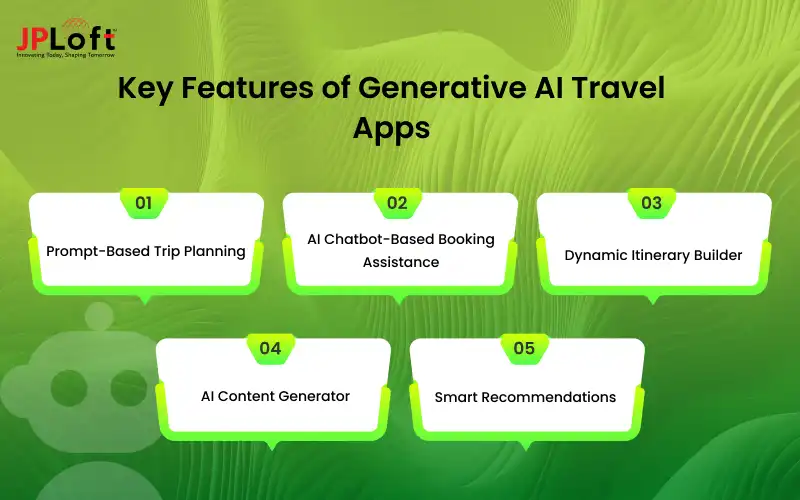
Here are the key features of generative AI travel apps that power smarter and more efficient travel experiences:
[1] Prompt-Based Trip Planning
This feature uses natural language processing to understand user prompts and convert them into structured travel outputs. It plays a key role in designing a travel app with intuitive, user-friendly travel-planning experiences.
[2] AI Chatbot-Based Booking Assistance
This feature depends on conversational AI models that process user queries and provide instant, meaningful responses. It enables smooth interactions by understanding context and efficiently guiding users through complex booking workflows.
[3] Dynamic Itinerary Builder
This feature uses real-time data processing to adjust travel plans based on changing inputs and conditions. It works well when supported by a strong travel app tech stack capable of handling large amounts of data efficiently.
[4] AI Content Generator
This feature uses generative models to produce structured travel content based on input data and context. To implement such systems effectively, businesses often hire app developers with experience in AI-driven solutions. It helps maintain consistency and accuracy while generating large volumes of travel-related information efficiently.
[5] Smart Recommendations
The smart recommendations feature uses machine learning models to analyze data patterns and deliver context-aware travel suggestions. Also, it improves relevance by combining user behavior, preferences, and external data sources for better recommendations.
These features of generative AI travel apps define how modern systems deliver intelligent and scalable travel experiences.
Challenges of Generative AI in Travel Apps
Generative AI improves travel apps, but it also introduces technical and operational challenges.
Addressing these issues is important to ensure reliable, secure, and scalable travel solutions.
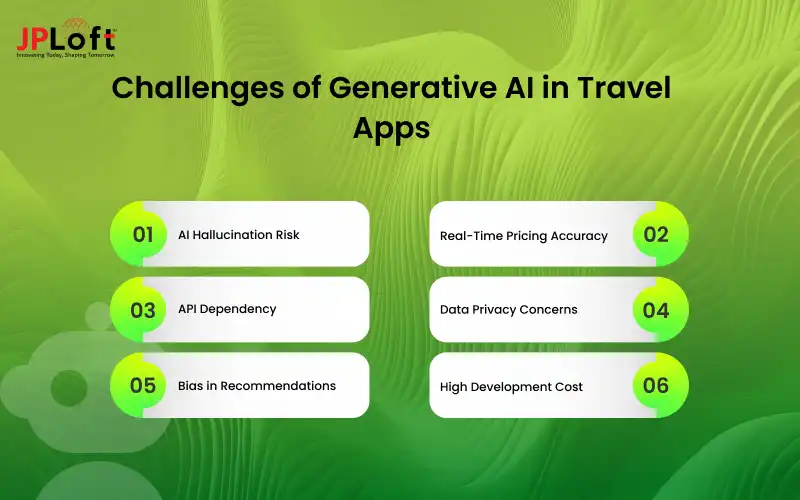
Here are the key challenges of gen AI in travel apps, along with their practical solutions:
Challenge 1: AI Hallucination Risk
Generative technology in travel app may generate incorrect or misleading outputs due to gaps in training data. This can confuse users and reduce trust in automated travel planning systems significantly.
Solution: To reduce hallucinations, businesses should combine verified data sources with human review processes. In addition, continuous training and validation checks help improve accuracy and ensure more reliable travel recommendations over time.
Challenge 2: Real-Time Pricing Accuracy
Travel prices change frequently. Such variability makes it difficult for AI systems to deliver updated and accurate information consistently. Therefore, this challenge can lead to mismatched expectations and affect user booking decisions negatively.
Solution: Integrating real-time data APIs and performing regular synchronization ensures accurate pricing information. Additionally, businesses should also implement validation checks and follow proper travel app testing to maintain consistent and reliable pricing outputs.
Challenge 3: API Dependency
Generative AI features rely on third-party APIs for travel data, bookings, and integrations. Any failure or delay in these services can disrupt functionality and negatively impact the overall user experience.
Solution: To manage dependency risks, businesses should use backup APIs and monitoring systems. They can also hire AI developers to build robust integrations and ensure better system stability. Good error handling and backup plans help keep things running smoothly and minimise problems when outside services fail.
Challenge 4: Data Privacy Concerns
Generative artificial intelligence in travel app processes sensitive user data, including preferences and travel history. This raises concerns about data misuse, security risks, and compliance with global privacy regulations across digital travel platforms.
Solution: Businesses must implement encryption, secure storage, and strict access controls to protect user data. Following mobile app security best practices ensures compliance, improves trust, and reduces risks associated with sensitive information handling.
Challenge 5: Bias in Recommendations
AI models may produce biased travel suggestions due to unbalanced or limited training data sets. This can result in repetitive recommendations and reduce the relevance of suggestions for diverse users across different regions.
Solution: Using diverse datasets and conducting regular audits helps reduce bias in AI systems. Partnering with a mobile app development company with expertise in AI-driven solutions supports continuous testing and updates. This ensures fair and relevant recommendations while improving overall system performance and user satisfaction.
Challenge 6: High Development Cost
Developing and maintaining AI-powered travel apps requires significant investment in infrastructure, tools, and expertise. This can create barriers for startups and businesses incorporating generative AI in travel market with limited budgets.
Solution: Businesses can reduce costs by using cloud services and pre-trained AI models. Besides, understanding common travel app development challenges helps plan budgets better and optimize resources while maintaining quality and scalability.
All in all, it is essential to address these challenges of generative AI in travel apps to build reliable and scalable travel applications.
Future of Generative AI in the Travel Industry
Generative AI will continue to reshape how people plan, book, and experience travel. It will make travel apps smarter, faster, and more intuitive for users and businesses.
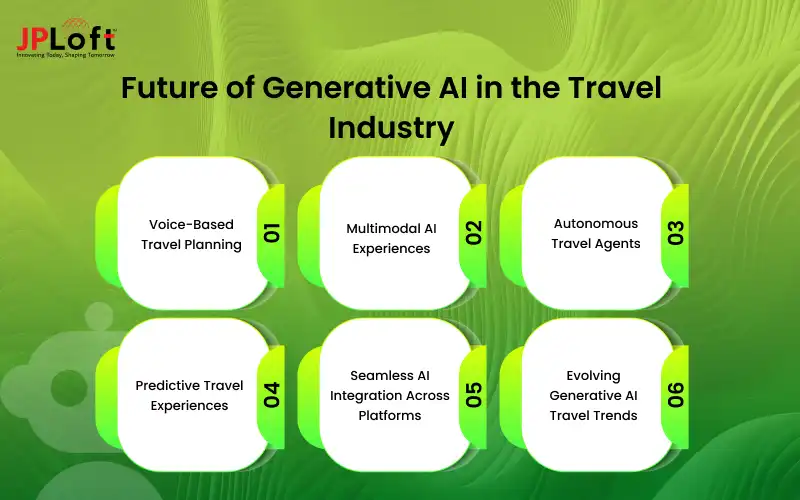
Here are the key generative AI travel trends shaping the future of travel platforms and user experiences:
1. Voice-Based Travel Planning
Voice technology will allow users to plan trips using simple spoken commands and natural conversations. This will make travel planning faster and more accessible, especially for users who prefer hands-free experiences.
2. Multimodal AI Experiences
Future systems will combine text, images, and voice to deliver richer and more interactive travel experiences. These innovations will inspire top travel app ideas that focus on immersive and user-friendly travel planning.
3. Autonomous Travel Agents
AI agents will handle complete travel planning, from searching options to booking and updating itineraries automatically. These systems will reduce manual effort and support smarter mobile app monetization through automated services.
4. Predictive Travel Experiences
Generative models will predict user needs before they are explicitly shared, based on past behavior and context. This will help users make faster decisions with minimal effort and improved accuracy.
5. Seamless AI Integration Across Platforms
Generative technology will integrate with multiple travel services, apps, and devices for a connected experience. Users will manage travel plans across platforms without switching between multiple tools or interfaces.
6. Evolving Generative AI Travel Trends
Emerging gen AI travel trends will focus on automation, personalization, and seamless user experiences. These trends will shape how platforms innovate and compete in a rapidly evolving digital travel market.
Overall, the future of generative AI in travel will focus on smarter systems, better experiences, and continuous innovation.
How JPLoft Can Help You Leverage Generative AI in Travel Apps?
JPLoft helps businesses build smart travel solutions using advanced AI technologies. As a trusted travel app development company, we design scalable and user-focused travel platforms.
Our team understands how to implement generative AI in travel app for real business impact.
We focus on building features that improve planning, booking, and overall user experience.
From idea validation to deployment, we ensure smooth and efficient development processes.
We also help businesses align with the future of generative AI in travel through modern solutions. Our approach combines strong design, performance, and reliable system architecture for better results.
Whether you are a startup or an enterprise, we build travel apps that grow with your needs.
With the right strategy and technology, we help you stay competitive in the evolving travel market.
Conclusion
Travel apps are evolving with smarter systems that improve how users explore and plan journeys. AI-driven solutions reduce effort and help users make quicker and more confident travel decisions.
Adopting generative AI in travel app allows businesses to deliver tailored experiences at scale.
It also helps streamline operations while improving accuracy across different stages of travel planning.
Looking ahead, the future of generative AI in travel will depend on innovation and adaptability.
Platforms that focus on value, usability, and trust will stand out in a competitive market.
With the right approach, businesses can build travel solutions that are both efficient and future-ready.
FAQs
Generative technology is mainly used to simplify trip planning by creating personalized travel recommendations. It helps users discover destinations, plan itineraries, and compare options quickly. This reduces manual effort and improves overall travel decision-making experiences.
Generative models improve travel planning by turning simple user inputs into complete travel plans. It organizes itineraries, suggests relevant destinations, and provides insights. This allows users to save time and avoid the hassle of researching multiple sources manually.
Yes, generative AI can handle real-time updates when integrated with live data sources. It provides users with updated pricing, availability, and schedule changes. This helps them make informed decisions during booking and planning without relying on outdated information.
Generative AI is safe when applications follow strong security and data protection practices. Using encryption, secure APIs, and privacy controls ensures user data remains protected. Also, it ensures building trust and maintaining compliance with modern data regulations.
Businesses should focus on data quality, model accuracy, and system scalability before using generative AI. They should also consider integration with existing systems, ongoing maintenance, and user experience to ensure long-term success and reliable performance.

Kris Jacobs brings 20+ years of experience in digital product strategy, user-focused design, and solving complex product challenges. She has worked across on-demand services, travel, entertainment, sports, insurance, education, and service marketplaces, including handyman, dog-walking, courier, event-management, and equine platforms. Her focus is on shaping practical, scalable digital experiences that align user needs with business goals and long-term product growth.





Share this blog