


Key Takeaways
eSIM apps enable users to activate digital SIM profiles, purchase global data plans, and manage connectivity directly from smartphones.
Businesses exploring how to make an eSIM app must prioritize telecom integrations, security protocols, and scalable infrastructure for reliability.
Essential eSIM app features include instant activation, real-time data tracking, multi-network switching, secure authentication, etc.
The cost to build an eSIM app typically ranges between $20,000 and $220,000+, depending on complexity, integrations, and scalability requirements.
Successful eSIM platforms generate revenue through data plan sales, subscriptions, enterprise partnerships, and other proven telecom monetization strategies.
JPLoft helps businesses design scalable eSIM platforms with strong telecom integrations, secure architecture, and seamless global connectivity experiences.
Staying connected while traveling internationally has always been a challenge.
Switching physical SIM cards, dealing with roaming charges, and finding reliable networks can quickly become inconvenient for users. As smartphones increasingly support embedded SIM technology, businesses are exploring new opportunities to simplify mobile connectivity through digital solutions.
For companies entering this space, understanding how to develop an eSIM app is becoming essential. These apps allow users to activate data plans instantly, manage networks digitally, and access global connectivity without replacing their SIM cards.
In this guide, we’ll walk you through everything you need to know to create an eSIM app, including how it works, key features, and the essential development steps.
We’ll also explore estimated costs and real-world examples to help you plan and launch a successful product.
What is an eSIM App & How Does It Work?
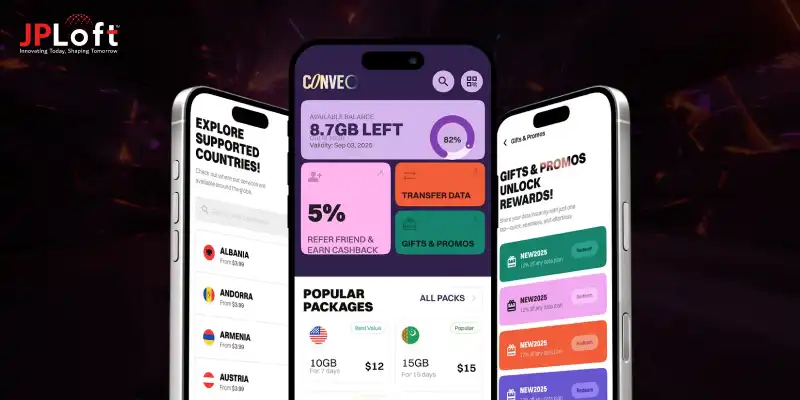
An eSIM app is a mobile application that allows users to activate and manage digital SIM profiles directly from their smartphones without inserting a physical SIM card.
These platforms enable users to purchase data plans, switch networks, and manage connectivity from a single interface.
With the rising popularity of eSIM apps for travel, these platforms have become a convenient solution for travelers seeking instant mobile connectivity across different countries.
How Does an eSIM Work?
An eSIM app works by digitally provisioning a mobile network profile to compatible devices without requiring a physical SIM card.
Working Process:
-
Plan selection: Users browse and purchase an international or regional data plan within the app.
-
Profile download: The selected carrier profile is securely downloaded to the device’s embedded SIM chip.
-
Digital activation: The smartphone activates the eSIM profile instantly without inserting a SIM card.
-
Network authentication: The telecom network verifies the user credentials and establishes a secure connection.
-
Usage management: Users can monitor data usage, switch plans, or change networks directly from the app dashboard.
As global connectivity solutions evolve alongside travel app development trends, businesses planning to create an eSIM app must prioritize seamless activation, secure provisioning, and intuitive user experiences.
Why Invest in an eSIM App?
Global travel and digital connectivity are evolving rapidly, increasing the demand for seamless mobile data access.
Businesses entering the telecom and travel ecosystem are exploring opportunities to develop an eSIM app that enables instant connectivity without the limitations of physical SIM cards.
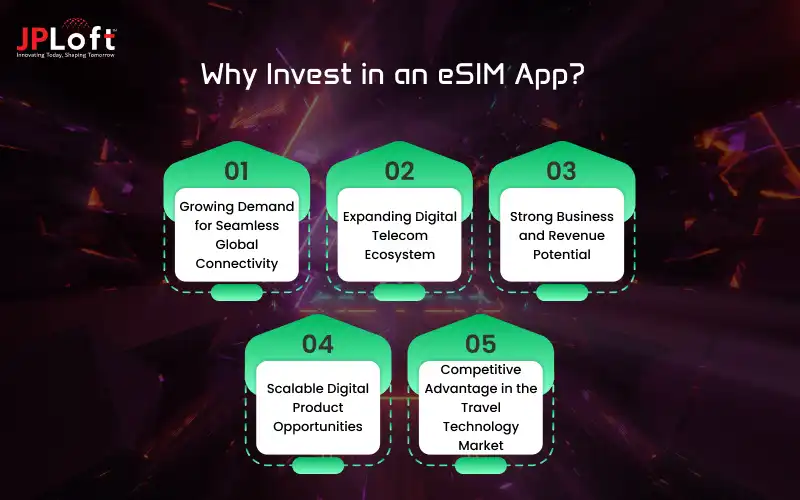
Below are the key reasons businesses are choosing this technology-driven solution.
1. Growing Demand for Seamless Global Connectivity
International travelers increasingly prefer eSIM apps for travel because they eliminate roaming hassles and physical SIM replacements.
By offering instant plan activation and flexible connectivity across multiple regions, businesses can meet the rising expectations of modern travelers. These users increasingly seek convenient and reliable mobile internet access wherever they go.
2. Expanding Digital Telecom Ecosystem
The telecom industry is steadily shifting toward embedded SIM technology.
Companies exploring how to build an eSIM app can leverage this transformation to deliver modern connectivity solutions. This enables telecom providers, startups, and digital platforms to offer flexible data services for global users.
3. Strong Business and Revenue Potential
eSIM platforms allow companies to generate revenue through regional data packages, subscription models, and international connectivity plans.
This business model supports scalable digital services while helping companies capture demand from frequent travelers, remote workers, and globally connected professionals.
4. Scalable Digital Product Opportunities
Organizations planning to build a mobile app in the telecom or travel sector can benefit from eSIM technology by creating a flexible connectivity platform.
These apps can scale across multiple regions, integrate with partner networks, and support a growing global customer base.
5. Competitive Advantage in the Travel Technology Market
Businesses that create an eSIM app can differentiate themselves by offering fast activation, global coverage, and simplified connectivity management.
This positions companies as innovative digital service providers in a competitive travel technology landscape.
Investing in eSIM technology helps businesses deliver modern connectivity solutions while unlocking long-term opportunities in the global digital telecom market.
Step-By-Step Process to Develop an eSIM App
Building a reliable connectivity platform requires strategic planning, telecom integrations, and scalable architecture.
Businesses must follow a structured development approach to ensure seamless activation, security, and global connectivity for modern users.
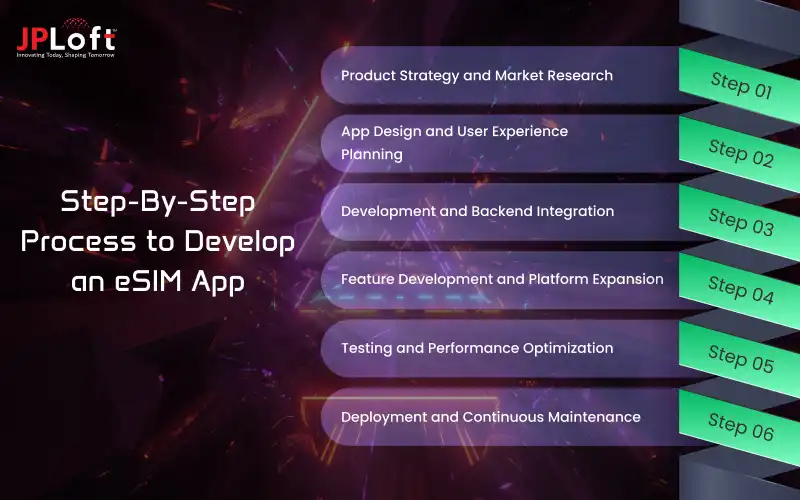
Below are the essential steps companies follow to successfully build an eSIM app for international connectivity solutions.
Step 1: Product Strategy and Market Research
A strong strategy helps businesses create an eSIM app aligned with market demand, telecom partnerships, global connectivity trends, and user expectations.
► Market and Competitor Research
Start by studying global connectivity solutions and leading eSIM travel apps to understand user expectations, pricing models, and popular features. These insights help companies succeed in competitive markets.
► Product Architecture Planning
Define the backend infrastructure, telecom APIs, provisioning systems, and security architecture required for the platform. This foundation enables the app to manage digital SIM profiles, international networks, and real-time connectivity services efficiently.
► Compliance and Carrier Partnerships
eSIM applications must comply with GSMA standards and telecom regulations. Establish partnerships with mobile carriers and provisioning platforms early to support secure profile downloads and reliable connectivity across regions.
Step 2: App Design and User Experience Planning
An intuitive design ensures users can easily activate plans, monitor usage, and switch networks within the app.
► Interface Structure Planning
Product teams begin with an app wireframe to map screen layouts, navigation flow, and feature placement. This helps businesses visualize how to create an eSIM app that offers seamless user interaction.
► Interactive Product Simulation
Designers build an app prototype to simulate the user journey and evaluate functionality before development begins. This ensures that the final interface supports seamless activation and connectivity management for travelers and global users.
► Visual Experience and Interface Design
A strong travel app design simplifies data plan selection, activation, and connectivity management within the app. This improves usability and ensures a seamless experience for global travelers using an eSIM platform.
Step 3: Development and Backend Integration
The development stage focuses on implementing telecom integrations, backend services, and secure provisioning systems that power the connectivity platform.
► Core Application Development
Businesses typically hire mobile app developers to implement frontend interfaces, backend systems, and provisioning logic required to build an eSIM app. This allows users to activate and manage data plans digitally through the platform.
► Dedicated Development Team Setup
Many companies hire dedicated developers to manage telecom integrations and implement scalable architecture. They also support multi-carrier connectivity infrastructure required to develop an eSIM app for international coverage.
► Telecom and Carrier Integration
Engineers integrate provisioning APIs, telecom operator systems, and authentication services.
These integrations enable secure eSIM profile downloads and automatic network connectivity across supported carriers worldwide.
Step 4: Feature Development and Platform Expansion
Once the core infrastructure is ready, developers focus on adding features that improve connectivity management and user convenience.
► Data Plan Selection and Management
Users can compare regional and global data packages directly within the app. This functionality is especially useful for companies exploring how to create a travel app that delivers seamless connectivity services.
► Security and Authentication Systems
Security protocols such as encryption, identity verification, and secure authentication are implemented to protect user data. These measures also ensure safe telecom provisioning processes across global network environments.
► Scalable Cloud Infrastructure
Cloud infrastructure allows businesses to make an eSIM app capable of handling increasing user demand and telecom integrations. It also supports high volumes of global data traffic efficiently.
Step 5: Testing and Performance Optimization
Extensive testing ensures the platform performs reliably across devices, network conditions, and regions while identifying bugs, improving stability, and optimizing overall app performance.
► Functional Testing and Validation
Teams perform detailed travel app testing to validate activation processes, telecom integrations, connectivity switching, and overall platform functionality. This ensures the eSIM application operates smoothly, reliably, and efficiently before its official launch globally.
► Performance and Security Testing
Developers evaluate server performance, network reliability, encryption protocols, and authentication systems. This ensures the platform remains stable while handling multiple users and international connectivity requests.
► Cross-Device Compatibility Testing
Testing across operating systems, smartphone models, and eSIM-compatible devices ensures consistent functionality, stable performance, and reliable network connectivity. This delivers a seamless experience for users accessing global mobile data services.
Step 6: Deployment and Continuous Maintenance
Launching the platform is only the beginning; continuous optimization, monitoring, and updates ensure long-term reliability, scalability, performance, and seamless connectivity experiences.
► Application Deployment
Development teams release the platform across app stores while configuring provisioning servers and telecom integrations. They also set up monitoring tools needed to operate the connectivity service successfully.
► Performance Monitoring and Updates
Analytics and monitoring tools track user activity, data usage patterns, and connectivity performance. This helps teams identify issues, enhance features, optimize system efficiency, and continuously improve the overall user experience.
► Post-Launch Support and Maintenance
Ongoing app maintenance services help fix bugs, introduce new connectivity features, and maintain system security. These services ensure the eSIM app evolves continuously with changing telecom technologies.
Following this structured approach helps businesses successfully develop an eSIM app that delivers secure connectivity, seamless activation, and scalable global telecom services.
Essential Features of an eSIM App
The success of digital connectivity platforms depends on the inclusion of powerful and user-centric functionalities. Therefore, businesses must focus on features that simplify activation, network management, and data monitoring. This helps deliver a smooth mobile experience.
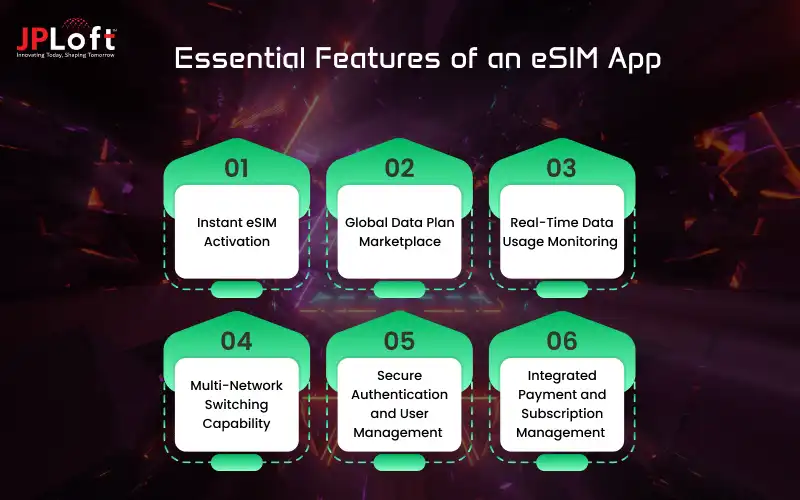
Below are the key eSIM app features that businesses should prioritize when planning modern telecom and travel connectivity solutions.
[A] Instant eSIM Activation
This is one of the most important eSIM app features. It allows users to download and activate a digital SIM profile directly through the application without inserting a physical SIM card. In addition, this feature simplifies onboarding and significantly improves user convenience in modern telecom platforms.
[B] Global Data Plan Marketplace
With this capability, users can explore and purchase regional or international connectivity packages. In fact, this feature is highly valuable in eSIM apps for travel, since it enables travelers to choose affordable data plans across different countries.
[C] Real-Time Data Usage Monitoring
The application should provide the facility of real-time data usage monitoring with insights such as real-time data consumption, plan validity, and remaining balance through an intuitive dashboard. These insights help users manage connectivity efficiently while reflecting the importance of practical mobile app features in an eSIM app.
[D] Multi-Network Switching Capability
A strong eSIM platform offers multi-network switching capability to its users. Using this, they can switch between supported telecom carriers depending on strength or pricing. This flexibility is among the most valuable travel app features that ensure reliable connectivity across multiple locations worldwide.
[E] Secure Authentication and User Management
When businesses plan to create an eSIMP app, they must ensure delivering secure global connectivity services. This can be done with the help of security tools such as encrypted profiles, identity verification, and multi-factor authentication that help protect telecom credentials and user data.
[F] Integrated Payment and Subscription Management
A built-in payment system allows users to purchase data packages, renew subscriptions, and manage billing seamlessly. This feature supports sustainable monetization while businesses make an eSIM app capable of scaling telecom services globally.
These core capabilities ensure businesses build reliable, scalable, and user-friendly eSIM platforms for modern mobile connectivity.
Cost & Timeline to Build an eSIM App
Developing a telecom-enabled connectivity platform involves multiple stages, including design, telecom integrations, security setup, and testing. Therefore, businesses should carefully evaluate technical complexity, integrations, and scalability before estimating the overall eSIM app development cost.
Below is a practical overview of the typical investment and development timeframe.
Estimated eSIM App Development Cost
|
Development Level |
Estimated Cost |
|
Basic eSIM App (activation, plan selection) |
$20,000 – $60,000 |
|
Mid-Level Platform (payments, analytics, multiple carriers) |
$60,000 – $120,000 |
|
Advanced Global Platform (enterprise integrations, automation, global networks) |
$120,000 – $220,000+ |
The cost to develop an eSIM app depends on telecom API integrations, infrastructure scalability, and security architecture. Companies evaluating the cost to build a mobile app should also consider backend systems, compliance requirements, and long-term platform upgrades.
Estimated Development Timeline
|
Development Phase |
Timeline |
|
Research & Planning |
2–3 weeks |
|
UI/UX Design & Architecture |
3–4 weeks |
|
Core Development & Integrations |
8–14 weeks |
|
Testing & Launch Preparation |
3–4 weeks |
On average, it takes 4–6 months to launch a fully functional platform. Collaborating with an experienced mobile app development company in Denver can help accelerate development while ensuring performance, scalability, and secure telecom integrations.
Popular eSIM App Examples To Consider
The growing adoption of digital SIM technology has led to the emergence of several innovative platforms worldwide. Studying these applications helps businesses understand user expectations, platform capabilities, and market standards before launching their own solution.
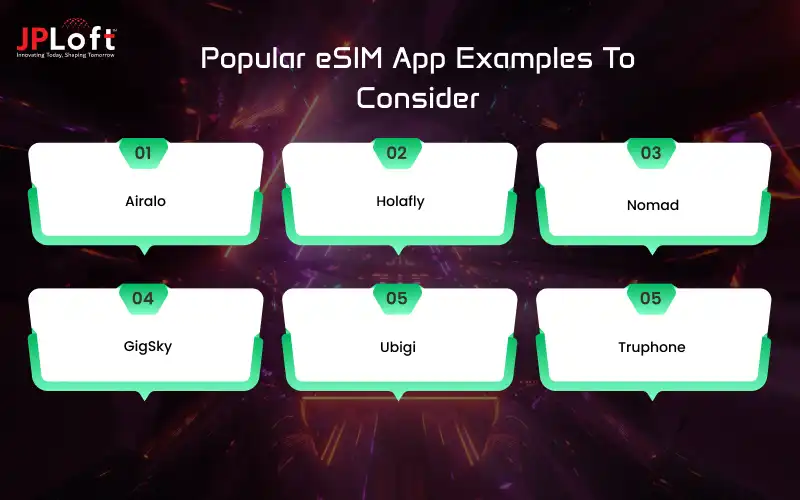
Below are some of the best eSIM app examples that businesses can analyze before planning to develop an eSIM app for modern connectivity services.
1. Airalo
Airalo is one of the most recognized global eSIM platforms offering affordable regional and international data packages. Its simple onboarding process, wide carrier coverage, and intuitive interface make it a strong reference point for startups entering the connectivity market.
2. Holafly
Holafly focuses on unlimited international data plans designed for travelers. The platform simplifies mobile connectivity abroad and represents how modern eSIM apps for travel prioritize convenience, fast activation, and reliable data coverage across multiple destinations.
3. Nomad
Nomad offers flexible prepaid data plans across numerous countries with transparent pricing and smooth plan activation. Its clean interface and efficient connectivity management provide useful inspiration for companies exploring how to build an eSIM app for global users.
4. GigSky
GigSky provides international mobile data services through partnerships with major telecom operators. The platform demonstrates how global connectivity apps can deliver stable coverage, flexible plan options, and reliable service for both business travelers and frequent flyers.
5. Ubigi
Ubigi delivers cellular connectivity for smartphones, tablets, and even connected vehicles using eSIM technology. It highlights how advanced eSIM travel apps integrate strong telecom partnerships with simple activation processes and consistent international network access.
6. Truphone
Truphone is known for enterprise-grade global connectivity powered by advanced telecom infrastructure. The platform illustrates how large-scale telecom services can manage international data services, multiple networks, and seamless connectivity through a single digital SIM platform.
These best eSIM app platforms highlight essential functionality, helping businesses understand market expectations before launching their own eSIM solution.
How eSIM Apps Make Money?
Successful connectivity platforms rely on sustainable revenue models to maintain telecom partnerships, infrastructure, and continuous platform improvements. Therefore, businesses planning to develop an eSIM app must incorporate clear monetization strategies that not only support long-term growth but also global connectivity services.
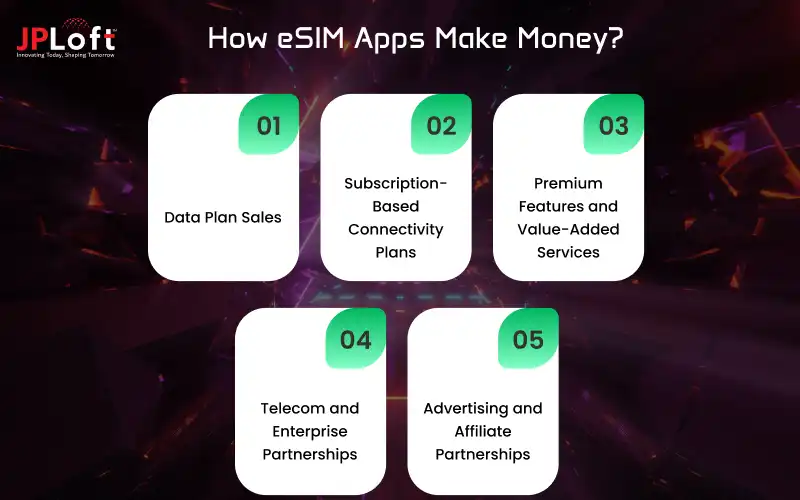
Here are the key monetization strategies commonly used by successful eSIM platforms.
1. Data Plan Sales
Selling regional and international mobile data packages is the primary revenue stream for most platforms. Companies build an eSIM app to partner with telecom carriers and earn commissions or margins whenever users purchase prepaid or subscription-based data plans.
2. Subscription-Based Connectivity Plans
Some platforms offer monthly or yearly subscriptions to provide continuous global connectivity. This approach generates predictable recurring revenue while allowing users to access multiple international networks without repeatedly purchasing individual data packages.
3. Premium Features and Value-Added Services
Advanced features such as priority network access, business travel connectivity tools, or analytics dashboards can be offered as paid upgrades. These services enhance the platform experience while creating additional revenue streams beyond basic data plan sales.
4. Telecom and Enterprise Partnerships
Businesses collaborate with airlines, travel platforms, or global enterprises to provide integrated connectivity services. These collaborations often follow proven travel app monetization strategies, where companies earn revenue through partnerships, bundled services, or platform integrations.
5. Advertising and Affiliate Partnerships
Some platforms integrate relevant promotions, travel services, or telecom partner offers within the application. Carefully placed affiliate partnerships allow companies to monetize user engagement while keeping the experience useful and relevant for international travelers.
A well-planned monetization strategy helps eSIM platforms generate sustainable revenue while delivering reliable global connectivity services to users.
Challenges in Developing an eSIM App
Building a digital connectivity platform comes with numerous challenges, including technical, operating, and regulatory ones. Therefore, businesses which are exploring how to create an eSIM app must carefully address these challenges to ensure reliable performance and seamless user experiences.
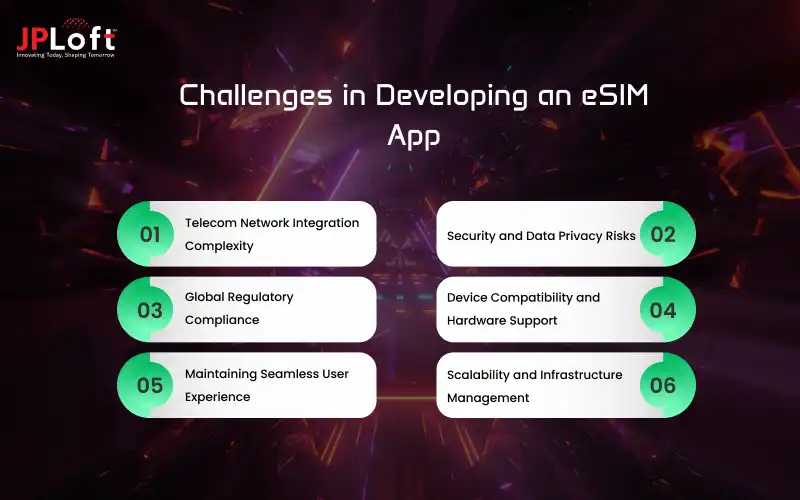
Below are the key challenges in an eSIM app development that businesses face, along with their practical solutions to overcome them.
Challenge 1: Telecom Network Integration Complexity
Integrating telecom carrier APIs, global connectivity networks, and device compatibility systems can be technically complex. This requires reliable infrastructure, seamless provisioning systems, and consistent connectivity performance across multiple regions.
Solution: Partnering with experienced telecom integration providers and adopting standardized GSMA eSIM protocols simplifies network connectivity management. In addition, using scalable backend infrastructure also ensures reliable provisioning, stable connections, and seamless carrier switching across different countries.
Challenge 2: Security and Data Privacy Risks
Handling digital SIM profiles, personal user information, and telecom authentication processes introduces security risks. Platforms must protect sensitive connectivity credentials and prevent unauthorized access while maintaining secure communication between mobile devices and telecom networks.
Solution: Implementing strong encryption, multi-factor authentication, secure profile management, and compliance with global data protection regulations helps safeguard user information. Additionally, this ensures trusted connectivity services across devices and telecom infrastructure.
Challenge 3: Global Regulatory Compliance
Telecom regulations vary across countries, making compliance difficult for companies offering global connectivity. Licensing requirements, regional telecom policies, and carrier agreements can complicate efforts when organizations create an eSIM app targeting international users.
Solution: Working with telecom partners familiar with regional regulations helps ensure compliance. Businesses should conduct legal audits, maintain updated documentation, and integrate regulatory frameworks within development processes to support international connectivity services.
Challenge 4: Device Compatibility and Hardware Support
Not all smartphones and IoT devices support eSIM functionality. Ensuring compatibility across multiple operating systems, device manufacturers, and hardware configurations becomes challenging when companies make an eSIM app designed for global connectivity services.
Solution: Maintaining an updated compatibility database and supporting widely adopted smartphone models helps address this challenge. Continuous app testing across devices ensures reliable performance and smooth eSIM activation experiences for users worldwide.
Challenge 5: Maintaining Seamless User Experience
Users expect simple activation, fast connectivity, and easy plan management. Similar to other travel app development challenges, complex telecom workflows can create friction, making it difficult for companies learning how to make an eSIM app effectively.
Solution: Designing clear onboarding flows, simplified plan selection interfaces, and automated activation processes improves usability. User-focused design strategies and continuous testing help create smooth experiences across devices and international connectivity environments.
Challenge 6: Scalability and Infrastructure Management
As user numbers grow, backend infrastructure must handle large volumes of telecom provisioning requests, payments, and connectivity management. Without scalable systems, platforms may face performance issues while supporting global users.
Solution: Using cloud-native architecture, distributed servers, and scalable telecom APIs ensures platforms handle growing demand efficiently. Infrastructure monitoring and automated scaling maintain performance while supporting expanding global connectivity services.
Addressing these challenges in an eSIM app development early helps businesses build scalable, secure, and reliable eSIM platforms for global connectivity services.
Why Choose JPLoft to Develop Your eSIM App?
Launching a successful digital connectivity platform requires strong technical expertise, telecom partnerships, and scalable product architecture.
Businesses exploring how to make an eSIM app need a reliable development partner that understands telecom ecosystems, mobile infrastructure, and global connectivity requirements.
JPLoft is a trusted travel app development company experienced in building advanced mobile solutions for global businesses.
Our experts guide organizations through every stage of development, from product strategy and telecom integrations to secure deployment and performance optimization.
We focus on building scalable platforms that support smooth activation, reliable connectivity, and user-friendly interfaces.
Our development approach also helps businesses understand how to build an eSIM app capable of supporting global users and evolving telecom technologies.
With deep industry expertise and a user-focused development process, JPLoft helps businesses successfully launch innovative eSIM platforms in competitive digital markets.
Conclusion
The rise of eSIM technology is transforming how people access mobile connectivity across the world. Businesses exploring how to develop an eSIM app now have a strong opportunity to deliver seamless digital SIM activation, global data access, and flexible connectivity services for modern travelers and professionals.
However, launching a successful platform requires careful planning, reliable telecom integrations, and scalable infrastructure.
From selecting the right features to ensuring smooth user experiences, every stage plays a critical role in building a sustainable platform.
With the right strategy and development expertise, businesses can introduce innovative eSIM solutions that meet growing connectivity demands while creating long-term value in the rapidly evolving telecom ecosystem.
FAQs
An eSIM app allows users to activate and manage digital SIM profiles directly from their smartphones without inserting a physical SIM card. It simplifies mobile connectivity by enabling users to purchase data plans, switch networks, and manage international connectivity through a single application.
To develop an eSIM app, businesses must integrate telecom carrier APIs, implement secure authentication systems, design an intuitive interface, and ensure compatibility with eSIM-enabled devices. Partnering with experienced developers also helps manage telecom integrations and scalability.
A successful eSIM platform typically includes instant eSIM activation, global data plan marketplaces and real-time data usage tracking. Among others, it includes multi-network switching, secure user authentication, and integrated payment systems for purchasing and managing connectivity plans.
The development timeline usually ranges from 4 to 6 months, depending on app complexity, telecom integrations, security requirements, and platform features. Advanced platforms with multiple carrier partnerships may require additional development and testing time.
The cost of eSIM app development ranges from $20k to $220k+. It depends on a variety of features, telecom API integrations, UI/UX design complexity, security infrastructure, scalability requirements, and testing. Global connectivity platforms with advanced capabilities generally require higher development investment.

Kris Jacobs brings 20+ years of experience solving complex digital product challenges through strategic thinking and user-centric design. With deep exposure to on-demand services, entertainment, travel, and interactive platforms, she collaborates across teams to shape scalable, engaging solutions that align business goals with intuitive user experiences across evolving digital landscapes.



Share this blog