


Key Takeaways :
Investing in travel apps increases revenue opportunities, customer engagement, scalability, digital convenience, and long-term competition.
Essential features include bookings, payments, GPS tracking, multilingual support, analytics, notifications, and customer assistance.
To make a clone like Klook, perform research, feature planning, development, testing, marketing, maintenance, and continuous upgrades.
Klook app clones generate revenue through commissions, subscriptions, advertising, featured listings, partnerships, and service fees.
Cost to make an app like Klook ranges between USD 10,000 to USD 90,000+, depending on app complexity and maintenance requirements.
JPLoft delivers scalable travel apps with advanced technologies, seamless designs, secure systems, and post-launch support for ease.
Travelers now expect everything in one place, from hotel bookings and transportation to local experiences. This growing demand has made businesses invest in how to make a travel app like Klook that simplifies trip planning and improves customer experiences.
Development requires advanced technologies, real-time integrations, secure payment systems, an engaging user interface, and personalized recommendations. From activity discovery to instant reservations, every feature plays a major role in user satisfaction and business growth.
In this blog, we will explore how to create a travel app like Klook, including its essential features, cost estimation, monetization strategies, and the latest market trends.
If you are planning to enter the booming travel industry, this guide will help you make a successful travel app like Klook.
All About the Klook App
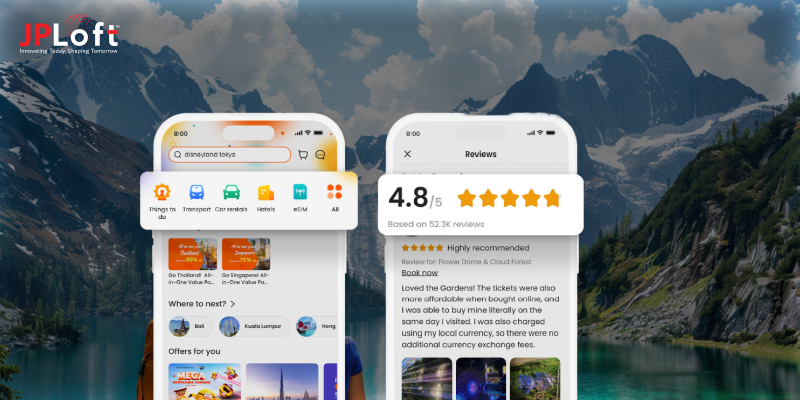
Founded in 2014 in Hong Kong, Klook gained popularity by offering seamless travel planning and discounted booking services for global travelers. The development of travel apps like Klook assists users in discovering and booking hotel stays, travel experiences, transportation services, attraction tickets, and local activities through a single app.
With 10 million+ downloads on the Play Store, the Klook travel app caught the eye of new startups and businesses.
It has a user-friendly interface with a personalized recommendation system, which is the biggest strength. Other popular benefits to build a travel app like Klook include multilingual support, instant booking confirmation, secure payment, digital vouchers, real-time availability tracking, and customer reviews.
Today, Klook operates in multiple countries and partners with thousands of travel service providers worldwide. Its success has inspired many businesses and startups to invest in how to build an app like Klook, following the growing travel app trends in the industry.
Why Invest in an App Like Klook?
The growing demand for digital travel services has made travel booking apps highly profitable for modern businesses. Investing to create a clone like Klook offers strong revenue opportunities, global market reach, improved customer engagement, and long-term business scalability in the expanding tourism industry.
1. High Revenue Generation Opportunities
Travel apps generate income through commissions, advertisements, premium listings, partnerships, and subscription models. Starting an online travel business like Klook creates multiple revenue streams by connecting travelers with service providers, making it a profitable business model.
2. Growing Global Travel Industry
The travel industry continues to expand as more people prefer online booking platforms for convenience and better travel planning. Investing to make a clone like Klook lets you target a massive global audience seeking hotels, activities, transportation, and travel experiences through mobile applications.
3. Increasing Demand for Digital Booking
Modern travelers prefer instant bookings, cashless payments, and real-time updates instead of traditional travel agencies. Top travel app ideas help you meet changing customer expectations while offering seamless travel management solutions that improve convenience and customer satisfaction.
4. Easy Business Scalability
If you make an app like Klook, it can easily expand into new services, destinations, and markets over time. Businesses can start with limited features and gradually add hotel bookings, local experiences, ride services, and AI-based travel assistance to support future growth and larger audiences.
5. Strong Customer Engagement
Travel apps keep users engaged through personalized recommendations, discounts, loyalty programs, notifications, and location-based suggestions. These features encourage repeat bookings and improve customer retention, helping businesses build long-term relationships with travelers while increasing overall app usage and revenue opportunities.
Key Features to Include in an App Like Klook
To successfully build a travel app like Klook, include features that improve booking convenience, user engagement, and travel management. The right choice of travel app features plays an important role in delivering a seamless customer experience and business growth.
|
Components |
Features |
Description |
|
User Registration & Profile |
Sign Up/Login, Social Login, Profile Management |
Allows users to create accounts, manage personal information, save preferences, and access booking history securely. |
|
Search & Discovery |
Smart Search, Filters, Category Browsing |
Helps users quickly find hotels, tours, transportation, restaurants, and activities based on location, budget, ratings, or interests. |
|
Travel Booking System |
Instant Booking, Ticket Reservation, Scheduling |
Enables users to book travel services and experiences with real-time availability and immediate confirmation. |
|
Personalized Recommendations |
AI-Based Suggestions, Wishlist, Recently Viewed |
Recommends travel activities and destinations according to user behavior, interests, and previous bookings. |
|
Payment Integration |
Multiple Payment Methods, Secure Checkout, Digital Wallets |
Supports safe and seamless online payments through cards, wallets, UPI, and other payment gateways. |
|
Reviews & Ratings |
User Feedback, Star Ratings, Travel Reviews |
Builds trust by allowing travelers to share experiences and rate services, tours, and activities. |
|
Push Notifications |
Booking Alerts, Offers, Travel Reminders |
Sends real-time updates about bookings, discounts, cancellations, and travel schedules to users. |
|
In-App Chat & Customer Support |
Live Chat, Help Center, AI Travel Agent |
Provides quick customer assistance and resolves booking or travel-related issues efficiently. |
|
Loyalty & Rewards Program |
Reward Points, Coupons, Membership Benefits |
Encourages repeat bookings by offering discounts, cashback, and loyalty rewards to users. |
How to Build a Travel App Like Klook?
To create an app like Klook, you require careful planning, modern technologies, and a user-focused approach. From booking management to personalized travel recommendations, every feature should improve the overall customer experience.
Below are the essential steps of how to develop a travel app like Klook:
Step 1. Conduct Market Research
The first step is understanding the travel industry, target audience, and competitors. Analyze the best travel apps. It helps to identify trending features, user expectations, pricing models, and customer pain points.
Research helps businesses understand what travelers need and how to create unique services that stand out in the competitive market. Define your niche. A clear business model helps simplify the process of making an app like Klook and the marketing strategy.
Step 2. Define Features and Functionalities
After market research for an app, list the features your app will include. Core features usually involve user registration, smart search filters, travel bookings, payment gateways, digital tickets, reviews, notifications, and customer support.
Advanced features to make an app like Klook can include AI-based recommendations, multilingual support, GPS navigation, loyalty programs, and real-time availability tracking. Prioritize essential functionalities first and plan advanced features for future updates.
Step 3. Choose the Monetization Model
A travel app like Klook can generate revenue through multiple monetization strategies. Businesses must decide whether they want to earn through commissions, subscriptions, advertisements, affiliate partnerships, or premium listings.
Selecting the right business model early helps shape the app structure, user flow, and overall functionality. It also ensures long-term profitability and scalability for the platform.
Step 4. Create an Engaging UI/UX Design
When you create an app like Klook, it must provide a smooth and visually appealing experience because users prefer simple and fast booking processes. The UI/UX design services provider should focus on easy navigation, quick search options, clear booking details, and secure checkout systems.
Use interactive layouts, high-quality visuals, and intuitive menus to improve user engagement. A clean travel app design reduces confusion and encourages users to complete bookings without difficulties. Mobile responsiveness and accessibility should also be considered during the design phase.
Step 5. Develop the Frontend
The frontend is the user-facing side of the application where travelers interact with features and services. Developers create responsive interfaces for Android, iOS, or cross-platform apps using popular travel app tech stacks like Flutter, React Native, or Swift.
This stage focuses on creating booking screens, activity listings, search interfaces, user dashboards, payment pages, and notifications. A fast and smooth frontend improves customer satisfaction and app performance.
Step 6. Build the Backend Infrastructure
The backend manages the core operations of the app, including databases, APIs, user authentication, booking systems, and payment processing. Hire dedicated developers for a strong backend that ensures real-time updates, secure transactions, and smooth communication between users and service providers.
Developers also integrate cloud storage, analytics tools, and third-party APIs for maps, travel bookings, payment gateways, and notifications. A scalable backend allows the platform to handle increasing user traffic and future feature expansion.
Step 7. Integrate Advanced Technologies
Modern travel apps use advanced technologies to improve personalization and convenience. AI and machine learning can recommend travel destinations and activities based on user preferences. GPS integration helps travelers explore nearby attractions and navigate locations easily.
Businesses can also add chatbots for customer support, blockchain in travel apps for secure transactions, and AR/VR features for virtual destination previews. These technologies improve user engagement and create a competitive advantage.
Step 8. Test the App Thoroughly
Testing is one of the most important stages of app development. Developers perform functional, performance, security, and usability testing to identify bugs and technical issues.
The app should be tested across different devices, operating systems, and screen sizes to ensure consistent performance. Proper testing helps improve travel app security, reduce crashes, and deliver a seamless user experience before launch.
Step 9. Launch and Market the App
Once testing is complete, publish the app on the Google Play Store and the Apple App Store. However, development alone is not enough.
Businesses must invest in marketing strategies such as SEO, social media promotion, influencer marketing, and paid advertising to attract users. Offering discounts, referral rewards, and promotional campaigns can also increase initial downloads and user engagement.
Step 10. Maintain and Upgrade the App
Post-launch mobile app maintenance services are essential for long-term success. Businesses should regularly update the app with new features, security improvements, bug fixes, and performance enhancements.
Monitoring user feedback and app analytics helps identify areas for improvement. Continuous upgrades ensure the platform remains competitive and meets changing customer expectations in the travel industry.
With proper planning and scalable development, businesses can create a profitable app that meets modern customer expectations.
What is the Cost to Create an App Like Klook?
The cost to develop an app like Klook varies between USD 10,000 to USD 90,000+. The travel app development cost depends on complexity, feature set, platform selection, UI/UX design, third-party integrations, and development team location.
|
Development Stage |
Features Included |
Estimated Cost |
|
MVP Development |
User registration, search filters, booking system, payment integration, and basic admin panel |
USD 10,000 – USD 25,000 |
|
Medium-Complexity App |
Real-time booking, push notifications, reviews & ratings, GPS tracking, multi-payment support |
USD 25,000 – USD 50,000 |
|
Advanced Travel App |
AI recommendations, multilingual support, loyalty programs, analytics dashboards, and vendor management |
USD 45,000 – USD 70,000 |
|
Enterprise-Level App |
Cloud infrastructure, advanced security, scalable architecture, AR/VR features, AI chatbots, automation |
USD 70,000 – USD 90,000+ |
Factors Affecting Klook-Like App Development Cost
The factors that affect the cost to make an app like Klook:
-
App Features and Complexity: Advanced functionalities increase development time and cost.
-
Platform Choice: Android, iOS, or cross-platform apps impact the overall budget.
-
UI/UX Design: Custom and interactive designs require higher investment.
-
Third-Party Integrations: APIs for maps, payments, and booking systems add additional expenses.
-
Development Team Location: Costs vary depending on the country and expertise of the development company.
-
Maintenance and Updates: Ongoing support, bug fixes, and feature upgrades require continuous investment.
You can reduce the initial cost to develop an app like Klook by starting with an MVP version and gradually adding advanced features based on user demand and market growth.
Monetization Strategies for an App Like Klook
A well-planned mobile app monetization strategy is essential after you know how to create a travel app like Klook for long-term success. It generates revenue through multiple income streams that improve profitability while delivering seamless travel experiences and valuable services to users worldwide.
[1] Featured Listings and Sponsored Promotions
Travel businesses pay to promote their services and appear at the top of search results or recommendation sections within the app.
How it Works: Hotels, travel agencies, restaurants, and activity providers purchase premium visibility to attract more travelers and increase bookings. Income is generated through sponsored listings, paid advertisements, and promotional campaigns.
[2] Commission-Based Model
This is the most common travel app monetization model used in travel marketplace apps. The platform earns a percentage from every successful booking made through the app.
How it Works: Hotels, tour operators, transportation providers, and activity organizers list their services on the platform. Users book these services directly through the app. The app charges a fixed commission or percentage fee from each completed booking or transaction.
[3] Dynamic Pricing and Service Fees
The app applies additional convenience charges or adjusts pricing during high-demand travel seasons and peak booking periods.
How it Works: Users pay small service fees for transactions, cancellations, priority bookings, or premium travel support services. Revenue is earned through platform convenience fees and surge-based pricing models.
[4] Travel Packages and Bundled Deals
The platform combines multiple travel services into discounted packages to increase booking value and user convenience.
How it Works: Users can purchase bundled deals that include hotels, transportation, sightseeing tours, and activities in a single booking. Higher booking margins and package commissions generate additional profits for the platform.
[5] Loyalty Programs and Reward Partnerships
The app collaborates with brands and businesses to offer reward-based loyalty programs that encourage repeat bookings.
How it Works: Users collect reward points through bookings and redeem them for discounts, cashback, or partner offers.
Revenue comes from brand partnerships, sponsored rewards, and increased customer retention.
Why Choose JPLoft to Build a Travel App Like Klook?
Building a successful travel app requires the right technology partner, and JPLoft delivers innovative, scalable, and user-focused development solutions tailored to modern business needs.
With years of experience in developing high-performance apps, JPLoft, a renowned travel app development company, helps startups, enterprises, and travel agencies create feature-rich apps like Klook. Ultimately, getting a platform that helps improve customer engagement and business growth.
Our expert developers specialize in advanced technologies such as AI integration, real-time booking systems, GPS tracking, secure payment gateways, cloud infrastructure, and multilingual support. We focus on creating appealing UI/UX designs that simplify travel planning and booking processes.
From market research and MVP development to deployment and post-launch support, we provide end-to-end development services under one roof. Our agile development approach ensures faster project delivery while maintaining high-quality standards and app security.
Whether you want to build a hotel booking platform, activity marketplace, or complete travel ecosystem, JPLoft offers customized solutions that help your business stay competitive in the growing travel industry.
Conclusion
Knowing how to develop a travel app like Klook can be a profitable opportunity for businesses looking to enter the growing digital travel industry. With the increasing demand for online bookings, personalized travel experiences, and seamless trip planning, travel apps have become an essential part of modern tourism.
However, creating an app like Klook requires more than basic booking features. Businesses must focus on user-friendly design, real-time booking systems, secure payments, advanced technologies, and strong customer engagement strategies.
From market research and feature planning to development, testing, and maintenance, every stage plays an important role in the app’s long-term success. Choosing the right monetization strategy and scalable technology stack can further improve profitability and business growth.
As the travel industry continues to evolve, investing in a smart, feature-rich travel app can help businesses attract global travelers. While enhancing customer experiences and strengthening their position in the competitive tourism market.
FAQs
Developing a travel app like Klook involves market research, UI/UX design, frontend and backend development, payment integration, testing, deployment, and ongoing maintenance. Businesses should also include booking systems, real-time updates, and personalized travel recommendations for better user experiences.
Businesses should invest in travel apps because online travel bookings continue to grow globally. Apps like Klook generate revenue through commissions, subscriptions, and advertisements while improving customer engagement, brand visibility, and long-term business scalability in the competitive travel and tourism market.
Core features include user registration, smart search filters, travel bookings, payment gateways, GPS tracking, push notifications, reviews, multilingual support, digital tickets, AI-based recommendations, customer support, and admin dashboards to manage bookings, users, vendors, and overall platform operations efficiently.
The cost usually ranges between USD 10,000 and USD 90,000+. The cost depends on factors like app complexity, features, platform selection, third-party integrations, design, developers' location, and post-launch maintenance requirements.
Technologies commonly used include Flutter, React Native, Swift, Kotlin, Node.js, Python, cloud computing, AI, machine learning, GPS integration, payment gateways, APIs, and database solutions like MongoDB or PostgreSQL for a secure and scalable app.

Kris Jacobs brings 20+ years of experience in digital product strategy, user-focused design, and solving complex product challenges. She has worked across on-demand services, travel, entertainment, sports, insurance, education, and service marketplaces, including handyman, dog-walking, courier, event-management, and equine platforms. Her focus is on shaping practical, scalable digital experiences that align user needs with business goals and long-term product growth.


Share this blog