



Key Takeaways:
The cost of a generative AI app can go somewhere from $25,000 - $350,000+, depending on multiple factors.
Several factors affect generative AI development cost, including AI model selection, infrastructure, type & complexity.
Some hidden costs can be LLM inference cost, vector database, fine-tuning, and model monitoring, which investors usually ignore.
You can go for either the in-house team or an experienced development company, based on what you need.
Gartner projects that by 2026, 80% of enterprises will deploy Gen AI- yet 60% will blow their budgets in their first two quarters.
The problem isn’t a lack of ambition, it’s a lack of reality.
Building a specialized assistant usually starts around $25,000, but moving into a fully autonomous system can easily cross the $350,000 + mark before you even hit 'launch'.
Most founders walk into AI development armed with ballpark figures from outdated blog posts that treat every LLM project like a cookie-cutter SaaS build.
Choosing between GPT-4.0, Claude, or a self-hosted open source model alone can swing your monthly bill by $40,000.
We wrote this guide for the founders who need the actual cost, from the first line of code to the monthly bill.
We’re breaking down every small to large detail about the Generative AI application development cost.
How Much Does Generative AI App Development Cost?
Generative AI development costs estimation typically ranges from $25,000 to $350,000+, depending on the complexity and scale of the solution.
A Proof of Concept (PoC) or MVP starts at $25,000 – $75,000, a production-ready app costs $80,000 – $250,000, and an enterprise-grade solution with proprietary model training can exceed $300,000 – $350,000+.
The overall AI development cost is shaped by model selection, infrastructure, fine-tuning requirements, and security compliance.
No two Gen AI application development cost structures look the same — and that's precisely where founders get burned.
The price you pay isn't determined by the app category alone; it's dictated by how deep the intelligence runs.
A PoC that stitches together an existing API is a fundamentally different financial commitment than a proprietary model trained on your enterprise data with SOC 2 compliance baked in.
Before your CFO signs off on a budget, here's the honest cost landscape across every serious development tier:
|
Development Tier |
Cost Range |
What's Actually Included |
|
Proof of Concept / MVP |
$25,000 – $75,000 |
Basic API integration (OpenAI/Claude), limited UI, single use-case validation |
|
Production-Ready App |
$80,000 – $250,000 |
Advanced fine-tuning, custom UI/UX, multi-API orchestration, scalable backend |
|
Enterprise-Grade Solution |
$300,000 – $350,000+ |
Proprietary model training, enterprise security, compliance frameworks, dedicated infrastructure |
|
Custom Small GenAI Model |
$50,000 – $120,000 |
Domain-specific model training on private datasets, evaluation pipelines |
|
RAG-Based Knowledge App |
$40,000 – $150,000 |
Vector DB setup, document ingestion pipeline, and embedding optimization |
If you want a better idea about the cost, you need to know what factors affect the cost to develop a Gen AI app.

Key Factors That Influence Generative AI Application Development Cost
No matter the industry, Gen AI application development cost is never a flat number; it's the sum of several interconnected decisions made during planning, design, and deployment.
Miss one variable, and your initial estimate can quietly double before launch.
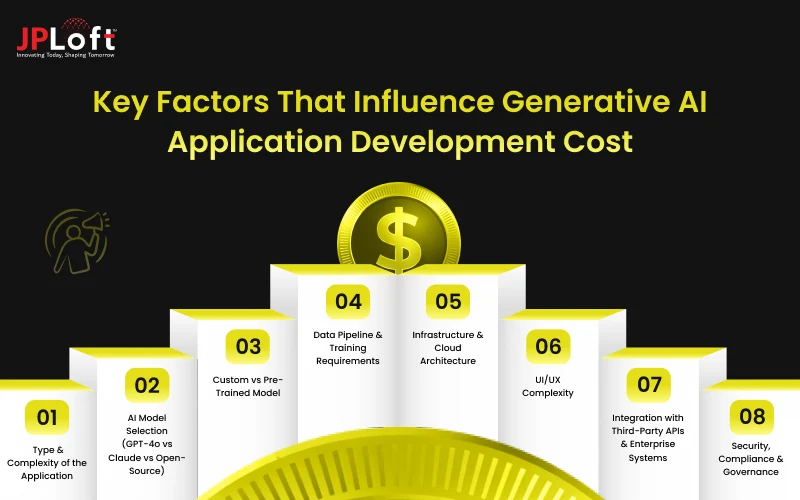
Here are the core factors every founder and business leader must evaluate before committing to a budget:
1. Type & Complexity of the Application
The single biggest cost driver is what your app actually does, and how deeply it needs to think.
A customer-facing AI chatbot that answers FAQs operates on a completely different complexity level than a generative AI platform that analyzes legal contracts, generates compliance reports, and learns from proprietary datasets over time.
The more use cases your AI app covers, the more layers of logic, model orchestration, and testing infrastructure you need. Founders often underestimate this early on and pay for it in mid-development scope creep.
2. AI Model Selection (GPT-4o vs Claude vs Open-Source)
The choice of an AI model directly impacts the Gen AI application development cost, especially in terms of usage fees and scalability.
Open-source alternatives like LLaMA 3 or Mistral eliminate licensing fees but introduce self-hosting infrastructure costs, maintenance overhead, and engineering expertise requirements.
There's no universally "cheaper" option; the right model depends on your use case, expected traffic volume, and how much latency your users can tolerate.
3. Custom vs Pre-Trained Model
Another important factor that shapes the cost of Gen AI application development cost is whether the application uses pre-trained models or fully customized AI systems.
Building a custom model means constructing from the ground up, trained exclusively on your data, reflecting your domain logic.
Pre-trained models suit most MVPs and mid-tier products efficiently.
But if your product requires deep industry specificity: say, medical diagnostics or financial risk modeling, a custom-trained model isn't optional, it's a competitive necessity.
And that shifts your cost into the $100,000 – $350,000+ range immediately.
4. Data Pipeline & Training Requirements
Clean, structured, labeled data is the fuel that makes any generative AI application intelligent.
The problem? Most businesses don't have it in a usable state. Building a reliable data pipeline involves collection, cleaning, annotation, storage architecture, and ongoing refresh cycles, none of which are cheap or fast.
If you're fine-tuning a model on proprietary data, add data engineering sprints, quality validation, and bias testing to your timeline.
Founders who skip proper data infrastructure end up with a model that performs brilliantly in demos but fails in production.
5. Infrastructure & Cloud Architecture
Once your AI app goes live, the real infrastructure bill begins. Generative AI workloads are computationally heavy: running LLM inference at scale demands GPU-backed cloud instances, load balancers, auto-scaling configurations, and optimized latency management.
Whether you deploy on AWS, Google Cloud, or Azure, costs spike significantly during peak usage if the architecture isn't designed for efficiency upfront.
Companies that over-provision waste capital; those that under-provision face downtime. Getting the infrastructure architecture right in the design phase directly protects your post-launch budget.
6. UI/UX Complexity
The interface layer is frequently underbudgeted, and it shouldn't be. A generative AI app isn't just a backend model; it's a product that real users interact with daily.
Streaming response rendering, dynamic prompt interfaces, conversation memory displays, and multi-modal input handling all of these require specialized frontend engineering.
When you decide to build an AI app, an intuitive UX that makes output feel trustworthy takes significantly more investment than a basic wrapper.
For B2B enterprise products, especially, poor UX is a direct dealbreaker regardless of how powerful the model is.
7. Integration with Third-Party APIs & Enterprise Systems
Most generative AI apps don't operate in isolation: they need to talk to CRMs, ERPs, internal databases, payment gateways, or communication platforms.
Every integration point adds development hours, error handling logic, authentication complexity, and long-term maintenance responsibility.
A single Salesforce or SAP integration can add $15,000 – $40,000 to the cost to develop a generative AI app, depending on data volume and sync requirements.
The more systems your AI app connects to, the more surface area exists for failures, which means more QA cycles, more testing environments, and more engineering time.
8. Security, Compliance & Governance
For any AI product handling sensitive user data: healthcare records, financial information, legal documents, security isn't a feature, it's a foundation.
HIPAA, GDPR, SOC 2, and ISO 27001 compliance requirements each add meaningful cost through security audits, encrypted data pipelines, access control frameworks, and documentation overhead.
Beyond basic regulation, the rise of AI in cybersecurity has introduced unique governance challenges like prompt injection vulnerabilities and automated threat detection.
Cutting your cost of Generative AI application development doesn't save money; it creates liability that costs far more to fix post-breach than it would have cost to build the first time correctly.
Hidden Cost to Develop Generative AI App Nobody Talks About
The initial cost to build a generative AI application is often just the tip of the iceberg.
While most founders budget for the development phase, the “Day 2” operational realities can lead to a financial wake-up call.
In 2026, the shift from a successful prototype to a sustainable business hinges on managing these four invisible expenses that rarely show up in the initial pitch deck.
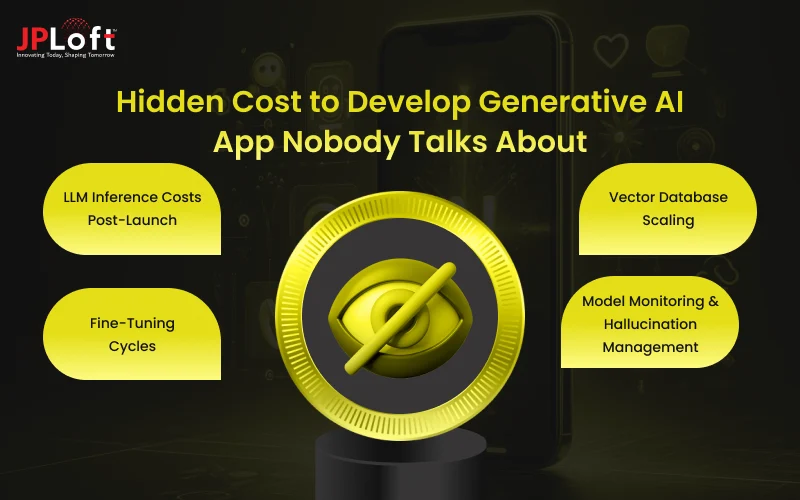
Let’s get to know those hidden factors that affect the cost to create a Gen AI app:
A. LLM Inference Costs Post-Launch
The biggest surprise for many startups is that the cost to build Generative AI doesn't end at deployment; it actually accelerates.
Every user interaction carries a "token tax." Without a smart strategy from an experienced LLM development company, these recurring fees can quickly overtake your original budget.
Implementing "semantic routing" or smaller, task-specific models can help, but a sudden spike in viral traffic could still result in a monthly bill that wipes out your margins before you can pivot.
B. Vector Database Scaling
A significant, yet often overlooked, part of the cost of implementing Generative AI app solutions is the long-term management of "memory."
Most RAG (Retrieval-Augmented Generation) systems rely on a vector database to give the AI "memory."
While these are cheap to start, their costs don't scale linearly.
As you move deeper into AI agent development, your agents will need to store and retrieve more complex memories.
In 2026, high-performance vector stores can cost anywhere from $500 to $2,000+ per month as you scale. Neglecting to optimize your data "chunking" early on can lead to a "scaling tax" that haunts your monthly OpEx.
C. Fine-Tuning Cycles
Founders often view fine-tuning as a one-time event, but it is actually a recurring cycle.
As your industry evolves, your model will suffer from "knowledge drift." Retraining a model isn't just about GPU hours; it’s about the human cost of NLP development experts who must curate and label new datasets.
Budgeting for at least 2–3 refinement cycles per year is a baseline requirement to keep your app from becoming obsolete within six months of launch.
D. Model Monitoring & Hallucination Management
"Build it and forget it" does not work with GenAI.
You need automated systems to watch your AI for hallucinations, bias, and toxic outputs in real-time.
These monitoring tools act as a continuous insurance policy, but they come with their own licensing fees and engineering overhead, often adding 15–25% to your annual maintenance budget.
Without this investment, a single high-profile mistake can lead to brand damage that far outweighs the savings of skipping a proper monitoring layer.
These are some of the hidden costs of implementing Generative AI that very few people talk about. However, as a top mobile app development company, we understand them well and have explained them clearly.
How Does a Generative AI App Actually Make Money?
Making the tech is only half the battle; the other half is turning those "tokens" into revenue.
In 2026, the most successful AI products have moved away from simple "pay-to-use" models and toward value-based pricing that justifies the initial cost of generative AI software development.
Here are the top ways businesses are monetizing their GenAI investments:
-
Outcome-Based Pricing Models: Charge clients for successful results, like "leads generated," rather than per-word. This high-value strategy directly justifies the initial Generative AI software cost.
-
Tiered Subscription Access Plans: Offer basic tools for free while gating advanced generative features behind premium monthly tiers to ensure consistent, scalable, and recurring revenue streams.
-
Credit-Based Micro-Payment Systems: Users purchase digital credits for intensive tasks, ensuring your most expensive API calls and GPU workloads are always covered by direct, upfront user payments.
-
Enterprise White-Label Licensing Deals: Recoup the cost of implementing generative AI by licensing your proprietary platform to other firms, allowing them to use your tech under-brand.
-
API-as-a-Service Monetization Route: Allow third-party developers to access your specialized generative engines via API, charging per request to turn your core infrastructure into a profitable marketplace.
-
Premium Human-in-the-Loop Services: Combine AI speed with expert human oversight. Charge a premium for "verified" AI outputs, catering to high-stakes industries like legal, medical, or financial services.
In-House vs Outsourced Development- What’s Cheaper?
If you are deciding between building an internal team or partnering with a company, it is surely one of the biggest financial crossroads for any founder.
While in-house sounds like it offers more control, the total cost of ownership in 2026 includes more than just salaries; it involves a 'war of talent' and massive infrastructure overhead.
Partnering with a specialized AI development company allows you to bypass these recruitment hurdles and access a ready-made team of experts.
The table below breaks down the reality of these two models to help you see where the hidden “budget killers’’ actually live:
|
Expense Category |
In-House Development (CapEx) |
Outsourced Development (OpEx) |
|
Talent & Salaries |
High & Fixed: Senior AI Engineers now command $180k–$300k+ annually, plus benefits (30% overhead). |
Flexible: Pay only for the hours or milestones needed. No long-term HR liabilities. |
|
Recruitment |
Expensive: Often costs 20% of the first-year salary to find specialized AI talent. |
Zero: The agency already has the vetted bench ready to start. |
|
Infrastructure |
Initial Setup: You bear the cost of GPU clusters, cloud licenses, and MLOps tools ($50k–$150k/year). |
Included: Most partners provide their own dev environments and optimization tools. |
|
Scalability |
Rigid: Hard to scale down if the project hits a plateau; requires painful layoffs. |
Fluid: Scale the team up or down instantly based on your roadmap. |
|
Time-to-Market |
Slow: Hiring and onboarding take 3–6 months on average. |
Fast: Typically kicks off in 2–4 weeks with a battle-tested team. |
So, this is how generative AI app development costs get affected due to various factors. Now, let’s get into how an expert company like JPLoft can not only make sure that you spend less on building generative AI but also help you get the best without compromising quality.
How JPLoft Can Help You Develop a Generative AI App?
Navigating the complexities of AI budgeting requires more than just technical skill; it requires a strategic partner who understands the “Day 2” costs of production.
As a leader in Generative AI development services, JPLoft helps you bridge the gap between high-level ambition and bottom-line reality.
We don’t just build apps, we architect cost-efficient systems.
By utilizing advanced prompt engineering, smart semantic routing, and optimized RAG pipelines, we ensure your infrastructure doesn’t eat your margins.
Our team focuses on “Human-centric” designs and rigorous hallucination management, delivering complete reliability without the typical corporate bloat.
From initial PoC to global scaling, we provide the roadmap to ensure your AI investment delivers a measurable ROI.
Conclusion
Understanding how much it does cost to develop a Generative AI app requires looking beyond a single number.
The final investment depends on multiple factors, including application complexity, model selection, infrastructure, integrations, and long-term operational expenses.
While a simple MVP may start around $25,000, enterprise-grade AI systems can exceed $350,000+ as capabilities expand. The key is planning strategically from the beginning so your budget aligns with your product goals.
By evaluating cost drivers early and working with experienced AI developers, businesses can build scalable generative AI solutions that deliver real value without unexpected financial surprises.
FAQs
The Generative AI app development cost typically ranges between $25,000 and $1,000,000+, depending on the complexity of the solution. A basic MVP or proof of concept may cost around $25,000 – $75,000, while production-ready applications can range from $80,000 to $250,000. Enterprise-grade AI platforms that involve custom model training, advanced integrations, and security frameworks can exceed $300,000 to $350,000 or more.
Several factors influence the cost to build a Generative AI app, including application complexity, AI model selection, custom vs pre-trained models, infrastructure requirements, data pipeline setup, third-party integrations, and security compliance.
Open-source AI models such as LLaMA or Mistral can reduce licensing costs, but they often require self-hosting infrastructure, GPU resources, and specialized engineering expertise. Paid APIs like GPT-4o or Claude simplify deployment but involve ongoing usage-based costs.
The development timeline varies based on the project scope. A basic MVP can take around 8–12 weeks, while a production-ready application may require 3–6 months. More complex enterprise AI systems with custom model training, data pipelines, and compliance requirements can take 6–12 months or longer to fully develop and deploy.
After deployment, businesses must account for inference costs, cloud infrastructure, vector database scaling, model monitoring, and periodic fine-tuning. These operational expenses can add 15–30% of the original development cost annually, depending on usage levels and system complexity.

Rahul Sukhwal is the CEO and Founder of JPLoft, a visionary technologist with 18+ years at the forefront of emerging tech innovation and software engineering. He channels deep software engineering and AI expertise into building smarter, scalable solutions that shape how forward-thinking businesses worldwide harness the true power of AI.





Share this blog