


Key Takeaways:
Bluesky’s decentralized architecture sets a new benchmark for transparency, user control, and algorithmic freedom in next-gen social platforms.
Building a Bluesky-like app requires robust backend engineering, strong moderation systems, and AI-powered personalization for long-term scalability.
The cost to create an app like Bluesky generally ranges from $20,000 to $100,000+, depending on features, tech stack, and decentralization needs.
Effective monetization strategies, like ads, premium add-ons, boosted posts, and API access, can fast-track revenue growth.
Partnering with JPLoft ensures expert guidance, reliable execution, and a future-ready product built with precision and innovation.
Bluesky’s rise as a decentralized, user-driven social platform has inspired countless startups to explore similar app ideas. But before jumping in, most founders eventually hit the same crucial question: how much does it cost to develop an app like Bluesky?
The short answer: building a Bluesky-like social networking app typically costs $20,000 to $100,000+, depending on features, scalability, and tech complexity.
As interest in open social platforms grows, understanding the cost to build an app like Bluesky becomes essential for proper planning. This blog breaks down every factor influencing the cost to develop an app like Bluesky, giving you clarity before you start your development journey.
Bluesky: A Growing Platform for Open Social Sharing
The social-media landscape has been shifting, and among the rising names is Bluesky, which many consider among the best social media apps emerging in recent years.
Its growth reflects a broader shift in social media consumption, and the scale and speed of that growth show why thoughts of building a similar product are increasingly common.
Bluesky by the Numbers
-
As of late 2025, Bluesky reportedly has crossed 40 million registered users.
-
Earlier in 2024, after a surge following restrictions on a competing platform, Bluesky soared from around 9 million to over 15 million users in just a few months.
-
By August 2025, Bluesky’s user base was estimated at ≈ 38 million.
-
Its growth rate has been described as “gaining a new user nearly every second,” reflecting how fast interest has spiked globally.
These numbers show Bluesky isn’t just a small experiment, it’s rapidly becoming a mainstream contender in the social app space.
Bluesky’s appeal isn’t accidental; its design and positioning align with the current wave in social media app development trends.
People dissatisfied with traditional centralized social networks are seeking alternatives that promise more transparency, user control, and decentralization. Bluesky, as an early mover, taps directly into that demand.
Because of this growth and shifting user sentiment, more entrepreneurs and developers are asking: “If Bluesky can grow this fast and reach tens of millions, maybe I can create an app like Bluesky too.” And that leads directly into thinking about what it takes, in technology, features, and resources, to bring such a platform to life.
How Does an App like Bluesky Work?
An app like Bluesky works through a decentralized architecture that allows users to control their identity and content across federated servers.
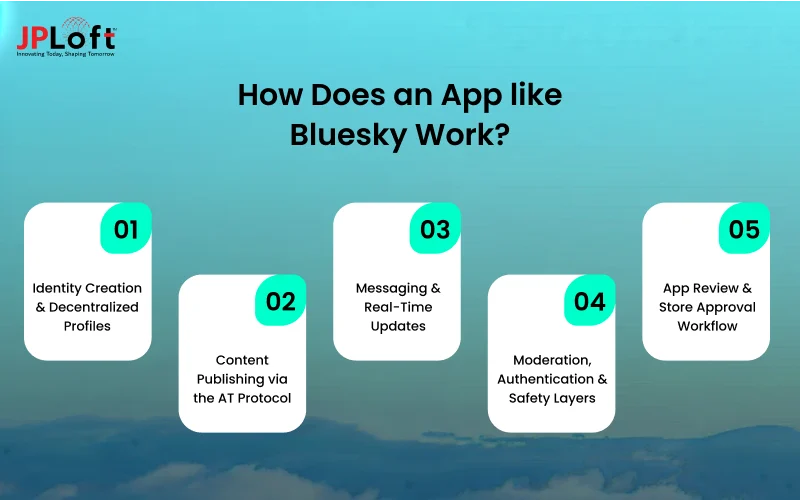
Its backend relies on open protocols, enabling transparency, portability, and seamless content sharing between networks.
1. Identity Creation & Decentralized Profiles
When understanding how to build an app like Bluesky, one of the foundational mechanisms is decentralized identity (DID). Users create portable profiles stored on distributed servers, allowing them to move accounts across platforms without losing followers or posts.
This ties directly into social media app features, where identity ownership and transferability are becoming crucial for modern platforms.
2. Content Publishing via the AT Protocol
To develop an app like Bluesky, the AT Protocol enables open data interchange, meaning posts aren’t restricted to one app.
It allows universal feed generation, cross-app content viewing, and algorithmic freedom. This structure also supports developers who want to extend platform capabilities or build interoperable services.
3. Messaging & Real-Time Updates
If you’re exploring how to develop a messaging app within a Bluesky-like architecture, real-time synchronization is key.
Messages and updates propagate through decentralized servers using lightweight APIs, ensuring efficient communication even across federated networks.
4. Moderation, Authentication & Safety Layers
A major component of how to make an app like Bluesky is establishing robust security. Here, social media app security plays a central role; apps must integrate layered authentication and AI-driven moderation to safeguard user activity.
Content filtering, and abuse detection further help maintain user trust in a permissionless environment.
5. App Review & Store Approval Workflow
If you intend to launch a decentralized platform on iOS, you must follow Apple’s strict guidelines. Knowing how to get your social media app approved on the iOS store is essential.
Developers must comply with UI standards, user-generated content policies, security rules, and data-handling requirements to ensure smooth app review and approval.
How Much Does it Cost to Build an App like Bluesky?
Building an app similar to Bluesky can typically cost between $20,000 and $100,000+, depending on the complexity of features, platform choice, and design requirements.
This price range covers everything from user interface creation to backend development, messaging systems, and security measures.
The cost to create an app like Bluesky is influenced by several key factors. Apps with advanced feed algorithms, real-time messaging, and robust moderation tools require more development time and technical expertise. If your goal is to launch a minimum viable product first, prioritizing core social media app development cost components can help manage the budget effectively.
High-quality mobile app design plays a significant role as well. Investing in intuitive UI/UX ensures users enjoy smooth navigation, which can reduce drop-offs and increase engagement.
Meanwhile, integrating features such as federated profiles and decentralized identity adds to the Bluesky-like app development cost but significantly improves scalability and user trust.
Even simple apps without complex AI or moderation tools will require careful planning to optimize costs while maintaining performance and security.
Considering all variables, understanding the cost to make an app like Bluesky becomes essential for proper project budgeting.
Cost Breakdown Table
|
App Type |
Description |
Estimated Cost Range |
|
Basic App |
Core posting features, simple profiles, basic feed, standard UI/UX |
$20,000 – $40,000 |
|
Mid-Level App |
Real-time messaging, better UI/UX, improved moderation, scalable backend |
$40,000 – $75,000 |
|
Advanced App |
Decentralized identity, federated protocols, advanced algorithms, AI-powered personalization |
$75,000 – $100,000+ |
Factors Impacting the Cost to Build an App like Bluesky
Understanding the major cost drivers is essential before estimating the cost to create an app like Bluesky.
Every technical, architectural, and design decision influences your total investment, whether you’re building a minimal MVP or a full-fledged decentralized social platform.
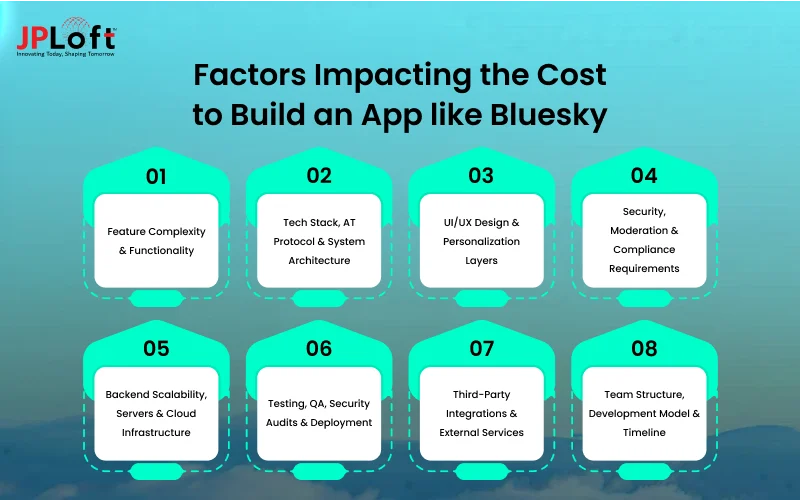
Below are the core factors that shape the total budget for Bluesky-type platforms.
1. Feature Complexity & Functionality
The number and sophistication of features, custom algorithmic feeds, decentralized identity (DID), federated moderation tools, user verification, content filtering, DMs, and advanced profile settings, heavily affect development effort.
Estimated Cost Range: $10,000 – $45,000
Feature-rich builds often face social media app development challenges, especially when implementing AT Protocol–based feeds or real-time data sync that requires advanced engineering. More personalization and dynamic content curation also increase the backend workload.
2. Tech Stack, AT Protocol & System Architecture
Your choice of programming languages, frontend frameworks, cloud hosting, GraphQL/REST APIs, and database engines (PostgreSQL, Cassandra, DynamoDB) directly impacts overall cost. For Bluesky-style apps, distributed architecture and federation add another layer of complexity.
Estimated Cost Range: $8,000 – $35,000
Scalable, decentralized architectures require expertise in peer-to-peer systems, protocol validation, and multi-server orchestration. These add time, engineering hours, and infrastructure planning.
3. UI/UX Design & Personalization Layers
User experience is a major cost driver. An app like Bluesky requires intuitive navigation, feed layouts, content cards, quick actions, onboarding flows, profile screens, and settings dashboards.
Estimated Cost Range: $7,000 – $20,000
Modern platforms increasingly leverage AI in social media to power interest-based feeds, content ranking, user similarity models, and recommendation systems, driving both design complexity and engineering integration costs.
4. Security, Moderation & Compliance Requirements
A public-facing social platform carries heavy security and moderation responsibilities. This includes encryption, spam filters, automated content flagging, bot detection, policy enforcement, and privacy controls.
Estimated Cost Range: $6,000 – $18,000
Apps must comply with GDPR, CCPA, Age-Appropriate Design Code, and regional data laws, which increases development time due to documentation, data handling rules, and privacy workflows.
5. Backend Scalability, Servers & Cloud Infrastructure
Scaling to thousands or millions of users requires strong backend architecture, load balancers, CDN layers, caching, microservices, and real-time sockets for notifications and messaging.
Estimated Cost Range: $7,000 – $30,000
Expect higher costs if your app requires multi-region hosting or rapid autoscaling during peak usage. Early infrastructure planning avoids future outages and ensures long-term sustainability.
6. Testing, QA, Security Audits & Deployment
A high-traffic social network must be thoroughly tested across devices, operating systems, and screen sizes. This includes regression testing, API validation, load testing, and moderation system QA.
Estimated Cost Range: $4,000 – $15,000
Deployment includes iOS/Android packaging, debugging, environment setup, CI/CD configuration, and App Store compliance checks.
7. Third-Party Integrations & External Services
Integrations such as analytics tools, push notifications, cloud storage, email services, content moderation APIs, and AI-based recommendation engines increase total cost.
Estimated Cost Range: $3,000 – $12,000
More integrations equal higher monthly operational expenses as well.
8. Team Structure, Development Model & Timeline
Whether you hire an agency, in-house team, or freelancers impacts cost significantly. Full-scale development teams with architects, UI/UX designers, developers, QA engineers, and PMs provide stronger outcomes but cost more.
Estimated Cost Range: $12,000 – $40,000
(Typically spread across multi-month development cycles)
Longer timelines increase labor hours, project management, and iterative testing costs.
Summary Table: Factors Influencing the Cost
|
Factor |
Estimated Cost Range |
|
Feature Complexity |
$10,000 – $45,000 |
|
Tech Stack & Architecture |
$8,000 – $35,000 |
|
UI/UX & Personalization |
$7,000 – $20,000 |
|
Security & Moderation |
$6,000 – $18,000 |
|
Backend Scalability |
$7,000 – $30,000 |
|
Testing & Deployment |
$4,000 – $15,000 |
|
Third-Party Integrations |
$3,000 – $12,000 |
|
Team & Timeline |
$12,000 – $40,000 |
A Brief on How to Build an App like Bluesky
Building a decentralized, scalable platform like Bluesky requires a structured development roadmap.
If you’re wondering how to develop an app like Bluesky?, here’s a simplified breakdown of the essential stages every founder should follow.
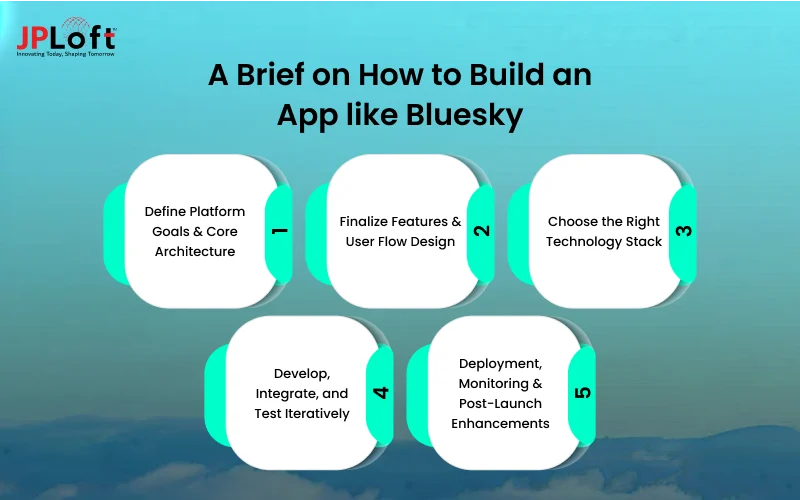
The goal is to help you Build an app like Bluesky with the right strategy, tools, and execution plan.
1. Define Platform Goals & Core Architecture
Begin by outlining your app’s purpose, public discussions, interest-based communities, or decentralized identity. Once the goals are defined, choose the architectural style (centralized, federated, or hybrid).
Federated platforms require strategic planning, especially when deciding data distribution, API structure, and scalability. Clear functional requirements also serve as the blueprint for the entire build process.
2. Finalize Features & User Flow Design
At this stage, list your must-have features: personalized feeds, user profiles, moderation tools, search, hashtags, and messaging. This flows into early prototypes and visual screens.
Understanding how to design a social media app becomes crucial here, as intuitive UI/UX encourages longer user engagement and reduces onboarding friction.
A well-crafted information hierarchy ensures users navigate effortlessly without cognitive load.
3. Choose the Right Technology Stack
Your development success heavily depends on picking the right frameworks, backend technologies, real-time systems, and cloud infrastructure.
Selecting an optimised mobile app tech stack helps manage performance, speed, and scalability, especially when supporting millions of interactions per minute.
This step influences both cost and technical stability, so engineering decisions should match long-term growth expectations.
4. Develop, Integrate, and Test Iteratively
After the architecture and tech stack are ready, developers start coding key modules: authentication, feed generation, posting system, real-time updates, and notifications.
This is followed by performance audits, QA cycles, usability checks, and compatibility testing across devices. Here, applying principles from social media app testing ensures your app meets industry-level reliability and security requirements.
5. Deployment, Monitoring & Post-Launch Enhancements
Once tested, the app moves to deployment on the App Store and Play Store. Continuous updates, bug fixes, and optimizations follow after initial launch.
A structured approach to mobile app maintenance helps ensure long-term stability, improved functionality, and reduced downtime as your community grows.
Strategies to Reduce the Overall Cost to Make an App like Bluesky
Minimizing development spending while still building a high-quality platform is fully achievable with a strategic plan.
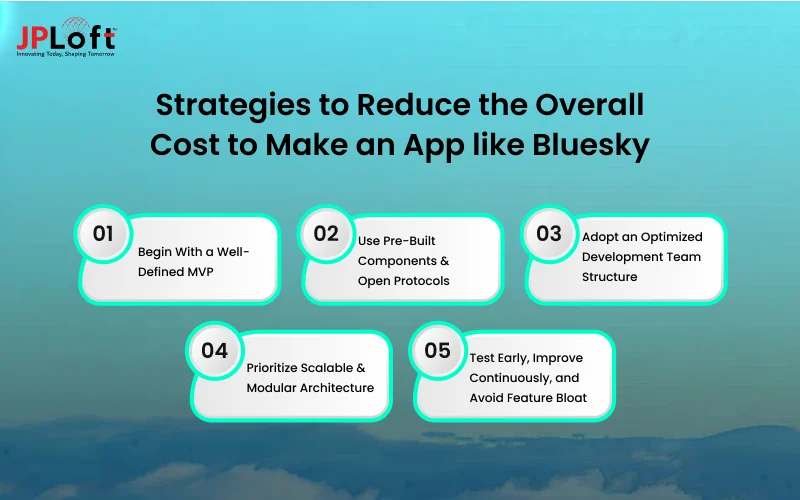
These proven methods help startups control the cost to make an app like Bluesky and speed up time-to-market, without cutting corners that affect product stability or user experience.
1. Begin With a Well-Defined MVP
Start by launching only the core essentials: user profiles, posting, feeds, moderation tools, and basic settings.
This controlled approach reduces engineering hours and lowers the cost to build a clone like Bluesky significantly.
MVPs also help validate user interest early, preventing unnecessary investment into features users may never use.
2. Use Pre-Built Components & Open Protocols
Instead of building every module from scratch, rely on reusable components, federated protocols, and open-source tools.
This reduces backend complexity and accelerates development cycles. Many early projects overspend due to overbuilding, one of the reasons why social media apps fail before reaching market adoption.
3. Adopt an Optimized Development Team Structure
A compact team with the right mix of frontend, backend, and QA specialists is more efficient than large, expensive teams.
Outsourcing specific tasks while keeping core development in-house helps bring down the cost to make a clone like Bluesky, especially for startups working with fixed budgets.
4. Prioritize Scalable & Modular Architecture
Choosing scalable backend and cloud infrastructure early reduces long-term expenses.
Modular code enables flexible upgrades, easier maintenance, and faster feature rollout, saving thousands of dollars that usually go into rewriting poorly structured systems later.
5. Test Early, Improve Continuously, and Avoid Feature Bloat
Frequent testing detects flaws early, and user feedback helps prioritize relevant features.
This prevents wasted development time and ensures that resources go toward high-value functionalities. Continuous optimization helps maintain a stable product without repeated development costs.
How to Monetize an App like Bluesky?
A well-structured revenue model is essential to recovering your Bluesky like app development cost and ensuring long-term sustainability. Here are some proven monetization strategies that align with decentralized and open social platforms.
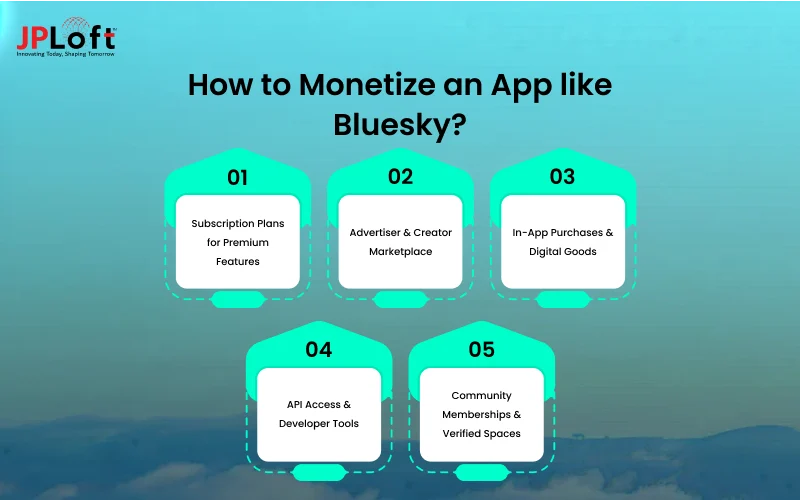
These models also reflect how leading platforms grow revenue, offering insights into how social media apps make money without disrupting user experience.
1. Subscription Plans for Premium Features
Introduce tiered subscription options that unlock advanced capabilities, enhanced profile tools, priority visibility, premium filters, analytics, or ad-free browsing.
Subscription models work well for platforms built on trust and privacy, giving users more control while generating consistent monthly revenue.
2. Advertiser & Creator Marketplace
Bluesky-like platforms are ideal for brand–creator collaborations because of their open algorithms and niche community spaces.
Offering sponsored posts, creator tools, or marketplace features helps brands reach targeted audiences. Revenue can be shared with creators to improve retention and platform growth.
3. In-App Purchases & Digital Goods
Sale of digital items, badges, themes, custom reactions, profile enhancements, or exclusive communities offers an easy revenue layer without overwhelming the user experience.
Such microtransactions also help early-stage startups create a clone like Bluesky that becomes financially self-sustaining faster.
4. API Access & Developer Tools
Decentralized platforms often attract developers building extensions, integrations, and bots.
Offering paid access to APIs, analytics dashboards, or developer utilities, powered by a scalable social media app tech stack, creates an additional revenue stream while promoting ecosystem growth.
5. Community Memberships & Verified Spaces
Users can pay for verified channels, private discussion groups, community badges, or “exclusive access” spaces.
This model promotes high-quality interactions and allows communities to self-regulate with premium perks, supporting platform stability and increasing user lifetime value.
Partner with JPLoft and Built Your App the Right Way
Building a powerful, scalable social platform requires the right expertise, and JPLoft, a leading social media app development company, is trusted by global brands.
Whether you want to build a clone like Bluesky with advanced features or plan to create an app like Bluesky with your own unique twist, our team delivers fast, secure, and high-performing solutions tailored to your vision.
From UI/UX design to backend engineering and post-launch support, we handle everything end-to-end, ensuring your product reaches the market with confidence.
Partner with JPLoft today and turn your idea into a world-class social platform that grows with your users.
Conclusion
Building a modern decentralized social platform requires thoughtful planning, the right tech approach, and a clear understanding of the investment involved.
Whether you’re creating a minimal MVP or a full-featured ecosystem, the cost to develop an app like Bluesky depends on design complexity, features, integrations, and long-term scalability needs.
With strategic development, smart budgeting, and expert guidance, businesses can significantly optimize the overall cost to make an app like Bluesky while still maintaining high performance and user experience standards.
If you’re ready to turn your concept into a reliable, scalable product, the next step is choosing a development partner who understands the platform, the technology, and your vision.
FAQs
Bluesky is a decentralized social networking platform built on the AT Protocol, which gives users more control over their data, content moderation, and algorithm choices. It’s trending because it offers an alternative to traditional centralized social media platforms.
The cost to build an app like Bluesky usually ranges between $20,000 and $100,000+, depending on factors like platform type (iOS, Android, Web), UI/UX complexity, backend architecture, decentralization requirements, real-time features, and engineering hours.
A basic MVP can take 3–5 months, while a fully featured decentralized app may require 8–12 months or more, depending on features, protocols, and scalability requirements.
Not necessarily. AT Protocol enables portability and openness, but you can choose other architectures or even a centralized model depending on your goals, budget, and timeline.
Maintenance includes server costs, updates, security improvements, and moderation tools. Generally, monthly maintenance ranges from 15–25% of the initial development cost.
Yes. Many founders launch with essential features and later integrate ads, subscriptions, premium features, or creator tools as their user base grows.

Conor has more than 10 years of experience in software development, app creation, solution engineering, and UX/UI design. With an impressive track record of high retention and growth working with Fortune 500 companies, he brings the technical depth and strategic perspective needed to help businesses build impactful, user-focused digital solutions.



Share this blog