


Key Takeaways:
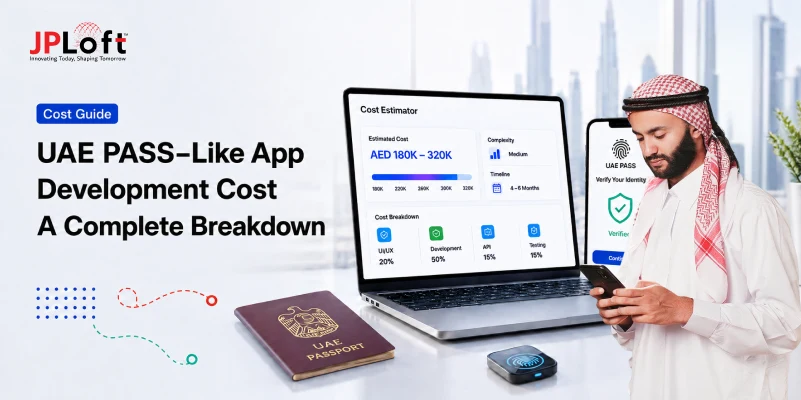
The cost to develop an app like UAE PASS can range from $20,000 to $180,000 (AED 70,000 to AED 650,000), based on features, security requirements, integrations, technology stack, development time, and overall app complexity.
Businesses can integrate UAE PASS using approved integration channels and APIs.
Biometric authentication adds an extra layer of security and convenience.
Identity verification, biometrics, digital signatures, and secure integrations are key APIs.
Digital identity apps require strong encryption, authentication, fraud protection, and compliance.
Cross-platform technologies can support UAE PASS-like apps on both iOS and Android.
Imagine logging into any government or private service in the UAE with a single tap, no passwords, no paperwork, just secure and instant access. That is the power UAE PASS has built, and millions of residents now trust it every day.
Businesses and investors across Dubai and beyond have taken notice. Digital identity is no longer a government-only concept; it is becoming a business opportunity.
This has led many founders to ask about the real UAE PASS like app development cost and whether building a similar solution is worth the investment.
A digital identity app like this can open doors across banking, healthcare, government services, and more, making it a smart move for forward-thinking businesses.
In this blog, you will learn what drives the price, which features matter most, and more.
Overview of UAE PASS App
UAE PASS is the national digital identity platform of the United Arab Emirates. It lets residents, citizens, and visitors prove their identity online with one secure profile.
Instead of juggling multiple logins, users get a single trusted pass accepted by government and private platforms alike.
Here is how it works:
-
Register and Verify Identity - Users create an account and complete the required identity verification process using their identification details.
-
Set Up Authentication - Users configure a PIN and available biometric options to securely access their digital identity.
-
Select UAE PASS - Users choose UAE PASS when accessing a participating government or private-sector digital service.
-
Approve Login - The app sends an authentication request, which users approve using their configured security method.
-
Authorize Data Sharing - Users review the requested identity information and authorize its sharing with the selected service.
-
Access the Service - After successful authentication, users can securely access the requested digital service.
-
Complete Digital Transactions - Users can complete supported activities, such as digitally signing eligible documents or approving requests.
This simple structure is exactly why so many businesses now want to build something similar for their own industry.
Key Features of a UAE PASS-Like App
Every successful digital identity app is built on a strong feature set. These core app features work together to keep the app secure, functional, and easy for users to trust.
1. User Registration & Login
Registration is the first step users take, so it must feel simple and quick. A smooth sign-up process using Emirates ID or mobile number verification builds early trust and reduces drop-offs during onboarding.
2. Digital Identity Verification
Identity verification confirms that a user is who they claim to be. This usually involves checking government-issued documents against official records, making sure only genuine users gain access to sensitive services.
3. Biometric Authentication
Biometric login replaces passwords with fingerprint or face scans, making access faster and far more secure. Since biometric data is unique to each person, it significantly reduces the risk of unauthorized access.
4. Facial Recognition
Facial recognition adds another layer of identity confirmation, especially useful during high-security actions like signing documents or approving transactions. It scans facial features and matches them against stored data in seconds.
5. Digital Signature
A digital signature allows users to approve documents online without printing or scanning anything. This feature alone can save businesses and individuals significant time on paperwork and official processes.
6. Document Upload & Storage
Users often need to store important documents like ID cards, certificates, or contracts. A secure upload and storage system keeps everything organized and accessible whenever needed.
7. QR Code Authentication
QR code login lets users access services quickly by scanning a code instead of typing credentials. It is especially useful for in-person verification at counters, kiosks, or partner locations.
8. Single Sign-On (SSO)
Single sign-on allows users to access multiple connected platforms using one login. Instead of creating separate accounts everywhere, they use their verified identity across banks, government portals, and partner apps.
How Much Does It Cost to Build An App Like UAE PASS?
The cost to build an app like UAE PASS typically ranges between $20,000 and $180,000 (AED 70,000 to AED 650,000). This wide range depends on how advanced your app needs to be.
A basic identity app with login and verification sits at the lower end, while a full-scale platform with biometric authentication, government API integration, and multi-service access pushes the cost higher.
However, the final cost to build a mobile app in Dubai depends on factors like design complexity, security layers, third-party integrations, and platform choice; all of which play a role. Businesses should treat this as an investment in trust and long-term user adoption, not just a one-time development expense.
|
App Complexity |
Features Included |
Estimated Cost |
|
Basic |
Registration, login, PIN/biometric access, basic profile |
AED 70,000 – AED 220,000 |
|
Intermediate |
Digital signature, document storage, government API integration |
AED 220,000 – AED 400,000 |
|
Advanced |
Multi-service access, AI fraud detection, enterprise-grade security, cross-platform sync |
AED 400,000 – AED 650,000 |
Factors Affecting the UAE PASS App Development Cost
Several moving parts shape the final cost to develop a mobile app. Understanding each one helps you plan a realistic budget and avoid surprises later.
Factor 1: Number of Features
More features mean more development hours. A simple login and profile system costs far less than an app with digital signatures, multi-service access, and document sharing. Each added feature increases both the design and testing workload, directly raising the overall budget.
|
Feature Level |
Examples |
Cost Impact |
|
Basic |
Login, profile, notifications |
Low |
|
Moderate |
Digital signature, document storage |
Medium |
|
Extensive |
Multi-service access, government integration |
High |
Factor 2: Security Requirements
A digital identity app handles sensitive personal data, so security cannot be an afterthought. Encryption, biometric checks, and fraud detection all add engineering time. The stronger the protection, the higher the cost, but this investment builds the user trust your app depends on.
|
Security Level |
Examples |
Cost Impact |
|
Standard |
PIN, password protection |
Low |
|
Enhanced |
Biometric login, encryption |
Medium |
|
Enterprise-grade |
AI fraud detection, multi-layer authentication |
High |
Factor 3: iOS & Android Development
Building for both platforms widens your reach but also increases cost. Native development for each platform takes more time than a single cross-platform build. Businesses often choose Flutter or React Native to save on both budget and development timelines.
|
Development Approach |
Platforms Covered |
Cost Impact |
|
Cross-platform |
iOS and Android together |
Lower |
|
Native (single) |
iOS or Android only |
Medium |
|
Native (both) |
iOS and Android separately |
Higher |
Factor 4: UI/UX Design
A clean, intuitive mobile app design keeps users comfortable sharing sensitive information. Basic templates cost less, while a custom, bilingual interface with smooth animations adds to the budget. Good design directly affects how much people trust and adopt your app.
|
Design Type |
Description |
Cost Impact |
|
Standard |
Pre-built templates, minimal customization |
Low |
|
Custom |
Brand-specific design, guided flows |
Medium |
|
Premium |
Bilingual, animated, highly interactive |
High |
Factor 5: Backend Architecture
The backend powers everything happening behind the scenes, from data storage to real-time verification. A scalable, secure backend costs more upfront but supports future growth. Weak backend planning often leads to expensive fixes later.
|
Backend Type |
Suitable For |
Cost Impact |
|
Basic |
Small user base, simple data needs |
Low |
|
Scalable |
Growing user base, moderate complexity |
Medium |
|
Enterprise |
Large-scale, high-traffic, regulated data |
High |
Factor 6: Third-Party API Integrations
Connecting to government systems, payment gateways, or banking APIs adds real functionality but also real cost. Each integration needs its own testing and approval process, especially when working with sensitive identity or financial data.
|
Integration Type |
Example |
Cost Impact |
|
Basic |
Maps, notifications |
Low |
|
Moderate |
Payment gateways |
Medium |
|
Complex |
Government APIs, banking systems |
High |
Factor 7: Arabic RTL Design
The UAE is a bilingual market, so right-to-left Arabic support is essential. This means redesigning navigation, flipping layouts, and running a separate testing cycle. Skipping this early and adding it later almost always costs more and increases English-Arabic app development challenges.
|
RTL Approach |
Description |
Cost Impact |
|
Basic translation |
Text-only Arabic support |
Low |
|
Full RTL layout |
Mirrored navigation, icons, forms |
Medium |
|
Retrofitted later |
Added after development is complete |
High |
Factor 8: Testing & Quality Assurance
Since the app deals with identity and sensitive data, thorough testing is non-negotiable. This includes security testing, performance checks, and usability testing across devices. Skipping proper QA can lead to costly bugs and security gaps after launch.
|
QA Level |
Coverage |
Cost Impact |
|
Basic |
Functional testing only |
Low |
|
Standard |
Functional and performance testing |
Medium |
|
Comprehensive |
Security, performance, and usability testing |
High |
How to Develop An App Like UAE PASS?
Building a digital identity app requires a structured approach from planning through launch. Following these steps ensures you build a mobile app that is secure, functional, and ready to earn user trust from day one.
Step 1: Define Business Requirements
Before writing any code, outline exactly what your app needs to achieve, who your target users are, and which industries you plan to serve. Clear requirements at this stage prevent costly changes later in development and keep the entire team aligned on the same vision.
-
Identify target users and real-world use cases
-
Define core features and long-term future scope
-
Set realistic budget, resources, and project timeline
Step 2: Plan Identity And Security Architecture
Since the app handles sensitive personal data, its architecture must be built around security from the very start. This step decides how data flows, gets stored, and stays protected across the entire system, shaping everything built afterward.
-
Choose encryption standards and secure storage methods
-
Design the authentication flow and access controls
-
Plan ahead for local data protection compliance
Step 3: Design UI/UX
Immersive UI/UX design services build user confidence in a security-focused app. This step focuses on making registration, verification, and daily use feel simple, especially for users unfamiliar with digital identity tools or biometric login systems.
-
Create app wireframes for all key user journeys
-
Design bilingual, right-to-left friendly interface layouts
-
Test usability early with real target users
Step 4: Integrate Identity And Verification APIs
This step connects your app to government databases, biometric verification tools, and other identity services. Proper integration ensures accurate, real-time verification without disrupting the user experience during sign-up, login, or document approval processes.
-
Connect Emirates ID and biometric verification APIs
-
Test API response accuracy, speed, and reliability
-
Handle errors and failed verifications gracefully
Step 5: Implement Security Controls
With the architecture in place, developers now build the actual app security features like encryption, biometric locks, and fraud detection. This step turns your earlier security plan into working, thoroughly tested protection layers across the app.
-
Add multi-factor authentication for sensitive actions
-
Implement real-time fraud monitoring and alerts
-
Encrypt data both in transit and storage
Step 6: Test The Application
Thorough app testing catches bugs, security gaps, and usability issues before real users ever encounter them. This step covers everything from basic functionality checks to how the app performs under heavy, real-world traffic conditions.
-
Run functional and performance testing cycles
-
Test across multiple devices and network conditions
-
Gather structured feedback through beta testing rounds
Step 7: Conduct Security Audits
An independent security audit checks for vulnerabilities that internal testing might easily miss. This step is especially important for identity apps, where even small security gaps can lead to serious, long-term consequences for users.
-
Perform detailed penetration testing sessions
-
Review compliance against data protection standards
-
Fix identified vulnerabilities before public launch
Step 8: Deploy The Application
Once testing and audits are complete, the app is finally ready for launch. This step involves final system checks, app store submissions, and making sure backend systems can comfortably handle real-world user traffic.
-
Submit the app to App Store & Play Store
-
Confirm backend scalability ahead of launch
-
Prepare rollback plans for unexpected emergencies
Step 9: Monitor & Maintain The Platform
Launch is not the finish line for a digital identity app. Continuous app maintenance services help catch issues early, while regular updates keep the app secure and aligned with changing regulations and evolving user expectations over time.
-
Track app performance and gather user feedback
-
Release regular security patches and feature updates
-
Stay compliant as regulations continue to evolve
Challenges in Building An App Like UAE PASS
Building a digital identity app comes with real technical and regulatory hurdles. Understanding these app development challenges early helps businesses prepare better and avoid costly setbacks.
Challenge 1: Protecting Sensitive Identity Data
Digital identity apps store highly personal information like Emirates ID details, biometric data, and documents. A single breach can damage user trust permanently and expose the business to serious legal and financial consequences.
Solution: Use end-to-end encryption and strict access controls throughout the app.
Challenge 2: Achieving High Authentication Accuracy
Biometric and facial recognition systems must work accurately across different lighting, devices, and user conditions. Even small errors in verification can lock out genuine users or, worse, let fraudulent access slip through unnoticed.
Solution: Hire AI developers to train recognition models on diverse, real-world testing datasets.
Challenge 3: Integrating Multiple External Systems
Connecting with government portals, banks, and third-party services involves different technical standards and approval processes. Delays or mismatches between systems can slow down development and create unreliable user experiences after launch.
Solution: Work with a trusted app development company to plan integrations early and test each connection thoroughly.
Challenge 4: Preventing Identity Fraud
Bad actors constantly look for ways to create fake identities or steal existing ones. Without strong safeguards, an identity app becomes an easy target, putting both users and the platform's reputation at serious risk.
Solution: Add AI-based fraud detection and multi-layer verification checks.
Challenge 5; Maintaining High Availability
Users expect instant access to their identity at any time, especially during urgent tasks like banking or government approvals. Downtime, even for a few minutes, can disrupt critical services and damage user confidence.
Solution: Hire app developers to use scalable cloud infrastructure with reliable failover systems.
Challenge 6: Managing Regulatory Requirements
Identity apps must comply with strict data protection laws and government approval processes, which vary across sectors. Missing a requirement can delay launch or result in penalties from regulatory authorities.
Solution: Work with legal experts familiar with UAE compliance standards.
Best Practices to Reduce UAE PASS-Like App Development Cost
Smart planning can significantly reduce the UAE PASS-like app development cost without cutting corners on quality. These best practices help businesses build a secure, reliable app while keeping the budget under control.
► Prioritize Essential Identity Features
Start with core features like registration, login, and verification instead of building everything at once. This keeps initial costs manageable and lets you launch faster, gathering real user feedback before investing in advanced additions.
► Use Cross-Platform Development
Building for iOS and Android together using frameworks like Flutter saves significant time and money. One codebase covers both platforms, reducing development hours while still delivering a smooth, native-like experience for users.
► Choose Existing APIs Where Appropriate
Instead of building every function from scratch, use trusted third-party APIs for tasks like document scanning or notifications. This cuts development time considerably while still maintaining the reliability your users expect.
► Use Scalable Cloud Infrastructure
Cloud platforms let you pay only for the resources you use, scaling up as your user base grows. This avoids overspending on infrastructure early on while keeping performance strong as demand increases.
► Build Integrations In Phases
Rolling out government or banking integrations gradually spreads out both cost and technical complexity. This phased approach allows your team to test, refine, and secure each integration before moving to the next.
► Plan Security From The Beginning
Adding security measures during initial development is far cheaper than fixing gaps later. Planning encryption, authentication, and compliance from day one avoids costly rework and protects user trust from the very start.
How does UAE PASS Like App Make Money?
A digital identity app is not just a service; it can also become a strong revenue stream. Here are the main app monetization models for businesses to monetize a UAE PASS-like platform.
1. B2B Subscription Plans
Businesses like banks, hospitals, and government partners can pay a recurring subscription to access identity verification services. This creates a steady, predictable income stream while giving partner companies a reliable way to verify users at scale.
2. Pay-Per-Verification Model
Some companies prefer paying only when they use the service. Charging a small fee per identity check, document verification, or biometric scan allows flexible pricing that grows naturally with partner usage.
3. API Usage Fees
Developers and businesses integrating your identity system into their own apps can be charged based on API calls made. This turns your backend infrastructure into a scalable, ongoing source of revenue.
4. Enterprise Licensing
Large organizations often want a customized, white-labeled version of the app for internal use. Offering enterprise licensing packages allows you to charge higher fees for tailored features, dedicated support, and exclusive access.
5. Digital Signature Charges
Since digital signatures carry legal weight, businesses are often willing to pay per signed document or through a monthly bundle. This feature alone can become a strong, recurring source of income.
6. Premium Business Features
Offering advanced tools like priority verification, detailed analytics, or dedicated account support as a paid upgrade provides businesses with greater value while adding another consistent revenue stream to the platform.

Why Choose JPLoft for UAE PASS Clone App Development?
Building a digital identity app is not a task for just any team. It demands proven expertise in security, compliance, and seamless user experience. JPLoft brings exactly that combination to the table.
As a trusted mobile app development company in Dubai, JPLoft understands the local market, regulatory landscape, and what it truly takes to earn user trust in a UAE PASS-like platform.
Our team specializes in biometric authentication, secure API integrations, and scalable architecture built to handle sensitive identity data with confidence.
From the first consultation to post-launch support, we focus on transparent communication and realistic timelines. Every project is handled by developers experienced in fintech, government-grade security, and cross-platform development.
If you are ready to turn your vision into a secure, reliable identity platform, JPLoft is the partner built to help you get there.
Final Words
Building an app like UAE PASS is a significant investment, but the returns in trust, efficiency, and market positioning make it worthwhile for forward-thinking businesses.
From understanding the UAE PASS-like app development cost to knowing the key features, challenges, and revenue models, you now have a complete picture of what this journey involves.
The right approach combines careful planning, phased development, and a strong focus on security from day one. With the UAE's digital identity space growing rapidly, businesses that act now stand to gain a real competitive edge.
If you are ready to build an app like UAE PASS, partnering with an experienced, security-focused development team makes all the difference.
The right guidance today can turn this opportunity into a secure, scalable reality for years to come.
FAQs
The cost to create an app like UAE PASS typically ranges from $20,000 to $180,000 (AED 70,000 to AED 650,000), depending on features, security requirements, integrations, and overall app complexity chosen for development.
Yes, businesses can integrate UAE PASS through approved APIs after TDRA approval, allowing users to log in and verify identity using their existing UAE PASS credentials securely.
Biometric authentication is not mandatory but highly recommended. It replaces passwords with fingerprint or face recognition, offering faster, more secure access for daily identity verification.
Key APIs include Emirates ID verification, biometric authentication, digital signature services, document management, and secure government or banking system integrations for identity confirmation.
Extremely secure. It requires end-to-end encryption, multi-factor authentication, fraud detection, and strict compliance with data protection regulations to safeguard sensitive personal information.
Yes, using cross-platform frameworks like Flutter or React Native, businesses can build one codebase that runs smoothly on both iOS and Android devices.

Priyanka Sukhwal is the Managing Director and Business Head of JPLoft, with 10+ years of experience in technology, digital product strategy, and business growth. She has worked closely with businesses building mobile applications, custom software, marketplaces, and on-demand platforms across mobility, automotive, consumer services, and startup ecosystems. At JPLoft, she focuses on understanding business models, identifying product opportunities, and helping companies plan digital solutions that can scale with changing market needs.




Share this blog