


Key Takeaways:
Plan carefully, launch a focused MVP, and work with an experienced team to build your Dubai app smoothly.
The development cost of a mobile app in Dubai ranges from AED 55,000 and AED 734,000+, depending mainly on complexity, platform, and features.
Competition, compliance, localization, and store approvals are common challenges, but early planning and expert support keep them manageable.
Subscriptions, freemium, in-app purchases, commissions, ads, and licensing are proven ways to earn from your Dubai app.
Strong mobile use, government support, and a growing startup scene make Dubai a smart choice for app investment.
Dubai moves fast, and so do its customers. Within a few taps, they order food, book rides, pay bills, and shop from their phones.
For a startup or growing business, that habit is a big opportunity. But a great idea alone is not enough.
If you plan to develop a mobile app in Dubai, you need a clear path, a realistic budget, and a team that understands this market.
Many founders lose time and money by starting to build before they plan. Others pick the wrong platform or ignore local rules.
This guide helps you avoid those mistakes. You will learn the key steps, costs, legal points, and smart choices that matter in 2026, all explained in simple words.
Whether you are a founder, CTO, or product manager, you will finish with an actionable plan.
How to Develop a Mobile App in Dubai? Step-Wise Process
For successful mobile app development, you need a clear plan. Following proper steps helps save time, control costs, and launch a product that fits what Dubai users expect.
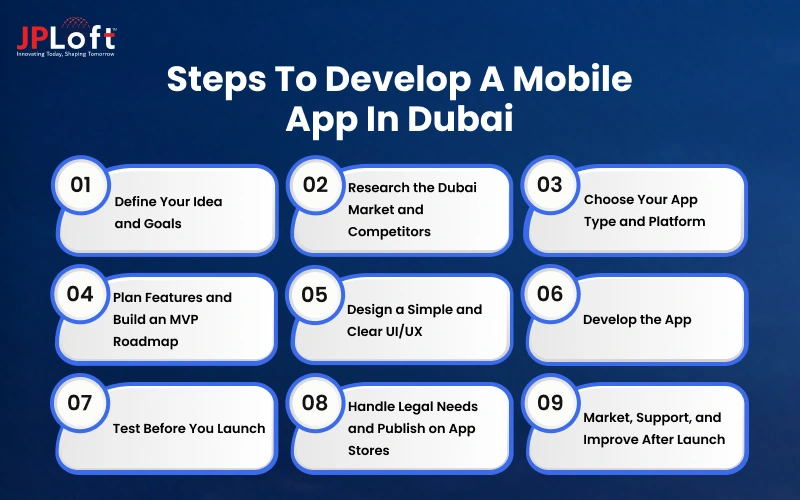
Step 1: Define Your Idea and Goals
Every strong app starts with a clear problem. Write down who your users are, what trouble they face, and how your mobile app idea solves it.
Then set simple goals, such as the number of downloads, monthly revenue, or user retention.
Talk to a few real people in your target group and ask what they need. This early step keeps your budget safe because it stops you from building features that nobody wants.
Step 2: Research the Dubai Market and Competitors
Dubai users are diverse, so study them well. If you want to know how to create a mobile app in Dubai that people actually use, begin with local research.
Do proper market research for apps that lead your category, read their reviews, and note what users complain about.
Look at pricing, languages, payment options, and how often rivals update their apps. These gaps show you where your app can stand out and win trust.
Step 3: Choose Your App Type and Platform
Next, decide where your app will live. Android and iOS both have a strong base in the UAE, but many startups launch on one platform first to save money.
Native apps give better speed, while cross-platform apps cut cost and time. Pick the option that fits your budget and audience.
Check this with real market data. Before you create a mobile app in Dubai, confirm which phones your users prefer.
Step 4: Plan Features and Build an MVP Roadmap
List every feature you want, then split them into must-have and nice-to-have. Your first version, called an MVP, should hold only the must-haves.
Common core features include sign-up, search, payments, push alerts, and a simple dashboard.
Set a clear timeline and budget for this first release, and keep enough room for later upgrades and user feedback.
Step 5: Design a Simple and Clear UI/UX
Good design keeps users coming back. Start with simple app wireframes that show each screen and how users move between them.
Choose trusted UI/UX design services to build a clean, easy design with clear buttons, short forms, and readable text. Test your design with a few real users early.
When you build a mobile app in Dubai, support right-to-left layout for Arabic, and follow Apple and Google design rules so approval goes smoothly in both stores.
Step 6: Develop the App
Now your team starts coding. Development usually has three parts: the front end that users see, the back end that runs the logic, and APIs that connect them.
Consider the best mobile app development companies in Dubai to pick tools that match your app size. Work in short sprints of two weeks, and review progress after each one.
Use secure code and cloud hosting from the start. Regular demos help you catch problems early and keep the project on track.
Step 7: Test Before You Launch
App testing protects your reputation. Check every feature, screen, and payment flow on real phones, not only on simulators.
Test speed, security, and battery use too. Any mobile app development guide in Dubai you consider should stress testing on many devices, because your users will use different phones and software versions.
Run a small beta with real users, collect feedback, and fix bugs before the public launch. This step saves costly fixes later.
Step 8: Handle Legal Needs and Publish on App Stores
Before launch, get your legal base ready. Register the business, hold the right trade licence, and follow the UAE's data protection law when you collect user data.
Then create developer accounts on the Apple App Store and Google Play. Prepare clear screenshots, a strong app description, and a privacy policy.
Store review can take a few days, so submit early and carefully plan your launch date around the approval window.
Step 9: Market, Support, and Improve After Launch
Launch is the start, not the finish. If you are asking how to build a mobile app in UAE that keeps growing, plan for support from day one.
Track downloads, crashes, and reviews every week. Fix bugs fast and release regular updates with new features based on what users say.
Promote the app through app store optimization, social media, and local partnerships, then scale servers as your user base grows.
Features to Add During Mobile App Development in Dubai
The right mobile app features decide whether users stay or leave. Dubai users expect fast, secure, and smart apps, so choose features that match their habits and your goals from the start.
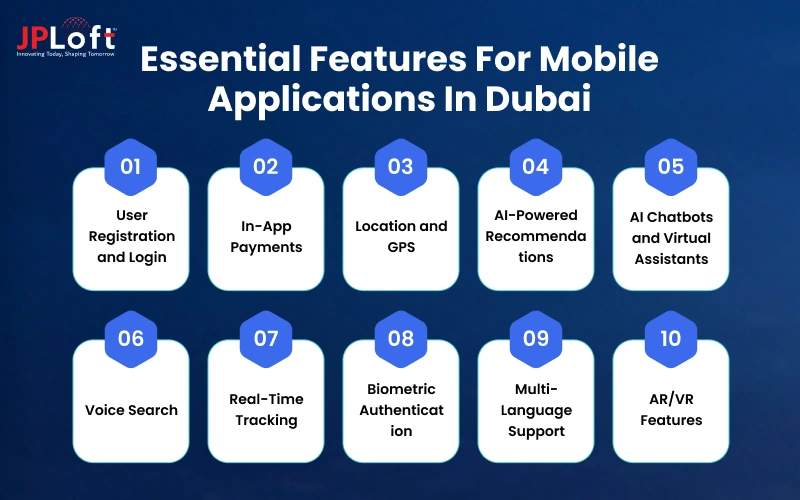
1. User Registration and Login
Registration is the first step every user takes, so offer simple sign-up with email, phone number, or social accounts. Add one-time codes for safe access.
2. In-App Payments
Payments turn visitors into paying customers. Support cards, Apple Pay, Google Pay, and local wallets so users can pay in a few taps.
Use trusted gateways and encrypted data, and follow card security rules to protect every transaction.
3. Location and GPS
Location features help apps show nearby offers, stores, and services. They are key for delivery, ride, travel, and real estate apps in a busy city like Dubai.
Always ask for permission and explain why you need it.
4. AI-Powered Recommendations
AI studies what users view, search, and buy, then suggests items, content, or offers they may like.
This makes each screen feel personal, raises engagement, and helps lift repeat orders in shopping, media, and food apps.
5. AI Chatbots and Virtual Assistants
When you develop a mobile app in Dubai, add a chatbot that answers common questions at any hour.
Virtual assistants can also book appointments, track orders, and hand tough cases to a human agent, which cuts support costs.
6. Voice Search
Voice search lets users find products or services by speaking instead of typing, which feels quick and natural.
It saves time, helps users on the move, and works well when the app also understands Arabic and English commands.
7. Real-Time Tracking
Real-time tracking shows live updates on orders, rides, deliveries, or assets on a map.
Users feel in control, and businesses can plan routes, cut delays, and send alerts when status changes. It needs fast servers and steady data syncing.
8. Biometric Authentication
If you make a mobile app in UAE that handles money or private data, biometric login adds strong protection.
Fingerprint and face unlock are fast, easy, and harder to steal than passwords, so users feel safe.
9. Multi-Language Support
Dubai is home to people from many countries, so language matters. Offer at least Arabic and English, and add more based on your audience.
Support right-to-left layout, local date and currency formats, and clear translated text.
10. AR/VR Features
AR and VR let users view products in their space or take virtual tours before they decide.
They suit real estate, retail, tourism, and education apps in Dubai. Start small, since these features can add cost.
How Much Does it Cost to Create a Mobile App in Dubai?
The cost to make a mobile app in Dubai usually ranges from AED 55,000 to AED 734,000+ ($15,000 to $200,000+), depending on scope.
However, if you plan to build a mobile app in Dubai, set your budget around app complexity first.
Below, we will differentiate the overall cost to develop a mobile app in Dubai on the basis of how complex your app gets.
|
App Complexity |
Cost |
Cost |
What It Includes |
|
Basic |
15,000 - 40,000 |
55,000 – 147,000 |
Static screens, simple flows |
|
Mid-level |
40,000 - 120,000 |
147,000 – 441,000 |
Real-time data, dashboards, multiple user roles |
|
Advanced |
120,000 - 200,000+ |
441,000 – 734,000+ |
AI logic, complex workflows, scalability planning |
Factors Affecting the Overall App Development Cost
-
App features and complexity: Real-time tracking, AI, and multiple user roles need more effort, and the cost to hire app developers in Dubai varies with app complexity.
-
Platform choice: One platform costs less than iOS and Android together, while cross-platform sits in between.
-
UI/UX design: Custom layouts, animations, and user testing raise the design budget.
-
Backend and integrations: Servers, APIs, payment gateways, and maps add build and testing time.
-
Security and compliance: Fintech and healthcare apps need stronger protection and regulatory checks.
-
Timeline: Tight deadlines need bigger teams, which pushes cost up.
-
Maintenance: Budget yearly for bug fixes, OS updates, and support after launch.
Hidden costs like localization, store rejections, and scaling can also add up, so keep a buffer.
Challenges to Develop a Mobile App in Dubai
Developing a mobile app in Dubai requires more than attractive design and useful features. Businesses must address security, local regulations, language preferences, payments, and platform requirements.
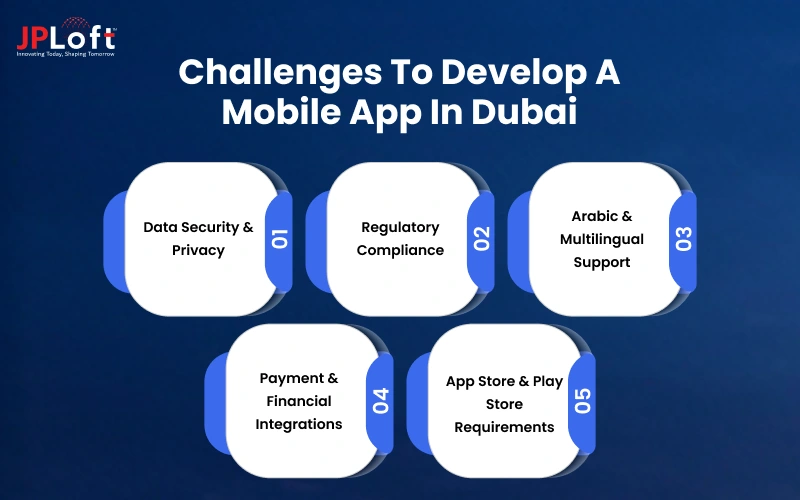
Below, we will discuss common mobile app development challenges most businesses face today.
Challenge 1: Data Security & Privacy
Mobile apps handle sensitive user information, including names, contact details, payment data, and location. Weak security can expose this information to unauthorized access, data breaches, and misuse, reducing user trust and creating serious business risks.
Solution: Use encryption, secure authentication, access controls, regular security testing, and protected cloud infrastructure to safeguard user and business data.
Challenge 2: Regulatory Compliance
Apps operating in Dubai must consider applicable UAE laws and industry-specific requirements. Compliance can become complex when apps collect personal data, process payments, or operate in regulated sectors such as healthcare, finance, and insurance.
Solution: Identify applicable regulations early and build privacy, consent, data handling, and security requirements directly into the development process.
Challenge 3: Arabic & Multilingual Support
Dubai serves a diverse population with users from different linguistic backgrounds. Apps that overlook Arabic support may create usability issues, especially when text direction, layouts, navigation, and translated content require proper right-to-left implementation.
Solution: Design multilingual interfaces from the start, support Arabic and English, and test right-to-left layouts across devices.
Challenge 4: Payment & Financial Integrations
Many Dubai apps depend on digital payments for purchases, bookings, subscriptions, or service transactions. Integrating payment gateways can involve security requirements, transaction failures, multiple payment methods, and compatibility with the app’s backend.
Solution: Choose reliable AI app development companies in UAE to use secure APIs, apply transaction encryption, and thoroughly test payment flows before launch.
Challenge 5: App Store & Play Store Requirements
Publishing an app requires compliance with Apple App Store and Google Play policies. Apps can face delays or rejection because of privacy issues, inaccurate information, inappropriate content, payment practices, or incomplete store requirements.
Solution: Review current platform guidelines, prepare accurate store information, complete privacy requirements, and test the app before submission.

Why Choose JPLoft for Seamless Mobile App Development In Dubai?
JPLoft is a trusted mobile app development company in Dubai that helps startups and growing brands turn ideas into scalable products.
With 16+ years of industry experience and 1,250+ successful projects delivered, the team knows what it takes to deliver apps that perform in real markets.
Our process covers product strategy, UI/UX design, architecture planning, development, testing, and launch support.
If you are still unsure how to develop a mobile app in Dubai within your budget, we share a detailed roadmap, a preliminary cost estimate, a timeline breakdown, and a risk overview before you commit. Your idea stays protected under an NDA from day one.
Choose JPLoft for clear communication, secure and scalable builds, and ongoing support after launch.
Partner with a trusted development partner in Dubai that treats your goals as its own. Book a free consultation today and start building.
Conclusion
Dubai gives founders a strong market for new apps, backed by high mobile use, strong government support, and a fast-growing startup scene.
Success, however, still depends on clear planning, not luck. This mobile app development guide in Dubai walked you through the full path: researching the market, choosing a platform, designing, building, testing, and launching.
Your budget will depend on complexity, platform, design, security, and team skill. Start with a focused MVP, add smart features like secure payments, AI, and Arabic support, and plan for hidden costs and ongoing maintenance.
The right development partner makes all of this easier. With a skilled team, clear goals, and a realistic budget, your idea can steadily grow into an app that earns user trust and delivers real, lasting value in Dubai's fast-moving digital market.
FAQs
To make a mobile app in Dubai, start with market research, define a focused MVP, pick the right platform, design for Arabic and English, test on real devices, and partner with an experienced team to launch smoothly.
The overall app development cost in Dubai usually ranges from AED 55,000 to AED 734,000+ ($15,000 to $200,000+). The final price depends mainly on app complexity, platform, design, security needs, integrations, testing, team expertise, and maintenance.
Common challenges include high competition, strict data and compliance rules, Arabic and English localization, store approval delays, and finding skilled developers. Early planning and an experienced partner reduce these risks.
Popular models include subscriptions, freemium with paid upgrades, in-app purchases, commission on transactions, advertising and sponsored listings, and enterprise licensing. Choose the one that matches your audience and app type.
Dubai offers near-universal mobile use, strong government support, a fast-growing startup scene, and a UAE app market forecast to reach US$7,993.6 million by 2033, giving new apps strong growth potential.

Priyanka Sukhwal is the Managing Director and Business Head of JPLoft, with 10+ years of experience in technology, digital product strategy, and business growth. She has worked closely with businesses building mobile applications, custom software, marketplaces, and on-demand platforms across mobility, automotive, consumer services, and startup ecosystems. At JPLoft, she focuses on understanding business models, identifying product opportunities, and helping companies plan digital solutions that can scale with changing market needs.



Share this blog