


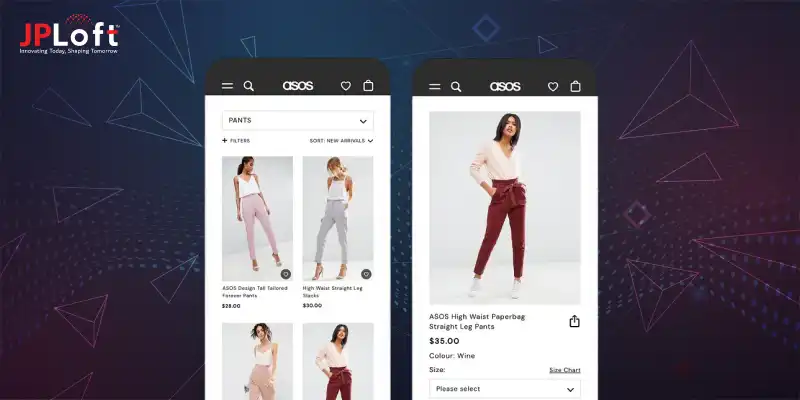
Key Takeaways
Building an app like ASOS helps fashion brands tap into the UK’s fast-growing mobile commerce market while creating direct customer relationships and repeat revenue.
Knowing how to build an app like ASOS starts with market research, MVP planning, and feature prioritization that matches real user shopping behavior.
Advanced features like AI recommendations, visual search, and personalization improve engagement, reduce churn, and increase average order value.
A scalable tech stack and secure architecture ensure long-term performance, compliance, and smooth growth as user demand increases.
Flexible monetization models such as subscriptions, commissions, and sponsored listings unlock multiple revenue streams beyond product sales.
The UK fashion technology market is projected to reach $28.8 billion by 2030, driven by mobile-first shopping habits and rising demand for personalized fashion experiences.
Apps like ASOS have set new standards for convenience, discovery, and engagement, making fashion commerce one of the most attractive digital opportunities in the UK.
So, how to build an app like ASOS?
It starts with understanding user behavior, defining the right feature set, choosing a scalable tech stack, and executing the development process with precision.
For entrepreneurs, an ASOS-like app opens doors to direct customer relationships, brand loyalty, and recurring revenue. For investors, it offers strong returns backed by a fast-growing market and scalable digital infrastructure.
This blog will walk you through the complete process, features, tech stack, cost, and monetization strategy needed to build an ASOS-style app in the UK.
All About the ASOS App & Related Market Statistics
ASOS is a leading British online fashion and cosmetics retailer that has completely revolutionized the way millennials and Gen Z shop for clothing, accessories, and beauty products.
At ASOS (short for As Seen On Screen), users can get fresh pieces daily with exclusive ranges that they cannot find anywhere else. Here, the new brands are being added all the time, including free delivery and returns. Additionally, wherever and whoever you are, exploring the style can never feel this good.
The company launched its iPad app in August 2011, and in March 2014, a dedicated shopping app for Android devices and a U.S version for iOS were released.
At the Play Store, the app has approximately 10M+ downloads. Along with this, the app has stood out as the most popular online shop in the UK.
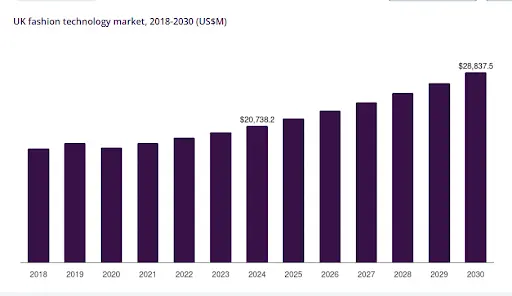
The fashion technology market in the UK is expected to reach a projected revenue of US$28,837.5 million by 2030. It is growing at a CAGR of 5.7%, which is expected of the UK fashion technology market from 2025 to 2030.
Well, apart from this, there are many reasons to switch to building an app like ASOS in the UK. Let’s learn them all in the following section.
Why Create an App like ASOS?
You can develop an app like ASOS because the online fashion market is growing in the UK, offer a seamless experience to the user, maximize revenue, leverage advanced features, and much more.
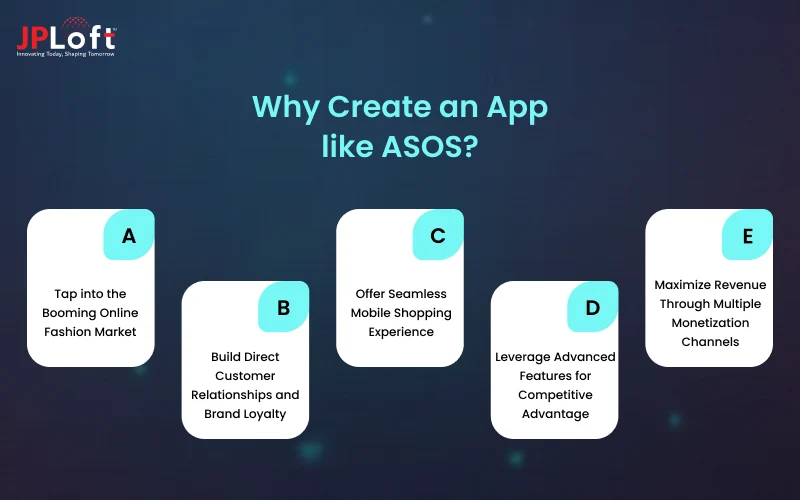
Let’s evaluate the complete list of reasons below.
1. Tap into the Booming Online Fashion Market
The global online fashion retail market is experiencing exponential growth, with consumers increasingly preferring digital shopping over traditional brick-and-mortar stores.
The global e-commerce market in the UK is expected to grow US$ 115,439.6 million by 2030. Hence, when you tap into the market, it will help you to contribute on a large and vital level.
2. Build Direct Customer Relationships and Brand Loyalty
A dedicated fashion app eliminates intermediaries, enabling you to establish direct relationships with customers and gather valuable data about their preferences, behaviors, and purchase patterns.
This direct connection allows for personalized marketing, exclusive app-only deals, and loyalty programs that foster repeat purchases. Therefore, you should invest in building direct customer relationships when you consider to create an app like ASOS.
3. Offer Seamless Mobile Shopping Experience
Mobile apps provide superior user experiences compared to mobile websites, with faster load times, intuitive navigation, offline capabilities, and personalized interfaces optimized for smartphone shopping.
Fashion consumers increasingly browse and purchase on the go, making a well-designed app essential for capturing impulse purchases. It does offer a seamless mobile shopping experience; hence, investing in such apps is a great idea.
4. Leverage Advanced Features for Competitive Advantage
Fashion apps enable innovative features like visual search, virtual try-ons using AR technology, AI-powered style recommendations, and social shopping integrations that aren't feasible on traditional e-commerce websites.
These advanced capabilities differentiate your platform from competitors, enhance user engagement, and reduce user churn rates. Therefore, it can be stated that investing in an app like ASOS is a crucial aspect when we go for implementing advanced features.
5. Maximize Revenue Through Multiple Monetization Channels
Apps like ASOS generate revenue not only through product sales but also through premium memberships, sponsored brand placements, affiliate partnerships, and data-driven advertising opportunities.
The app ecosystem supports subscription models for exclusive benefits, commission-based marketplace operations for third-party brands, and targeted promotional campaigns that create multiple income streams beyond traditional retail margins.
Now, as you are ready to hire mobile app developers in the UK, let's proceed with the diversified features that can be included when you create an app like ASOS, within the following section.
Features to Include in an App like ASOS
The diversified features that can be included in an app like ASOS are an effective user interface, visual fitting rooms, stylish user interface, social integration, and quick as well as secure checkout.
Hire a mobile app developer who is well aware of the fashion industry and knows the effective features that you can add to an app like ASOS.
Let’s discuss the complete list of features in the table mentioned below.
|
Feature |
What It Does |
|
User Registration & Profiles |
Allows users to sign up, save preferences, manage addresses, and track orders from a single dashboard. |
|
Advanced Product Search |
Enables fast discovery using keywords, filters, categories, brands, sizes, and price ranges. |
|
Smart Product Recommendations |
Suggests products based on browsing history, past purchases, and real-time user behavior. |
|
Visual Search |
Lets users upload photos to find similar fashion items, reducing friction in product discovery. |
|
Wishlist & Favorites |
Allows users to save items for later, increasing repeat visits and purchase intent. |
|
Real-Time Inventory Tracking |
Shows accurate stock availability by size and color to avoid failed or delayed orders. |
|
Personalized Home Feed |
Displays curated collections, trending items, and offers tailored to individual users. |
|
Secure In-App Payments |
Supports multiple payment methods with encryption for fast and safe checkouts. |
|
Order Tracking & Notifications |
Provides real-time updates on order status, shipping progress, and delivery timelines. |
|
Easy Returns & Refunds |
Simplifies return requests and refund tracking, building trust and reducing drop-offs. |
|
Ratings & Reviews |
Allows customers to share feedback, helping others make confident purchase decisions. |
|
Push Notifications |
Sends alerts for discounts, restocks, cart reminders, and order updates at the right moment. |
Now, after evaluating the features, let’s learn the definite process to include them in an app, as well as how to proceed with the complete development sequence in the following section.
How to Make an App like ASOS in the UK?
Building an app is not a robot science; however, it is one of the crucial aspects that you cannot overlook if you are entering a competitive industry.
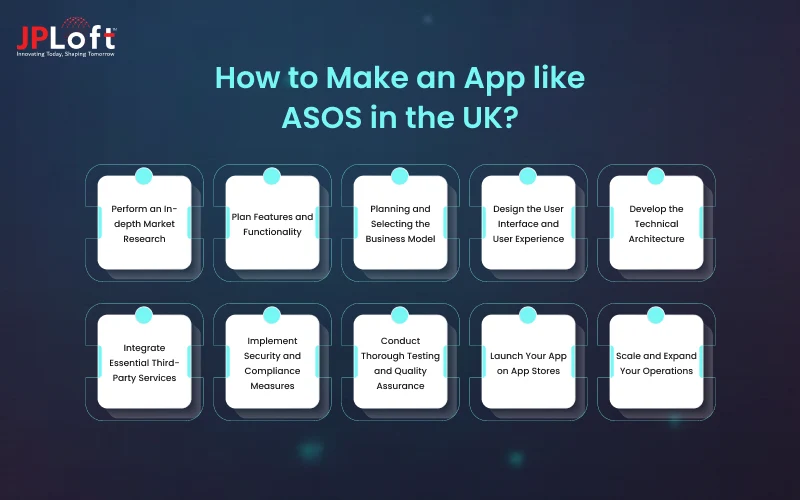
Let’s check out the complete process to create an app like ASOS in the UK in this section.
Step 1: Perform an In-depth Market Research
Well, when it comes to proceeding without market research, you can fail, or have a wide risk of failure in this AI era.
It's important to begin with market research and to understand the UK fashion e-commerce landscape to effectively launch your app. This will be helpful to learn about the users in detail, their journey mapping, buyer personas, and much more.
Apart from this, it is crucial to define what kind of audiences you can target, and analyze the competitors, comprising of ASOS, Boohoo, Zara, and others. It is crucial to understand the customer pain points, shopping behaviors, and preferences, which help you develop a differentiated offering that stands out in the crowded market.
Step 2: Plan Features and Functionality
Now, the second step is to plan features and functionality successfully. You should list down all essential and advanced features of your app. Here, the core features should comprise user registration and, product catalog with advanced search filters.
Along with this, the advanced features that can be included are visual search using AI< virtual try-on with AR technology, personalized recommendations, and much more.
When you evaluate the features, it is important to create a detailed user journey map showing how customers will navigate from app launch through product discovery, and more.
Step 3: Planning and Selecting the Business Model
Decide whether you'll operate as an inventory-based retailer (buying and selling your own stock like ASOS's private label), or a hybrid model combining both approaches.
Determine your pricing strategy, shipping policies, return policies, and membership options (free vs. premium with benefits like faster delivery).
Consider additional revenue streams such as sponsored product placements, brand partnerships, affiliate marketing, and subscription services. Your business model directly impacts technical requirements, logistics infrastructure, and legal obligations in the UK market.
Step 4: Design the User Interface and User Experience
This step is all about developing the mobile app wireframes and creating the prototypes that show up layout, navigation flow, and visual design before the development begins.
Apart from this, you should focus on initiative navigation, visually appealing product displays with high-quality images. This is the first impression of the user with the app, hence it is required to be effective and engaging.
It is important to conduct usability testing with potential users to identify pain points and refinement opportunities. You should be very sure that the design works seamlessly across the different device sizes and follows iOS and Android platform design guidelines for a native feel.
Step 5: Develop the Technical Architecture
It is important to create a robust technical foundation comprising frontend, backend, and admin panel for business management. When you develop an app like ASOS, it's crucial to select the top technologies that will support your features.
Build a robust technical foundation, including frontend (mobile apps for iOS and Android), backend (server, databases, APIs), and an admin panel for business management.
Choose an appropriate technology stack for native development (Swift for iOS, Kotlin for Android) for best performance, or cross-platform frameworks (React Native, Flutter) for faster development and cost efficiency.
Step 6: Integrate Essential Third-Party Services
Another crucial step to not overlook is the integration of third-party services or apps. Here, you should evaluate all the essential external services that can be integrated into the app to enhance the functionality and operational efficiency.
It is important to identify what are the crucial third-party services that you can integrate into your app. Here, you can integrate shipping providers for order fulfillment and tracking, payment gateways for ensuring secure transactions, and email and SMS services for customers.
Along with this, you should integrate diversified social media platforms that help users to share products and sign in with social accounts. When you build an app like ASOS in the UK, it's essential to go through different types of third-party services that you should integrate with the app.
Step 7: Implement Security and Compliance Measures
In this step, you should consider the security parameters. The mobile app security is all about protecting the sensitive user data from any kind of breaches, malware, and cyberattacks, which preserve user trust, prevent financial loss, and help to ensure privacy.
Here, you can proceed with including GDPR for data protection, PCI DSS for payment security, and the consumer protection laws that govern online retail.
Along with this, you should comply with the UK and EU regulations, including GDPR regulations for data protection. Apart from this, you should include SSL encryption in your app with secure authentication and regular security audits.
Step 8: Conduct Thorough Testing and Quality Assurance
In this step, you should conduct thorough mobile app testing along with quality assurance. Here, it is crucial to perform functional testing by ensuring all features work correctly, with usability testing to identify experience issues, and performance testing.
Along with this, you should test edge cases like network failures, low storage scenarios, that handle large order volumes.
Perform beta testing with a limited user group to gather feedback and identify issues that are missed during internal testing.
Step 9: Launch Your App on App Stores
Prepare for launch by creating compelling app store listings with engaging descriptions, high-quality screenshots, preview videos, and keyword optimization for discoverability.
Submit your app to Apple App Store, publish your app to Google Play Store, or you can select the cross-platform scope, following their respective guidelines and review processes, which typically take several days to weeks.
Ensure compliance with app store policies regarding content, functionality, and business practices. After this, you should plan a launch marketing campaign, including social media announcements, influencer partnerships, etc., to make an app like ASOS in the UK.
Step 10: Scale and Expand Your Operations
As your user base grows, focus on scaling infrastructure to handle increased traffic and transaction volumes without performance degradation. Expand your product catalog based on popular categories and customer requests, potentially adding new fashion segments, beauty products, or accessories.
Consider geographic expansion beyond the UK to other European markets or globally. Introduce advanced features like subscription boxes, personal styling services, or sustainable fashion initiatives that differentiate your platform.
Build strategic partnerships with fashion brands, logistics providers, and payment services that enhance your value proposition. Continuously invest in technology improvements, customer experience enhancements, and operational efficiency to maintain a competitive advantage in the evolving fashion e-commerce landscape.
Now, as you are aware of the steps to build an app like ASOS in the UK, let's learn in-depth about the tech stack in the following section.
Tech Stack to Include in an App like ASOS
The mobile app tech stack is all about a combination of programming languages, databases, frameworks, tools, and services that lead to building an app like ASOS.
Here is a complete list of tech stacks that you can include when it comes to ASOS-like app development., lets list them all in the table below.
|
Tech Stack Component |
Technology & Purpose |
|
Frontend (Mobile App) |
React Native / Flutter – Builds high-performance iOS and Android apps from a single codebase. |
|
Frontend (Web) |
React.js / Next.js – Delivers fast, SEO-friendly product browsing and smooth user interactions. |
|
Backend |
Node.js / Django – Handles APIs, business logic, user data, and real-time operations reliably. |
|
Database |
PostgreSQL / MongoDB – Stores user profiles, orders, product catalogs, and behavioral data efficiently. |
|
Cloud Infrastructure |
AWS / Google Cloud – Ensures scalability, uptime, and global performance during traffic spikes. |
|
Search & Filtering |
Elasticsearch – Powers fast product search, filters, and autocomplete at scale. |
|
Payments |
Stripe / PayPal – Enables secure, global payment processing with fraud protection. |
|
Authentication |
OAuth 2.0 / Firebase Auth – Manages secure user login and account access across devices. |
|
AI & Recommendations |
Python + ML Models – Drives personalized recommendations, pricing insights, and demand prediction. |
|
Analytics |
Firebase Analytics / GA4 – Tracks user behavior, conversions, and in-app engagement. |
|
Notifications |
Firebase Cloud Messaging – Sends real-time order updates, offers, and cart reminders. |
|
DevOps & CI/CD |
Docker + GitHub Actions – Automates testing, deployment, and version control for faster releases. |
After considering the complete tech stack, let's evaluate the overall cost to make an app like ASOS in the following section.
What’s the Cost to Make an App like ASOS?
The cost to develop an app like ASOS can vary from $15,000 to $80,000+. This cost can vary depending on different aspects such as the complexity of features, UI/UX design, tech stack, and much more.
Let’s cover and explain the complete cost in the table below.
|
Cost Factor |
Estimated Cost Range |
Cost Impact Explanation |
|
App Complexity & Core Features |
$6,000 – $20,000 |
Basic shopping flows cost less, while advanced filters, wishlists, and personalization increase scope. |
|
Platform Selection (iOS / Android) |
$3,000 – $10,000 |
Single-platform development is cheaper; dual-platform builds raise effort and testing costs. |
|
UI/UX Design |
$2,500 – $8,000 |
Custom fashion-centric layouts, animations, and branding require more design hours. |
|
Backend & API Development |
$4,000 – $15,000 |
Scalable APIs, real-time inventory, and order management increase backend complexity. |
|
AI & Recommendation Engine |
$4,000 – $12,000 |
Personalization, smart suggestions, and sizing logic significantly raise development cost. |
|
Payment & Security Integration |
$2,000 – $6,000 |
Multiple payment gateways, encryption, and compliance add to setup costs. |
|
Third-Party Integrations |
$1,500 – $5,000 |
Shipping, analytics, CRM, and marketing tools increase integration effort. |
|
Testing & Quality Assurance |
$1,500 – $4,000 |
Cross-device testing and performance checks reduce long-term risk. |
|
Maintenance & Scalability Setup |
$1,000 – $5,000+ |
Cloud hosting, monitoring, and future scalability add ongoing expenses. |
Now, as we consider the overall cost to build an app like ASOS, let’s proceed ahead with the diversified monetization strategies to include in an app like ASOS, in the following section.
Monetization Strategies to Make an App like ASOS
Different monetization strategies that can be included in an app like ASOS are subscription plans, paid app downloads, in-app purchases, in-app advertising, and many others.
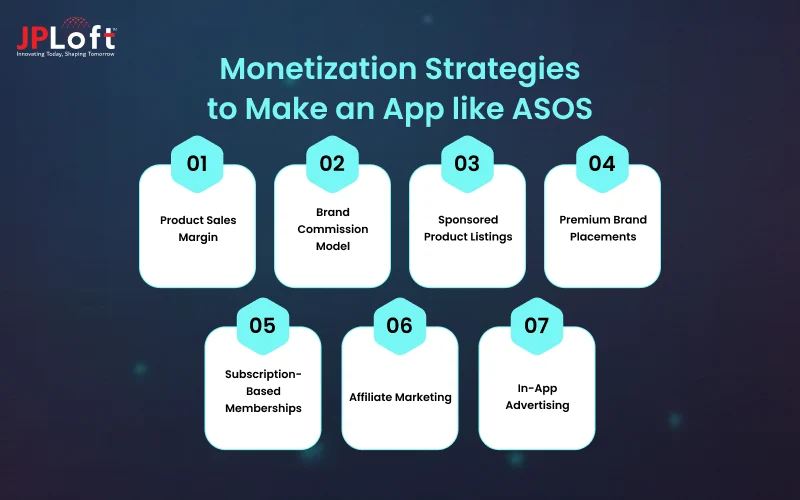
Let’s learn the details of mobile app monetization strategies to include in ASOS-like app development in this section.
1. Product Sales Margin
Revenue comes from the markup between manufacturing or sourcing costs and the final selling price of fashion items. Hence, you can include this monetization model by considering the markup price and selling price, developing a marketplace like ASOS.
2. Brand Commission Model
Partner brands pay a commission on each successful sale, allowing revenue to scale directly with platform order volume. While creating an app like ASOS, you can consider this for the local suppliers or merchants.
3. Sponsored Product Listings
Brands pay for higher placement in search results, category pages, and curated collections to boost visibility. As a marketplace app like ASOS, you can charge the brands for listing them in your app.
4. Premium Brand Placements
Exclusive homepage banners or featured sections are sold to brands for fixed or recurring promotional fees. For the premium brand placements, you can charge a high amount.
5. Subscription-Based Memberships
Recurring income is generated through paid plans offering benefits like free shipping, early access, and member-only deals. It is an important monetization model when it comes to creating an app like ASOS.
6. Affiliate Marketing
The app earns referral fees by directing users to external fashion, beauty, or lifestyle partners. This can be an additional source of revenue generation when you build an app like ASOS in the UK.
7. In-App Advertising
Targeted ads are shown based on user behavior, browsing patterns, and purchase history to maximize ad revenue. fIn-App advertising is all about displaying paid ads to reach engaging users.
How JPLoft can Help You build Your Dream App like ASOS?
When you decide to build an app like ASOS, its essential to look forward to a company that can understand your vision.
JPLoft helps founders turn ambitious fashion app ideas into scalable, revenue-ready products built for real users. From discovery to deployment, the team focuses on clean UX, strong performance, and features that actually drive conversions, not vanity additions. Every app is designed with personalization, smart search, secure payments, and future growth in mind.
As a trusted mobile app development company in the UK, JPLoft understands regional user behavior, compliance standards, and global fashion commerce trends. The team works closely with you to define the right MVP, control costs, and launch faster without cutting corners. Post-launch, JPLoft supports optimization, scaling, and feature expansion so your app can compete confidently with platforms like ASOS in a demanding market.
Conclusion
Building an app like ASOS in the UK is not just about replicating features; it is about creating a fast, personalized, and scalable fashion experience that users return to daily.
With the UK fashion tech market growing steadily, brands that invest in strong UX, AI-driven discovery, secure infrastructure, and flexible monetization gain a clear edge.
From market research and MVP planning to tech stack selection and post-launch scaling, every step matters.
When executed with the right strategy and technology partner, an ASOS-like app can evolve into a powerful digital commerce platform with long-term growth potential.
FAQs
The development cost typically ranges from $15,000 to $80,000+, depending on feature complexity, platforms, UI/UX depth, AI integration, and scalability needs.
Start with market research, define features, build an MVP, design user-focused UI, develop a scalable backend, integrate payments and logistics, test thoroughly, then launch and scale.
On average, it takes 4 to 8 months to complete research, design, development, testing, integrations, and app store deployment.
Essential features include advanced product search, AI recommendations, visual search, secure checkout, order tracking, easy returns, and push notifications.
AI is optional but highly effective for personalization, visual search, trend prediction, and improving user engagement and conversions.
Yes. Startups can compete by targeting niche fashion categories, offering better personalization, faster UX, and differentiated brand experiences.

Priyanka Sukhwal is the Managing Director and Business Head of JPLoft, with 10+ years of experience in technology, digital product strategy, and business growth. She has worked closely with businesses building mobile applications, custom software, marketplaces, and on-demand platforms across mobility, automotive, consumer services, and startup ecosystems. At JPLoft, she focuses on understanding business models, identifying product opportunities, and helping companies plan digital solutions that can scale with changing market needs.



Share this blog