


Key Takeaways
Poor maintenance affects app store ratings through crashes, slow performance, and unresolved bugs, leading to user frustration and negative reviews.
Even one bad experience can trigger emotional reactions, causing users to leave low ratings rather than silently uninstalling the app.
Delayed fixes and recurring issues signal neglect, resulting in harsh reviews, reduced trust, and declining app credibility over time.
App store algorithms favor stable, well-maintained apps, so poor ratings directly hurt discoverability, organic installs, and growth.
Regular updates, performance monitoring, compatibility checks, and proactive testing help maintain stability, user trust, and high ratings.
With proactive maintenance, performance optimization, and user-focused updates, JPLoft helps businesses prevent rating drops and build long-term app success.
Ever noticed how quickly users abandon an app after just one bad experience? In today’s competitive app ecosystem, even a small technical glitch can turn loyal users into harsh critics.
This is where poor maintenance affects app store ratings more than most businesses realize. Crashes, slow loading times, outdated features, and unresolved bugs directly influence how users perceive your app and how they rate it.
App store ratings are no longer just feedback, they are powerful trust signals that impact visibility, downloads, and long-term growth. When maintenance is ignored or delayed, negative reviews start piling up, pushing your app down the rankings.
In this blog, we’ll break down how poor maintenance affects app store ratings and share practical strategies to prevent rating drops caused by performance and usability issues.
Understanding App Store Ratings & User Psychology
App store ratings and reviews are a direct reflection of how users feel about an app, not just how it functions. Most users don’t leave reviews when everything works fine but the moment they face frustration, they react emotionally.
A crash during checkout, a slow-loading screen, or a feature that suddenly stops working triggers disappointment, and that emotion often turns into a low rating. This is where the impact of app maintenance on ratings becomes clearly visible.
From a user’s perspective, recurring mobile app performance issues signal neglect. Users subconsciously associate poor performance with a lack of professionalism, security risks, and unreliability. Even a well-designed app can lose credibility if updates are inconsistent or bugs remain unresolved.
Over time, these experiences shape user behavior, leading to negative reviews, quick uninstalls, and reduced trust. That’s why a well-planned mobile app maintenance guide is essential.
Consistent maintenance reassures users that the app is reliable, responsive, and actively supported, encouraging positive ratings and long-term engagement.
How Poor Maintenance Affects App Store Ratings?
Nowadays, users expect stability, speed, and consistency from the very first interaction. When these expectations are not met, dissatisfaction builds quickly, and this is exactly where app maintenance plays a critical role.
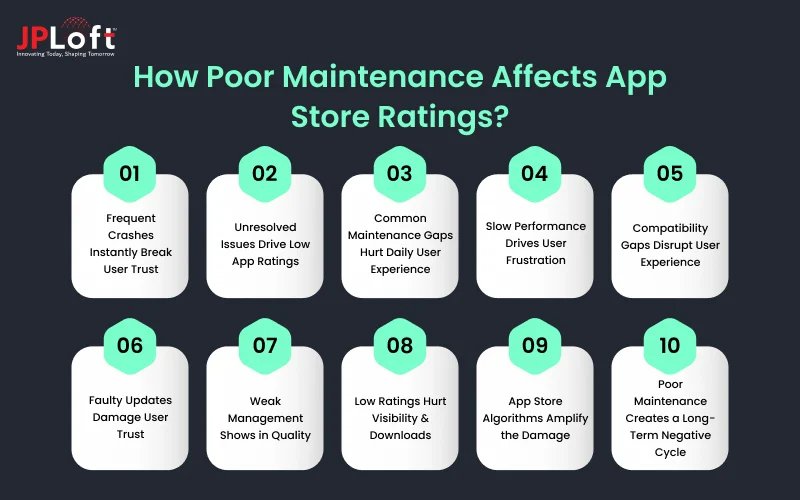
Understanding the specific ways poor maintenance impacts user perception helps explain why ratings drop so rapidly and why recovery becomes difficult without proactive action.
1. Frequent Crashes Instantly Break User Trust
One of the clearest ways poor maintenance affects app store ratings is through frequent technical failures. When users experience app crashes and bugs, especially during important actions like login, payments, or content access, frustration sets in immediately.
These interruptions damage the mobile app user experience, making users feel the app is unreliable.
Over time, recurring crashes indicate deeper app stability issues, which push users to express their dissatisfaction through low ratings rather than giving the app another chance.
2. Unresolved Issues Drive Low App Ratings
Many users genuinely wonder why apps get low ratings despite offering good features. The answer often lies in unresolved problems that persist across multiple versions.
These unresolved issues quickly turn into the most common reasons for negative app reviews, as users feel ignored when their problems remain unfixed.
When maintenance is delayed, frustration builds, and users are far more likely to leave a one-star review than wait for improvements.
3. Common Maintenance Gaps Hurt Daily User Experience
Several common app maintenance mistakes, such as delayed updates, broken features, and outdated UI elements, directly impact usability.
These gaps result in app bugs affecting user experience, including unresponsive buttons, incorrect data display, or features that fail unexpectedly.
Even small glitches repeated frequently can make users feel that the app lacks quality and care, leading them to rate it poorly.
4. Slow Performance Drives User Frustration
Performance plays a critical role in user satisfaction. Persistent slow app performance issues, such as long loading times or laggy transitions, make apps feel outdated and inefficient.
Users expect speed and smoothness, and when these expectations aren’t met, patience runs out quickly. In many cases, businesses choose to hire iOS app developers to optimize performance, reduce latency, and ensure smooth transitions across devices.
Over time, unresolved performance problems become a recurring complaint in reviews and significantly drag down app store ratings.
5. Compatibility Gaps Disrupt User Experience
Without regular maintenance, apps start facing app compatibility issues across devices, screen sizes, and operating system versions. An app that works well on one phone but crashes or malfunctions on another creates inconsistency.
This inconsistency leads to a poor app user experience, as users expect uniform performance regardless of their device.
Such experiences often result in low ratings, even if the app performs well on certain platforms.
6.Faulty Updates Damage User Trust
Updates are meant to improve apps, but poor mobile app testing can lead to app crashes after updates, which frustrates users even more than existing bugs.
When users install an update expecting improvements and instead face new issues, trust erodes quickly.
These negative experiences often lead to immediate rating drops and harsh reviews criticizing the app’s reliability.
7. Weak Management Shows in Quality
Poor maintenance often points to ineffective app quality management. Users may not understand technical details, but they easily sense when an app feels neglected.
Inconsistent updates, repeated issues, and lack of improvements create a perception that quality is not a priority.
This perception strongly influences how users rate the app, regardless of its core idea or features.
8. Low Ratings Hurt Visibility & Downloads
There is a strong impact of low app ratings on downloads, as users rely heavily on star ratings before installing an app. Even a small drop in ratings can discourage new users, reducing organic installs significantly.
This low app ratings impact not only affects downloads but also increases marketing costs, as businesses need to spend more to attract users.
Partnering with the best mobile app development company can help ensure consistent updates, performance optimization, and proactive maintenance, protecting your app’s ratings and maximizing visibility.
9. App Store Algorithms Amplify the Damage
App store algorithms favor apps with high engagement, stability, and positive reviews. When maintenance is neglected, the impact of app maintenance on ratings becomes more severe, as lower-rated apps lose visibility in search results and category rankings.
Reduced visibility means fewer impressions, fewer installs, and slower overall growth. Over time, this creates a compounding effect, low ratings lead to poor discoverability, which in turn leads to fewer downloads and even harsher reviews.
Consistent maintenance is essential not just for user satisfaction but also to stay competitive within the app store ecosystem.
10. Poor Maintenance Creates a Long-Term Negative Cycle
Ultimately, poor maintenance affects app store ratings by creating a cycle of frustration, negative reviews, and declining visibility. As ratings drop, fewer users download the app, feedback becomes harsher, and recovery becomes harder.
Using a structured mobile app maintenance checklist helps businesses stay on top of updates, bug fixes, performance optimizations, and compatibility issues, preventing this negative cycle.
Without consistent maintenance, even a well-designed app risks losing credibility, users, and long-term success in an increasingly competitive app market.
In summary, app store ratings are not influenced by a single bug or update but by the overall maintenance experience users encounter over time.
Consistent app maintenance ensures reliability, trust, and performance, while neglect creates frustration and negative reviews.
Real-World Scenarios: How Maintenance Failures Lead to Rating Drops
From glitches to slow performance, real users are quick to express frustration through reviews, showing that poor maintenance affects app store ratings in tangible ways.
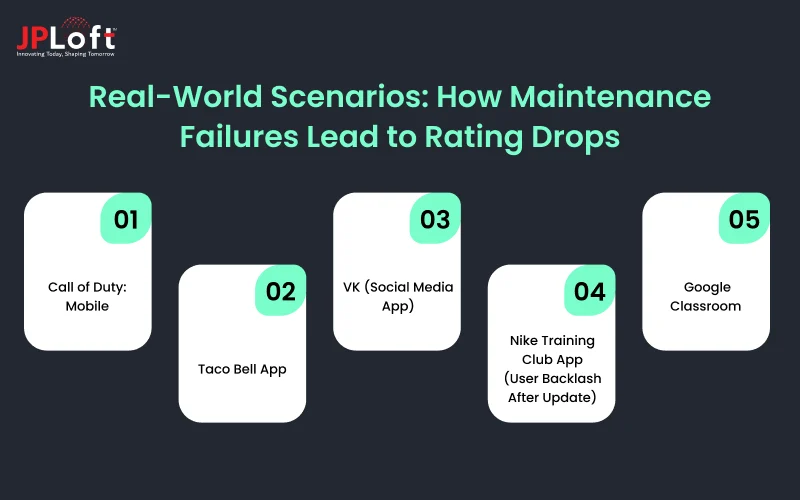
The examples below highlight some well-known apps that faced rating challenges and how proactive maintenance helped them recover.
A] Call of Duty: Mobile
It is one of the most popular gaming apps globally, becoming notorious in 2024 for frequent stability issues and glitches. Players reported crashes and glitches that made critical gameplay moments frustrating, resulting in a flurry of negative reviews and lower star ratings on both Apple App Store and Google Play Store.
It highlights the clear link between mobile app performance issues and user dissatisfaction. However, after addressing these issues through timely updates, optimized performance, and robust bug fixes, the app has bounced back spectacularly.
Today, this app is consistently ranking among the top-grossing and most downloaded games worldwide, proving that strong maintenance can restore user trust and ratings.
B] Taco Bell App
The Taco Bell food ordering app has been repeatedly listed among the buggiest apps, with users complaining that the app fails to place orders, freezes at checkout, or refuses to load properly.
Such persistent technical problems contribute to a poor app user experience and a barrage of low ratings, showing how even big brands can suffer when maintenance lags. After revamping the app, it now provides a seamless ordering experience and enjoys high user ratings.
C] VK (Social Media App)
VK, a widely used social media platform in several regions, ranks among the apps with the most reported bugs per 1,000 reviews. Users frequently mention login errors, freezes, and navigation issues, classic signs of app bugs affecting user experience.
Through consistent maintenance, performance optimization, and user feedback integration, VK has stabilized its platform and regained user trust. Today, it continues to remain a leading social media network in several countries, showing how proper maintenance can turn ratings around.
D] Nike Training Club App (User Backlash After Update)
After a major update to the Nike Training Club app, users expressed frustration over lost popular features and a less intuitive interface, which many felt degraded the app experience.
This led to a noticeable shift in review sentiment and lower ratings on app store pages, when poorly maintained or tested, can trigger rating drops. But, after carefully redesigning the interface, restoring fan-favorite features, and addressing app stability issues, it has bounced back with strong positive reviews.
E] Google Classroom
While not always due to maintenance faults, Google Classroom has maintained consistently low user ratings in certain regions and periods, with users reporting bugs and usability concerns.
Then, with ongoing updates, performance improvements, and regular user support, Google Classroom has strengthened its platform and is now trusted by millions of students and teachers globally.
These real-world scenarios clearly demonstrate that timely updates, bug fixes, and performance optimization are not optional, they are essential for maintaining user trust and high ratings.
Whether it’s gaming, social media, food delivery, or education, apps that invest in consistent maintenance see restored visibility, higher downloads, and stronger user loyalty.
Proven Maintenance Strategies to Keep App Ratings High
Maintaining high app ratings isn’t about luck, it’s about consistent, strategic actions that improve performance, user experience, and reliability.
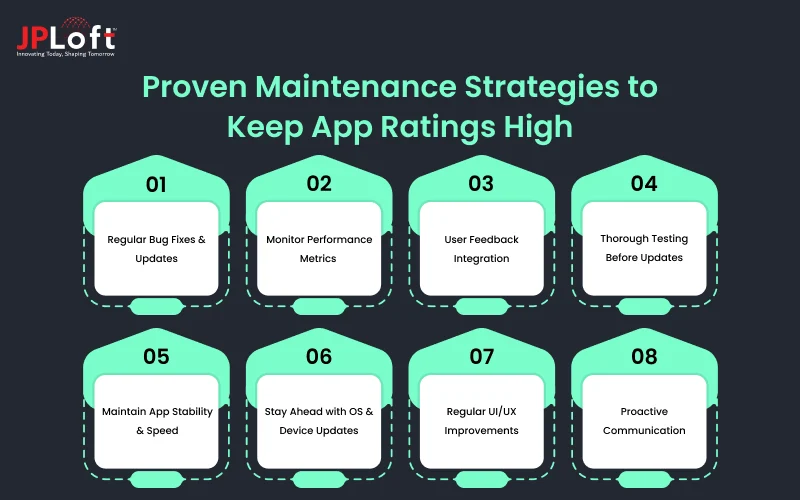
Here are some proven strategies every app owner should follow:
1. Regular Bug Fixes & Updates
Frequent updates to fix app crashes, bugs, and slow performance issues show users that the app is actively maintained.
Regular updates keep the app compatible with new OS versions and devices, preventing app compatibility issues that can frustrate users and lower ratings.
2. Monitor Performance Metrics
Track app performance through analytics tools to detect mobile app performance issues early.
Monitoring crashes, load times, and user engagement metrics allows developers to act proactively before minor issues escalate into reasons for negative app reviews.
3. User Feedback Integration
Collect and analyze app store ratings and reviews regularly. Address user complaints promptly and implement features that users request.
This builds trust and ensures the app evolves according to actual user needs, reducing poor app user experience.
4. Thorough Testing Before Updates
Every update should undergo extensive testing for functionality, compatibility, and performance.
This prevents app crashes after updates and ensures smooth operation across devices, which directly protects ratings.
5. Maintain App Stability & Speed
Optimize backend processes, improve server response times, and reduce slow app performance issues.
Stable and fast apps enhance the mobile app user experience, encouraging positive reviews and higher star ratings.
6. Stay Ahead with OS & Device Updates
Ensure your app is compatible with the latest OS updates and a variety of devices.
Address app compatibility issues proactively to prevent frustration and negative reviews.
7. Regular UI/UX Improvements
A visually appealing, intuitive, and responsive interface keeps users engaged.
Avoid poor app user experience by continuously improving design, navigation, and usability. Happy users are more likely to leave positive ratings.
8. Proactive Communication
Inform users about upcoming features, updates, or temporary downtime.
Transparent communication builds trust, prevents misunderstandings, and reduces negative reviews stemming from common maintenance issues.
By following these proven maintenance strategies, businesses can safeguard their app’s reputation, prevent rating drops, and maximize user satisfaction.
Consistent maintenance transforms apps from merely functional to highly reliable, keeping users happy and ratings high.

Partner with JPLoft to Maintain App Performance, Ratings & User Trust
Partnering with JPLoft ensures your app stays fast, stable, and highly rated in an increasingly competitive app marketplace. Our expert-led mobile app maintenance services are designed to proactively identify performance issues, eliminate bugs, and optimize app functionality before users are affected.
From regular updates and performance monitoring to compatibility testing and security enhancements, JPLoft focuses on maintaining a seamless user experience that protects your app’s ratings and reputation.
We closely analyze user feedback, app analytics, and store reviews to implement improvements that directly impact retention and satisfaction.
With a proven maintenance-driven approach, we help businesses prevent rating drops, build long-term user trust, and ensure their app consistently meets evolving user and platform expectations.
Final Wrap-Up
App ratings are a direct reflection of how well an app is maintained over time. As real-world examples show, even popular apps can suffer rating drops when bugs, crashes, or poor updates go unchecked, clearly proving how poor maintenance affects app store ratings.
Consistent maintenance, proactive monitoring, and timely improvements are no longer optional; they are essential for long-term success.
By prioritizing regular updates and performance optimization, companies can protect user trust, improve retention, and ensure their apps continue to deliver value in a highly competitive digital landscape.
In the long run, well-maintained apps not only earn higher ratings but also achieve stronger visibility, sustained growth, and lasting user loyalty.
FAQs
Poor maintenance affects app store ratings by leading to crashes, bugs, and slow performance, which frustrate users and trigger negative reviews, lower ratings, and reduced app visibility.
Apps should be updated regularly to fix bugs, improve performance, and stay compatible with OS and device changes.
Yes, timely bug fixes, performance optimization, and user-focused updates can restore trust and improve ratings.
Frequent crashes, slow loading times, compatibility issues, and poorly tested updates are the most common problems.
They ensure app stability, improve user experience, prevent rating drops, and support long-term app growth.

Yashwant Sharma is the CTO of JPLoft, with 18+ years of experience in software engineering, solution architecture, and digital innovation. His expertise spans scalable application development, AI-powered systems, RAG solutions, cross-platform development, software maintenance, and emerging mobility technologies such as EV and EV-charging platforms. He works across complex technical environments to help businesses build secure, maintainable, and high-performing digital products for industries including education, fitness, aviation, and healthcare.



Share this blog