


Is your restaurant losing revenue, customers, and valuable time just because everyday operations still depend on manual processes?
The pressure is real: in the National Restaurant Association's 2026 State of the Restaurant Industry report, 42% of operators reported being unprofitable, and 60% reported softer customer traffic.
As a restaurant owner, you need to manage rising operating costs, changing customer expectations, staff coordination, and service quality without affecting profitability. This is where technology in the restaurant industry is making a real difference.
From digital ordering systems and AI-powered tools to smart kitchen equipment and automated inventory management, technology is changing how restaurants operate and serve customers.
These solutions can help you reduce manual work, improve order accuracy, control expenses, and make better business decisions.
However, adopting technology is not just about following trends. It is about finding practical ways by partnering with a restaurant app development company to solve business challenges, improve customer experiences, and create new growth opportunities.
In this guide, you will see 10 ways technology used in restaurants helps you cut costs and serve guests faster.
How Is Technology Transforming the Restaurant Industry?
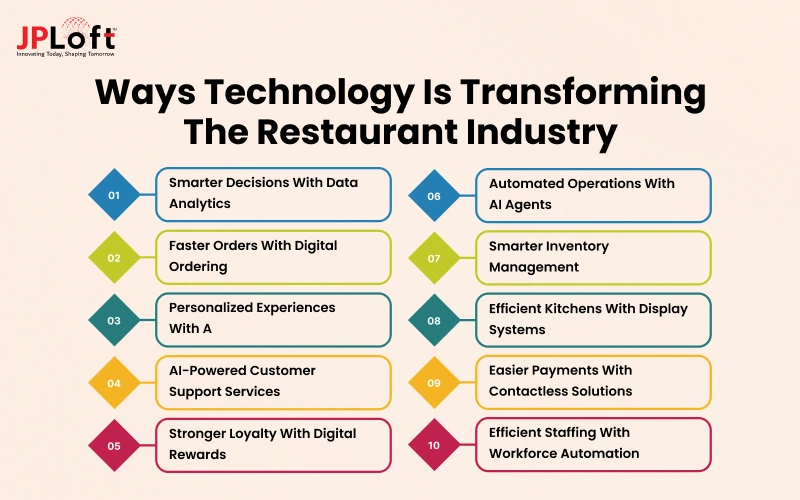
Modern solutions help restaurant owners reduce manual tasks, control operating expenses, improve service quality, and make informed decisions. From AI in restaurant apps to automated kitchen equipment, these technologies offer practical ways to improve restaurant performance.
Here are the 10 ways restaurant technology is transforming the industry:
1. Enables Smarter Decisions With Restaurant Data Analytics
Restaurant analytics tools collect information from POS systems, inventory platforms, customer databases, and sales reports. Such technology in the restaurant industry turns information into useful business insights.
With restaurant analytics, you can:
-
Track sales performance: Compare daily, weekly, and monthly revenue.
-
Identify popular dishes: Understand which menu items generate the most orders.
-
Monitor customer behavior: Analyze purchasing patterns and ordering frequency.
-
Evaluate operating costs: Review food expenses, labor costs, and other business expenses.
-
Measure promotions: Identify which discounts and marketing campaigns generate better results.
For example, if a dish generates high sales but has expensive ingredients, you can review its pricing or recipe. These insights help you make informed decisions about menus, staffing, and business expansion.
2. Streamlines Order Management With Digital Ordering Systems
Digital ordering systems allow customers to browse menus, customize meals, and place orders through websites, mobile apps, or self-service kiosks.
These systems help restaurant owners:
-
Reduce manual order handling: A self-ordering kiosk app lets customers place orders without relying entirely on staff.
-
Improve order accuracy: Reduce mistakes caused by handwritten tickets or verbal communication.
-
Manage multiple channels: Handle dine-in, takeaway, and delivery orders from one platform. Integrating it with your cloud POS and third-party delivery apps sends every order straight to the kitchen without re-entry.
-
Reduce wait times: Let customers place orders more quickly.
This latest restaurant technology gives your staff more time to focus on food preparation and customer service.
3. Personalizes Customer Experiences Through Data and AI
Customers appreciate restaurants that understand their preferences and provide relevant suggestions. AI-powered personalization tools help restaurants use customer data to create more meaningful experiences.
These solutions can support:
-
Personalized recommendations: Suggest dishes based on previous customer orders.
-
Targeted promotions: Send offers that match individual purchasing preferences.
-
Customized loyalty rewards: Provide benefits based on customer activity.
-
Dietary recommendations: Highlight menu options based on recorded preferences.
-
Customer segmentation: Group customers based on spending patterns and visit frequency.
For example, you can offer discounts on a customer's frequently ordered meal or recommend similar dishes based on previous purchases. This can improve customer engagement and encourage repeat visits.
.webp)
4. Improves Customer Service With AI Chatbots and Voice Agents
AI-powered chatbots help restaurants handle common customer queries without requiring employees to respond to every request.
Newer AI voice agents go further by taking phone and drive-thru orders. The National Restaurant Association's 2026 report found that only 6% of restaurants use AI to take customer orders, yet about 60% of millennials and Gen Z are open to ordering through an AI bot.
They can assist customers with:
-
Menu information: Answer questions about dishes, ingredients, prices, and available options.
-
Table reservations: Chatbots check availability and take bookings through an AI table reservation app.
-
Order tracking: Provide updates about ongoing food deliveries.
-
Customer support: Respond to questions about operating hours, payment methods, and restaurant services.
These smart restaurant technology tools can operate across websites, messaging platforms, and mobile applications. You can provide round-the-clock assistance while allowing employees to focus on in-person service.
5. Strengthens Customer Loyalty With Digital Loyalty Programs
Traditional loyalty cards make it difficult to track customer activity and measure the success of reward campaigns. Digital loyalty platforms simplify this process by recording purchases and automatically tracking reward points.
Restaurant owners can use these platforms to:
-
Create reward programs: Offer points for purchases and repeat visits.
-
Provide exclusive discounts: Give loyal customers access to special offers.
-
Send promotional notifications: Inform customers about new dishes and upcoming deals.
-
Track customer activity: Monitor purchase frequency and reward redemption.
-
Encourage referrals: Reward customers who bring new visitors to the restaurant.
These platforms also provide insights into customer retention and purchasing behavior. This helps you identify loyal customers, improve engagement, and encourage more frequent visits.
Chipotle shows how well this works: in Q1 2026, digital sales made up 38.6% of its total sales, and about 90% of app orders were tied to its rewards program.
6. Automates Restaurant Operations With AI Agents
AI agents in restaurant apps can manage multi-step restaurant workflows by analyzing information, making decisions, and completing tasks within set limits and approvals.
For example, they can help with:
-
Inventory monitoring: Track stock levels and identify ingredients that need replenishment.
-
Purchase requests: Prepare supplier orders when inventory falls below required levels.
-
Staff scheduling: Analyze business demand and suggest employee schedules.
-
Customer management: Handle routine requests and support personalized interactions.
-
Performance monitoring: Review operational information and highlight areas that need attention.
This type of latest restaurant technology reduces repetitive administrative work and gives restaurant managers more time to focus on business growth.
7. Makes Inventory Management More Accurate
Managing food inventory manually can lead to overstocking, ingredient shortages, and unnecessary food waste. Restaurant inventory management software helps you monitor stock and control purchasing activities.
Key capabilities include:
-
Real-time stock tracking: Monitor ingredient quantities as orders are processed.
-
Low-stock alerts: Receive notifications when essential ingredients need replenishment.
-
Supplier management: Maintain supplier details and organize purchase orders.
-
Food waste tracking: Identify unused or frequently wasted ingredients.
-
Demand forecasting: Estimate future ingredient requirements using historical sales data.
For example, a connected restaurant POS system updates ingredient quantities whenever a customer places an order. This helps you plan purchases, control food costs, and maintain suitable inventory levels.
8. Enhances Kitchen Efficiency With Kitchen Display Systems
Kitchen Display Systems (KDS) replace traditional printed tickets with digital screens that show incoming orders directly in the kitchen.
They help kitchen teams:
-
View incoming orders: Display order details clearly on digital screens.
-
Prioritize preparation: Organize orders based on preparation time and service requirements.
-
Track order progress: Update the status of meals as they move through preparation.
-
Reduce communication errors: Minimize confusion between kitchen and front-of-house employees.
-
Manage peak hours: Keep orders organized when customer demand increases.
For restaurant owners, KDS technology can improve kitchen coordination, reduce preparation errors, and support faster service.
9. Simplifies Payments With Contactless Payment Solutions
Contactless dining technology allows customers to complete transactions using QR codes, NFC-enabled cards, digital wallets, and mobile payment applications.
These solutions offer several benefits:
-
Faster checkout: Allows customers to complete payments without lengthy billing processes.
-
Multiple payment options: Accept digital wallets, contactless cards, and supported mobile payments.
-
Reduced cash handling: Minimizes the need to manage physical cash.
-
Better transaction tracking: Connect payment records with POS systems.
-
Improved convenience: Let customers pay directly from their smartphones.
For restaurant owners, such smart restaurant technology can simplify billing, improve payment convenience, and support more accurate transaction records.
10. Improves Staff Management With Workforce Automation
Managing employee schedules, attendance, payroll, and shift changes can consume significant management time. Restaurant workforce management software helps automate these responsibilities.
Some important capabilities include:
-
Automated scheduling: Create employee shifts based on operational requirements.
-
Attendance tracking: Monitor working hours and employee attendance.
-
Shift management: Allow employees to request shift changes through the platform.
-
Labor cost monitoring: Track staffing expenses against business revenue.
-
Demand-based staffing: Use historical sales data to estimate workforce requirements.
This helps you assign the right number of employees during busy and slow periods. It also reduces scheduling conflicts and unnecessary labor expenses.
Emerging Restaurant Technology Trends in 2027
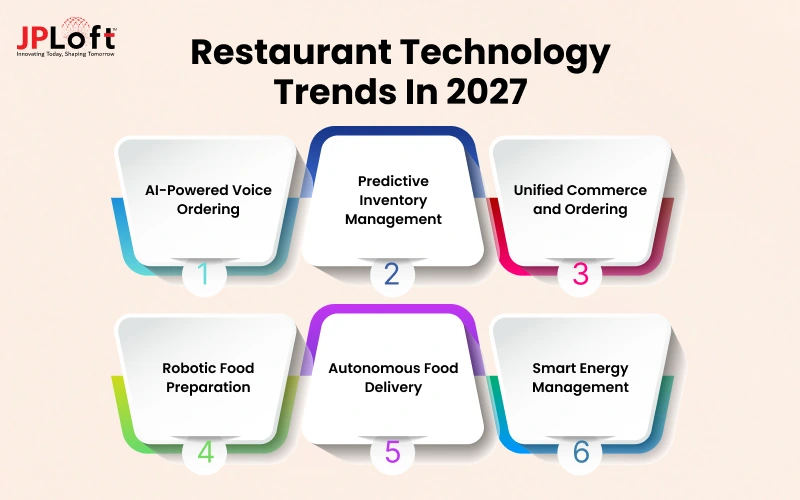
Restaurant technology is rapidly moving beyond basic ordering and billing. In 2027, innovations by restaurant technology companies will change how you manage kitchens, serve customers, control costs, and grow your business.
Here are the key restaurant technology trends worth checking out:
1. AI Voice Ordering for Phone and Drive-Thru
AI voice agents answer calls and drive-thru lanes, take orders, confirm details, and pass them to your POS. As more guests get comfortable ordering through AI, expect this to move from pilot projects to standard practice in 2027.
2. Predictive Inventory and Waste Reduction
Predictive tools forecast demand from past sales and suggest ingredient orders before shortages or waste happen. They build on the inventory tracking covered above and turn it into smarter purchasing decisions.
3. Unified Commerce Across POS, Online, and Delivery
Unified commerce connects your POS, your own app or website, and third-party delivery platforms into one system. Orders, menus, stock, and customer data stay in sync, so you avoid re-entering delivery orders and see sales across every channel in one place.
4. Robotics and Automated Food Preparation
Restaurant robots can handle repetitive kitchen tasks such as frying, chopping, grilling, and assembling meals.
These systems help maintain consistent food quality and reduce manual workloads. They are particularly useful for high-volume restaurants looking to improve kitchen productivity.
5. Autonomous Food Delivery Robots
Autonomous delivery robots, a form of technology used in restaurants, use sensors, cameras, and navigation software to deliver food without human drivers.
They can serve nearby customers in controlled environments such as campuses and residential communities. Restaurants can explore this technology to improve local delivery operations.
6. Smart Energy Management Systems
Smart energy systems monitor electricity consumption across refrigeration, lighting, ventilation, and kitchen equipment.
They can automatically adjust selected equipment settings based on operating schedules. This helps restaurant owners reduce unnecessary energy consumption and control utility expenses.
Challenges of Adopting Technology in the Restaurant Industry
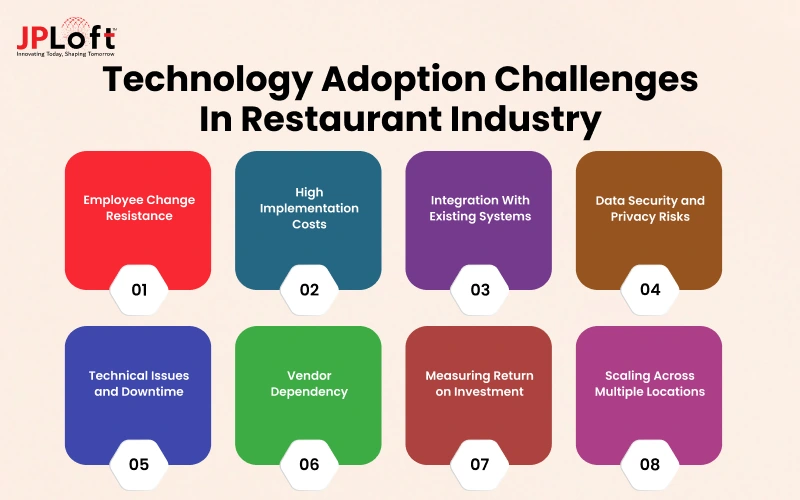
Adopting restaurant technology solutions can improve efficiency, but the transition is not always simple. From high implementation costs to employee resistance and integration issues, you must overcome several restaurant app development challenges to make technology work for your business.
1. Employee Training and Resistance to Change
Employees may struggle to use unfamiliar systems or resist changes to established workflows. Without proper training, new technology can create confusion, increase operational mistakes, and slow down restaurant service.
Solution: Provide hands-on training, simple instructions, and ongoing support to help employees adapt to new technology confidently.
2. High Initial Implementation Costs
Implementing restaurant technology requires investment in software, hardware, system integration, and employee training. These expenses can strain small restaurant budgets, especially when businesses need multiple tools to manage daily operations.
Solution: Start with essential technologies, prioritize high-impact restaurant app features, and introduce new systems gradually to manage costs and improve ROI.
3. Integration With Existing Restaurant Systems
New technology may not integrate smoothly with existing POS, inventory, accounting, and customer management systems. This can create data silos, duplicate entries, and communication gaps across restaurant operations.
Solution: Choose compatible platforms with reliable APIs and integration support to connect existing systems and centralize business data.
4. Data Security and Customer Privacy Risks
Restaurant systems handle customer details, payment records, and order histories. Weak restaurant app security practices can expose this information to cyberattacks, unauthorized access, payment fraud, and data breaches.
Solution: Choose technology providers that use encryption, secure payment gateways, access controls, and regular security updates, and that follow PCI DSS for card data.
5. Technical Issues and System Downtime
Software glitches, internet disruptions, and hardware failures can interrupt order processing, payments, and kitchen operations. These issues become more costly during peak dining hours when service speed matters.
Solution: Maintain backup systems, schedule regular restaurant app maintenance, and choose technology providers offering reliable technical support.
6. Dependence on Technology Providers
Restaurants often depend on third-party vendors for software updates, cloud hosting, maintenance, and technical support. Provider issues, rising subscription fees, or discontinued services can disrupt business operations.
Solution: Review vendor contracts, support terms, data ownership policies, and service-level agreements before choosing a technology provider.
7. Difficulty Measuring Return on Investment
Some technology investments deliver benefits that are difficult to measure immediately. Without clear performance metrics, restaurant owners may struggle to determine whether new systems justify their implementation and maintenance costs.
Solution: Track order accuracy, labor expenses, service time, customer retention, app order share, repeat order rate, and per-order margin to evaluate technology performance.
8. Difficulty Scaling Technology Across Multiple Locations
Technology that works well in one restaurant may not support the different menus, staffing needs, and workflows of multiple branches. Managing disconnected systems can create operational inconsistencies.
Solution: Invest in scalable platforms with centralized management, location-specific settings, and consistent reporting capabilities.
.webp)
Why Choose JPLoft to Build Your Restaurant Technology Solutions?
Building the right restaurant technology solution requires a clear understanding of your business operations, customer expectations, and growth goals.
This is where JPLoft can help. With 16+ years of experience and 1,250+ projects delivered, we are a trusted restaurant app development partner. We develop custom restaurant solutions that simplify operations and improve business performance.
From restaurant management platforms and POS systems to AI-powered ordering, inventory management, and customer engagement applications, our team builds solutions around your specific requirements.
We focus on creating user-friendly, scalable, and secure platforms that integrate with your existing business systems. Whether you are launching a new restaurant technology platform or upgrading an existing solution, JPLoft supports you through planning, design, development, testing, and ongoing maintenance.
Partner with JPLoft to turn your restaurant technology vision into a practical solution that supports efficiency, customer satisfaction, and long-term business growth.
Wrapping Up
Restaurant technology is no longer just an operational advantage. Instead, it is becoming an essential part of running a competitive restaurant business. The combination of AI, automation, cloud computing, digital payments, and data analytics is creating smarter and more connected restaurant operations.
Restaurants that adopt the right technologies can improve efficiency, reduce costs, enhance customer experiences, and build long-term profitability. However, success depends on choosing solutions that address actual business challenges rather than following every new trend.
FAQs
Technology helps restaurants automate daily operations, improve order accuracy, and manage inventory. It also enhances customer experiences through digital ordering, personalized services, and faster payments.
Common restaurant technologies include POS systems, kitchen display systems, inventory software, digital ordering platforms, and payment solutions. Many restaurants also use AI-powered tools.
Restaurant technology reduces costs by automating repetitive tasks, minimizing food waste, optimizing staff schedules, and improving inventory control. It also helps prevent order errors.
Costs depend on the tools you choose, the number of locations, and whether you buy ready-made software or build a custom platform. Subscription tools cost less to start, while custom builds fit your workflows better. Begin with one high-impact system and expand once it pays back.
Start with the system that solves your biggest daily problem. Most owners begin with a cloud POS that connects to online ordering, delivery apps, and inventory, because it becomes the base for every other tool. Add AI ordering, loyalty, or kitchen displays after that foundation works.
Restaurants often face high implementation costs, employee training difficulties, integration issues, and cybersecurity risks. Careful planning helps businesses manage these challenges effectively.

Conor has 10+ years of experience in software development, application engineering, solution design, and UX/UI. He has worked across digital products in restaurant technology, food and grocery delivery, healthcare, media, streaming, and social platforms, bringing both technical and user-experience perspectives to product development. His experience working with large organizations and growth-focused digital products helps businesses translate complex requirements into practical, user-focused solutions.


Share this blog