


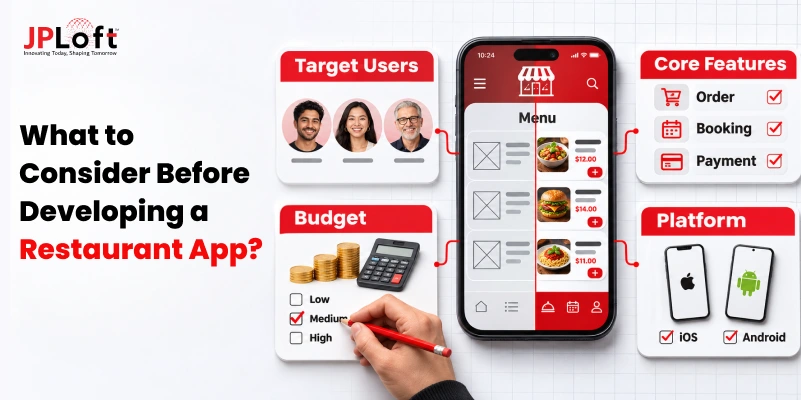
Key Takeaways:
Business Goals and Customer Needs: Define clear objectives, understand customer preferences, and identify measurable outcomes before starting app development.
App Type and Essential Features: Select the right restaurant app model and prioritize core features based on customer expectations and operational needs.
Technology and Integrations: Evaluate platform compatibility, POS systems, payment gateways, and third-party integrations early to prevent technical and operational complications.
Security, Performance, and Scalability: Plan data protection, secure transactions, reliable peak-hour performance, and future expansion requirements before finalizing development decisions.
Development Budget and Long-Term Costs: Consider upfront investment, hosting, maintenance, third-party fees, and future upgrades to assess overall financial feasibility.
Development Approach and Launch Strategy: Compare custom and white-label solutions, choose a suitable development partner, and establish measurable post-launch performance indicators.
Are customers asking for easier ordering or reservations, or are you considering an app because other restaurants have one? That difference matters when deciding where to invest. A dedicated app should solve a problem your restaurant can identify and measure.
Before choosing features or hiring developers, check how guests already order, book tables, and return to your restaurant. Your existing processes, software, and budget will shape what the app can realistically deliver.
Poorly scoped apps often create extra work for staff. Orders may need to be entered twice, menu changes may not appear across systems, and customers may have little reason to download another app.
With clear requirements, the app can give regular customers a quicker way to reorder, reduce booking errors, or connect online orders more closely with kitchen operations.
Consulting experts at a restaurant app development company early can help uncover limitations in your POS system or other existing software before they affect the project scope and budget.
This guide examines the practical decisions to make before development, so you can judge whether an app is justified and prepare a clearer project brief.
Is Your Restaurant Business Ready for a Mobile App?
A dedicated app may make sense for restaurants with frequent returning customers, regular direct orders, or complicated reservations. If your website already handles occasional orders effectively, improving that experience could be a better first investment.
The following considerations can help you evaluate your restaurant's readiness:
|
Consideration |
What to Evaluate |
|
Digital Operations |
Identify delays, manual processes, or disconnected systems affecting ordering, reservations, and daily management. |
|
Customer Demand |
Assess ordering frequency, repeat customers, and preferences for mobile ordering, reservations, or loyalty services. |
|
Existing Business Challenges |
Determine whether an app could address recurring problems that your website or third-party platforms cannot adequately solve. |
|
Business Objectives |
Identify measurable improvements you want to achieve, such as more direct orders, better retention, or fewer reservation errors. |
|
Operational and Financial Resources |
Evaluate your budget, staff readiness, technical support, and ability to maintain the app after launch. |
For instance, a neighborhood restaurant receiving occasional online orders may find a mobile-friendly website sufficient. However, a multi-location restaurant managing frequent orders, reservations, and repeat customers may benefit from a dedicated application.
The key is to establish whether your restaurant has a genuine business need, sufficient customer demand, and the resources to make app development a worthwhile investment.
Which Type of Restaurant App Should You Develop?
The app type should follow your business objective. An ordering app, for example, needs different workflows from an employee-facing management tool or a marketplace serving several independent restaurants.
The five common models below serve different users and business needs.
1. Food Ordering and Delivery Apps
Food ordering apps let guests choose meals, make payments, and arrange pickup or delivery. They work well for restaurants and cloud kitchens with frequent order activity. Before development, decide how the kitchen will receive orders and how customers will see accurate prices and availability.
2. Table Reservation and Booking Apps
Reservation apps show table availability, accept bookings, and send confirmations or reminders. Restaurants with busy dining rooms should also plan for cancellations, late arrivals, and changes made by staff.
3. Restaurant Discovery and Finder Apps
Restaurant discovery apps help diners compare venues by location, cuisine, price, or reviews. These are typically marketplace products rather than apps for a single restaurant, so they need restaurant onboarding and listing management as well.
4. Loyalty and Customer Engagement Apps
A loyalty app gives regular guests a reason to return through rewards, membership benefits, or saved preferences. It is most useful when the restaurant already has a returning customer base and can honor offers consistently at checkout.
5. Restaurant Management Apps
Restaurant management apps support internal activities such as inventory monitoring, staff scheduling, order management, reporting, and multi-location coordination. They are suitable for restaurants seeking to reduce manual administration, improve operational visibility, and coordinate processes across teams or locations.
12 Key Factors to Consider Before Developing a Restaurant App
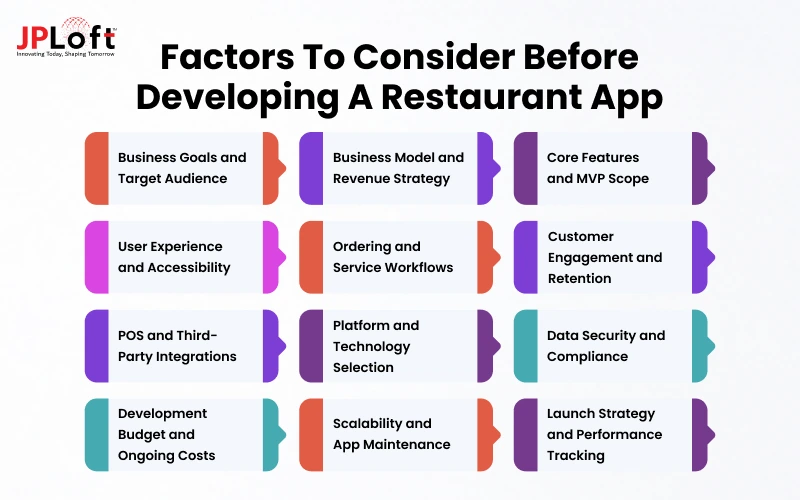
After deciding what kind of app fits your restaurant, examine the requirements that will influence its development and daily use. Each factor below addresses a different decision.
Use these 12 factors to turn a broad app idea into a brief your team and potential development partners can evaluate.
1. Business Objectives and Target Customer Needs
Your restaurant app should address a clearly defined business problem. Rather than adding features simply because competitors offer them, identify what you want to achieve and how customers are likely to use your application.
-
Business Objectives: Establish one primary goal, such as increasing direct orders, reducing reservation errors, or improving operational efficiency. Use this objective to guide development priorities.
-
Target Customers: Examine ordering frequency, preferred digital channels, and customer expectations. For example, office workers may value quick reordering, while fine-dining guests may prefer convenient reservations.
-
Measurable Outcomes: Define relevant performance indicators and establish a baseline so you can assess improvements after launch rather than relying only on app downloads.
2. Restaurant App Business Model and Revenue Strategy
The business model determines how your app creates value and which commercial capabilities it requires. A restaurant-owned application and a multi-restaurant marketplace, for example, involve different revenue arrangements and operational responsibilities.
-
Revenue Sources: Identify whether the app will support direct food sales, marketplace commissions, subscriptions, or other revenue streams relevant to your business.
-
Operating Expenses: Consider delivery costs, discounts, payment processing charges, and platform fees when estimating the financial impact of app-based transactions.
-
Financial Viability: Evaluate expected order volume, customer adoption, and contribution margins to determine whether the proposed model can support ongoing operating costs.
3. Core Features and MVP Prioritization
An effective restaurant app should deliver its primary service reliably before introducing advanced functionality. Defining a minimum viable product (MVP) helps control development scope and identify what must be ready for the initial launch.
-
Essential Features: Identify the functionality required to complete the main user journey. An ordering app, for example, may need menus, a cart, checkout, order confirmation, and administrative controls.
-
Feature Dependencies: Consider the systems required to make each feature work. Real-time ordering, for instance, may depend on accurate menu availability and reliable kitchen communication.
-
Future Enhancements: Reserve capabilities such as advanced loyalty programs or personalized recommendations for later releases unless they are central to your app's purpose.
4. User Experience and Accessibility
Customers should be able to complete important tasks without confusion or unnecessary effort. Before development, consider how users will navigate your application, access information, and interact with its core functionality.
-
Intuitive Navigation: Organize menus, categories, reservations, and account options so users can find essential functions without navigating through unnecessary screens.
-
Simplified User Journeys: Minimize avoidable steps during ordering, payment, and reservations. Clearly display item availability, pricing, additional charges, and confirmation details.
-
Accessibility Requirements: Plan for readable text, sufficient color contrast, descriptive controls, and assistive technology compatibility. Validate these requirements through usability and accessibility testing.
5. Ordering, Reservations, and Service Workflows
A restaurant app must function within your existing service operations. Planning these workflows before development helps prevent situations where customer actions cannot be processed accurately by restaurant staff or connected systems.
-
Order Processing: Map how incoming orders reach the kitchen, how preparation status changes, and how customers receive reliable confirmations and updates.
-
Reservation Management: Determine how table availability, operating hours, cancellations, and seating capacity will remain synchronized with actual restaurant operations.
-
Exception Handling: Establish procedures for unavailable menu items, failed payments, cancelled orders, and delayed deliveries so staff can resolve problems without losing transaction information.
6. Customer Engagement and Retention Strategy
Customers need a meaningful reason to use your restaurant app repeatedly. Your engagement strategy should therefore reflect customer behavior and the value your application provides beyond existing ordering or communication channels.
-
Repeat-Use Incentives: Assess whether convenient reordering, loyalty rewards, membership benefits, or personalized services would encourage customers to return.
-
Relevant Communication: Plan transactional notifications, reservation reminders, and promotional messages according to their usefulness rather than sending frequent alerts.
-
Customer Preferences: Determine how communication choices, purchase history, and appropriate consent will support relevant experiences without collecting unnecessary personal information.
7. POS, Payment, and Third-Party Integrations
Your restaurant app may depend on existing POS systems, payment providers, kitchen displays, and delivery services. Before choosing restaurant app development services, confirm that these systems can be integrated to avoid costly changes once development begins.
-
System Compatibility: Verify that existing providers offer the necessary APIs, permissions, and documentation for synchronizing orders, menus, prices, and inventory.
-
Payment Requirements: Evaluate supported payment methods, refunds, transaction confirmation, provider fees, and applicable payment security responsibilities.
-
Integration Reliability: Define how synchronization failures will be detected and resolved. For example, a successful payment should not result in an unnoticed order if the POS connection fails.
8. Platform Selection and Technology Requirements
The technology approach you select influences development effort, application capabilities, and long-term maintenance. The decision should reflect customer usage patterns and the operational requirements identified during planning.
-
Platform Requirements: Compare native iOS, Android, cross-platform, and web-based solutions according to audience preferences, functionality, and available development resources.
-
Technical Infrastructure: Assess backend services, databases, authentication, hosting, and integration architecture based on expected application usage.
-
Long-Term Flexibility: Consider how platform choices will affect updates, integrations, maintenance, and the introduction of new functionality as business needs change.
9. Data Security, Privacy, and Compliance
Restaurant apps may handle customer contact details, addresses, ordering histories, location information, and payment-related data. Understanding these responsibilities before development helps establish appropriate safeguards from the beginning.
-
Data Protection: Plan secure authentication, role-based access, encrypted communication, and appropriate data storage and retention practices.
-
Privacy Requirements: Identify which information is necessary, why it is collected, how customer preferences are managed, and which regional privacy laws may apply.
-
Compliance Obligations: Evaluate applicable payment security standards, app store policies, and security testing requirements based on your application's actual functionality and data handling.
10. Development Budget and Long-Term Costs
Your financial plan should account for more than the initial cost of building the application. Development scope, technical dependencies, and ongoing operational requirements all influence the investment.
-
Initial Investment: Include requirements planning, UI/UX design, development, integrations, testing, and deployment when evaluating project estimates.
-
Recurring Expenses: Account for hosting, maintenance, third-party subscriptions, payment processing, technical support, and future updates.
-
Financial Feasibility: Compare expected business benefits against total ownership costs and establish a contingency budget for changes or unforeseen integration requirements.
11. Scalability, Performance, and Maintenance
Your restaurant app should remain dependable during peak operating hours and adapt to realistic changes in business demand. Planning for these requirements early can reduce service disruptions and expensive technical adjustments.
-
Operational Performance: Evaluate expected order-processing capacity, transaction reliability, response times, and system availability during peak periods.
-
Business Scalability: Consider anticipated growth in customers, transactions, restaurant locations, and supported services without overinvesting in unnecessary infrastructure.
-
Maintenance Planning: Establish responsibilities for security updates, operating system compatibility, third-party API changes, monitoring, and technical support.
12. Launch Strategy and Success Measurement
A restaurant app requires a clear rollout strategy to turn development efforts into actual business outcomes. Plan customer adoption, employee readiness, and performance evaluation before the application goes live.
-
Launch Preparation: Arrange end-to-end testing, staff training, operational documentation, and customer support procedures before introducing the application.
-
Customer Adoption: Identify how existing customers will discover and begin using the app. Consider a limited launch at one location to validate the experience before wider deployment.
-
Success Measurement: Track relevant indicators such as completed orders, repeat purchase rates, reservation accuracy, and order profitability against established pre-launch benchmarks.
Custom vs White-Label Restaurant Apps: Which Is Right for Your Business?
Custom and white-label apps can both support restaurant operations. The choice depends on how closely an existing product matches your processes, how much flexibility you need, and the costs of operating it.
The following comparison highlights the factors to evaluate before choosing a development approach.
|
Consideration |
Custom Restaurant App |
White-Label Restaurant App |
|
Development Approach |
Built around your restaurant's specific requirements and operational workflows. |
Uses an existing platform configured for your restaurant's branding and available functionality. |
|
Initial Investment |
Generally higher due to tailored design, development, and integrations. |
Often lower upfront, with potential subscription, setup, or licensing fees. |
|
Time to Launch |
Depends on the complexity of requirements and integrations. |
Typically faster when existing functionality meets business needs. |
|
Customization |
Greater flexibility to implement unique features and workflows. |
Limited by the provider's available features and configuration options. |
|
POS and Third-Party Integrations |
Can be developed for compatible systems based on technical feasibility. |
Restricted to supported integrations or provider-approved extensions. |
|
Scalability |
Can be designed around anticipated business expansion. |
Depends on provider capabilities, pricing plans, and technical limitations. |
|
Ownership and Data Control |
Source-code rights, intellectual property, and data access depend on contractual terms. |
Governed by vendor agreements, including data access and portability restrictions. |
|
Long-Term Costs |
Requires ongoing maintenance, infrastructure, and technical support. |
May involve recurring fees, transaction charges, and additional costs for upgrades. |
|
Best Suited For |
Restaurants with specialized requirements, complex workflows, or extensive customization needs. |
Restaurants whose requirements can be met by standard, configurable functionality. |
Which option should you choose?
A white-label solution may be suitable when your restaurant needs standard ordering, reservations, or loyalty functionality and wants to launch without extensive customization.
Custom development becomes more relevant when your business requires specialized integrations, unique operational workflows, or capabilities that existing platforms cannot adequately support.
Before deciding, compare the total cost over several years, confirm data ownership and portability, and verify whether the solution can accommodate your expected business requirements. These considerations can be more important than the initial development quote alone.
Common Mistakes to Avoid Before Investing in Restaurant App Development
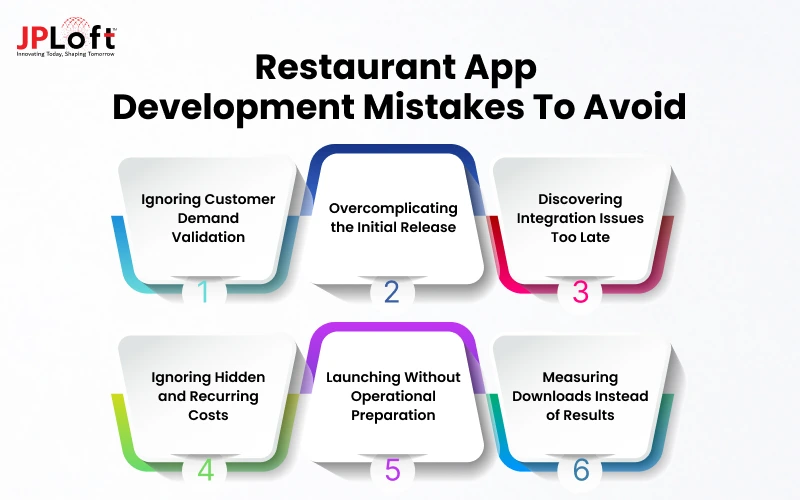
Even with a clear development plan, certain oversights can lead to unexpected expenses, operational disruptions, and poor app adoption. Understanding where restaurant app projects commonly go wrong can help you identify risks before making a significant investment.
Here are six common mistakes to watch out for:
A] Developing Without Validating Customer Demand
Investing based on competitor activity rather than customer behavior can result in an app that receives few downloads or repeat visits. Validate demand through customer feedback, existing ordering patterns, or a limited pilot.
B] Overcomplicating the Initial Release
Including too many features can extend development timelines and increase testing requirements. Launch with functionality that supports the app's primary purpose before investing in additional capabilities.
C] Discovering Integration Issues Too Late
Assuming your existing POS or inventory software will connect easily can lead to unexpected development changes. Verify compatibility, API access, and provider limitations before finalizing the project scope.
D] Ignoring Hidden and Recurring Costs
Focusing only on development quotes can leave your business unprepared for hosting charges, transaction fees, software subscriptions, and maintenance. Account for these expenses when evaluating the overall investment.
E] Launching Without Operational Preparation
Introducing an ordering or reservation app without training staff can create missed orders, booking conflicts, and inconsistent service. Test real workflows and prepare employees before launch.
F] Measuring Downloads Instead of Business Results
High download numbers do not necessarily indicate a successful investment. Evaluate completed orders, repeat purchases, reservation reliability, and financial performance to understand whether the app delivers business value.
How to Choose the Right Restaurant App Development Partner?
Choosing a restaurant app development partner requires more than comparing pricing and portfolios. The right company should understand your restaurant's operational needs, technical requirements, and long-term business goals.
Before making a decision, evaluate these factors:
-
Restaurant Industry Experience: Look for experience with ordering systems, reservations, delivery workflows, and POS integrations. Ask how the team has addressed restaurant-specific operational challenges.
-
Relevant Portfolio and Technical Expertise: Review previous projects, technical capabilities, and verifiable client feedback. Evaluate whether the company has handled requirements similar to yours.
-
Transparent Pricing and Project Scope: Request a clear breakdown of deliverables, development milestones, integration responsibilities, estimated costs, and how scope changes will be managed.
-
Communication and Collaboration: Understand how the team gathers requirements, shares progress, incorporates feedback, and resolves issues throughout development.
-
Post-Launch Support: Confirm the availability of maintenance, security updates, bug fixes, performance monitoring, and support for future enhancements.
Before finalizing your partner, ask how they would handle a real operational issue, such as a successful customer payment that fails to appear in your restaurant's POS system. Their response can help you assess whether they understand the technical and operational challenges involved.
Why Partner With JPLoft To Build Your Restaurant App?
Knowing what to consider before developing a restaurant app is important, but turning those considerations into the right development decisions requires technical expertise and careful planning.
With 16+ years of industry experience and 1,250+ projects delivered, JPLoft helps businesses transform their app ideas into practical development strategies.
Our on-demand restaurant app development services help restaurants, cloud kitchens, and food businesses evaluate their requirements, prioritize essential features, select suitable technologies, and plan integrations with existing restaurant systems.
Whether you're planning an ordering platform, reservation app, or restaurant management solution, our team helps align development scope, technical requirements, and investment decisions with your business objectives.
Ready to take the next step? Connect with JPLoft's experts to assess your restaurant app idea, explore technical possibilities, and build a development roadmap that fits your operational needs and budget.
Conclusion
Developing a restaurant app is a significant business decision that requires more than selecting attractive features or the latest technologies. Its success depends on understanding your customers, identifying operational challenges, choosing the right development approach, and planning for long-term costs and maintenance.
The factors discussed in this guide can help you evaluate your restaurant's readiness, prioritize essential requirements, and avoid costly mistakes before development begins.
Remember, the goal isn't simply to launch a mobile app but to build a solution that delivers measurable value to your customers and business.
Start by defining what your restaurant actually needs, validate those requirements, and make development decisions that support your long-term business goals.
FAQs
Before developing a restaurant app, evaluate your business objectives, target audience, app type, essential features, technology requirements, and budget. Also consider POS integrations, data security, scalability, and ongoing maintenance to ensure the application supports your operational needs and long-term goals.
The right app depends on your restaurant's business model and primary objectives. Ordering and delivery apps suit restaurants focusing on direct sales, reservation apps work well for dine-in establishments, and loyalty apps support customer retention. Management apps are more suitable for improving internal operations.
Essential features depend on the app's purpose. An ordering app typically requires digital menus, order customization, secure payments, and order tracking. Reservation apps need table availability and booking management, while loyalty apps may include rewards and personalized offers. Prioritize core functionality before adding advanced features.
Restaurant app development costs vary based on app complexity, supported platforms, UI/UX requirements, third-party integrations, and development approach. Custom applications generally require greater upfront investment than standard white-label solutions. Hosting, maintenance, and future upgrades also affect the total cost. A reliable estimate requires a defined project scope.
Choose a white-label solution if your restaurant needs standard functionality, quicker deployment, and lower initial development effort. Custom development may be more suitable for unique workflows, specialized integrations, or extensive customization. Compare long-term costs, ownership terms, and flexibility before deciding.
A relatively simple restaurant app may take a few months to develop, while complex applications involving multiple user roles, delivery management, or extensive integrations can take considerably longer. The timeline depends on development scope, platform selection, testing, and third-party dependencies.
Yes, restaurant apps can integrate with many POS systems and payment gateways, provided the existing software supports the required APIs and permissions. Before development, verify compatibility, menu and order synchronization, payment processing, refund workflows, and procedures for handling integration failures.
A restaurant app can encourage repeat interactions through convenient reordering, loyalty rewards, personalized offers, and reservation reminders. It also enables direct communication with customers through relevant notifications and updates. The effectiveness of these features depends on customer preferences, consistent service quality, and meaningful incentives.

Conor has 10+ years of experience in software development, application engineering, solution design, and UX/UI. He has worked across digital products in restaurant technology, food and grocery delivery, healthcare, media, streaming, and social platforms, bringing both technical and user-experience perspectives to product development. His experience working with large organizations and growth-focused digital products helps businesses translate complex requirements into practical, user-focused solutions.


Share this blog