


Key Takeaways:
Building Healthcare app requires a structured process, covering idea validation, market research, feature planning, security and compliance, UI/UX design, technology selection, development, testing, launch, and ongoing maintenance.
The right app type and features depend on the target users, and app focus, whether telemedicine, patient care, remote monitoring, pharmacy services, or clinical workflows.
Security and compliance are core requirements of the app as it connects to EHR/EMR systems, medical devices, pharmacies, laboratories, and other platforms.
Development costs can range from $20,000 to $450,000+, depending on complexity, features, integrations, platforms, security requirements, and advanced technologies.
Healthcare apps can earn from subscriptions, consultation fees, commissions, provider fees, B2B licensing, product sales, and partnerships.
AI, remote patient monitoring, interoperability, personalized care, and connected ecosystems are among the key trends shaping healthcare mobile app development.
Healthcare is moving beyond the walls of hospitals and clinics. Digital platforms now help people access care, connect with providers, manage health information, and stay engaged with their healthcare journey.
For businesses, this creates opportunities to build apps that make healthcare more accessible, connected, and convenient.
But building healthcare apps comes with challenges that traditional consumer apps may not face. Sensitive health data, clinical workflows, interoperability, accessibility, security, and regulatory requirements all need to be considered from the start.
The goal is not simply to digitize healthcare services. It is to create a reliable digital experience that works for patients, healthcare professionals, and organizations.
This healthcare mobile app development guide covers everything from healthcare app types and essential features to the development process, technology stack, cost, monetization, challenges, and trends shaping the industry in 2026.
What is a Healthcare App?
A healthcare app is a mobile or web application designed to support healthcare delivery, management, or access. Depending on its purpose, it can serve patients, doctors, healthcare organizations, pharmacies, or other stakeholders.
These apps can support functions such as appointment management, telemedicine, medical records, prescriptions, remote patient monitoring, healthcare communication, and administrative workflows.
Healthcare apps often work with sensitive health information and may connect with EHR/EMR systems, laboratories, pharmacies, wearables, or medical devices.
This makes security, privacy, interoperability, accessibility, and applicable regulatory requirements important considerations during development.
How Does a Healthcare App Work?
A healthcare app connects patients, healthcare professionals, and care systems through a secure digital platform. While the workflow varies by app type, it generally follows these steps:
-
Registration & Login: Users create accounts and securely access the platform.
-
Profile Setup: Patients or providers add relevant personal and healthcare information.
-
Service Access: Users book appointments, consult providers, manage prescriptions, or access health records.
-
Data Exchange: The app securely exchanges information with healthcare systems, devices, or third-party services.
-
Notifications: Users receive reminders, alerts, results, messages, or other updates.
Example: A telemedicine app may follow the flow: Sign Up → Find Doctor → Book Appointment → Consultation → Prescription → Follow-Up.
Why Invest in a Healthcare App in 2026?
Investing to build mobile apps for care delivery is becoming an important part of the digital healthcare ecosystem, creating opportunities for businesses to improve service delivery while developing new revenue channels.
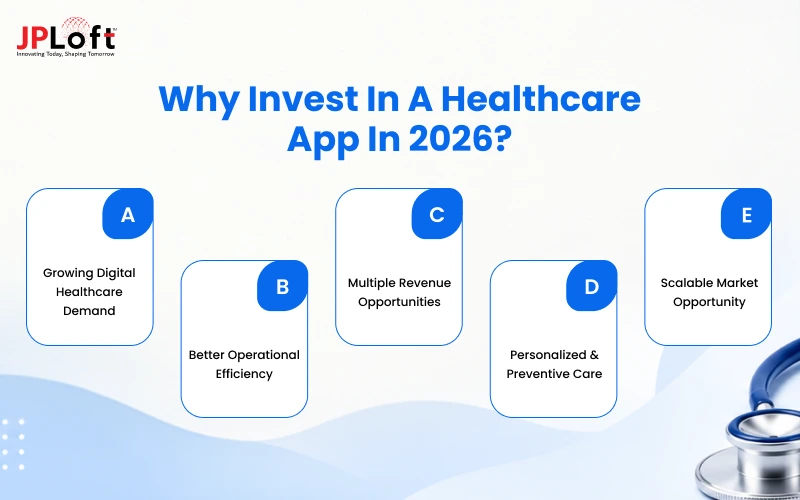
Here are the key reasons why entrepreneurs should plan to invest in healthcare app solutions:
► Growing Digital Healthcare Demand
Digital health is becoming a core part of healthcare delivery. WHO reports that 129 countries have established national digital health strategies, showing how governments and healthcare systems are increasingly prioritizing digital transformation.
► Better Operational Efficiency
Digital platforms can automate repetitive workflows such as appointment management, communication, documentation, and data exchange. This can help healthcare providers reduce administrative workloads and focus more on patient care.
[C] Multiple Revenue Opportunities
Healthcare apps can support several monetization models, including subscriptions, consultation fees, commissions, provider fees, B2B licensing, product sales, and partnerships. The industry reports predict that revenue from digital health will surpass US$271.82bn by 2031.
► Personalized & Preventive Care
Apps connected to wearables and other digital health technologies can collect health information outside traditional clinical settings. The FDA notes that digital health technologies can help move healthcare closer to patients and potentially support earlier interventions.
► Scalable Market Opportunity
The digital healthcare market is projected to grow from $420.2B billion in 2026 to $1,830.4B by 2033, representing a projected 23.4% CAGR. This growth highlights the expanding commercial opportunity for businesses entering digital healthcare.

Popular Healthcare App Types
Healthcare apps serve different purposes across patient care, clinical workflows, medication management, remote monitoring, and healthcare operations.
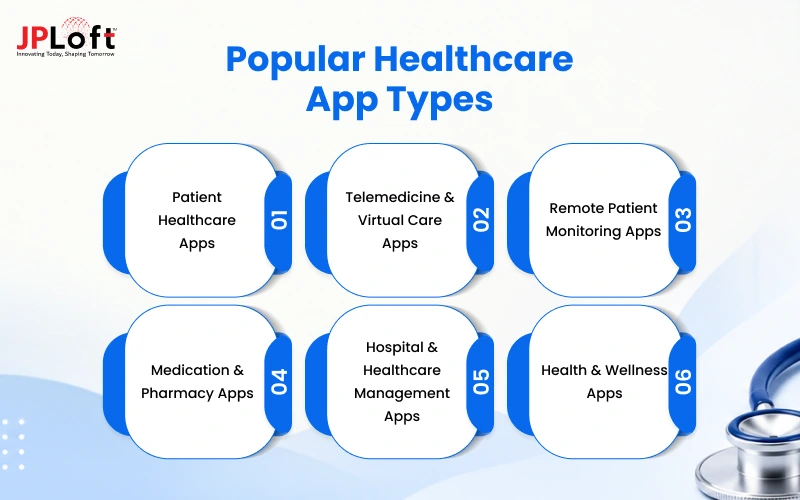
While some platforms combine multiple capabilities, the following categories represent the most common types based on their primary purpose.
1. Patient Healthcare Apps
Patient care apps give users a centralized platform to access and manage healthcare services. They can help patients handle appointments, medical records, prescriptions, payments, and communication with healthcare providers.
Key Features: Appointment management, Medical records access, Prescription management, Secure messaging, Test results, Digital payments, Health information management
Examples: MyChart, Patient Access, and Practo.
2. Telemedicine & Virtual Care Apps
Telemedicine apps enable patients to consult healthcare professionals remotely through video, voice, or secure messaging. They can support the complete virtual consultation journey, from booking to follow-up.
Key Features: Video consultations, Voice and chat, Appointment scheduling, Digital prescriptions, Provider search, Payments, Follow-up reminders
Examples: Teladoc Health, Amwell, and Doctor On Demand.
3. Remote Patient Monitoring Apps
Remote patient monitoring apps collect health data from patients outside traditional healthcare settings and make it available to authorized care teams. They are particularly useful for monitoring chronic and long-term conditions.
Key Features: Vital sign tracking, Wearable integration, Medical device connectivity, Health alerts, Patient dashboards, Provider monitoring, Data analytics
Examples: Dexcom, iHealth, and Omada Health.
4. Medication & Pharmacy Apps
Medication and pharmacy apps help users upload prescriptions and access medicines more conveniently. Depending on the platform, they can support medicine discovery, prescription processing, refills, reminders, payments, and delivery.
Key Features: Medicine search, Prescription uploads, Refill management, Medication reminders, Price comparison, Online ordering, Delivery tracking
Examples: GoodRx, Medisafe, CVS Pharmacy, and Walgreens.
5. Hospital & Healthcare Management Apps
Hospital management apps focus on the administrative and operational side of healthcare organizations. They help teams coordinate resources, manage workflows, and monitor organizational activities through centralized systems.
Key Features: Patient admissions, Staff management, Bed management, Billing, Inventory management, Scheduling, Reports and analytics
Examples: Oracle Health, Epic, and athenahealth.
6. Health & Wellness Apps
Health and wellness apps focus on preventive health, fitness, nutrition, and lifestyle management rather than direct clinical care. They help users monitor everyday health activities and build healthier habits.
Key Features: Activity tracking, Nutrition tracking, Sleep monitoring, Weight management, Fitness goals, Health insights, Wearable integration
Examples: MyFitnessPal, Fitbit, and Apple Health.
Essential Features of a Healthcare App
The essential features of a healthcare app depend on who uses the platform and what it is designed to accomplish.
Patients need easy access to healthcare services, providers need tools to deliver and manage care, and administrators need features to manage users, operations, and security.
The table below highlights the core mobile app features for each user group.
|
For Patient |
For Healthcare Provider |
For Admin |
|
Secure registration & login |
Provider dashboard |
User & role management |
|
Patient profile |
Patient management |
Access & permission management |
|
Appointment management |
Patient records access |
Provider management |
|
Telemedicine & virtual consultations |
EHR/EMR integration |
Appointment management |
|
Medical records |
Clinical documentation |
Billing & payment management |
|
Prescription management |
e-Prescriptions |
Content management |
|
Secure messaging |
Appointment management |
Analytics & reporting |
|
Payments |
Secure communication |
Audit logs |
|
Notifications & reminders |
Care plan management |
System & platform management |
How to Develop a Healthcare App: Step-by-Step Process
The process to develop a custom healthcare app requires more than building a set of healthcare features.
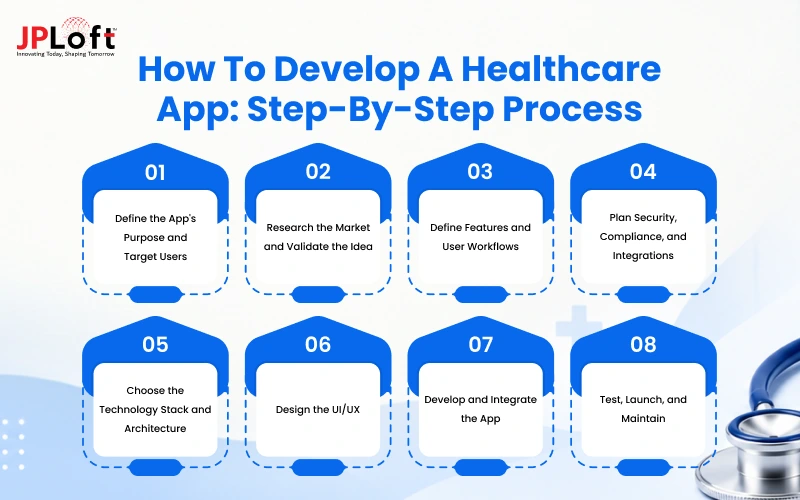
The process must account for user needs, clinical workflows, data security, compliance, interoperability, and long-term scalability. A structured process helps reduce technical risks and creates a product that is easier to use, secure, and maintain.
Step 1: Define the App's Purpose and Target Users
Start by identifying the healthcare problem the app will solve and the people who will use it. Define whether the platform is intended for patients, doctors, hospitals, pharmacies, insurers, or multiple user groups.
At this stage, determine the core use case, business objectives, target market, and primary workflows. This helps establish the foundation for the product and prevents unnecessary features from entering the initial scope.
Step : Research the Market and Validate the Idea
Analyze competing healthcare apps, user expectations, market gaps, and existing solutions. Interviews and feedback from patients, healthcare professionals, and other stakeholders can help validate whether the proposed solution addresses a genuine need.
The app market research should also identify the applicable healthcare regulations and data requirements for the target market.
Step 3: Define Features and User Workflows
Once the idea is validated, define the features required for each user role. Separate essential MVP features from advanced capabilities that can be introduced later.
Map important workflows such as registration, appointment booking, consultation, prescription management, payments, medical-record access, or remote monitoring. This creates a clear functional scope before design and development begin.
Step 4: Plan Security, Compliance, and Integrations
Healthcare apps often process sensitive health information, so app security and compliance should be considered from the architecture stage. Depending on the app and target market, requirements may include HIPAA, GDPR, FDA requirements, or applicable local regulations.
Plan authentication, role-based access, encryption, audit logging, consent management, and secure APIs. Also identify required integrations with EHR/EMR systems, FHIR or HL7 interfaces, laboratories, pharmacies, payment platforms, wearables, and medical devices.
Step 5: Choose the Technology Stack and Architecture
Select technologies based on the app's functionality, platforms, integration requirements, security needs, and expected scale.
Decide whether the app requires native or cross-platform development and define the backend, database, APIs, cloud infrastructure, and third-party services. A scalable architecture allows the product to support additional users, features, integrations, and healthcare workflows as it grows.
Step 6: Design the UI/UX
Design intuitive interfaces for each user group while keeping healthcare workflows simple and accessible. Patient interfaces should make common tasks easy to complete, while provider and admin dashboards should prioritize information clarity and workflow efficiency.
Accessibility, responsive app design, clear navigation, readable content, and consistent interaction patterns should be considered throughout the design process.
Step 7: Develop and Integrate the App
Development typically begins with the backend, APIs, database, and security infrastructure before building the application interfaces. Healthcare app developers then implement the approved features and connect the required healthcare systems and third-party services.
For complex healthcare platforms, development can be divided into modules so teams can build, test, and integrate individual workflows more efficiently.
Step 8: Test, Launch, and Maintain
Healthcare apps require more than functional testing. Conduct security, performance, usability, accessibility, interoperability, and device testing before launch. Validate that sensitive data is handled correctly and that integrations exchange information accurately.
After deployment, continuously monitor performance and security, fix vulnerabilities, update dependencies, maintain integrations, and introduce new features based on user feedback and changing healthcare requirements.
Technology Stack to Build a Custom Healthcare App
A healthcare app needs an app tech stack that supports secure data handling, reliable performance, interoperability, and scalable healthcare workflows. The right technologies depend on the app's functionality, target users, compliance requirements, and integrations.
|
Technology Layer |
Recommended Technologies |
Purpose |
|
Mobile Development |
Swift, Kotlin, Flutter, React Native |
Build secure iOS and Android patient and provider apps |
|
Web Development |
React, Next.js, Angular |
Develop provider portals, admin dashboards, and web-based healthcare platforms |
|
Backend |
Node.js, Python, Java, .NET |
Manage APIs, business logic, authentication, and healthcare workflows |
|
Database |
PostgreSQL, MySQL, MongoDB |
Store patient, clinical, appointment, and application data |
|
Healthcare Interoperability |
FHIR, HL7, SMART on FHIR, DICOM |
Exchange healthcare data and connect with EHR/EMR and medical imaging systems |
|
Cloud & Infrastructure |
AWS, Microsoft Azure, Google Cloud |
Support scalable hosting, backups, disaster recovery, and monitoring |
|
Security & Authentication |
OAuth 2.0, OpenID Connect, MFA, RBAC, TLS |
Protect healthcare data and control access based on user roles |
|
AI & Connected Health |
OpenAI, Gemini, TensorFlow, HealthKit, Health Connect |
Enable AI capabilities and integrate health data from devices and wearables |
|
Communication & Analytics |
WebRTC, Firebase, Twilio, Power BI |
Support virtual consultations, notifications, messaging, and healthcare analytics |
How Much Does It Cost to Develop a Healthcare App?
The cost to create a healthcare app can range from $20,000 to $450,000, depending on the app's complexity, features, integrations, security requirements, and development approach.
A basic patient app with limited functionality will cost significantly less than an enterprise healthcare platform with multiple user roles, EHR integrations, AI capabilities, and advanced security.
|
App Complexity |
Estimated Cost |
Estimated Timeline |
Typical Scope |
|
Basic |
$20,000–$60,000 |
2–3 months |
Patient profiles, appointments, notifications, basic healthcare services |
|
Medium |
$60,000–$150,000 |
3–6 months |
Telemedicine, payments, prescriptions, dashboards, third-party integrations |
|
Advanced |
$150,000–$300,000 |
6–10 months |
EHR/EMR integration, remote monitoring, multiple user roles, advanced analytics |
|
Enterprise |
$300,000–$450,000+ |
10–12+ months |
Complex workflows, multiple integrations, AI, medical devices, advanced security and scalability |
Factors Affecting Custom Healthcare App Development Cost
Several factors can influence the cost of developing a healthcare app. These should be considered before finalizing the development scope and budget.
-
App Complexity: More features and complex workflows increase development effort.
-
Platforms: Building for iOS, Android, and web separately or with a shared code base impacts development scope and budget.
-
User Roles: Multiple patient, provider, and admin roles require additional workflows.
-
Integrations: EHR/EMR, payment, pharmacy, and device integrations add complexity.
-
Security & Compliance: Healthcare data protection and applicable regulations require additional development and testing.
-
Advanced Technologies: AI, remote monitoring, and medical device capabilities increase costs.
-
UI/UX Design: Custom, accessible, and user-friendly interfaces require additional design effort.
-
Testing & QA: Security, performance, interoperability, and functional testing add to development time.
-
Infrastructure: Scalable cloud infrastructure and data management affect ongoing and initial costs.
-
Maintenance: Updates, security patches, monitoring, and feature enhancements add post-launch expenses.
How Do Healthcare Apps Make Money?
Simply focusing on how to build a HIPAA-compliant AI healthcare app is not enough. But along with that it is also important to have an understanding of how healthcare apps can generate revenue.
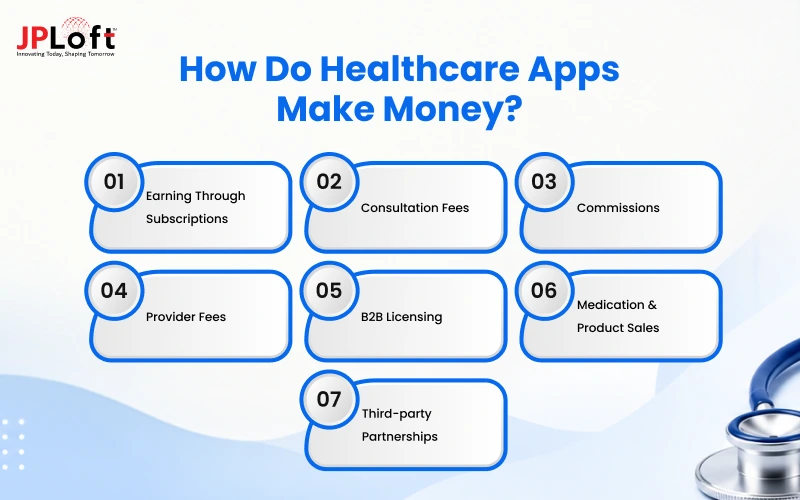
Here are some of the common ways through which mobile apps make money in the healthcare space:
1. Earning Through Subscriptions
Users pay a recurring monthly or annual fee to access premium features, personalized health insights, digital services, or exclusive content. This model creates a predictable revenue stream for the app.
2. Consultation Fees
Telemedicine apps charge patients for virtual consultations with doctors or other healthcare professionals. The platform can earn a fixed service fee or a percentage of each consultation.
3. Commissions
Healthcare marketplaces earn a fixed fee or percentage from transactions completed through the platform. This can include appointments, medicine orders, diagnostic services, or other healthcare services.
4. Provider Fees
Doctors, clinics, and healthcare professionals pay to access premium platform features and tools. These may include patient management, enhanced visibility, analytics, or workflow management capabilities.
5. B2B Licensing
Healthcare organizations license the platform for internal operations or digital patient services. Pricing can be structured around users, features, facilities, or overall platform usage.
6. Medication & Product Sales
Pharmacy and healthcare apps can generate revenue from medicines, medical supplies, wellness products, or other healthcare-related purchases. Revenue may come from product margins or transaction fees.
7. Third-party Partnerships
Apps can partner with insurers, healthcare providers, pharmaceutical companies, employers, and other organizations. Revenue can come through referral agreements, service contracts, or integrated healthcare offerings.

Key Challenges in Healthcare Mobile Application Development
Healthcare mobile application development involves challenges related to security, compliance, interoperability, usability, and scalability. Addressing these areas early helps create a reliable and sustainable healthcare solution.
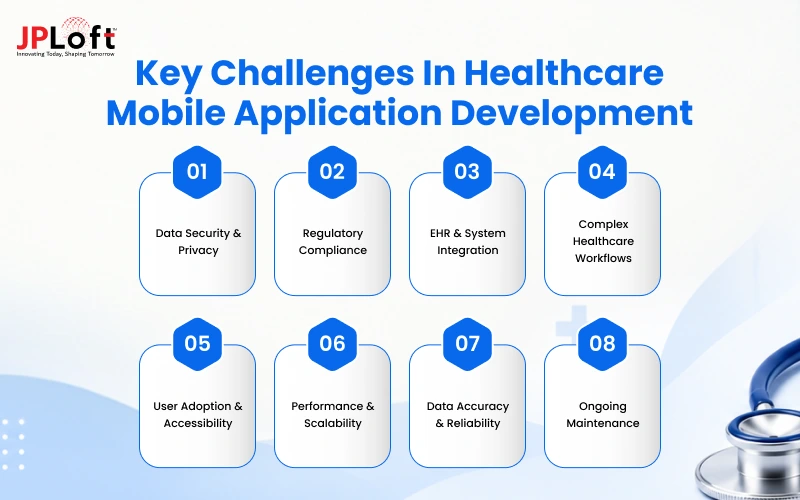
Here are the key app development challenges and the best practices to address them:
Challenge 1: Data Security & Privacy
Healthcare apps handle sensitive patient and clinical data, making them attractive targets for unauthorized access and cyberattacks.
Solution: Use encryption, MFA, role-based access control, secure APIs, audit logs, and regular security testing to protect healthcare information throughout its lifecycle.
Challenge 2: Regulatory Compliance
Healthcare apps may need to meet regulations such as HIPAA, GDPR, or applicable medical-device requirements depending on their functionality and target market.
Solution: Identify applicable requirements during planning and incorporate compliance controls into the architecture, development, testing, and maintenance processes.
Challenge 3: EHR & System Integration
Healthcare organizations often rely on multiple legacy systems that may use different data formats and interfaces.
Solution: Use established interoperability standards such as FHIR and HL7 and design APIs that allow healthcare data to move securely between systems.
Challenge 4: Complex Healthcare Workflows
Patients, doctors, nurses, and administrators follow different workflows, making it difficult to create one experience that works equally well for everyone.
Solution: Map user journeys and clinical workflows before development, then create role-specific interfaces and permissions.
Challenge 5: User Adoption & Accessibility
Healthcare apps must serve users with different ages, abilities, technical skills, and healthcare needs.
Solution: Prioritize simple navigation, accessible interfaces, clear content, responsive design, and usability testing with real users.
Challenge 6: Performance & Scalability
Growing user numbers, increasing health-data volumes, and real-time services can place significant demands on the application.
Solution: Use scalable cloud infrastructure, efficient APIs, optimized databases, monitoring, caching, and performance testing to support future growth.
Challenge 7: Data Accuracy & Reliability
Incorrect, delayed, or incomplete healthcare information can negatively affect user decisions and provider workflows.
Solution: Implement data validation, synchronization checks, error handling, audit trails, and reliable integration processes to maintain data accuracy.
Challenge 8: Ongoing Maintenance
Healthcare platforms require continuous updates as technologies, integrations, security threats, and regulatory requirements change.
Solution: Invest in app maintenance services covering security patches, dependency updates, performance monitoring, integration maintenance, compliance reviews, and feature improvements.
Popular Healthcare Application Development Trends in 2026
Healthcare apps are moving beyond basic digitization toward AI-powered, connected, interoperable, and more personalized care. In 2026, the strongest trends focus on making healthcare more proactive while improving clinical workflows and patient experiences.
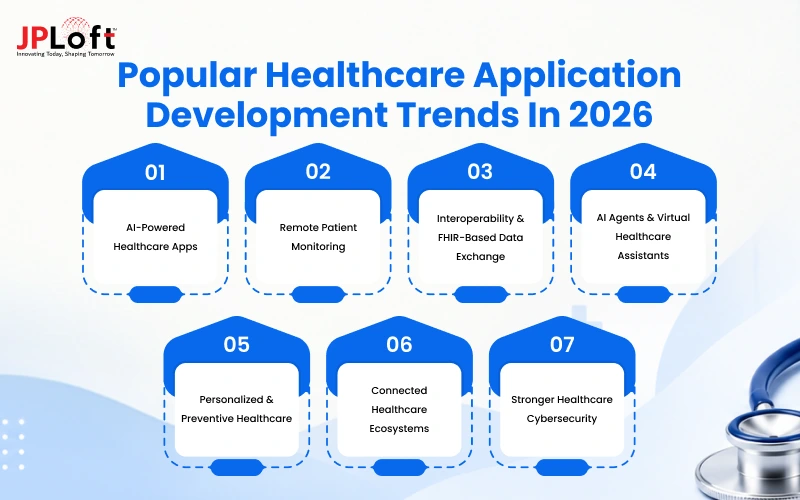
[A] AI-Powered Healthcare Apps
AI is becoming part of everyday healthcare workflows rather than remaining limited to experimental use cases. Apps are increasingly using AI in Healthcare for symptom assessment, clinical decision support, predictive analytics, documentation, patient assistance, and workflow automation.
[B] Remote Patient Monitoring
Healthcare apps are increasingly connecting with wearables and medical devices to monitor patients beyond hospitals and clinics. Real-time health data can help providers identify changes earlier and support continuous care for chronic and post-treatment conditions.
[C] Interoperability & FHIR-Based Data Exchange
Healthcare apps are moving toward standardized data exchange instead of operating as isolated platforms. FHIR, HL7, and SMART on FHIR are becoming increasingly important for connecting apps with EHRs, hospitals, laboratories, insurers, and other healthcare systems.
[D] AI Agents & Virtual Healthcare Assistants
Healthcare providers are exploring AI agents that can handle tasks such as patient intake, appointment coordination, follow-ups, documentation, and basic patient interactions. Human oversight remains important, particularly when AI systems influence clinical decisions.
[E] Personalized & Preventive Healthcare
Healthcare apps are using patient-generated data, AI, wearables, and behavioral information to deliver more personalized health experiences. The focus is shifting from treating problems after they occur toward early detection, prevention, and continuous health management.
[F] Connected Healthcare Ecosystems
Healthcare apps are increasingly becoming part of broader digital ecosystems rather than standalone products. Integration with EHRs, medical devices, pharmacies, laboratories, insurers, and digital health infrastructure is required to move across different stages of the patient journey.
[G] Stronger Healthcare Cybersecurity
Cybersecurity is becoming a core product requirement, with healthcare apps becoming a connected ecosystem. Healthcare mobile app developers are placing greater emphasis on identity management, encryption, access controls, monitoring, backups, and resilient infrastructure to protect patient data and maintain service availability.

Why Partner with JPLoft For Building Healthcare App Solutions?
Choosing the right development partner can directly influence how securely, efficiently, and reliably a healthcare application performs. JPLoft combines healthcare domain expertise with modern mobile, web, AI, and cloud development capabilities to build scalable, secure, and user-focused digital healthcare solutions.
With 16+ years of experience, 1,250+ projects delivered, and a team of 130+ professionals, JPLoft provides end-to-end healthcare app development services. Our expertise spans telemedicine, patient engagement, healthcare management, remote patient monitoring, AI-powered solutions, IoT, cloud platforms, and healthcare system integrations.
We prioritize security, data protection, role-based access control, encryption, and relevant compliance requirements throughout the development lifecycle.
Our team can integrate healthcare applications with EHR/EMR systems, healthcare APIs, wearable devices, medical equipment, and third-party platforms to create connected healthcare ecosystems that can scale with evolving business and patient needs.
Conclusion
Building healthcare apps is no longer limited to digitizing basic healthcare services. Modern apps can connect patients, providers, healthcare organizations, devices, and digital health systems through a single platform.
From telemedicine and patient management to remote monitoring and AI-powered healthcare, the opportunities continue to expand.
However, building a successful healthcare app requires more than the right features. Security, compliance, interoperability, user experience, scalability, and reliable integrations should be considered throughout development.
With the right strategy, a healthcare app can improve access to care, streamline workflows, enhance patient engagement, and create a sustainable digital healthcare business.
FAQs
To build a healthcare app, start by defining the target users and healthcare problem, then validate the idea, plan features, design the UI/UX, select the technology stack, develop the app, integrate required healthcare systems, conduct security and compliance testing, and launch with ongoing maintenance.
Creating a healthcare app can cost anywhere between $20,000 and $450,000, depending on the app's complexity, features, platforms, integrations, security requirements, and advanced technologies.
A basic healthcare app can take around 2-3 months, while medium-complexity apps may require 3-6 months. Further, advanced apps can take 6–10 months, while enterprise-level solutions may require 10–12+ months.
Common features include secure login, patient profiles, appointment management, telemedicine, medical records, prescriptions, payments, notifications, provider dashboards, and secure communication.
Not every healthcare app is automatically subject to HIPAA. Its applicability depends on factors such as the app's functionality, the organization operating it, and how protected health information is handled.

Rahul Sukhwal is the CEO and Founder of JPLoft, with 18+ years of experience in software engineering, emerging technologies, and digital product development. His expertise spans artificial intelligence, including AI agents, generative AI, LLMs, chatbots, computer vision, and machine learning, as well as blockchain, IoT, AR/VR, mobile, web, and enterprise software. He focuses on applying these technologies to real business challenges across industries such as healthcare, education, mobility, finance, real estate, and on-demand services.



Share this blog