


Healthcare has quietly become one of the most competitive spaces in software development, and patient expectations are the reason why.
Someone who once waited weeks for a specialist appointment now books one from their phone in under a minute, and a clinic that ran entirely on paper charts is expected to sync records across three systems without losing a single field.
That shift has pushed hospitals, startups, and medical device companies to look beyond generalist agencies.
They now seek healthcare mobile app development companies that understand regulated patient data, legacy hospital integrations, and compliance audits.
These challenges are rarely part of general consumer app development.
Get any of that wrong, and you're not dealing with a buggy release; you're dealing with data breaches or a product clinicians refuse to use.
This healthcare app development companies guide breaks down which companies are genuinely worth your time, and why.
How Big Is the Healthcare App Market in 2026?
If you want to build a healthcare app, you should know the healthcare app space is already growing.
Here’s where things stand heading into 2026:
-
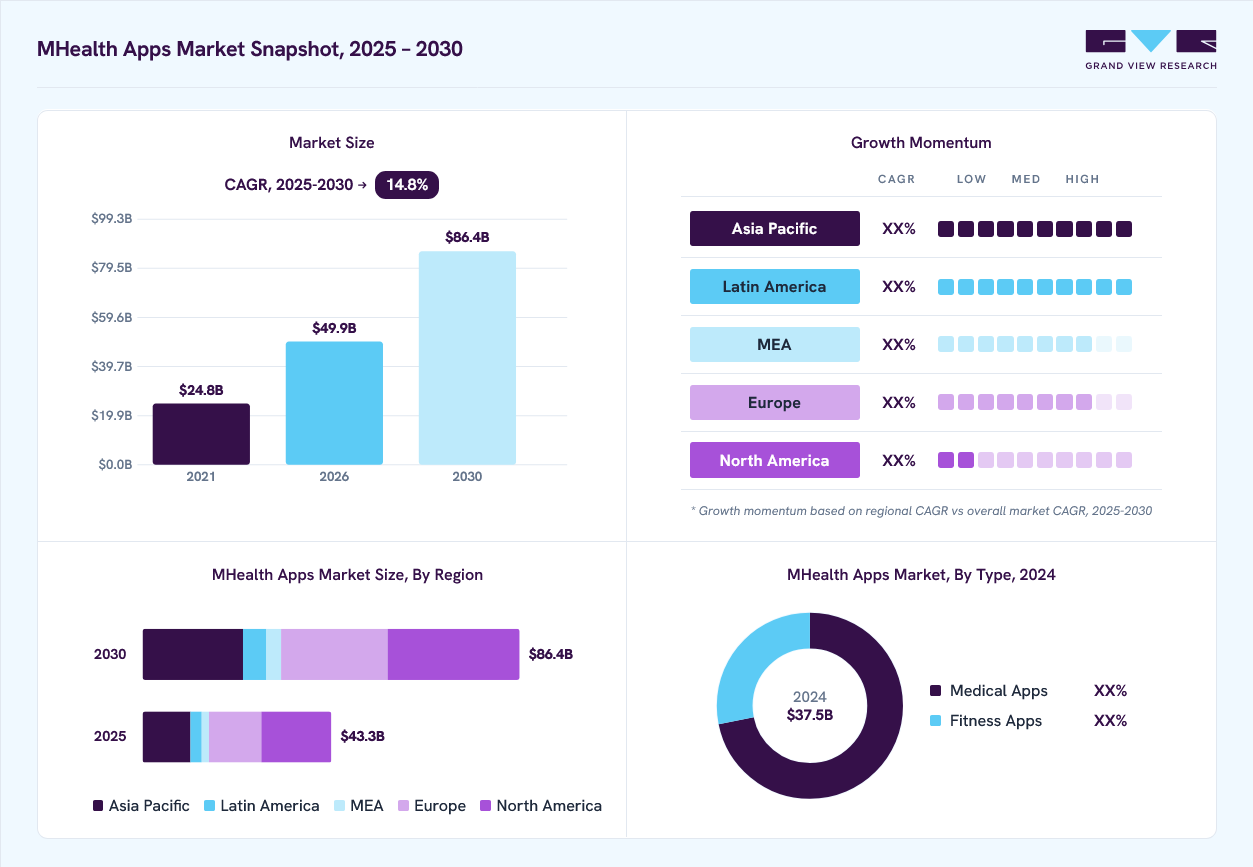
The global mHealth apps market is expected to climb from $49.9 billion in 2026 to $86.4 billion by 2030, growing at a CAGR of 14.8%.
-
Asia-Pacific is projected to be the fastest-growing region over the forecast period.
-
By mode of operation, hybrid apps are projected to grow fastest, at a 41.02% CAGR through 2031.
-
Mental health and mindfulness apps are expanding the quickest, at a 42.11% CAGR through 2031.
-
iOS solutions are forecast to grow fastest, at a 41.33% CAGR through 2031.
How We Selected Healthcare App Development Companies in 2026?
Not every software agency that lists "healthcare" as a service on its website actually understands the industry.
Before putting this list together, we looked past the marketing language and focused on the details that actually separate capable healthcare mobile app developers from teams that are simply dabbling in the space.
Here's what we checked for each company:
-
Regulatory Depth – Genuine, hands-on experience with HIPAA in the US, and where relevant, GDPR or other region-specific frameworks, built into the architecture from day one rather than bolted on before launch.
-
Real Project History – Actual telemedicine platforms, patient portals, EHR integrations, or remote monitoring apps shipped to real clients, not just vague claims of "healthcare solutions" on a homepage.
-
Interoperability Know-How – Comfort working with HL7 and FHIR standards, which matter enormously for any product that needs to talk to hospital systems or insurers.
-
Team Structure – How involved senior engineers and healthcare domain specialists actually are on client work, since healthcare projects tend to go sideways when junior developers make architectural decisions unsupervised.
-
Verified Client Feedback – Reviews on platforms like Clutch and GoodFirms, cross-referenced with public case studies, to get a realistic sense of how each company performs once the contract is signed.
Top 10+ Healthcare App Development Companies
Are you looking for top-rated healthcare app development companies to partner with for your health & wellness projects?
Well, our experts have curated this list where you'll find trusted, experienced teams vetted for their compliance expertise, technical depth, and real-world healthcare project experience, so you can pick the right partner without the guesswork.
Let’s get right into it:
1. JPLoft
JPLoft is a healthcare app development company USA businesses turn to for its combination of technical depth and genuine healthcare domain knowledge, backed by more than sixteen years of technology experience.
Healthcare is a core focus area for the team, not a side offering, and their engineers spend real time mapping patient journeys and provider workflows before writing a single line of code.
Key highlights:
-
Builds telemedicine platforms, patient engagement apps, remote monitoring tools, and AI-driven healthcare solutions
-
Compliance-ready architecture built in from the start, not added before launch
-
Uses AI, machine learning, and IoT where they genuinely add value, such as predictive health tracking through wearables
-
Discovery-first approach that maps clinical workflows before development begins
Best suited for: Startups and healthcare providers who want a development partner willing to invest time in understanding their workflow before writing a single line of code.
2. Blaze.tech
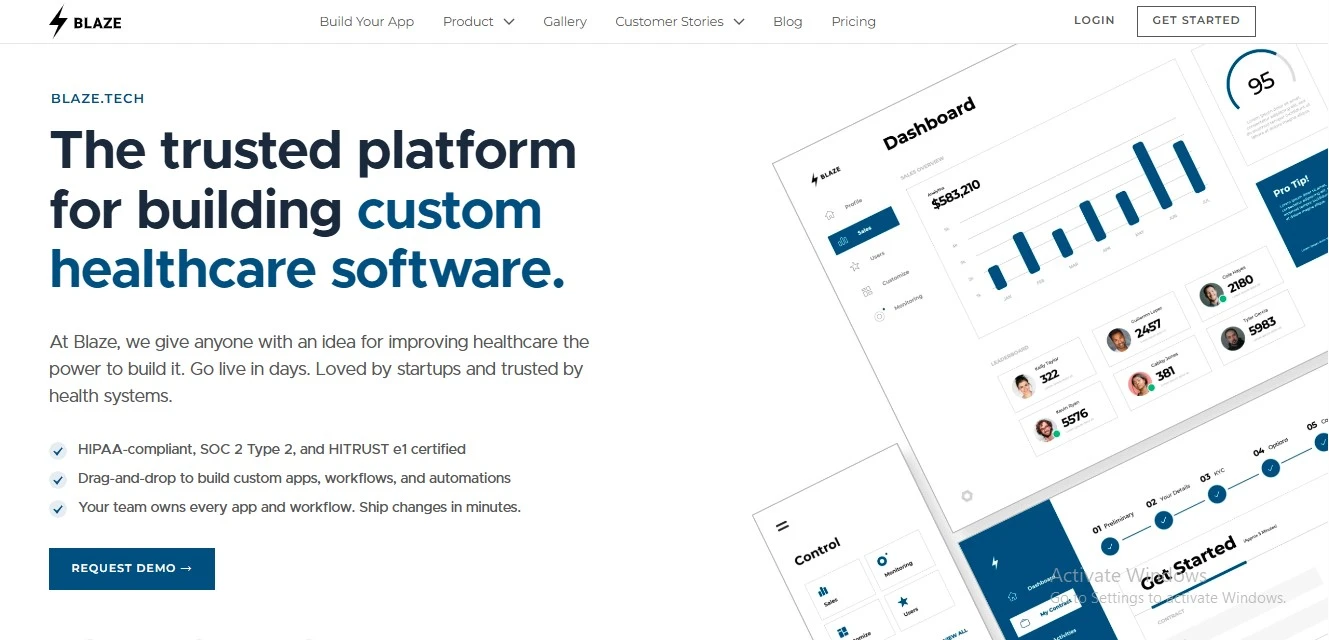
Blaze.tech takes a different approach from most healthcare mobile app development companies on this list.
Instead of functioning as a traditional custom development agency, Blaze.tech offers something different.
It's a no-code, AI-powered platform that lets healthcare organizations build their own HIPAA-compliant applications. No full engineering team required.
Key highlights:
-
No-code platform for building patient portals, scheduling systems, billing tools, and EHR-connected workflows
-
HITRUST e1-certified and SOC 2 Type II compliant
-
Supports native e-prescribing and EHR/EMR integrations
-
Typical builds go from concept to working application in weeks, backed by a small implementation team
-
Can hit limitations on extremely complex or highly customized clinical workflows
Best suited for: Mid-to-large healthcare operations that want to build and iterate on internal or patient-facing apps quickly, without a lengthy traditional development cycle.
3. ScienceSoft
ScienceSoft has been in software development since 1989, with a dedicated healthcare practice spanning more than two decades.
That kind of longevity is one reason they're often named among the top healthcare app development companies for large, complex builds.
Key highlights:
-
ISO 13485 and ISO 27001 certified, with an in-house medical consultant on staff
-
Team of 750+ professionals suited to enterprise-scale engagements
-
Portfolio includes HIPAA-compliant health information exchange solutions, telemedicine platforms, EHR systems, and FDA-regulated medical device software
-
Built patient portals that scaled to 1,500+ users within months of launch
-
Delivered IoT-based rehabilitation platforms with custom motion capture technology
Best suited for: Large healthcare organizations and enterprises that need comprehensive compliance support alongside deep integration with existing medical infrastructure.
4. Intellectsoft
Intellectsoft has been delivering healthcare IT solutions since 2007, with work that leans heavily toward digital transformation projects bringing AI, blockchain, and IoT into healthcare delivery.
Among medical app development companies, they stand out for tackling technically demanding, emerging-tech-heavy builds.
Key highlights:
-
Healthcare portfolio spans EHR/EMR systems, patient portals, telemedicine platforms, medical image analysis tools, and IoMT products
-
Built a web application for a brain-science startup with mobile-optimized access to diagnostic reports and 3D imaging models
-
Offers full-cycle development from discovery through deployment and long-term maintenance
-
Strong focus on incorporating advanced analytics and predictive modeling into healthcare products
Best suited for: Healthcare organizations pursuing digital transformation initiatives that involve emerging technologies and complex system integrations.
5. Arkenea
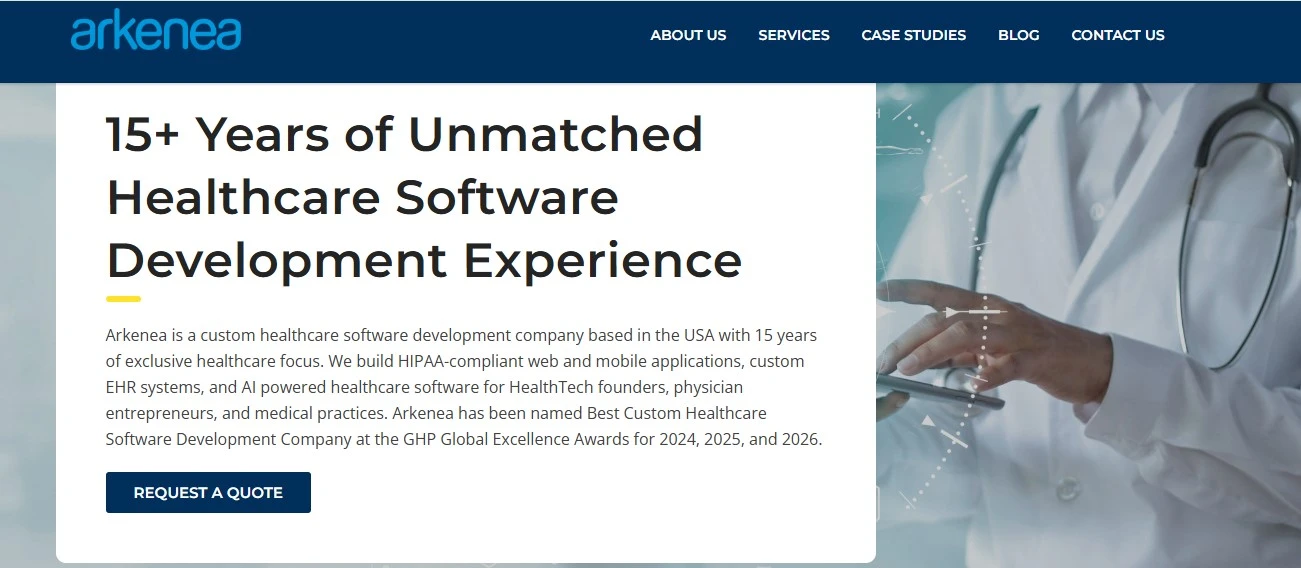
Arkenea has worked exclusively in healthcare software since 2011, and that singular focus is the company's defining trait.
Every engineer, designer, and product manager on the team works within the same domain, which is a rare thing among healthcare app development agencies that usually split their attention across multiple industries.
Key highlights:
-
100% healthcare-focused since 2011, with no other industry verticals
-
Portfolio includes telemedicine platforms, patient portals, practice management systems, and medical device companion apps
-
Built ORLink, a HIPAA-compliant surgical workflow platform, and HomeHosp, a telehealth platform combining scheduling, document sharing, and payments
-
Handles both FDA device regulations and patient-facing usability requirements
Best suited for: Healthcare organizations that want a vendor with one hundred percent healthcare focus and genuinely deep regulatory expertise.
6. Itransition
Itransition operates as a custom healthcare software development company backed by an in-house R&D lab, which the team uses to explore emerging technologies before rolling them into client projects.
As one of the more consultative top healthcare app development agencies, they help clients decide between platform-based and fully custom builds rather than pushing one option by default.
Key highlights:
-
Offers both platform-based (configured and customized) and fully custom software builds
-
Strong focus on interoperability, connecting administrative and clinical systems through custom or pre-built APIs
-
In-house R&D lab dedicated to evaluating emerging technologies
-
Known for scaling distributed development teams without sacrificing delivery speed
Best suited for: Healthcare organizations deciding between platform-based tools and fully custom software who want a consultative partner to help them choose.
7. Cognizant
Cognizant operates on a different scale than most names on this list, offering large-scale digital healthcare transformation backed by advanced analytics and enterprise-grade innovation.
As a global IT services giant, it works with major healthcare payers, providers, and life sciences organizations that need transformation initiatives well beyond a single app.
Key highlights:
-
Large-scale healthcare IT transformation services for payers, providers, and life sciences organizations
-
Integrates AI and analytics into existing enterprise healthcare environments
-
Supports modernization of legacy infrastructure and multi-year transformation roadmaps
-
Best suited to organizations with substantial budgets and complex, multi-system environments
Best suited for: Large healthcare enterprises and payer organizations undertaking enterprise-wide digital transformation rather than a standalone application build.
8. Appinventiv
Appinventiv focuses on AI-enabled healthcare applications built around intelligent automation and modern user experiences.
Among the best mobile app development companies for healthcare, they lean more aggressively into newer technology stacks and AI-driven features than some of the more traditional healthcare-only firms.
Key highlights:
-
AI-driven healthcare applications focused on patient engagement and operational efficiency
-
Integrates analytics and cloud infrastructure into every build
-
Strong emphasis on modern, intuitive UX rather than digitized paper workflows
-
Works across multiple industries, so it's worth confirming the assigned team's specific healthcare depth
Best suited for: Health-tech startups and organizations that want a strong AI and UX focus built into their healthcare product from the start.
9. Tekrevol
Tekrevol is a global digital transformation company headquartered in Houston, with a healthcare practice covering cloud, mobile, and wearable application development.
Its delivery record of more than eight hundred projects across industries gives it a broad technical base to pull from as a healthcare mobile app development company.
Key highlights:
-
Builds platforms aligned with CCHIT certification standards
-
Uses FHIR standards to support interoperable data exchange between providers and systems
-
Delivers custom mHealth apps, electronic health record software, and wearable technology integrations
-
Features like automated charting and real-time monitoring aimed at reducing administrative bottlenecks
Best suited for: Healthcare businesses that want a technology partner experienced across multiple industries, with healthcare as one of several strong verticals.
10. Space-O Technologies
Space-O Technologies has built a substantial healthcare portfolio over more than fifteen years in business.
The company has worked with over one hundred healthcare clients. And delivered hundreds of solutions across hospitals, clinics, and health startups.
It's regularly named among top healthcare app development companies for the sheer breadth of its healthcare work.
Key highlights:
-
ISO 27001:2022 certified, with HIPAA compliance built in from the outset
-
Telemedicine platforms built on React Native and WebRTC, with HL7 FHIR integration
-
Remote patient monitoring software and medical education platforms with surgical simulations
-
Delivered MedCall WorkComp, a full telehealth ecosystem with separate patient and doctor apps plus an admin portal, using AI-driven patient-doctor pairing
Best suited for: Hospitals, clinics, and health startups looking for a development partner with a genuinely broad healthcare portfolio.
11. OpenXcell
OpenXcell is a custom software development company that has expanded into healthcare with a focus on AI-driven solutions for the industry.
As health app developers, the team builds both mobile and web applications tailored to healthcare needs rather than positioning itself purely as a mobile app shop.
Key highlights:
-
Builds both mobile and web applications tailored for healthcare
-
Focus areas include clinical decision support and radiology and imaging solutions
-
Broader software development experience across mid-market and enterprise clients
-
Healthcare is a growing focus area layered on top of strong general engineering practices
Best suited for: Healthcare organizations looking to bring AI-powered clinical decision support or imaging tools into their existing digital infrastructure.
How to Choose the Right Healthcare App Development Company?
With so many capable healthcare app development companies to choose from, the decision usually comes down to a handful of practical questions rather than which name has the flashiest portfolio.
Here's what to check before signing with any healthcare app development agency:
-
How deep does their healthcare experience actually run? A firm that has built dozens of telemedicine platforms and EHR integrations will spot problems before they happen in ways a generalist team can't, no matter how talented their developers are.
-
Can they speak specifically about compliance? Ask about their experience with HIPAA, and if your project involves data exchange with hospitals or insurers, ask about HL7 and FHIR too. Vague answers here are a warning sign.
-
Who will actually work on your project? Healthcare software punishes teams heavy on junior developers and light on senior oversight. Ask directly how involved senior engineers and healthcare domain experts will be throughout the engagement, not just during the sales process.
-
Do you need a fully custom build, or would a platform-based or no-code solution work? Not every healthcare product needs to be built from scratch, and being honest about your actual complexity needs can save significant time and budget.
-
What do real clients say? Look past the marketing pages and dig into verified reviews on Clutch or GoodFirms, and ask for case studies that closely resemble your own project.
Conclusion
Choosing a healthcare app development company is never just a technical decision.
It's a decision about who you trust to handle sensitive patient data responsibly, who understands the regulatory weight your product carries, and who can translate real clinical workflows into software people will actually use.
The companies covered in this guide each bring something different to the table, from JPLoft's workflow-first approach to healthcare builds.
Blaze.tech's no-code speed, to Cognizant's enterprise-scale transformation capabilities, and the right fit depends entirely on your project's size, complexity, and timeline.
Take the time to have real conversations with a few of these top healthcare app development companies before committing.
Ask hard questions about compliance, team structure, and past healthcare-specific work, and pay attention to how clearly they answer. The right partner won't just build what you ask for.
They'll push back when something doesn't make sense for a clinical workflow, and that kind of honest, experienced guidance is often what separates a healthcare app that actually gets adopted from one that quietly gets abandoned six months after launch.
FAQs
Look for proven healthcare-specific experience, not just general app development skills.
Check their track record with HIPAA compliance, HL7/FHIR interoperability, and past projects similar to yours in scope and complexity.
The strongest healthcare app development companies are the ones where senior engineers are genuinely involved in your project, not just present in the sales pitch.
Client reviews on Clutch or GoodFirms and detailed case studies are usually more reliable than a polished homepage.
Costs vary widely depending on complexity, compliance requirements, and integrations. A basic MVP with core features like appointment booking or telehealth consultations can start in the tens of thousands of dollars, while a full-scale platform with EHR integration, remote monitoring, and AI-driven features can run into the hundreds of thousands. Most established healthcare app development companies will also factor in ongoing maintenance, compliance audits, and third-party integrations when quoting long-term costs.
Healthcare apps have to meet strict regulatory requirements like HIPAA in the US or GDPR in Europe, handle sensitive patient data securely, and often integrate with legacy hospital systems using standards like HL7 or FHIR. A single compliance gap or security flaw can have far more serious consequences than in a typical consumer app, which is exactly why healthcare app development companies with genuine domain expertise matter so much when choosing a partner.
A straightforward MVP with core features can typically be built in three to five months. More complex platforms involving EHR integrations, AI-driven features, remote patient monitoring, or multi-terminal support usually take six to twelve months or longer, depending on the number of integrations and the depth of compliance testing required.
It depends on how complex and specific your workflows are. No-code platforms like Blaze.tech can get you to market faster and work well for standard use cases like scheduling or patient portals. Fully custom development makes more sense when your project involves highly specialized clinical workflows, deep EHR integrations, or unique compliance needs that off-the-shelf tools can't accommodate.

Rahul Sukhwal is the CEO and Founder of JPLoft, a visionary technologist with 18+ years at the forefront of emerging tech innovation and software engineering. He channels deep software engineering and AI expertise into building smarter, scalable solutions that shape how forward-thinking businesses worldwide harness the true power of AI.


Share this blog