


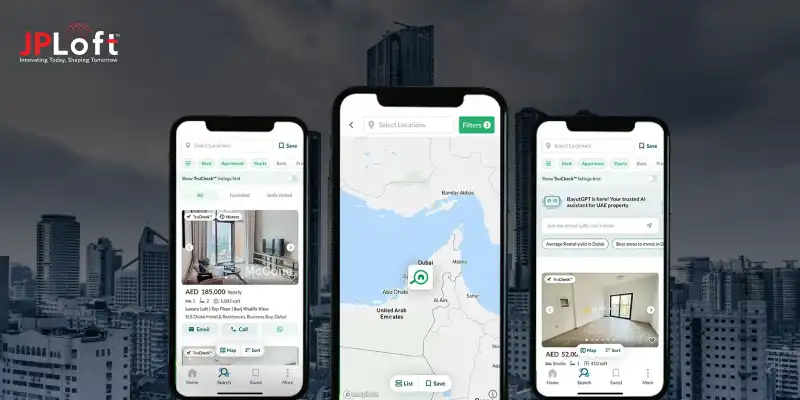
Key Takeaways
Real estate apps like Bayut meet rising digital demand by offering faster property discovery, verified listings, and transparent data that modern buyers and renters expect.
To understand how to develop an app like Bayut, businesses should focus on market research, MVP-first development, user-centric UX, secure systems, and phased feature expansion
Strong monetization models drive sustainable revenue through premium listings, subscriptions, lead generation, and transaction-based services instead of one-time income.
Scalable architecture enables regional and global expansion with localization, multi-language support, and flexible data models supporting long-term growth.
The overall cost to create an app like Bayut ranges from AED 30,000 to AED 50,000 (USD 8,200 to USD 13,600), depending on diversified cost drivers such as complexity, design, etc.
Data-driven features create a competitive advantage by turning user behavior, price trends, and demand insights into smarter decisions for businesses and agents.
JPLoft helps businesses build future-ready real estate apps by combining strategy, UX, scalable technology, and industry expertise into solutions that perform and grow.
The global real estate software market was valued at over USD 10 billion in 2023 and is projected to grow at a strong double-digit CAGR through 2030, driven largely by mobile property search platforms.
In the UAE alone, real estate apps have crossed millions of active users as buyers and renters increasingly rely on digital tools for faster, more transparent decisions.
Apps like Bayut have reshaped property discovery by combining verified listings, smart filters, and real-time insights in one place.
This rapid adoption highlights a clear shift toward app-led real estate ecosystems. Among the diversified real estate apps, Bayut has gained much popularity in Dubai.
Hence, investors or entrepreneurs often ask, “How to develop an app like Bayut? “
The answer starts with in-depth market research, followed by user-centric design, a scalable tech stack, secure data handling, and monetization models aligned with agents and property owners.
Now, let's proceed with the guide, where you will find the complete list of steps, monetization strategies, cost, and much more.
What Is the Bayut App and How Does It Work?
Bayut is the UAE's leading real estate portal and property search app, founded in 2008 and headquartered in Dubai.
The platform connects property seekers with sellers, landlords, and real estate agents across the United Arab Emirates, offering comprehensive listings for buying, selling, and renting residential and commercial properties.
Bayut features over 250,000+ verified property listings spanning Dubai, Abu Dhabi, Sharjah, and other Emirates, complete with detailed descriptions, high-quality images, virtual tours, and interactive maps.
The app provides advanced search filters, mortgage calculators, area guides, market insights, and direct communication with agents.
Acquired by Emerging Markets Property Group (EMPG) in 2022, Bayut has become the go-to platform for UAE property transactions, serving millions of users monthly.
Let’s check out the related stats and other industry numbers below.
-
The global real estate software market size was valued at USD 10,285.7 million in 2023, and is projected to reach USD 21,766.9 million by 2030, growing at a CAGR of 11.3% from 2024 to 2030.
-
Additionally, the global rental apps for the real estate market size is expected to be worth around USD 38.4 billion by 2034, from USD 12.03 billion in 2024, which is growing at a CAGR of 12.30% from 2025 to 2034.
-
When it comes to the Bayut App in the UAE, the app currently has 1 million+ downloads.
Now, are you ready to hire mobile app developers in the UK and build a realistic app?
Well, if you’re still confused, then the next section is for you.
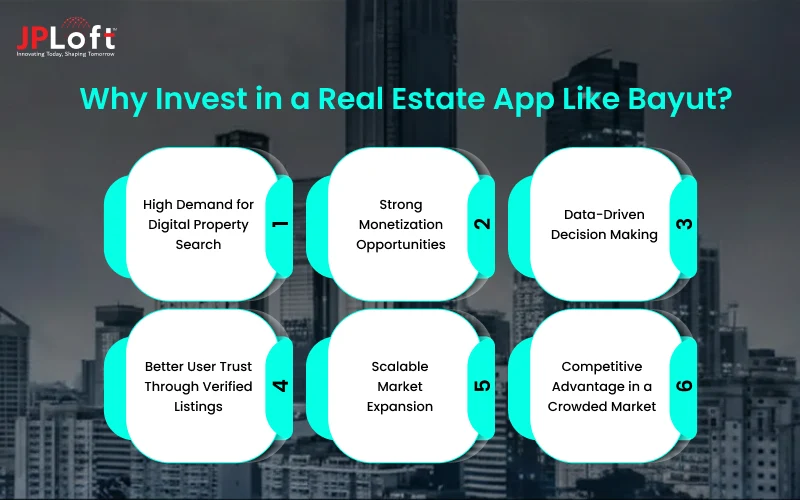
Why Invest in a Real Estate App Like Bayut?
You should invest in a property listing app like Bayut, because of several reasons, such as growing the market of real estate, the growing interest of users in the market, and much more.
Let’s discover all the reasons below.
1. High Demand for Digital Property Search
Homebuyers and renters now expect instant access to verified listings, pricing, and location insights on their phones. The UAE residential real estate market is set to expand from USD 36.32 billion in 2024 to USD 52.32 billion by 2030.
An app like Bayut meets this demand by offering convenience, speed, and transparency in one place. This shift toward mobile-first property discovery makes real estate apps a long-term, high-usage investment.
2. Strong Monetization Opportunities
Real estate apps open multiple revenue streams such as featured listings, agent subscriptions, lead generation fees, and in-app advertising.
Platforms like Bayut prove that brokers and developers are willing to pay for visibility and qualified leads. This creates predictable, recurring revenue instead of one-time transactions. With a strong monetization model, you can convert the potential user into a buyer.
3. Data-Driven Decision Making
A Bayut-like app collects valuable data on user behavior, property demand, price trends, and location preferences. Furthermore, you should opt for data-driven decision-making
This data helps businesses refine offerings, optimize listings, and attract better partners. Over time, analytics become a competitive advantage that traditional offline models cannot match.
4. Better User Trust Through Verified Listings
Users trust platforms that offer accurate data, verified agents, and real-time availability. A structured app experience reduces misinformation, fake listings, and manual follow-ups. This trust directly improves engagement, retention, and conversion rates across buyers, renters, and agents.
5. Scalable Market Expansion
A real estate app scales easily across cities, regions, and even countries without heavy physical infrastructure. Features like filters, maps, and localization allow quick expansion into new markets. This scalability makes the model attractive for startups and established real estate businesses alike.
6. Competitive Advantage in a Crowded Market
Building an app like Bayut positions your business as a tech-enabled real estate brand rather than a traditional listing provider.
Advanced features such as smart search, saved preferences, and instant alerts improve user experience. This differentiation helps you stand out in an increasingly competitive property market.
Now that you are clear on why to invest in an app like Bayut, it's time to include the key features. Hence, the following section can be considered.

Key Features of the Bayut App
Let’s consider the list of key features that you can include when it comes to building an app like Bayut.
Here, you can check out the table given below for more.
|
Feature |
Description |
|
Advanced Property Search |
Allows users to filter properties by location, price, property type, size, and amenities for faster discovery. |
|
Verified Listings |
Displays authenticated properties and agents to reduce fake listings and build user trust. |
|
Interactive Map View |
Enables users to explore properties visually using map-based search with nearby landmarks. |
|
High-Quality Property Media |
Supports HD photos, videos, and virtual tours to give a realistic view of properties. |
|
Saved Searches & Favorites |
Lets users save preferred listings and search criteria for quick access later. |
|
Real-Time Property Alerts |
Sends instant notifications for new listings or price changes matching user preferences. |
|
Agent Profiles & Ratings |
Showcases verified agent details, reviews, and ratings to help users choose confidently. |
|
In-App Contact Options |
Allows direct calling, messaging, or inquiry submission to agents from the app. |
|
Price Trends & Insights |
Provides market insights and price comparisons to support informed decisions. |
|
Multilingual Support |
Caters to diverse users by offering content in multiple languages. |
|
Location & Neighborhood Insights |
Shares nearby schools, transport, and lifestyle details for better evaluation. |
|
Cross-Platform Availability |
Works seamlessly across Android, iOS, and the web for wider accessibility. |
Now, as we proceed with the features, you can include them while considering developing an app like Bayut in the next section.
How to Develop a Real Estate App like Bayut?
You should begin with the research and planning step. This will be all about entering the UK market, learning the nuances, and a lot more.
Well, to build a mobile app, you should begin by learning about the core audience, how to reach these target users, and what they are actually seeking in the app.
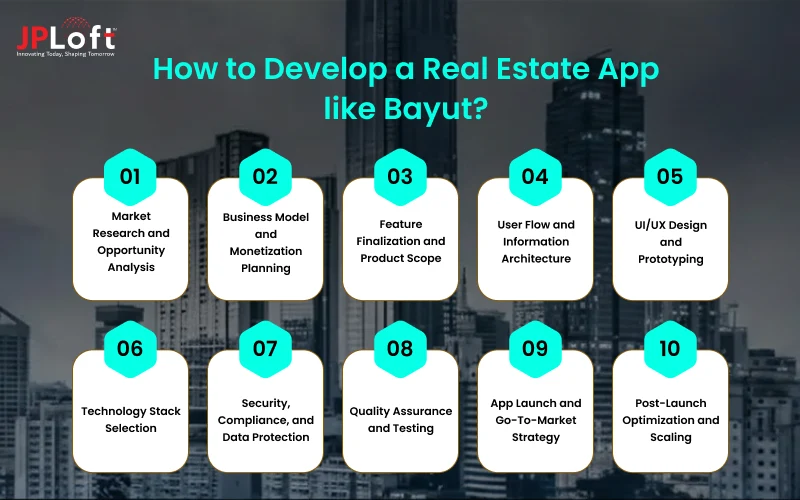
Let’s learn the step-by-step process to build an app like Bayut from scratch, below.
Step 1: Market Research and Opportunity Analysis
This is the step to proceed with if you have finalized your mobile app idea for the next project. You should discover what the current market is offering when it comes to real estate.
► Target Audience Analysis
Identify buyers, renters, agents, and developers along with their search behavior, expectations, and pain points. This step is all about learning the core needs of the audience, what they prefer when it comes to real estate, and what they are looking for in a new app.
► Competitor and Market Gap Study
Analyze existing real estate platforms to understand feature gaps, pricing models, and user experience shortcomings. There are various competitors of Bayut, such as Dubizzle, Property Finder, Zillow, and many more.
Hence, you should identify what they aren’t offering and what you can bring to the industry to address growing users’ issues.
Step 2: Business Model and Monetization Planning
In this step, you should state the business model and the type of monetization planning. Different types of app monetization models that you can include here are freemium, subscription plan, and advertising.
► Revenue Stream Definition
Decide on monetization models like featured listings, agent subscriptions, lead fees, or in-app advertising. Defining the complete revenue streams can be all about stating the types to engage the users and including ROI methods.
► Long-term Scalability Planning
Ensure the business model supports expansion across cities and regions without operational complexity. It's all about evaluating the company’s capacity to grow and handle more demand without substantially increasing costs.
Step 3: Feature Finalization and Product Scope
In this step, you should finalize the features that can be included in an app like Bayut. The different types of features that you can add to the real estate app, like Bayut, are advanced property research, verified listings, high-quality property media, and much more.
► MVP Feature Selection
This is the prime step when it comes to launching an MVP of an app like Bayut in the competitive market. Shortlist essential features such as property search, filters, maps, agent profiles, and inquiry management. It is all about getting approval from the investors or early birds.
► Future Roadmap Planning
Plan advanced features like analytics, AI search, and price insights for later development phases. You should plan the definite implementation of features, like as which updates you will include, which type of features as per the growing demands of the real estate app like Bayut.
Step 4: User Flow and Information Architecture
Are you aware of the user flow and how the users are proceeding with the app?
Well, if not, then this is the time you should actually act on it.
► Buyer and Renter Journey Mapping
Define how users move from search to inquiry with minimal friction and clear navigation. You should plot the buyer and renter journey mapping. Look for the steps that a general user takes while going across to a real estate app like Bayut. The start with framing the structure of the app.
► Agent and Admin Workflow Design
Structure listing uploads, lead management, and dashboard access for agents and administrators. Apart from the users, a top mobile app development company knows well that they need to finalize the workflow design for the admin as well as for the agent.
Step 5: UI/UX Design and Prototyping
In this step, you should start with the frontend of the app. This is all about how you engage the target users by improving the first impression. It's all about adding tools and key design elements that can take your users at first glance of your app.
► Trust-focused Interface Design
Design layouts that emphasize clarity, verified listings, and easy comparison of properties.
You can connect with the leading UI/UX design services to build an engaging and informative design for your real estate app.
► Interactive Prototyping and Validation
Create clickable prototypes to test usability and refine flows before development begins. Apart from this, you should check out the mobile app prototype as well as the mobile app wireframe to decide which interactive element is the best.
Step 6: Technology Stack Selection
Under this step, it's all about including an effective technology stack. You should decide the databases, technologies, along languages that are fruitful for the
► Frontend and Mobile Framework Choice
Choose technologies that support fast rendering, smooth navigation, and responsive property views. For a simple and effective functioning app, it's crucial to include technologies that support the core functions.
► Backend and Database Architecture
Select scalable backend systems capable of handling large listing volumes and real-time updates. Now, it's significant to find a suitable architecture in the process of developing an app like Bayut. You should integrate APIs that are suitable for the functionality of your app, and make the user’s interaction with the app simpler.
Step 7. Security, Compliance, and Data Protection
Mobile app security is one of the important measures to consider when it comes to developing an app like Bayut. For a real estate app that includes payment integration, effective social media networks, it's important to ensure the trust of the users.
► User Authentication and Access Control
Implement secure login, role-based access, and encrypted user data storage. Along with this, it's essential to opt for data protection measures through encrypting the messages or chats with a secure protocol.
► Regulatory and Privacy Compliance
Ensure adherence to regional data protection and property listing regulations. In the process of building an app like Bayut, you should obey the real estate compliance and regulations. You should follow the legal compliances of the UAE and Dubai when it comes to an app like Bayut.
Step 8: Quality Assurance and Testing
Now, under this step, you should enhance the quality of the app by proceeding with the mobile app testing. This step is all about checking out every aspect of the app, before you bring it to the competitive market.
► Functional and Usability Testing
Test search accuracy, filters, maps, and inquiry flows across devices. The functionality testing is all about whether the product’s features work in a specified manner or not. However, to create an app like Bayut, you should consider usability testing too. It is all about checking if the features are easy and satisfying for real users.
► Performance and Load Testing
Validate app stability under high traffic and large data loads. Here, performance testing and load testing are critical for an app like Bayut because they ensure that the platform can handle a high volume of users.
Step 9: App Launch and Go-To-Market Strategy
Now, you should go ahead with launching the app in the competitive market. You should launch the app on the Play Store, or submit the app to the App Store, or you can opt for a cross-platform solution as per the target audience.
► App Store Readiness and Optimization
Prepare store listings, visuals, and descriptions to improve discoverability. Along with this, you should check if your app is ready to publish on the app store or not. Here, after checking on how to build a real estate app like Bayut, you should opt for the practical implementation of the app launch.
► Soft Launch and Feedback Loop
Release to a limited audience to gather insights and fix issues before full rollout. Now, after the soft launch, let's get ahead with the feedback loop. It's about releasing the app to a small, controlled audience for gathering real-world data and user input.
Step 10: Post-Launch Optimization and Scaling
After the Bayut-like app development and launching it on the platform, the next step is all about post-launch optimization and scaling. It's all about mobile app maintenance and regular updates.
► Analytics and User Behavior Tracking
Monitor search trends, engagement, and drop-off points to refine the experience. Now, it's time to analyse how the users are responding to the app, are they find it suitable to get the required information or use, and if not, what’s the gap that exists.
► Feature Expansion and Market Growth
Introduce advanced features and expand into new regions based on usage data. If you are opting for the market growth parameter, connecting with the leading mobile app maintenance services can be helpful.
Now, as you are aware of how to develop an app like Bayut, for detailed information related to the tech stack, this guide saves you from committing mistakes related to tech stack selection.
Hence, let's get ahead with the tech stack further.
Tech Stack to Include while Building an App like Bayut
If you are still puzzled about the mobile app tech stack that you can include in building an app like Bayut, then in this section, you can find a complete list.
Let’s learn the technologies briefly in the table below.
|
Technology Component |
Recommended Tools/Frameworks |
Description |
|
Frontend (Mobile) |
React Native, Flutter, Swift (iOS), Kotlin (Android) |
Cross-platform frameworks like React Native or Flutter enable code reuse across iOS and Android, reducing development time and costs while maintaining native-like performance for property browsing and search features. |
|
Backend |
Node.js, Python (Django/Flask), Ruby on Rails, Java (Spring Boot) |
Robust backend frameworks handle business logic, API management, user authentication, property listings management, and complex search queries with scalability for high user volumes. |
|
Database |
PostgreSQL, MongoDB, MySQL, Amazon RDS |
Relational databases like PostgreSQL store structured property data, user profiles, and transactions, while MongoDB handles unstructured data like property descriptions and flexible attributes for diverse listing types. |
|
Cloud Infrastructure |
AWS, Google Cloud Platform (GCP), Microsoft Azure |
Cloud platforms provide scalable hosting, storage solutions, content delivery networks (CDN), and computing resources that grow with user demand while ensuring high availability and reliability. |
|
Search Engine |
Elasticsearch, Algolia, Apache Solr |
Advanced search engines enable fast, accurate property searches with filters for location, price, property type, amenities, and features, delivering instant results even with millions of listings. |
|
Mapping & Location |
Google Maps API, Mapbox, HERE Maps |
Mapping services display property locations, enable area exploration, calculate distances to amenities, provide directions, and offer interactive map-based property search with geolocation features. |
|
Image & Media Storage |
Amazon S3, Cloudinary, Firebase Storage |
Cloud storage solutions efficiently manage and deliver property images, videos, virtual tours, and documents with optimization, CDN distribution, and automatic resizing for different devices. |
|
Payment Gateway |
Stripe, PayPal, Braintree, local payment providers |
Secure payment processors handle premium listing fees, featured property payments, subscription charges, and commission transactions with PCI DSS compliance and fraud protection. |
|
Authentication |
Firebase Authentication, Auth0, OAuth 2.0, JWT |
Identity management systems provide secure user registration, login, social authentication, multi-factor authentication, and session management protecting user accounts and sensitive data. |
|
Push Notifications |
Firebase Cloud Messaging (FCM), OneSignal, AWS SNS |
Notification services deliver real-time alerts for new listings, price changes, saved search updates, messages from agents, and viewing appointments to keep users engaged. |
|
Analytics |
Google Analytics, Mixpanel, Amplitude, Firebase Analytics |
Analytics platforms track user behavior, conversion funnels, property search patterns, engagement metrics, and app performance to inform data-driven improvements and marketing strategies. |
|
Real-Time Communication |
Twilio, SendGrid, Socket.io, WebRTC |
Communication tools enable instant messaging between buyers and agents, video calls for virtual property tours, SMS notifications, and email campaigns for property alerts. |
|
AI/ML Services |
TensorFlow, PyTorch, AWS SageMaker, Google AI Platform |
Machine learning powers personalized property recommendations, price predictions, image recognition for property categorization, and chatbots for automated customer support and inquiries. |
|
Content Delivery Network |
Cloudflare, Akamai, Amazon CloudFront, Fastly |
CDNs distribute property images and content globally through edge servers, reducing load times, improving user experience, and handling traffic spikes during peak usage periods. |
|
CRM Integration |
Salesforce, HubSpot, Zoho CRM |
Customer relationship management systems help real estate agents manage leads, track interactions, automate follow-ups, and maintain relationships with potential buyers and sellers. |
|
DevOps & CI/CD |
Docker, Kubernetes, Jenkins, GitHub Actions, GitLab CI |
Container orchestration and continuous integration tools automate testing, deployment, and scaling processes, ensuring smooth updates and maintaining app stability across environments. |
Now, as you proceed with the tech stack, let's proceed with the cost factors and cost elements in the following section.
Cost to Create a Property Listing App like Bayut
The cost to create a property listing app like Bayut typically falls within AED 30,000 to AED 50,000 (USD 8,200 to USD 13,600) and depends on features, design complexity, and technical scope.
A basic to mid-level app with core functionality such as property listings, advanced search filters, map view, agent profiles, and admin management fits well within this range.
This budget is ideal for startups and businesses aiming to validate the market with a scalable, performance-ready MVP before expanding into advanced features and integrations.
Here, the cost to hire mobile app developers in Dubai will vary when you specify the niche. Let’s check out the complete cost in the table below.
|
Cost Component |
Basic App |
Mid-Level App |
Advanced App |
|
Core Features (Listings, Search, Filters) |
AED 8,000 |
AED 10,000 |
AED 13,000 |
|
UI/UX Design |
AED 4,000 |
AED 6,000 |
AED 9,000 |
|
Map & Location Integration |
AED 3,000 |
AED 4,000 |
AED 5,000 |
|
Agent Profiles & Admin Panel |
AED 5,000 |
AED 6,000 |
AED 8,000 |
|
Backend & Database Setup |
AED 6,000 |
AED 7,000 |
AED 9,000 |
|
Testing & Quality Assurance |
AED 4,000 |
AED 5,000 |
AED 6,000 |
|
Estimated Total Cost |
~AED 30,000 |
~AED 38,000 |
~AED 50,000 |
Now, after evaluating the cost parameter, let's get ahead with the monetization strategies that you can include in an app, if you need to cover the complete cost to make an app like Bayut.
Hence, let’s switch to the following section, below.

How to Monetize an App Like Bayut?
You can monetize an app like Bayut by including effective business models such as premium property listings, subscription plans, lead generation, including advertising as a strategy, and much more.
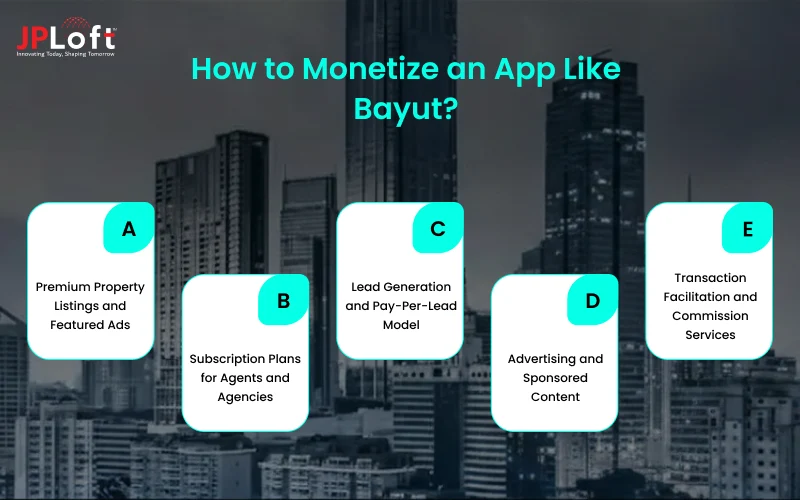
Let’s get ahead with the monetization strategies below.
1. Premium Property Listings and Featured Ads
Charge real estate agents, brokers, and property owners premium fees to feature their listings at the top of search results or homepage for increased visibility.
When you make an app like Bayut, you can go for featured listings with badges like "Hot Deal" or "Premium" to attract significantly more views and inquiries, making them valuable for sellers in competitive markets.
Implement tiered pricing based on listing duration and prominence level, generating substantial recurring revenue as agents continuously refresh featured positions to maintain exposure.
2. Subscription Plans for Agents and Agencies
Offer monthly or annual subscription packages with different tiers providing benefits like unlimited listings, priority support, advanced analytics, and CRM tools.
Basic plans allow limited free listings while premium tiers offer unlimited postings, featured placements, and detailed performance reports. I
Agency-level subscriptions provide multi-user access, branded profiles, and bulk listing management, creating stable recurring revenue while encouraging long-term platform commitment.
3. Lead Generation and Pay-Per-Lead Model
Another crucial monetization model is lead generation and the pay-per-lead model. Charge agents and brokers for qualified leads when potential buyers or renters request property information, schedule viewings, or contact agents directly.
Implement a credit-based system where agents purchase lead packages at different price points, with costs varying based on property value and location desirability.
This performance-based model to create an app like Bayut aligns platform success with agent success, as they only pay for actual business opportunities.
4. Advertising and Sponsored Content
Partner with mortgage providers, moving companies, interior designers, home insurance companies, and furniture retailers to display targeted advertisements throughout the app.
To make an app like Bayut, you need to offer banner ads, native sponsored content, and dedicated promotional sections for partner services.
Implement contextual advertising showing relevant services based on user behavior, diversifying revenue while providing value-added services that enhance rather than disrupt user experience.
5. Transaction Facilitation and Commission Services
Expand beyond listings to facilitate complete property transactions, earning commissions when deals close through the platform.
When you build an app like Bayut, you can offer end-to-end services including document verification, legal assistance coordination, mortgage processing support, and transaction management tools.
Partner with legal firms, banks, and government services to streamline paperwork while collecting referral fees or transaction percentages, generating substantial revenue per successful deal.
Now, after working on the monetization strategies, let's get ahead with evaluating the future of a real estate app in the next section.
What Are the Future Trends You Can Leverage in An App Like Bayut?
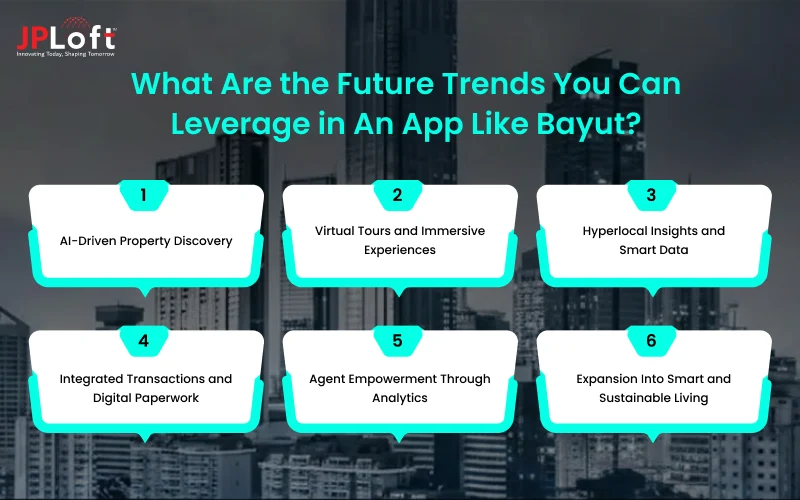
The different future trends that you can include in an app like Bayut are AI-driven property discovery, virtual tours and immersive experiences, hyperlocal insights, agent empowerment, and more.
A leading mobile app development company knows well that with an app like Bayut, you can scale up your real estate business to the next level.
Let’s learn it all in the points listed below.
► AI-Driven Property Discovery
Future real estate apps will rely heavily on AI to personalize property recommendations based on user behavior, budget patterns, and location preferences. Search will feel predictive rather than manual. This reduces decision time and increases user satisfaction.
► Virtual Tours and Immersive Experiences
3D walkthroughs, AR-based previews, and virtual site visits will become standard features. Users will explore properties remotely with near-real accuracy. This shortens sales cycles and attracts international buyers and investors.
► Hyperlocal Insights and Smart Data
You can develop an app like Bayut that will evolve into a local intelligence platform offering price trends, rental yields, neighborhood demand, and lifestyle data. Buyers will make informed decisions without external research. Data becomes a core differentiator.
► Integrated Transactions and Digital Paperwork
Future platforms will move beyond listings into end-to-end property transactions. Digital documentation, e-signatures, payment integrations, and booking flows will reduce reliance on offline processes. Convenience will drive adoption.
► Agent Empowerment Through Analytics
Advanced dashboards will help agents track leads, optimize listings, and understand buyer intent. Performance insights will replace guesswork. This creates higher-quality interactions and better conversion rates.
► Expansion Into Smart and Sustainable Living
Real estate apps like Bayut will highlight energy efficiency, smart home features, and sustainability metrics. Buyers increasingly value long-term cost savings and environmental impact. Apps that surface this data gain a competitive edge.
Build a Bayut-Like Real Estate App with JPLoft
When you create an app like Bayut, it demands more than listings and filters. It requires a deep understanding of property discovery, user trust, performance, and scalability.
JPLoft, a trusted mobile app development company in Dubai, focuses on building real estate platforms that combine clean UX, fast search, verified listings, and secure agent interactions into one seamless product. From market research and feature planning to UI design, backend architecture, and launch readiness, every step is handled with clarity and purpose.
The result is an app that attracts users, retains agents, and supports long-term growth across regions. This approach ensures your real estate app stays competitive, reliable, and ready to scale in high-demand property markets.

Conclusion
Building an app like Bayut is not just about creating a property listing platform. It’s about delivering trust, speed, and clarity in a highly competitive real estate market. From verified listings and advanced search to scalable architecture and smart monetization, every element plays a role in long-term success.
As digital property discovery continues to grow across the UAE and global markets, investing in a Bayut-like app positions businesses for sustained growth. With the right strategy, technology stack, and development partner, you can create a future-ready real estate app that attracts users, empowers agents, and scales confidently across regions.
FAQs
To develop an app like Bayut, start with market research and feature planning, followed by UI/UX design, backend development, and mobile app development. Focus on verified listings, advanced search, scalability, and performance. Testing, launch strategy, and post-launch optimization are critical for long-term success.
A basic to mid-level Bayut-like app usually takes 3 to 5 months to develop. This timeline includes research, design, development, testing, and deployment. Advanced features can extend the duration.
Key features include advanced property search, verified listings, interactive maps, agent profiles, saved searches, and real-time alerts. These ensure trust, usability, and higher engagement.
Building a real estate app like Bayut typically costs between AED 30,000 to AED 50,000, depending on the complexity, features, and customization requirements. The final cost varies based on factors such as design sophistication, backend infrastructure, third-party integrations, and the development team's expertise.
Revenue comes from premium listings, agent subscriptions, pay-per-lead models, advertisements, and transaction commissions. Multiple monetization streams ensure steady income growth.
Startups can launch an MVP with essential features to validate the market. This approach controls costs while allowing gradual feature expansion based on real user demand.

Priyanka Sukhwal is the Managing Director and Business Head of JPLoft, with 10+ years of experience in technology, digital product strategy, and business growth. She has worked closely with businesses building mobile applications, custom software, marketplaces, and on-demand platforms across mobility, automotive, consumer services, and startup ecosystems. At JPLoft, she focuses on understanding business models, identifying product opportunities, and helping companies plan digital solutions that can scale with changing market needs.


Share this blog