


Key Takeaways
The cost to develop an app like Qiwa in Saudi Arabia typically ranges from SAR 112,500 to SAR 1,312,500, driven more by compliance and system integrations than by visual design.
Government API integrations, regulatory logic automation, and Saudi data residency rules are the biggest contributors to overall development cost.
Security is not optional. Compliance with PDPL and NCA standards adds mandatory layers of encryption, audits, and hosting requirements.
A phased, compliance-first MVP approach helps control budget while ensuring the platform is legally and operationally ready.
Long-term success depends on scalability and maintenance planning, with most platforms budgeting 15–20% annually for updates and regulatory changes.
As the Saudi Arabian digital economy undergoes a profound metamorphosis, the Qiwa platform has emerged as a definitive blueprint for Saudi Vision 2030.
As it accelerates its digital transformation, entrepreneurs and enterprises are increasingly asking: What’s the Cost to Develop an App like Qiwa?
In practical terms, developing a platform similar to Qiwa in Saudi Arabia typically falls between SAR 112,500 and SAR 1,312,500 ($30,000 to $350,000).
The final investment shifts based on feature depth, compliance requirements, system integrations, and how far the platform needs to scale across government and enterprise users.
Building such a comprehensive ecosystem is a multi-layered effort. One part focuses on integrating critical modules like contract management, work permit issuance, and Saudization compliance into a single, unified platform.
Another part demands high-level security and seamless government API integrations, where accuracy and data integrity are non-negotiable.
The investment required is not just about coding; it involves creating a robust, legally compliant infrastructure that handles sensitive labor data for millions of users.
Whether you are looking to build a private HR portal or a niche labor market solution, understanding the financial and technical blueprint of a Qiwa-like platform is important.
Let’s explore how much it cost to create an app like Qiwa and more through this blog.
Overview of the Qiwa App
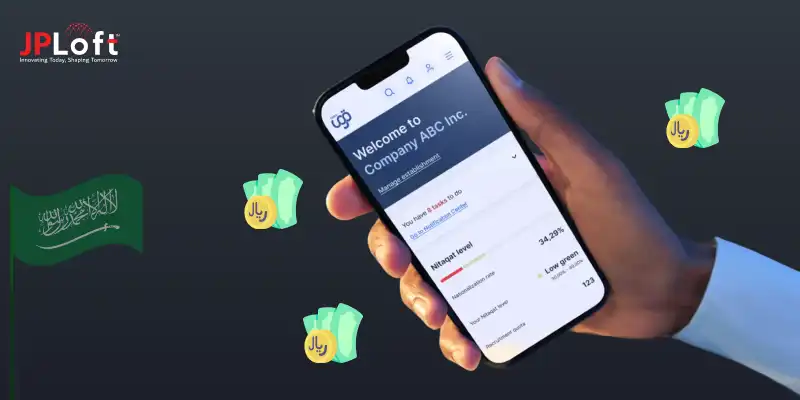
The Qiwa app is a centralized digital platform designed to modernize labor management and workforce compliance in Saudi Arabia.
It connects employers, employees, and government authorities within a single ecosystem that manages contracts, work permits, Saudization policies, and employment data in real time.
From onboarding to compliance monitoring, Qiwa reduces manual processes and replaces fragmented systems with structured digital workflows.
At its core, the platform is built to handle sensitive labor data at scale, which means security, accuracy, and system reliability are non-negotiable.
For businesses aiming to build a mobile app with similar capabilities, the focus goes far beyond UI and basic functionality.
It involves deep integrations with government systems, role-based access control, multilingual support, and scalable backend architecture.
The real value of Qiwa lies in how it simplifies complex regulatory processes while staying aligned with national labor laws. This depth and responsibility directly influence the Qiwa like app development cost.
How Much Does it Cost to Create an App like Qiwa?
Here’s the thing. An app like Qiwa is not priced like a standard HR or marketplace app. It sits in a different category because it handles compliance, legal workflows, sensitive workforce data, and government-level integrations. These requirements directly shape the mobile app development cost.
In the Saudi market, the cost to create an app like Qiwa typically ranges from SAR 112,500 to SAR 1,312,500 ($30,000 to $350,000). The lower end covers a focused platform with core HR workflows, limited integrations, and controlled user roles.
As you move toward enterprise-grade features, real-time validations, advanced security layers, multilingual support, and scalable architecture, the investment increases quickly.
What this really means is that cost depends less on screens and more on responsibility. Compliance depth, backend robustness, and long-term scalability are the biggest cost drivers.
|
Cost Factor |
Estimated Cost (SAR) |
Estimated Cost ($) |
|
UI/UX Design & User Flows |
18,750 – 75,000 |
5,000 – 20,000 |
|
Backend Development & Architecture |
37,500 – 187,500 |
10,000 – 50,000 |
|
Mobile App Development (iOS/Android) |
30,000 – 150,000 |
8,000 – 40,000 |
|
Government API Integrations |
18,750 – 112,500 |
5,000 – 30,000 |
|
Security & Compliance Implementation |
15,000 – 75,000 |
4,000 – 20,000 |
|
Testing, QA & Deployment |
11,250 – 45,000 |
3,000 – 12,000 |
|
Maintenance & Scalability Planning |
11,250 – 45,000 |
3,000 – 12,000 |
Note: The pricing shared above can vary based on your specific requirements, project goals, preferred design approach, and overall platform complexity. For a more accurate estimate, it’s best to discuss your vision with an experienced mobile app development company like JPLoft to gain a clear, tailored cost outlook.
Factors Affecting the Overall Cost to Make an App Like Qiwa
A Qiwa-like platform does not live in the app store category of simple tools. It operates as a digital infrastructure that carries legal, operational, and regulatory weight.
That’s why understanding the cost to create an app like Qiwa requires more than surface-level estimates.
This section is where we unpack the real cost drivers and explain how each factor shapes the cost:
1 . Integration with Government Gateways
The most significant factor you’ll face is the complexity of "talking" to Saudi government systems.
You aren't just building an app; you're building a secure bridge to entities like the MHRSD, GOSI, and Absher. These integrations are the lifeblood of the platform, allowing for real-time contract verification and visa processing.
Each secure API connection requires rigorous data synchronization and military-grade security protocols to ensure that sensitive citizen and business data remains protected.
This heavy-duty backend work is a primary reason the cost to build an app like Qiwa in Saudi Arabia sits at a premium. It involves hundreds of hours of testing to ensure that a single request in your app accurately reflects in the national database.
2. High-Level Security and Data Residency
When you handle labor contracts and personal identification, data privacy and app security aren't just a feature–it’s the entire foundation. In the Kingdom, you must comply with the National Cybersecurity Authority (NCA) standards and the Personal Data Protection Law (PDPL).
This means your data cannot just sit on any random server; it usually needs to be hosted on local Saudi-based cloud providers.
Implementing end-to-end encryption, multi-factor authentication (MFA), and secure biometric logins adds layers of complexity to the development cycle. This level of protection ensures your platform is "government-ready" and legally compliant.
When calculating the cost to develop a mobile app like Qiwa in Saudi Arabia, you have to factor in these non-negotiable security audits and specialized hosting environments that keep your users' data safe within the Kingdom's borders.
3. The Intelligence of Regulatory Logic
Think about the Nitaqat system or the complex rules of Saudi Labor Law; your app needs to understand all of them.
You have to build custom "intelligence engines" that can calculate Saudization ratios on the fly and alert businesses if they fall out of compliance. This isn't just basic math; it's a dynamic system that must be updated every time the Ministry issues a new decree.
Designing these automated compliance workflows requires a deep understanding of local regulations paired with senior backend engineering.
This specialized "legal-tech" logic is a massive driver for the cost to build an app in Saudi Arabia, as it replaces thousands of hours of manual HR work with a single, automated dashboard that gives businesses instant peace of mind.
4. Bilingual UX/UI with RTL Support
In Saudi Arabia, your app must speak two languages perfectly: Arabic and English. But it’s not just about translation; it’s about "Right-to-Left" (RTL) design.
When a user switches to Arabic, the entire interface, buttons, sidebars, and data visualizations must flip seamlessly to provide a natural experience.
Creating a high-end, intuitive design that caters to both a local business owner in Riyadh and a global HR manager requires world-class designers. You need a UI that feels professional yet simple enough for millions of users to navigate without a manual.
This dual-language complexity often doubles the design effort, which is why choosing the right mobile app developers for hire who understand the cultural and linguistic nuances of the region is so critical for your success.
5. Multi-Tenant User Roles
A platform like Qiwa isn't a "one size fits all" interface; it’s a three-headed beast.
You have the Employee portal for viewing contracts, the Employer portal for managing a workforce, and the Government/Admin portal for oversight.
Each of these "tenants" needs a completely different set of features, permissions, and security levels.
Developing these distinct user journeys means you are essentially building three interconnected apps.
Managing the permissions so an employee can't see sensitive company data while an admin can requires a sophisticated Role-Based Access Control (RBAC) system.
This multi-layered architecture is a major reason why many enterprises choose dedicated developers for hire to ensure each portal is built with the focus and precision it deserves.
6. Scalability for Millions of Users
Qiwa currently manages millions of active users and over a hundred million work permits.
If your platform is successful, it will face massive traffic spikes, especially during visa renewal seasons or major policy shifts. You cannot afford for the system to lag or crash when a business is trying to meet a legal deadline.
Building a scalable architecture means using modern cloud technologies and microservices that allow the app to grow as your user base does, but it's important to consider the cost to hire mobile app developers with the necessary expertise for such tasks.
It ensures that whether you have 1,000 users or 10 million, the performance remains lightning-fast. This "future-proofing" is a vital component of the long-term value in your development budget.
7. Continuous Maintenance and Updates
The day you launch is actually just the beginning. In the fast-moving Saudi market, technology evolves quickly, and labor regulations continue to change.
To stay relevant, your app needs a clear roadmap for regular updates, security patches, and feature enhancements.
You’ll need a team ready to respond when the Ministry updates an API or when a new iOS or Android version rolls out. This is where mobile app maintenance services become essential, not optional.
In most cases, budgeting around 15% to 20% of your initial development cost annually helps cover ongoing support and improvements.
Planning maintenance from day one protects your investment and ensures the platform remains a reliable, compliant tool for the Saudi business ecosystem.
How to Reduce the Overall Qiwa like App Development Cost?
Building a Qiwa-style platform does not mean you must stretch budgets unnecessarily. The smart approach is not cutting corners, but cutting waste.
When founders and enterprises look at the Qiwa clone app development cost in KSA, the biggest savings come from better planning, phased execution, and the right technical choices.
Let’s get to know the practical and proven ways to control cost without compromising compliance, security, or long-term scalability:
1] Start with a compliance-focused MVP
Instead of launching every possible feature, begin with a Minimum Viable Product that covers core labor workflows and mandatory compliance.
This reduces initial engineering effort while validating real usage.
A phased rollout keeps the cost to develop an app like Qiwa in Saudi Arabia manageable and prevents spending on features that may not be required immediately.
2] Prioritize backend architecture early
Many cost overruns happen due to backend rework. Investing upfront in a scalable, modular backend prevents expensive rebuilds later.
When architecture is future-ready, adding new labor rules or integrations becomes faster and cheaper.
This approach directly reduces the long-term Cost to build a mobile app like Qiwa in Saudi Arabia.
3] Use cross-platform wisely, not blindly
Cross-platform development can lower initial costs, but critical government-facing features may still require native optimization.
A hybrid strategy often works best.
You can still hire an iOS app developer with expertise only for performance-critical flows while keeping shared logic reusable, balancing quality and budget effectively.
4] Limit government integrations in phase one
Not all integrations need to go live on day one. Identify which Ministry APIs are essential for launch and defer secondary integrations.
This staged approach reduces testing complexity, shortens timelines, and significantly controls the Qiwa clone app development cost in KSA during the early stages.
5] Reuse proven components and frameworks
Custom-building everything from scratch is expensive and unnecessary. Using secure, battle-tested frameworks for authentication, role management, and reporting speeds up development.
This reduces engineering hours without affecting reliability, helping optimize the cost to develop a mobile app like Qiwa in Saudi Arabia.
6] Plan maintenance alongside development
Apps that ignore maintenance planning often face sudden cost spikes. Defining update cycles, API monitoring, and security patch processes early avoids emergency fixes later.
This proactive planning stabilizes long-term expenses and keeps the Cost to build an app like Qiwa in Saudi Arabia predictable.
7] Choose a domain-experienced development partner
Teams familiar with Saudi compliance, labor systems, and enterprise platforms work faster and make fewer costly mistakes.
A knowledgeable partner reduces revision cycles, accelerates approvals, and ensures you invest once, not twice, when managing the Qiwa clone app development cost in KSA.
Building a world-class digital ecosystem is only half the battle; the real mastery lies in transforming that high-stakes investment into a sustainable, profit-generating machine.
How do Apps like Qiwa Earn Money?
While Qiwa serves as a national utility, it operates with a highly efficient business engine that proves public service can also be a powerhouse of sustainability.
By choosing a sophisticated mobile app monetization model, such platforms transform administrative necessity into a massive, recurring revenue stream.
Let’s get to know the different ways your app, like Qiwa, can make money:
► Tiered Subscription Fees
Most HR platforms in the Kingdom use a subscription model where businesses pay an annual fee based on their total employee count.
A small startup with five employees pays a minimal entry fee, while a massive enterprise with thousands of workers pays a premium.
This ensures a steady, predictable cash flow that scales naturally as the private sector expands.
► Transactional Service Charges
Think of this as the "pay-as-you-go" layer for high-value administrative tasks.
Users are often charged specific fees for instant services like issuing work permits, authenticating digital contracts, or processing employee transfers.
By attaching a small cost to these essential transactions, the platform generates high-frequency revenue without requiring a permanent commitment from the user.
► Premium "Super Tier" Features
While basic contract viewing might be free, advanced "power tools" are gated behind a paywall.
This includes access to AI-driven Nitaqat simulators, advanced workforce analytics, or interactive Saudization planning dashboards.
Companies are willing to pay extra for these insights because they prevent expensive legal errors and help them maintain a "Green" or "Platinum" compliance status.
► Third-Party Service Marketplace
By acting as a central hub for all things HR, the platform becomes a prime spot for affiliate partnerships.
You can monetize by allowing legal firms, insurance providers, or recruitment agencies to offer their services directly to businesses within the app.
Each time a company hires a consultant or buys insurance through the portal, the platform earns a commission.
► Specialized Training & Certification
Modern workforce apps often double as e-learning hubs to help employees level up their skills.
By offering paid certification programs or professional training modules that are recognized by the Ministry, the platform creates a new revenue stream.
This adds value to the employee’s career while giving the app owner a foothold in the massive corporate training market.
► Value-Added Data Insights (B2B)
Aggregated, anonymous data about labor market trends is gold for researchers, large investors, and consultancy firms.
While personal data is strictly protected by PDPL laws, high-level reports on industry-wide salary averages or regional employment trends can be sold as "Market Intelligence."
This turns back-end data into a front-line revenue engine for the platform.
How JPLoft Can Help You Develop an App like Qiwa in Saudi Arabia?
Building a Qiwa-style platform requires more than technical execution. It demands a deep understanding of Saudi labor regulations, government integrations, data security laws, and enterprise-scale architecture.
This is where JPLoft steps in as a trusted mobile app development company in Saudi Arabia with proven experience in handling complex, compliance-driven digital products.
JPLoft works closely with businesses from the planning stage, helping define scope, prioritize compliance-critical features, and design scalable system architecture.
From secure government API integrations to bilingual UX with RTL support, every component is built with long-term sustainability in mind.
The team also plans for post-launch evolution, ensuring the platform stays aligned with regulatory updates and technology changes.
Instead of just delivering software, JPLoft helps you build a future-ready digital ecosystem tailored for the Saudi market.
Conclusion
Developing an app like Qiwa is not a conventional app project. It is the creation of a high-responsibility digital infrastructure that must operate flawlessly within a regulated national ecosystem.
From government integrations and security compliance to scalability and ongoing maintenance, every decision directly impacts cost, performance, and long-term value.
Understanding these factors early allows businesses to plan realistically, avoid costly rework, and invest where it truly matters.
With the right strategy, phased execution, and an experienced development partner, building a Qiwa-like platform becomes a structured, achievable goal rather than a risky bet.
When technology, compliance, and business vision align, such platforms don’t just support operations; they become foundational tools powering the future of Saudi Arabia’s digital workforce ecosystem.
FAQs
Developing a Qiwa-like app typically takes 4 to 8 months, depending on feature scope, government integrations, compliance depth, and testing requirements. Enterprise-grade platforms may take longer.
Yes. Apps that integrate with Saudi government systems or handle labor data usually require approvals, security audits, and compliance checks from relevant authorities before going live.
The cost to develop an app like Qiwa typically ranges from SAR 112,500 to SAR 1,312,500 ($30,000 to $350,000), depending on features, complexity, and development time.
Major cost drivers include government API integrations, security and data residency compliance, regulatory logic automation, multilingual UX with RTL support, and scalability planning.
Initial development cost usually excludes maintenance. Businesses should plan an additional 15–20% of the build cost annually for updates, security patches, and regulatory changes.

Priyanka Sukhwal is the Managing Director and Business Head of JPLoft, a results-driven leader with 10+ years of experience steering technology ventures and business growth. Her strategic acumen and deep understanding of digital markets and on-demand solutions have consistently translated into innovations that help businesses scale, evolve, and lead in competitive landscapes.



Share this blog