


Key Takeaways
AI in equine apps improves horse health monitoring, performance tracking, and stable operations through data insights and automation.
Integrating AI requires clear objectives, quality data, scalable infrastructure, expert validation, and continuous optimization for outcomes.
Implementing AI presents challenges such as data gaps, high costs, integrating with wearables, and user adoption resistance
The personalization through AI in equine apps costs between USD 5,000 to USD 25,000+, depending on the model complexity.
Following best practices like user-friendly design, strong security, and model retraining ensures successful AI integration in equine apps.
Partnering with JPLoft enables businesses to build secure, scalable, and innovative AI-powered equine platforms aligned with goals.
Recently, it has been witnessed that the equine industry is entering a smarter digital transformation. Stable owners, trainers, breeders, and riders now expect faster insights and better tools to manage horses with care and precision.
This is where AI equine apps make a real difference. AI helps track health patterns, track performance, predict risks, and simplify daily stable operations. Instead of relying only on manual records, equestrian businesses can now use data-driven systems that learn and improve over time.
From smart feeding schedules to injury prediction and behavior analysis, the role of AI in equine apps brings accuracy and efficiency to every step. For businesses planning to invest in equine apps, understanding how AI works in this space is essential. It is not just automation.
Applications of AI in equine apps are to build intelligent solutions that improve the health of stable pets, reduce operational costs, and create long-term value in a competitive market.
In this blog, we will explore how AI in equine app development works, its key features, benefits, challenges, and best practices to successfully integrate smart technology into modern equine platforms.
Overview of AI in Equine App
AI equine apps transform how equestrian businesses manage horse care, performance tracking, and stable operations. AI uses data, algorithms, and machine learning to analyze patterns and deliver smart insights.
In the equine industry sector, it helps make better decisions backed by real-time information instead of guesswork. An AI-powered equine app can monitor vital health signs, track training progress, analyze moment patterns, and detect early signs of injury or illness.
These artificial intelligence in equine apps collect data from wearable devices, stable management systems, and user inputs. The system then processes this information to generate alerts, recommendations, and performance reports.
For stable owners and trainers, AI reduces manual paperwork and improves operational accuracy. For veterinarians, it provides structured health records and predictive insights. For breeders, it supports lineage tracking and reproductive management.
Beyond care management, AI also enhances business efficiency. It can automate scheduling, optimize feeding plans, and forecast expenses. As the equine industry adopts AI solutions, they have helped improve pet health, increase productivity, and build scalable equestrian businesses.
AI and Equine App Market Statistics
Here are the most recent statistics of the impact of artificial intelligence in equine apps:
-
According to MarketReportAnalytics, the horse management app market reached ~USD 500 million in 2025 and is projected to hit USD 1.5 billion by 2033 at 15% CAGR, with AI-powered analytics as a major innovation driver.
-
The global AI in the animal health market is projected to reach USD 2.06 billion in 2026, as estimated by RootsAnalysis.
-
North America dominates the equine app and software markets due to high equestrian activity and tech adoption, according to GrowthMarketReports.
Now that we understand how AI in equine apps improves user experience and supports management at a technical level. Let us examine the key benefits that AI brings to equine apps and how it enhances both pet health and operational efficiency.

Benefits of Using AI in Equine Apps
The benefits of AI in equine apps offer measurable advantages for equestrian businesses. From improved horse care to streamlined operations, AI enables smarter and faster decision-making.
Below, we have listed how AI in equine apps is shaping modern equine:
1. Improved Health Monitoring
AI analyzes data from wearables and health records to detect early signs of illness or injury. This helps trainers and veterinarians take preventive action and reduce medical risks. It also creates detailed digital health histories that improve long-term care planning.
2. Accurate Performance Tracking
AI-powered systems track training sessions, movement patterns, and recovery rates. Businesses can adjust training plans based on real performance data instead of assumptions. This ensures each horse follows a personalized training program for optimal results.
3. Predictive Risk Management
Machine learning models identify patterns that signal potential health or behavioral issues. Early alerts minimize downtime and protect long-term horse performance. This proactive approach reduces emergency treatments and unexpected expenses.
4. Automated Stable Operations
The importance of AI in equine apps helps streamline feeding schedules, appointment reminders, inventory tracking, and staff management. Automation reduces manual errors and saves valuable time. It also improves coordination between trainers, caretakers, and stable managers.
5. Data-Driven Decision Making
Centralized dashboards convert complex data into simple insights. Owners and managers can plan breeding, training, and budgeting strategies with greater confidence. This leads to smarter investments and better resource allocation.
The benefits of AI in equine apps vary from improved health monitoring and performance insights to streamlined stable management and smarter decision-making.
To truly understand functioning, let’s explore the core AI features that drive modern equine apps and make them so effective.
Core AI Features in Modern Equine Apps
Integration of AI in core equine app features combines intelligent automation with data-driven insights to improve pet care and stable management.
Below are the core AI features shaping equine technology platforms today:
|
AI Feature |
Description |
Business Impact |
|
Smart Health Monitoring |
Uses AI algorithms to analyze vital signs such as heart rate, temperature, and movement patterns collected from wearable devices. Detects irregularities and sends instant alerts. |
Enables early diagnosis, reduces emergency medical costs, and improves overall equine welfare. |
|
Predictive Injury Detection |
Machine learning models study gait, workload, and recovery data to identify patterns that signal potential injuries before symptoms become visible. |
Minimizes downtime, protects performance horses, and lowers long-term treatment expenses. |
|
Performance Analytics |
AI evaluates training sessions, speed, endurance, and recovery cycles to generate performance insights and improvement suggestions. |
Helps trainers optimize training programs and enhance competitive outcomes. |
|
Behavioral Analysis |
Analyzes activity data and behavioral trends to detect stress, discomfort, or unusual habits in horses. |
Supports proactive care and improves stable management decisions. |
|
Automated Feeding Optimization |
AI calculates personalized feeding schedules based on weight, age, workload, and health conditions. |
Reduces feed waste and ensures balanced nutrition for peak performance. |
|
Breeding Management Intelligence |
Uses historical lineage data and reproductive health records to predict breeding success rates and optimal timing. |
Improves breeding outcomes and increases return on investment. |
|
Smart Scheduling & Task Automation |
Automates vet appointments, farrier visits, vaccination reminders, and staff assignments using predictive scheduling tools. |
Enhances operational efficiency and reduces manual errors. |
|
Expense Forecasting & Budget Insights |
AI analyzes spending patterns, maintenance costs, and medical expenses to forecast future financial needs. |
Supports better financial planning and cost control. |
|
Data-Driven Reporting Dashboard |
Converts large volumes of stable and horse data into easy-to-read visual reports and insights. |
Enables faster strategic decisions for business growth. |
|
Real-Time Alert System |
Sends instant notifications for health risks, feeding times, abnormal activity, or missed tasks. |
Ensures timely action and improves overall stable management responsiveness. |
These AI-powered features are the reason why AI in equine apps matters today! It helps businesses move toward smarter, data-driven operations with long-term sustainability.
The next step is to understand how to effectively integrate AI in equine apps to ensure seamless performance, scalability, and real-world impact.
How to Integrate AI in Equine Apps?
The impact of AI in equine apps requires a structured and business-focused approach. It is beyond just adding smart features. It builds a system that delivers accurate insights, improves horse care, and supports stable operations at scale.
Below is a step-by-step process to successfully integrate AI in equine apps:
Step 1. Define Clear Business Objectives
Start working on an AI-powered equine app by identifying the exact problems you want AI to solve. This may include injury prediction, automated feeding plans, performance tracking, or breeding optimization.
Clear equine app ideas help you choose the right AI models and avoid unnecessary development costs. Align AI use cases with measurable business outcomes such as reduced medical expenses or improved training efficiency.
Step 2. Collect and Organize Quality Data
AI systems rely on structured and reliable data. Gather historical health records, training logs, breeding details, feeding schedules, and wearable sensor data. Ensure the data is clean, categorized, and consistently formatted.
Poor data quality leads to inaccurate predictions and unreliable outputs. You should also plan secure storage using cloud infrastructure to handle large datasets and allow real-time updates.
Step 3. Choose the Right AI Technologies
Select the best uses of AI in equine apps based on your use case. For example, ML models for injury prediction, computer vision for gait and movement analysis, and predictive analytics for expense forecasting
Choose scalable frameworks for app development that support continuous learning. The system should improve as more data is collected over time.
Step 4. Integrate IoT and Wearable Devices
The role of AI in equine apps often connects with smart halters, biometric sensors, and GPS trackers. These devices collect real-time data such as heart rate, temperature, and activity levels.
Partner with an IoT app development company to ensure AI models receive live inputs instead of static records from the IoT devices. This step requires API development and secure data synchronization between devices and the application.
Step 5. Develop and Train AI Models
Once the data pipeline is ready, data scientists train AI models using historical datasets. The model identifies patterns and learns to make predictions. Mobile app testing is crucial to know the vulnerabilities of this advanced integration.
Run simulations to measure accuracy, reduce bias, and validate results before deployment. Regular retraining is necessary to maintain model performance as new data enters the system.
Step 6. Build a User-Friendly Interface
AI insights must be easy to understand. Mobile app design dashboards that display alerts, performance charts, and health recommendations in a simple format.
Avoid overwhelming users with raw data. Instead, convert complex outputs into actionable insights for trainers, veterinarians, and stable managers.
Step 7. Ensure Data Security and Compliance
Equine businesses handle sensitive health and financial information. Implement strong encryption, secure authentication, and role-based access controls.
Conduct regular mobile app security audits and vulnerability assessments to prevent breaches. Compliance with regional data protection standards builds trust and reduces legal risks.
Step 8. Monitor, Optimize, and Scale
After deployment, continuously monitor AI performance. Track prediction accuracy, user engagement, and operational improvements.
Gather feedback from trainers and stable owners to refine features. As your business grows, scale the infrastructure to support more horses, devices, and advanced analytics tools.
Building an AI app is a strategic investment in 2026. When executed correctly, it enhances horse welfare, streamlines stable management, and creates a competitive advantage.
Now let’s break down the key factors that influence the cost of implementing AI in an equine app.
Cost to Implement AI in Equine App
The cost to integrate AI in equine app solutions ranges between USD 5,000 to USD 25,000+.
The cost of developing an equine app depends on complexity, features, and infrastructure requirements. The final investment depends on data volume, AI model sophistication, third-party integrations, and long-term scalability goals.
Below is a structured cost breakdown of personalization through AI in equine apps:
1. Basic AI Integration - USD 5,000 to USD 10,000
Suitable for startups or small equestrian businesses.
Includes:
-
Basic health tracking analytics
-
Simple predictive alerts
-
Limited wearable device integration
-
Standard dashboard and reporting
This level focuses on rule-based automation and entry-level machine learning models. It works well for stable management and basic performance monitoring.
2. Mid-Level AI Integration - USD 10,000 to USD 25,000
Ideal for growing equine businesses.
Includes:
-
Predictive injury detection
-
Performance analytics
-
Feeding optimization algorithms
-
IoT and wearable integration
-
Cloud-based data storage
At this stage, machine learning models are trained on historical datasets. The system supports real-time alerts and more advanced reporting capabilities.
3. Advanced AI-Powered Solution - USD 25,000+
Designed for large-scale equestrian operations or enterprise platforms.
Includes:
-
Advanced predictive analytics
-
Computer vision for gait analysis
-
Breeding intelligence models
-
Financial forecasting tools
-
Real-time multi-device synchronization
-
Custom AI model development
This level requires dedicated data science teams, high-end cloud infrastructure, continuous model training, and strong security frameworks.
Knowing the cost of implementing AI in an equine app provides a clear picture of the investment required, but what does that investment actually deliver in real-world practice? Let's see next!
Real-World Use Cases of AI in Equine Apps
AI is reshaping equine technology with real, practical impact. Let’s explore what is the importance of AI in equine apps to improve horse care, performance tracking, and stable management.
Here are some top equine apps with AI integration:
[1] Equiyd
Equiyd is an AI-driven equine management platform that centralizes a horse’s life data, from health and training history to performance insights, in one secure profile.
AI Integration:
-
Predictive analytics: AI learns from historical care, training, and movement data to reveal patterns and early signals that are otherwise not obvious.
-
AI Riding Analysis: Users can upload videos to receive AI-powered movement and performance insights, tying both horse and rider data together.
-
AI assistant (Equi-Agent): A 24/7 equine assistant guiding training, care, and competitions.
[2] Sleip
Sleip is an advanced AI-powered gait analysis tool used by vets and equine professionals to assess locomotion objectively using just a smartphone.
AI Integration:
-
Computer vision gait analysis: AI tracks over 100 anatomical key points to measure asymmetry and movement irregularities with high precision.
-
Performance & health monitoring: Helps detect subtle gait variations and track movement trends over time, supporting early referrals or rehab decisions.
[3] Ridesum
Ridesum is an equestrian training and performance app built for riders and trainers.
AI Integration:
-
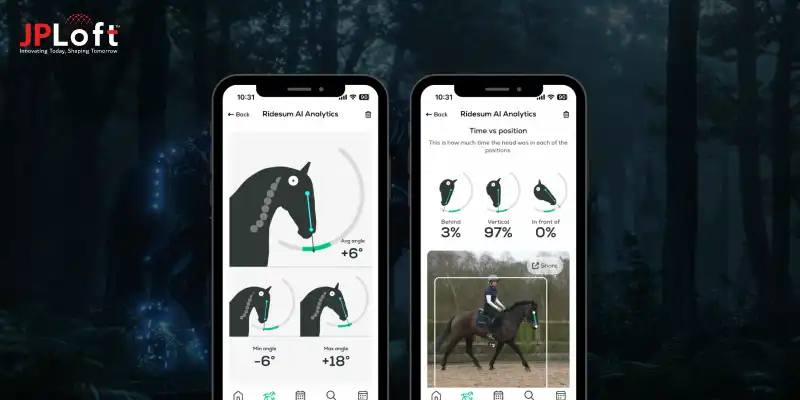
AI Equine Analytics: Uses AI to measure key movement metrics (e.g., head carriage, stride, limb motion) to optimize performance and detect potential issues from video footage.
-
AI Seat Analytics: Evaluates rider posture and biomechanics to refine technique.
-
Personalized training insights: Tailored suggestions and progress tracking based on performance trends.
[4] Happie Horse
Happie Horse focuses on comprehensive horse management, from daily care and health tracking to training journals and environmental analytics.
AI Integration:
-
Happie AI Chat Assistant: Users can ask about management routines, training suggestions, or health concerns and receive tailored recommendations through conversational AI.
-
Symptom & plan guidance: The assistant offers recommendations on vaccination schedules, deworming, training adjustments, and more based on stored data of the stable.
[5] Equestrian AiK
Equestrian AiK is a motion analysis app designed for riders and trainers that uses AI to assess technique and biomechanics.
AI Integration:
-
AI Motion Analysis: Evaluates rider balance, symmetry, and position using only smartphone-captured video.
-
Personalized feedback: Offers recommendations to refine riding technique and prevent bad habits.
-
Progress tracking: Users can compare performance metrics across sessions to visualize improvements over time.
These real-world examples show why AI in equine apps matters today. It makes businesses smarter and helps with data-driven decisions.
To build sustainable and effective solutions, let’s examine the key challenges businesses may face when integrating AI into equine apps.
Challenges in Implementing AI in Equine App
Integrating AI in equine apps offers strong business value, but implementation comes with various AI integration challenges for equine apps.
With the right strategy, businesses can overcome these challenges and unlock long-term operational and health benefits.
Here are the major challenges in equine app projects every equestrian business should know about:
1. Limited and Unstructured Data
Challenge: Many stables still rely on manual records, spreadsheets, or incomplete health logs. AI systems require large volumes of clean and structured data to function accurately. Poor data quality leads to unreliable predictions.
Solution: Start with data standardization. Digitize historical records and use consistent data entry formats. Integrate wearables and IoT devices to capture real-time structured data. Implement data validation rules within the app to maintain accuracy.
2. High Development Costs
Challenge: AI development involves data scientists, advanced infrastructure, model training, and testing. For startups or mid-sized equine businesses, this investment can seem expensive.
Solution: Adopt a phased development approach. Begin with one high-impact AI feature, such as injury prediction or automated feeding optimization. Use cloud-based AI services to reduce infrastructure costs. Scale gradually based on ROI.
3. Integration with Wearables and IoT Devices
Challenge: Connecting biometric sensors, GPS trackers, and smart halters requires stable APIs and secure data synchronization. Compatibility issues may arise across devices when you follow up with the top trends of equine apps.
Solution: Use standardized APIs and select IoT devices that support open integration frameworks. Conduct early-stage testing for device compatibility. Partner with reliable hardware providers to ensure seamless data flow.
4. Accuracy and Model Reliability
Challenge: AI models may produce incorrect predictions if trained on biased or limited datasets. In equine health, inaccurate insights can lead to serious consequences.
Solution: Use diverse datasets during training and perform continuous model validation. Work closely with veterinarians and trainers to verify outputs. Implement human oversight before critical decisions are finalized.
5. Data Security and Privacy Risks
Challenge: Equine apps store sensitive health, breeding, and financial data. Cybersecurity threats can damage trust and create legal issues.
Solution: Apply end-to-end encryption, multi-factor authentication, and role-based access controls. Host data on secure cloud platforms and conduct regular security audits. Ensure compliance with regional data protection regulations.
6. User Adoption Resistance
Challenge: Traditional stable owners and trainers may hesitate to rely on AI systems. They may prefer manual methods due to familiarity.
Solution: Design simple dashboards with clear visual insights. Provide onboarding training and demonstrate measurable benefits. Start with AI as a support tool rather than a replacement for human expertise.
By following proven strategies and industry best practices, businesses can avoid challenges to implement AI in equine apps.
While streamlining adoption, reducing risks, and maximizing the impact of AI. Let’s look at the best practices for successfully integrating AI into these equestrian apps.
Best Practices to Integrate AI in Equine App
Implementing AI in equine app solutions requires more than adding smart algorithms. You need a clear strategy, reliable data, and a scalable technical foundation.
Below are the best practices to ensure the successful development of AI-powered equine app:
A. Start with a Clear Use Case
Define a specific problem before building AI features. Focus on areas such as injury prediction, gait analysis, feeding optimization, or performance tracking. A well-defined use case prevents unnecessary development and ensures measurable ROI.
B. Prioritize High-Quality Data
AI systems depend on accurate and structured data. Standardize health records, training logs, and feeding schedules. Integrate wearable sensors and IoT devices to capture real-time information. Clean and validated datasets improve prediction accuracy.
C. Build a Scalable Architecture
Choose a cloud-based infrastructure that supports large datasets and real-time processing. Use modular AI components so new features can be added without disrupting existing systems. Scalability ensures long-term growth.
D. Collaborate with Equine Experts
Work closely with veterinarians, trainers, and breeders during development. Their domain knowledge helps validate AI outputs and ensures practical relevance. Human oversight improves trust and reliability.
E. Focus on User-Friendly Design
Present AI insights in simple dashboards with alerts, charts, and clear recommendations. Avoid technical jargon. The goal is to provide actionable insights that stable owners and trainers can easily understand.
F. Ensure Strong Data Security
Protect sensitive information like health and financial data with encryption, multi-factor authentication, and role-based access control. Regular security audits reduce compliance risks and strengthen user trust.
G. Continuously Train and Optimize Models
AI models should improve over time. Regularly retrain systems with new data and monitor performance metrics. Collect user feedback to refine algorithms and enhance prediction accuracy.
H. Test Before Full Deployment
Run pilot programs with selected users before launching widely. Measure accuracy, usability, and system performance. Early testing reduces operational risks and improves final product quality.
Follow these best practices to get access to the best uses of AI in equine apps for improving the welfare of stable pets. It will also help build intelligent equine management solutions that scale with industry demands.

How JPLoft Can Help You Develop an AI-Powered Equine App?
Building an intelligent equine solution requires more than app development. It demands deep technical expertise, industry understanding, and a clear AI strategy.
JPLoft offers custom equine app development services that help businesses like yours turn innovative ideas into scalable, AI-powered platforms that deliver measurable results.
From predictive health monitoring and gait analysis to automated stable operations and performance analytics, we design solutions that improve pet health and operational efficiency.
We follow a structured development process that includes requirement analysis, data strategy planning, AI model integration, IoT connectivity, and secure cloud deployment. Our experts ensure that every AI feature is aligned with your business goals and delivers real value.
At JPLoft, we focus on scalability, security, and user-friendly design. Whether you are a startup building a new equine app or an established business upgrading your digital infrastructure, we provide end-to-end support.
Partner with JPLoft to build future-ready, AI-driven equine platforms that drive innovation and long-term growth.
Conclusion
Understanding how AI in equine apps improves user experience is reshaping equine care, performance tracking, and stable operations. From predictive health monitoring to smart training insights, AI brings accuracy and efficiency to every stage of equine management.
AI helps automate workflow, reduce risks, lower operational costs, and improve overall management of stability through data-driven decisions. However, successful implementation requires clear objectives, structured data, scalable infrastructure, and collaboration with equine experts.
Businesses that follow best practices and address technical challenges strategically can unlock long-term value. As the equine industry continues to adopt digital innovation, AI-powered platforms will no longer be optional.
They will become essential tools for competitive growth and sustainable operations. Investing in the technology partner and a well-planned AI strategy today can position your equine business for smarter, more profitable outcomes tomorrow.
FAQs
AI in equine apps improves health monitoring, predicts injuries, analyzes performance, and automates stable tasks. It reduces manual errors, enhances decision-making, and optimizes feeding and training plans. Businesses gain better efficiency, lower operational costs, and improved stable pet welfare through data-driven insights.
Start by defining a clear use case and collecting structured data. Choose suitable AI models, integrate IoT devices for real-time inputs, and build a scalable cloud infrastructure. Test thoroughly, validate results with experts, and continuously retrain models for improved accuracy.
The cost depends on features, data complexity, AI models, and integrations. Basic AI features may start from moderate development budgets, while advanced predictive analytics and IoT integrations increase expenses. Ongoing costs include cloud hosting, model training, maintenance, and upgrades.
Common challenges include limited structured data, high development costs, integration issues with wearables, model accuracy concerns, and data security risks. User resistance can also slow adoption. Proper planning, testing, and phased deployment help overcome these obstacles.
Define clear objectives, use high-quality data, and build a scalable architecture. Collaborate with equine experts to validate outputs. Focus on user-friendly dashboards and strong security measures. Continuously monitor performance and retrain AI models to maintain long-term accuracy and value.

Kris Jacobs brings 20+ years of experience solving complex digital product challenges through strategic thinking and user-centric design. With deep exposure to on-demand services, entertainment, travel, and interactive platforms, she collaborates across teams to shape scalable, engaging solutions that align business goals with intuitive user experiences across evolving digital landscapes.




Share this blog