


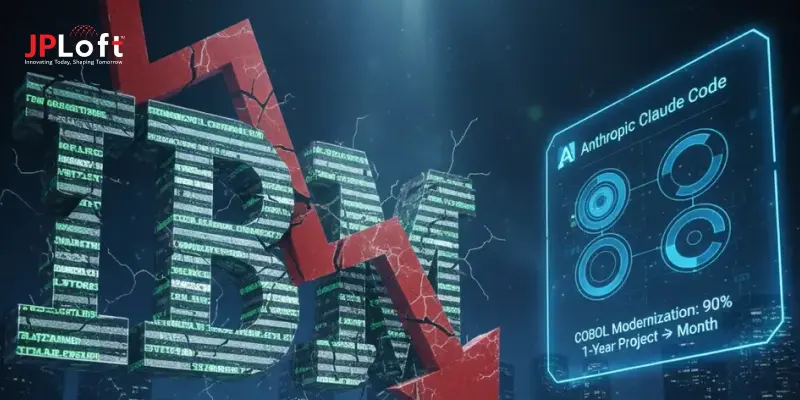
IBM is facing renewed market pressure after artificial intelligence entered one of its most established business areas: COBOL modernization. The company’s stock fell 13%, wiping approximately $30 billion off its market value in a single trading session, following investor concerns that AI could disrupt its legacy software services segment.
The reaction came after AI startup Anthropic showcased its Claude Code tool, which demonstrated the ability to assist in modernizing COBOL systems. COBOL, a programming language developed more than six decades ago, continues to power mission-critical systems across banking, insurance, and government institutions worldwide.
AI Raises Questions Around IBM’s Legacy Advantage
For decades, IBM has benefited from enterprises relying on its mainframes and consulting expertise to maintain and upgrade COBOL-based systems. These legacy systems remain deeply embedded in financial infrastructure and large-scale transaction processing environments.
Anthropic’s demonstration suggested that generative AI could accelerate the translation and modernization of COBOL code. This sparked concerns among investors that AI-assisted tools might reduce dependency on traditional, consulting-heavy modernization services — a segment that has historically contributed to IBM’s enterprise revenue.
The market reaction was swift. IBM’s 13% stock decline reflected growing uncertainty about how rapidly AI could reshape enterprise software transformation economics.
Modernization Goes Beyond Code Conversion
While AI tools may help automate portions of code refactoring, analysts caution that enterprise modernization extends far beyond rewriting legacy programs.
Large-scale system transformation involves architectural redesign, regulatory compliance alignment, data migration, and integration with modern cloud environments.
COBOL systems are not just lines of code; they are deeply interconnected with decades of enterprise workflows.
Mainframes continue to process high-volume financial transactions and support essential government services. As a result, full system replacement or modernization remains a complex, multi-layered process.
Industry experts suggest that AI may serve as an accelerator rather than a replacement for enterprise modernization services. Generative AI can assist developers by identifying dependencies, suggesting improvements, and speeding up documentation processes.
As enterprises explore AI-powered modernization, many are partnering with teams specializing in generative AI development services to accelerate legacy system transformation.
However, enterprise-grade transformation still requires structured governance, security validation, and domain expertise.
A Turning Point for Legacy Software Economics
The Anthropic recent developments highlight a broader shift in enterprise technology. Artificial intelligence is increasingly capable of addressing legacy infrastructure challenges that once required extensive manual effort.
For IBM, the situation presents both risk and opportunity. While investor concerns triggered billions in valuation drop, the company remains deeply embedded in global enterprise systems.
IBM has also invested heavily in AI, hybrid cloud, and consulting capabilities, positioning itself to potentially integrate AI-driven modernization into its own offerings.
The episode underscores how rapidly market sentiment can shift when new technologies threaten established revenue streams. It also reflects growing investor sensitivity toward AI disruption across traditional enterprise segments.
As generative AI tools continue to evolve, enterprises may begin reevaluating how they approach legacy modernization. The key question is not whether COBOL systems will be modernized, but how much of that process can be accelerated by artificial intelligence.
In this phase, many organizations are consulting an experienced AI development company to better understand how AI can be safely integrated into legacy environments.
IBM’s recent stock movement signals that investors are watching closely. The company’s long-term trajectory may depend on how effectively it adapts its legacy services strategy in an era increasingly shaped by AI-assisted development.
Our Thoughts
This situation may look dramatic, but there is no reason for panic. Every major technology shift creates uncertainty in the beginning. AI entering legacy modernization does not mean traditional players suddenly become irrelevant. It simply means the rules are evolving.
Yes, AI tools can speed up code analysis and conversion. But enterprise systems are complex, sensitive, and deeply integrated into critical operations. Replacing or transforming them still requires careful planning, compliance checks, and experienced oversight.
What this really signals is adaptation, not disruption overnight. The companies that stay calm, integrate AI wisely, and balance automation with expertise will be in the strongest position moving forward.

Rahul Sukhwal is the CEO and Founder of JPLoft, a visionary technologist with 18+ years at the forefront of emerging tech innovation and software engineering. He channels deep software engineering and AI expertise into building smarter, scalable solutions that shape how forward-thinking businesses worldwide harness the true power of AI.




Share this blog