


Key Takeaways:
The cost to create a real estate app typically ranges from $10,000 to $150,000+, depending on features, platform, and scalability requirements.
Factors impacting cost include feature scope, business model, platform choice, UI/UX design, backend scalability, and integrations.
Advanced features like AI recommendations, real-time data syncing, and virtual tours can increase costs by 15%–30% or more.
Hidden costs such as property data management, media storage, map APIs, and real-time updates add significant recurring expenses.
Cost can be reduced by starting with an MVP, using cross-platform development, integrating third-party APIs, and prioritizing core features.
Ever wonder how Zillow or Redfin turned a simple idea into a billion-dollar business?
It all started with one bold move-building the app.
But before you jump in, there’s a question every founder eventually asks: “What is the actual cost to develop a real estate app?”
Here’s the honest answer — there’s no fixed price tag.
The cost to develop a property app can range from $10,000 to $150,000+, depending on features such as vismartl tours, smart recommendations, and live agent chat.
Add in your platform choice, the team you hire, and features like maps or payments, and the number, and start moving fast.
That’s why understanding real estate app development cost matters so much before you spend a single dollar.
Because guessing your budget today usually means paying for it later. So, let’s break down the exact real estate app development cost, no jargon, just the real picture.
Why Invest in Real Estate App Development in 2026?
The real estate industry is becoming increasingly digital.
Buyers, sellers, agents, and property managers are relying on mobile apps for faster and more convenient transactions.
Investing in a real estate app can help businesses reach a wider audience and create new revenue opportunities.
Here are some solid reasons to analyze the cost to develop a real estate app in 2026 and invest in this industry:
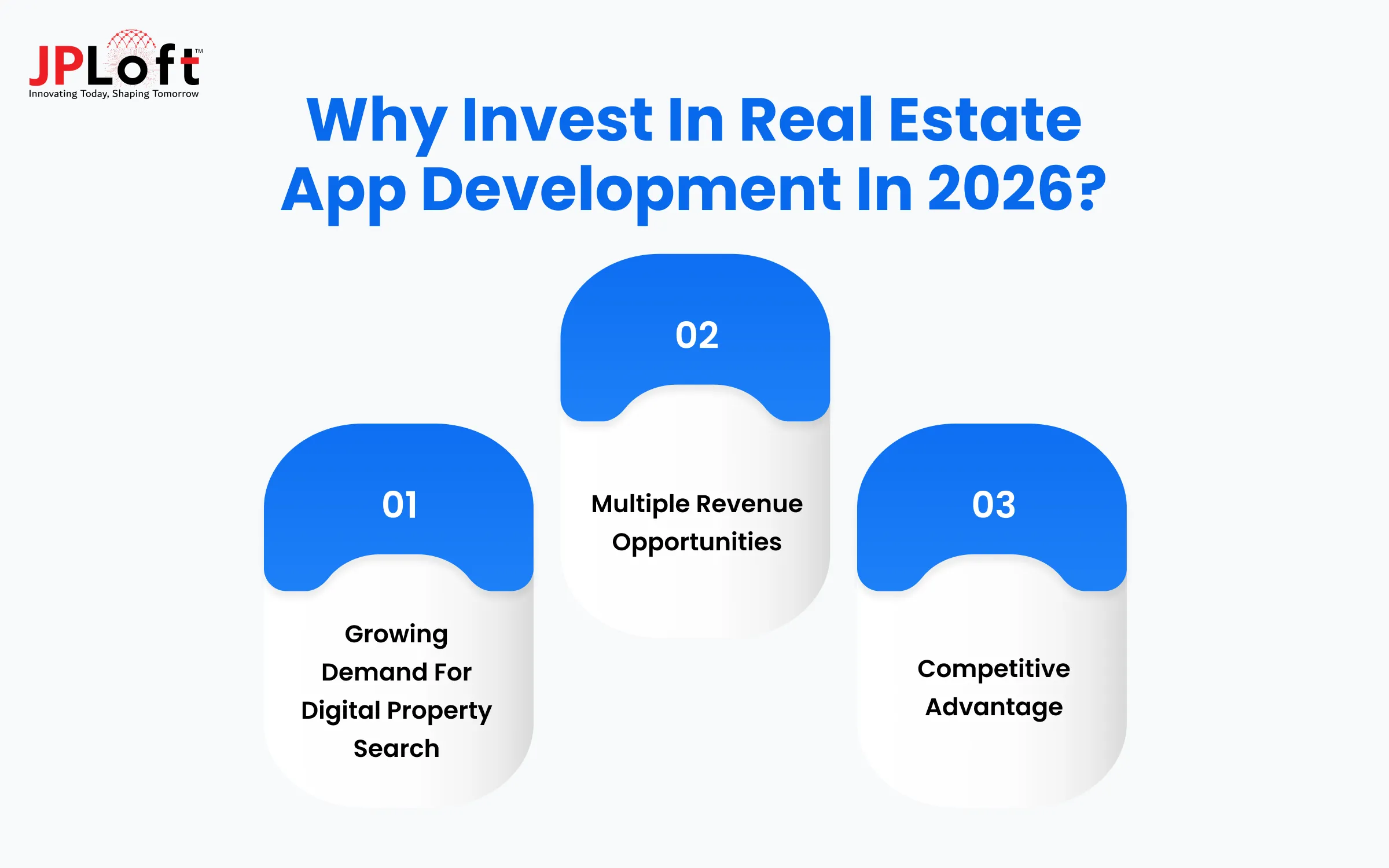
1. Growing Demand For Digital Property Search
Most property buyers and renters now prefer searching for homes through mobile apps instead of relying solely on traditional brokers or property listings.
A real estate app can provide instant access to listings, images, pricing, locations, and property details.
This growing preference for digital property discovery creates a strong opportunity for businesses to build a real estate app that keeps users engaged.
2. Multiple Revenue Opportunities
A real estate app can generate revenue through several models rather than depending on a single income source.
Businesses can charge agents and property owners for premium listings, featured placements, subscriptions, or lead generation.
3. Competitive Advantage
A well-designed real estate app can help businesses stand out in an increasingly competitive property market.
You can ensure to include features such as AI-powered recommendations, virtual property tours, smart filters, instant messaging, and personalized alerts, which provide a more convenient user experience.
How Much Does It Cost to Develop a Real Estate App?
Real estate app development cost can typically range from $10,000 to $150,000+, depending on the app complexity, feature scope, tech stack, and development team location.
Cost Breakdown by App Complexity:
►Basic/MVP Real Estate App ($10,000 to $50,000+)
Your real estate app should focus on core functionality to enter the market quickly. This includes user registration, basic property listings, essential search filters, Google Maps integration, and a direct “Contact Agent” feature.
► Mid-Level Real Estate App ($50,000-$100,000+)
It includes multi-role access (Buyer, Seller, Agent), live MLS data syncing, in-app chat/messaging, schedule viewings, mortgage calculators, and push notifications.
►Advanced Real Estate Platform ($100,000-$150,000+)
It incorporates high-end technology solutions to enhance the user experience. These include AI-powered property recommendations, Automated Valuation Models (AVMs), 3D virtual tours, natural language search, AR floor plans, and custom agent CRM dashboards.
Factors Affecting the Property App Development Cost
When you are analyzing real estate app development costs, you should know the factors affecting the overall pricing.
It helps to plan for unexpected surprises. So, let’s get to know all about it:
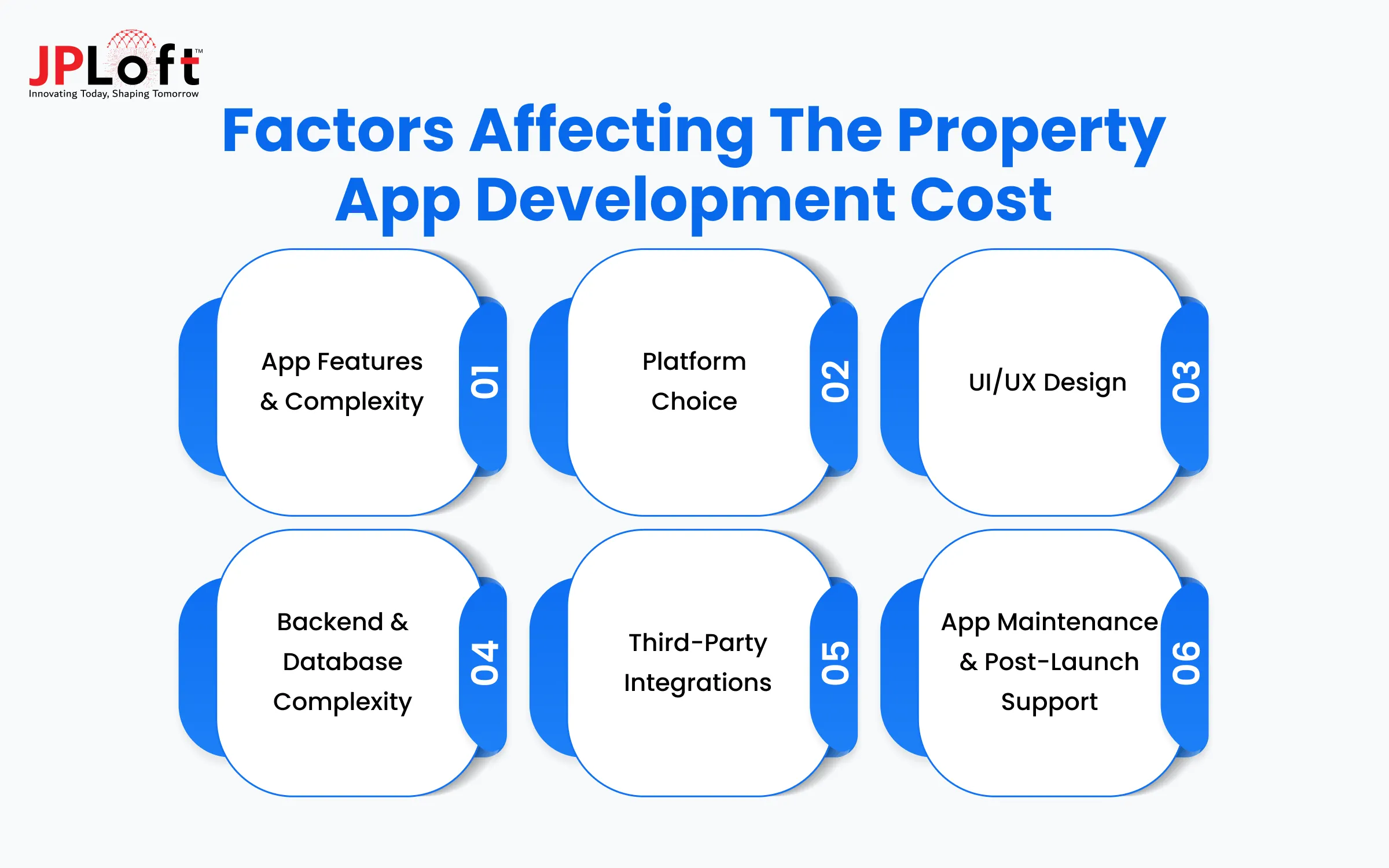
Factor 1: App Features & Complexity
More features mean more work, simple as that.
If you start with basic real estate app features, then the cost to develop a real estate app will not be that much.
But going for advanced features such as, AI-powered property recommendations, AR/VR viewing, smart search, or more, the cost will surely increase.
|
Feature Level |
Examples |
Cost Impact |
|
Basic |
Listings, search, filters |
Low |
|
Medium |
Chat, favorites, notifications |
Moderate |
|
Advanced |
AI recommendations, virtual tours, mortgage calculator |
High |
Factor 2: Platform Choice
iOS, Android, or both — this one decision moves the needle a lot.
If you are going for a single platform, it’s going to be quicker and cheaper. Whereas, if you go for cross-platform, it doubles the developer's effort, requires more testing, but reaches more users.
Native apps usually cost more but perform better, while hybrid apps save money upfront, but many need extra polishing later.
|
Platform |
Description |
Cost Impact |
|
Single Platform |
iOS or Android only |
Low |
|
Hybrid |
One codebase, both platforms |
Moderate |
|
Native (Both) |
Separate iOS + Android builds |
High |
Factor 3: UI/UX Design
People judge an app in seconds; your UI/UX design isn’t an option anymore.
A clean, intuitive layout keeps users scrolling longer. Basic templates are budget-friendly, but custom designs with animations, 3D property views, or interactive maps take more design hours.
The more unique and polished the experience, the more it adds to your overall budget.
|
Design Type |
Description |
Cost Impact |
|
Template-Based |
Pre-built UI kits |
Low |
|
Semi-Custom |
Branded layouts, basic animations |
Moderate |
|
Fully Custom |
Unique design, advanced UX, 3D views |
High |
Factor 4: Backend & Database Complexity
The backend is what powers the whole experience.
A simple backend handles listings and basic user data effortlessly.
But when it comes to real-time updates, large property databases, and multi-user roles (agents, buyers, and admins), stronger architecture is needed.
The more data your app juggles, the more backend power and cost it demands.
|
Backend Type |
Handles |
Cost Impact |
|
Simple |
Basic listings, static data |
Low |
|
Moderate |
User accounts, real-time updates |
Moderate |
|
Complex |
Large databases, multi-role access, analytics |
High |
Factor 5: Third-Party Integrations
A real estate app rarely works alone.
Behind every smooth property search, instant location update, or online payment is a network of third-party integrations working in the background.
From Google Maps & Payment gateways to MLS platforms, CRMs, and property APIs, these connections add functionality but also increase development efforts.
As a result, the cost to make a real estate app in 2026 can rise with every integration, especially when custom APIs and complex data syncing are involved.
|
Integration |
Purpose |
Cost Impact |
|
Maps API |
Location & navigation |
Low-Moderate |
|
Payment Gateway |
Bookings, deposits |
Moderate |
|
MLS / CRM Sync |
Live listings, agent tools |
High |
Factor 6: App Maintenance & Post-Launch Support
Once your real estate app is launched, time to go for app maintenance services.
After all, maintaining your app is as important as building it in the first place. Bugs, updates, and OS changes need ongoing attention.
Regular maintenance keeps your app running securely, smoothly, and compatible with new devices.
If you skip this, it may cost more later in emergency fixes, so budgeting for support from day one is always the smarter move.
|
Support Level |
Includes |
Cost Impact |
|
Basic |
Bug fixes only |
Low |
|
Standard |
Updates + minor feature tweaks |
Moderate |
|
Full Support |
Continuous updates, new features, monitoring |
High |
Region-Wise Cost Comparison
Where your developers are from can increase the budget by tens of thousands of dollars, sometimes even more than the features you choose.
One of the major aspects that affect the overall real estate app development cost is that it isn’t just about lines of code; it’s about geography, cost of living, and market maturity.
A team in San Francisco and a team in the Philippines might deliver the same quality app, but with different pricing.
Why so? Well, due to higher developers' salaries and the cost of living. Your choice here can shift your total budget by thousands of dollars.
|
Region |
Hourly Rate |
Basic App |
Mid App |
Advanced App |
|
USA |
$120 – $180 |
$40,000 – $60,000 |
$70,000 – $100,000 |
$120,000 – $150,000+ |
|
UK / Western Europe |
$80 – $140 |
$30,000 – $45,000 |
$55,000 – $80,000 |
$100,000 – $130,000 |
|
Eastern Europe |
$40 – $70 |
$20,000 – $35,000 |
$45,000 – $65,000 |
$80,000 – $110,000 |
|
India / Southeast Asia |
$15 – $40 |
$10,000 – $20,000 |
$30,000 – $50,000 |
$60,000 – $90,000 |
In-House Team vs Outsourcing: Cost Comparison
One of the biggest decisions that shapes the cost of real estate app development is hiring a mobile app development company or having an in-house team.
An in-house team offers tighter control, easier communication, and long-term product ownership, but it comes with higher overhead like salaries, benefits, office space, and recruitment costs.
Outsourcing, on the other hand, gives you access to experienced developers at a fraction of the cost, with flexibility to scale the team up or down as needed.
The right choice depends on your budget, timeline, and how long-term your product vision is.
|
Parameter |
In-House Team |
Outsourcing |
|
Initial Cost |
High (salaries, equipment, office setup) |
Low to Moderate (project or hourly based) |
|
Hiring Time |
4–8 weeks per developer |
1–2 weeks to onboard a team |
|
Team Size Flexibility |
Fixed; scaling takes time & cost |
Highly flexible; scale up/down easily |
|
Long-Term Cost |
Higher (benefits, retention, training) |
Lower (pay only for active work) |
|
Expertise Access |
Limited to local talent pool |
Access to global expert talent |
|
Project Control |
Full control, direct oversight |
Requires strong communication & PM tools |
|
Best Suited For |
Long-term products, ongoing innovation |
MVPs, fixed-scope projects, tight budgets |
|
Estimated Cost Impact |
20–40% higher than outsourcing |
30–50% cost savings on average |
Build vs Buy: Custom Software vs Off-the-Shelf Tools
Before getting into a full breakdown of real estate app development pricing, it’s worth answering a more fundamental question: should you build custom software or buy an off-the-shelf solution?
Off-the-shelf solutions and tools get you up and running fast with the least upfront investment, making them attractive for businesses trying them out first.
However, custom software development is built specifically around your business goals, branding, and long-term vision, offering greater flexibility and differentiation as you scale.
The right choice depends on how unique your business needs are and how much control you want over the product’s future.
|
Parameter |
Off-the-Shelf Tools |
Custom AI Software |
|
Upfront Cost |
Low ( Up to $10,000 setup/subscription) |
High ($25,000 – $150,000+) |
|
Time to Launch |
Days to weeks |
3–9 months |
|
Customization |
Limited to the platform's built-in features |
Fully tailored to business needs |
|
Scalability |
Restricted by vendor's infrastructure |
Built for unlimited scalability |
|
Ownership |
Vendor owns the platform & data |
Full ownership of code & data |
|
Long-Term Cost |
Recurring subscription fees add up |
Higher upfront, lower long-term cost |
|
Competitive Edge |
Minimal; same tools as competitors |
High; unique features & branding |
|
Best Suited For |
Startups testing an idea, tight budgets |
Established businesses, long-term vision |
MVP vs Enterprise AI Real Estate Software Development Cost
The AI real estate software development cost varies significantly depending on the scope, features, and target scale of the product.
An MVP (Minimum Viable Product) is designed to validate your app idea quickly with basic app features.
Whereas an enterprise-grade solution is built for scalability, advanced AI capabilities, and complex integrations.
Here’s a side-by-side comparison to help you plan your budget:
|
Parameter |
MVP Version |
Enterprise Version |
|
Core AI Features |
Basic property recommendations, chatbot, search filters |
Predictive analytics, AI-driven valuation, personalized recommendations, computer vision for property images |
|
Team Size |
3–5 members (PM, 2 developers, 1 designer, 1 QA) |
10–20+ members (PMs, backend/frontend devs, AI/ML engineers, DevOps, QA, security specialists) |
|
Tech Stack Complexity |
Standard frameworks with limited AI integration |
Advanced ML models, cloud-native architecture, microservices |
|
Third-Party Integrations |
Basic (maps, payment gateway) |
CRM, MLS data feeds, ERP, advanced analytics dashboards |
|
Scalability |
Limited; suited for early-stage validation |
Built for high user volume, multi-region deployment |
|
Data Security & Compliance |
Basic security protocols |
Enterprise-grade encryption, GDPR/CCPA compliance, audit trails |
|
Maintenance & Support |
Minimal post-launch bug fixes |
Ongoing support, regular AI model retraining, feature upgrades |
|
Customization |
Limited to core use cases |
Highly customizable workflows and white-labeling options |
Key Takeaway: An MVP helps you test your idea without spending too much on AI PropTech software development.
Once users respond well and demand grows, you can invest in advanced features and scale the product for long-term growth.
Hidden Factors Affecting Real Estate App Development Cost
When budgeting for a real estate app, most estimates only cover design, development, and basic testing.
However, the actual property tech app development cost often extends far beyond the initial quote.
Understanding these hidden costs upfront helps you plan a realistic budget and avoid unpleasant surprises down the line:
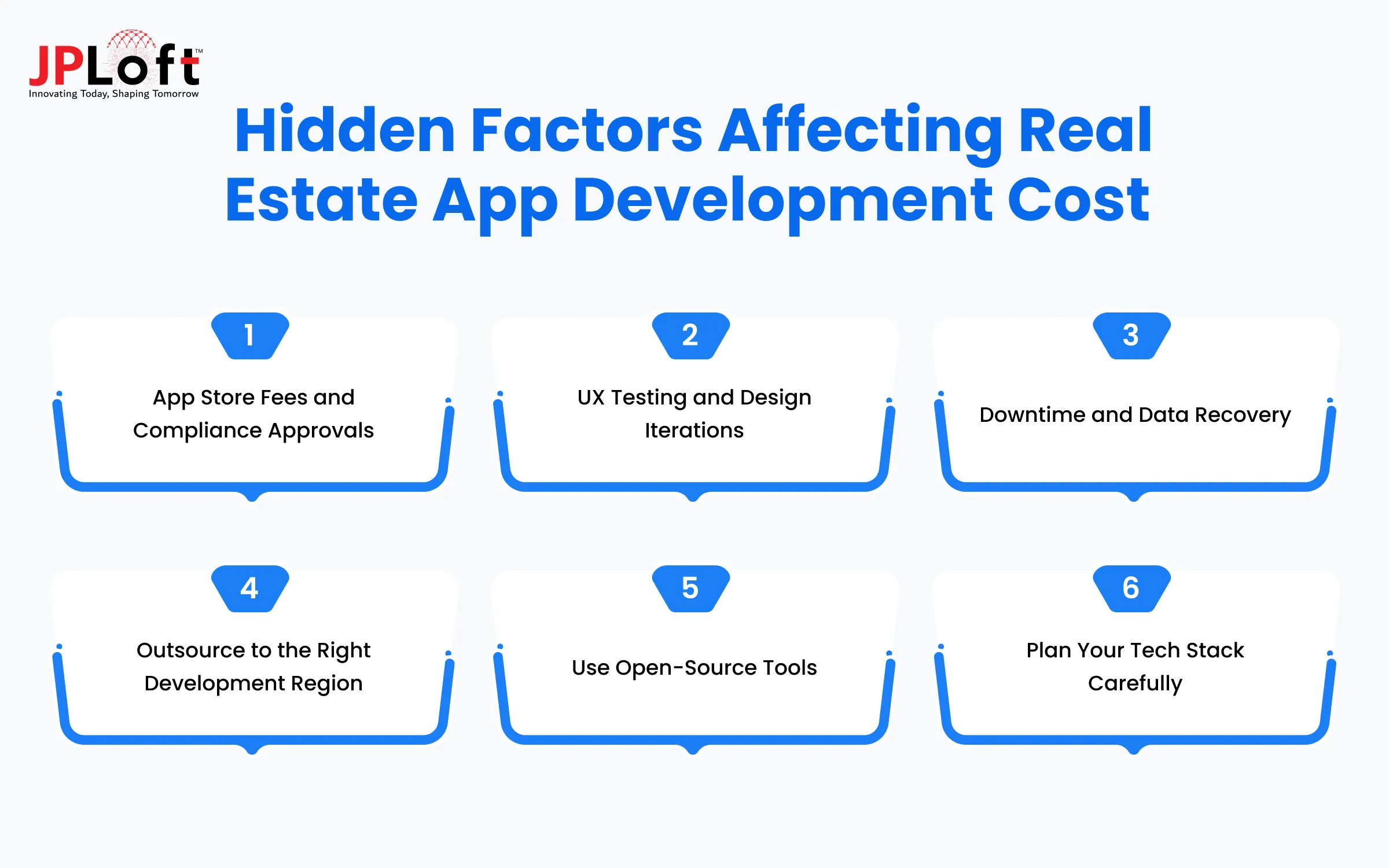
1. App Store Fees and Compliance Approvals
As you know, when you publish your app on the App Store or submit an app to the Play Store, it isn’t free.
Developer account fees, in-app purchase commissions (up to 30%), and repeated app rejections due to policy violations can quietly inflate your budget.
Estimated Range: $99-$500+
2. UX Testing and Design Iterations
A design may look perfect on paper, but real users can tell you where things actually go wrong.
App testing with real users helps uncover confusing screens, unnecessary steps, and friction points that may otherwise go unnoticed.
Their feedback gives you a chance to improve the experience before small UX issues turn into bigger problems.
Estimated range: $1,500 – $8,000
3. Downtime and Data Recovery
Server issues or security breaches can quickly turn into unexpected expenses.
Real estate apps handle sensitive personal and financial data, making security a major concern.
You can prevent costly problems later by regular security checks, reliable backups, and proper monitoring prevent costly problems later.
Spending a little on security upfront is far better than paying for emergency fixes or dealing with lost customer trust after a breach.
Estimated range: $1,500 – $8,000
How to Reduce Real Estate App Development Cost?
Launching a smart real estate app doesn’t have to drain your budget.
With the right strategy, you can reduce the overall cost without cutting corners on quality or user experience.
Here’s how successful teams keep their budgets lean while still delivering a powerful product:
1. Work on MVP
Resist the urge to build every feature on day one.
Launch with important features such as listings, search, and basic AI recommendations.
You should understand the market, gather their user feedback, and validate demand before investing in advanced features like AR tours or predictive analytics.
This approach saves money upfront and reduces the risk of building features nobody actually wants.
2. Choose Cross-Platform Development
If you are building separate native apps for iOS & Android, it can double your development time and cost.
Frameworks like Flutter or React Native let you write one codebase that runs smoothly on both platforms.
You get faster time-to-market, easier maintenance, and significant savings, without sacrificing much on performance or user experience.
3. Leverage Pre-Built AI Models & APIs
If you are building AI from scratch, it is going to be expensive and time-consuming.
Instead, tap into pre-trained models and third-party APIs for chatbots, image recognition, or property valuation.
Platforms like OpenAI, Google Cloud AI, or AWS AI services offer ready-to-integrate solutions.
This reduces the overall app development time while giving your app powerful, intelligent features users expect.
4. Outsource to the Right Development Region
Where you hire matters more than you think.
For ex: If you hire professionals from Asia, the cost is going to be lower. But hiring mobile app developers in Denver, Chicago, or any other place can increase the cost of delivering the same quality.
Choosing the right outsourcing partner can cut your total budget significantly, without compromising on code quality or communication.
5. Use Open-Source Tools
Why pay for tools when solid free alternatives exist?
Open-source frameworks, libraries, and databases can handle much of your app’s backend and frontend needs without licensing fees.
From PostgreSQL to TensorFlow, these tools are battle-tested, community-supported, and constantly improving, saving you money without sacrificing reliability or performance.
6. Plan Your Tech Stack Carefully
One thing we can bet on: changing your app tech stack mid-project is costly and time-consuming.
Invest time upfront in choosing a scalable, future-proof tech stack that matches your app’s true needs.
Avoid adding unnecessary complexity and under-planning that forces expensive migrations later.
The right foundation saves both money and headaches down the road.
So, these are some ways through which you can successfully reduce real estate app development costs.
Cost to Build Popular Real Estate Platforms
Ever wondered what it takes to build an app like the industry giants? The cost to build popular real estate platforms varies widely based on features, AI sophistication, and scale.
Platforms like Zillow and Redfin didn't start with massive budgets; they scaled over time as user demand grew.
When they started, they made sure to invest where the opportunity was available. And knowing all about these clone solutions app development cost can help you set realistic benchmarks for your own investment.
|
Platform |
Key Features |
Estimated Development Cost |
|
AI-powered Zestimate valuation, smart search, personalized recommendations |
$70,000 – $100,000+ |
|
|
Predictive pricing, real-time data analytics, AI recommendations |
$10,000 – $40,000+ |
|
|
Realtor.com |
Behavior-based suggestions, AI chatbots, trend analysis |
$90,000 – $150,000+ |
|
Trulia |
Neighborhood insights, AI-driven filters, lifestyle recommendations |
$50,000 – $90,000+ |
|
Opendoor |
Instant offers, dynamic pricing algorithms, automated tools |
$80,000 – $100,000+ |
|
Compass |
Agent tools, predictive analytics, client tracking features |
$40,000 – $90,000+ |
How Can a Real Estate App Development Company Be of Help?
Launching a real estate app isn’t just about writing code; it’s about understanding what buyers, sellers, and agents actually need.
This is exactly where the right real estate app development services partner makes all the difference.
At JPLoft, we’ve spent years helping real estate businesses turn their concepts into life, whether that’s a simple property listing app or a full-featured platform powered by AI.
We take care of everything along the way, understanding your vision, designing a smooth user experience, building smart features, and making sure your app works well after launch too.
With 16+ years of experience, 1,250+ projects delivered, and countless happy clients along the way, we're confident we can help you too.
So, if you want to turn your idea into a real, working product, JPLoft is ready to help you get there.
Conclusion
By now, you've got a clear picture of what goes into real estate app development cost, from features and business model to integrations and scalability.
But remember, the initial build is just the beginning; hidden costs and ongoing operations shape your total investment over time.
At the end of the day, building a great real estate app isn't about cutting corners. It's about making smart choices that balance functionality, performance, and growth.
Stay focused on what matters, and you'll avoid unnecessary spending while still building something solid.
That's where a team like JPLoft comes in, helping you plan smarter, use resources wisely, and build something that actually delivers long-term value.
FAQs
Real estate app development typically costs between $10,000 and $150,000+, depending on features, complexity, platform choice, and your development team's location.
Key factors include app features, design complexity, platform (iOS/Android), backend architecture, third-party integrations, and your chosen development team's region.
Yes, building an MVP first reduces upfront costs, helps validate your idea, and lets you scale features gradually based on real feedback.
Yes, hidden costs include cloud hosting, API fees, UX testing, marketing, security audits, and ongoing maintenance after your app launches.
Start with an MVP, use cross-platform frameworks, leverage pre-built APIs, outsource wisely, and prioritize features based on actual business value.

Rahul Sukhwal is the CEO and Founder of JPLoft, a visionary technologist with 18+ years at the forefront of emerging tech innovation and software engineering. He channels deep software engineering and AI expertise into building smarter, scalable solutions that shape how forward-thinking businesses worldwide harness the true power of AI.



Share this blog