


Key Takeaways:
Real-time multiplayer systems, matchmaking, leaderboards, and social interaction features remain the best features for gaming apps.
Advanced technologies such as cloud gaming, AR/VR integration, and predictive analytics are shaping the future of gaming experiences in 2026.
Gaming apps should prioritize a scalable backend infrastructure to support multiplayer functionality, live events, and cloud sync without performance issues.
Features like reward systems, daily challenges, push notifications, and personalization help increase session duration and improve long-term user retention.
Secure payment gateways, encrypted transactions, and fraud detection systems are critical for building trust and supporting gaming app monetization.
Startups should prioritize must-have gaming app features based on target audience, game genre, monetization goals, and scalability requirements.
The mobile gaming industry is expected to reach $289.21 billion by 2034, and continues to grow rapidly as users demand more interactive, competitive, and personalized gaming experiences.
This exploding demand for gaming apps can be better addressed by the industry players by building platforms that deliver a relevant experience. In the process, finalizing the mobile game app development features checklist is one of the most important aspects to focus on.
The right features help businesses improve player engagement and build scalable gaming ecosystems that support long-term growth.
In this blog, we will explore the top mobile game app features startups or enterprises should consider in 2026. The list includes essential functionalities, advanced gaming capabilities, panel-wise features, and key factors that help create future-ready gaming platforms.
Must-Have Game App Features
The success of mobile gaming apps depends on the level of engagement and excitement they can generate among the players.
Such excitement majorly depends on the features of the mobile game that startups have planned for during the initial launch. If the included features serve what players were looking for, it will ensure the game's virality; otherwise, it might lead to failure.
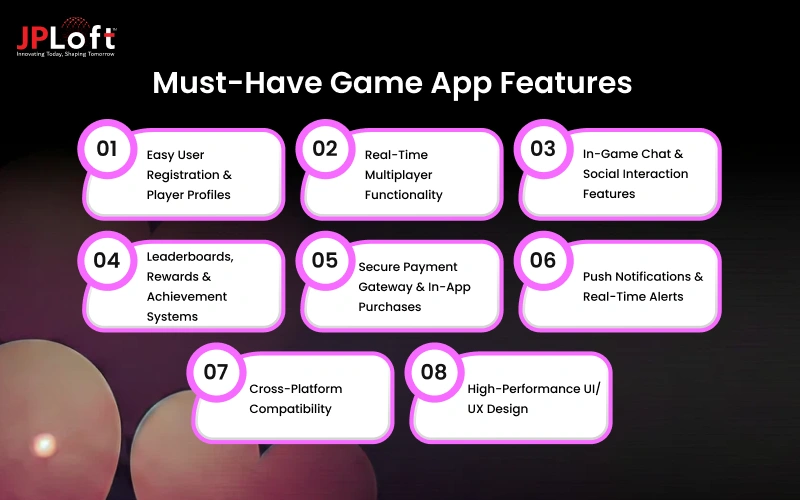
Here are the must-have features to consider when building a mobile game app in 2026:
1. Easy User Registration & Player Profiles
The most important game app feature is having a simple onboarding process. Players should be able to quickly sign up through email, mobile numbers, or social logins without lengthy registration steps.
Post login, they should have the option to personalize their player profiles. These profiles allow players to track achievements, gaming history, rankings, rewards, and in-game purchases from a centralized dashboard.
The key elements of a gamer/player profile include:
-
Avatar customization
-
Gaming preferences
-
Achievement badges
-
Cross-device synchronization
-
Personalized recommendations
2. Real-Time Multiplayer Functionality
Multiplayer gaming is one of the best features for gaming apps that continue to dominate the current industry. Such a feature offers interactive and community-driven experiences to gamers over isolated gameplay.
Real-time multiplayer functionality allows players to compete, collaborate, and communicate instantly. This significantly increases user retention because players spend more time interacting with friends, teams, and online gaming communities.
Such a gaming app feature should be supported by:
-
Low-latency networking
-
Real-time synchronization
-
Matchmaking systems
-
Dedicated gaming servers
-
Team-based gameplay support
-
Anti-cheat mechanism
3. In-Game Chat & Social Interaction Features
Social engagement is one of the essential features for mobile game apps, as it improves real-time interaction and long-term player retention. Today’s gamers expect platforms that allow them to communicate with other players, build gaming communities, collaborate with teams, and participate in live gaming events seamlessly.
Hence, potential app features like live chat, voice messaging, team communication, and gaming communities increase session duration and improve platform stickiness.
Social engagement gaming features include the following:
-
One-to-one messaging
-
Team chat rooms
-
Voice chat integration
-
Friend requests
-
Community forums
-
Livestream interaction support
4. Leaderboards, Rewards & Achievement Systems
When planning for engagement and retention in a mobile gaming app, plan to incorporate reward-driven features. Competitive ranking systems motivate users to spend more time inside the application.
Game leaderboards encourage healthy competition by displaying player rankings, tournament positions, and global scores in real time. Achievement systems further improve engagement through badges, unlockable rewards, streak bonuses, and milestone recognition.
Key elements to include in a gaming app to support this feature:
-
Seasonal reward systems
-
Daily challenges
-
Battle passes
-
Loyalty rewards
-
Referral bonuses
-
Progress tracking systems
5. Secure Payment Gateway & In-App Purchases
A key feature that can’t be ignored when developing gaming apps is app security. The mobile game app should allow in-game payments, making secure payment gateway integration an important and intelligent choice for game developers.
Secure and frictionless payment systems directly affect conversion rates and in-app revenue generation. Such a feature also helps improve gamer trust and loyalty.
A secure payment infrastructure of a gaming app should support:
-
Multiple payment methods
-
Encrypted transactions
-
Fraud detection systems
-
Secure wallet integration
-
Global payment accessibility
6. Push Notifications & Real-Time Alerts
Even the dedicated gamers don’t stay on the gaming app 24*7. Hence, it is important to introduce push notifications and real-time alerts to your mobile game app. Such a game app feature continues to play an important role in improving player engagement and reactivation.
The modern gaming apps are now focusing on personalized notifications instead of generic alerts to get gamers' attention. Personalized engagement notifications improve click-through rates while reducing uninstall risks caused by excessive messaging.
The alert and notifications can help gamers with:
-
Tournament reminders
-
Reward availability
-
Friend activity
-
Live events
-
Seasonal campaigns
-
Incomplete challenges
7. Cross-Platform Compatibility
Gamers are no longer just limited to mobile devices, but depending on their mood and comfort, they shift to tablets, PC, and even gaming consoles. Hence, they expect an uninterrupted gaming experience, making it important to ensure cross-platform compatibility to maximize user reach and retention.
This cross-platform compatibility feature integration also helps businesses reduce development complexity by maintaining a unified gaming ecosystem across platforms.
Cross-platform gaming allows users to:
-
Continue gameplay across devices
-
Maintain synchronized progress
-
Access shared multiplayer ecosystems
-
Improve gameplay flexibility
8. High-Performance UI/UX Design
When deciding the top gaming app features, the game design and user experience should not be skipped. The appearance and experience directly influence player satisfaction, retention, and monetization.
Even advanced gaming platforms fail when navigation becomes confusing or gameplay performance drops during high activity. Modern UI/UX design services focus heavily on accessibility, immersive interfaces, and gesture-based interactions to improve overall gameplay quality.
Gaming apps should focus on:
-
Fast loading speed
-
Smooth navigation
-
Responsive controls
-
Optimized screen layouts
-
Minimal latency
-
Device adaptability
Advanced Features for a Modern-Day Mobile Game
Along with the must-have gaming app features, the game app developers need to plan for certain advanced features.
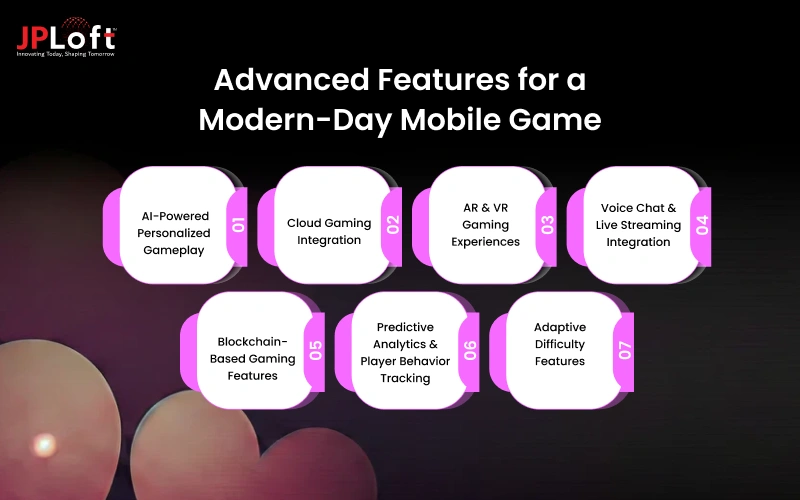
Such advanced features are essential to offer a unique gameplay experience and to ensure the game's competitiveness on the app store.
[A] AI-Powered Personalized Gameplay
Personalization in AI-powered gaming apps based on user behavior and gameplay patterns is transforming the gamer’s experiences.
Looking for AI development services for a game app ensures automation throughout the gameplay sessions. It adjusts difficulty levels, recommends challenges, improves matchmaking accuracy in multiplayer games, and predicts player drop-off risks.
This level of personalization improves player engagement while helping businesses optimize retention and align with gaming app monetization features more effectively.
[B] Cloud Gaming Integration
Another advanced gaming feature powering 21st-century games is cloud gaming. It allows users to stream high-quality games without depending heavily on device hardware.
For businesses, this feature makes gaming experiences accessible across multiple devices while reducing storage and performance limitations.
With improved internet infrastructure and 5G connectivity, cloud gaming features are becoming increasingly important for scalable and high-performance gaming applications.
[C] AR & VR Gaming Experiences
Augmented reality and virtual reality game development companies are helping gaming businesses create more interactive and immersive experiences.
AR-based mobile games combine virtual elements with real-world environments, while VR gaming focuses on fully interactive digital gameplay.
These tech features are becoming more common in simulation, sports, adventure, and multiplayer gaming that aim to improve user engagement through immersive experiences.
[D] Voice Chat & Live Streaming Integration
In-game communications and interactions are getting advanced with voice chat and real-time interaction.
Voice chat functionality, included along with the game app development features, improves communication during multiplayer gameplay. On the other hand, live streaming features allow users to share gameplay experiences directly within the application.
These mobile game app features are helping the platforms to increase user engagement, strengthen gaming communities, and encourage longer session durations.
[E] Blockchain-Based Gaming Features
Blockchain development solutions are gradually influencing gaming platforms that focus on digital ownership and decentralized economies.
Game developers are exploring blockchain integration for NFT collectibles, secure asset ownership, transparent reward systems, and tokenized gaming environments.
While still developing, these blockchain gaming features are creating new monetization opportunities and expanding player-controlled digital ecosystems within gaming applications.
[F] Predictive Analytics & Player Behavior Tracking
Modern gaming applications generate large amounts of behavioral data that businesses use to improve engagement and retention strategies.
The predictive analytics features help gaming platforms understand player activity, purchase behavior, gameplay patterns, and drop-off points.
These insights allow gaming businesses to optimize features, improve monetization planning, and deliver more personalized experiences that align with player expectations.
[G] Adaptive Difficulty Features
The modern-day gaming experiences can be improved with the help of adaptive difficulty features. Integrating such a feature helps adjust gameplay complexity automatically based on player performance and progression.
This feature helps maintain balanced gameplay experiences for both beginners and experienced players. Also, it creates curiosity among the players regarding the game whenever they log in to the game.
Adaptive difficulty also eliminates repetitive gameplay and encourages users to continue engaging with the gaming platform for longer periods.
Panel-Wise Gaming App Features List
Now, let’s have a look at the panel-wise gaming feature that needs to be taken care of when planning for an engaging gaming app.
► Player Panel Features
The player panel acts as the main interface where users interact with the gaming platform. It should provide smooth navigation, personalized controls, multiplayer accessibility, and real-time engagement features that improve the overall gaming experience across devices.
|
Feature |
Description |
|
User Profile Management |
Allows players to manage personal information, avatars, and gaming preferences. |
|
Gameplay History |
Stores previous matches, scores, and gameplay activity for easy tracking. |
|
Achievement Tracking |
Displays badges, rewards, rankings, and completed milestones. |
|
Friend Management |
Helps users add friends and manage multiplayer connections easily. |
|
Matchmaking Access |
Connects players with suitable opponents based on gameplay skill levels. |
|
Wallet Integration |
Enables players to manage virtual currencies and in-game transactions securely. |
|
Reward Redemption |
Allows users to claim bonuses, rewards, and promotional offers directly. |
|
Notification Center |
Sends updates related to tournaments, rewards, and gameplay activities. |
|
Tournament Participation |
Provides access to join and track gaming competitions and live events. |
|
Settings & Preferences |
Lets players customize controls, privacy, notifications, and gameplay configurations. |
► Admin Panel Features
The admin panel helps manage game operations, monitor performance, control revenue systems, and analyze player activity from a centralized dashboard. A strong admin panel supports scalability while ensuring better engagement, retention, and operational efficiency.
|
Feature |
Description |
|
User Management |
Helps admins monitor, manage, and control player accounts and activity. |
|
Revenue Analytics |
Tracks earnings, purchases, subscriptions, and performance metrics. |
|
Content Management |
Allows administrators to update game content, banners, and promotional materials. |
|
Tournament Controls |
Manages tournament scheduling, participation, rewards, and competition settings. |
|
Reward Management |
Configures loyalty rewards, bonuses, and in-game incentive systems efficiently. |
|
Ad Management |
Controls advertisement placements, campaigns, and revenue-generating promotional content. |
|
LiveOps Configuration |
Supports live events, seasonal campaigns, and time-sensitive gaming activities. |
|
Fraud Monitoring |
Detects suspicious transactions, cheating attempts, and unusual player behavior. |
|
Performance Analytics |
Provides insights into gameplay performance, engagement, and retention metrics. |
|
Payment Management |
Handles payment tracking, transaction verification, and financial reporting processes. |
How to Choose the Right Features for Your Gaming App?
The discussed features of a gaming app can be utilised to build a scalable and engaging platform. But not every feature is built for every gaming app; you need to filter out the options and decide which feature suits your platform the best.
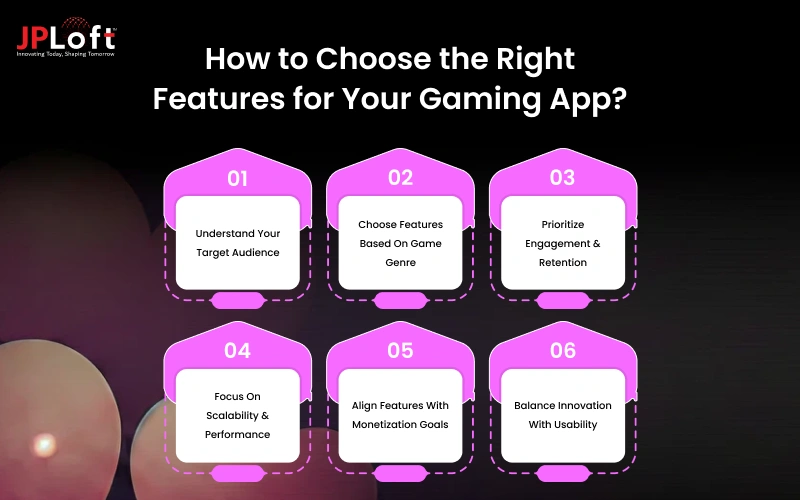
Here are the key ways that can help you pick the best features for your gaming app, without overwhelming gamers.
Step 1: Understand Your Target Audience
Different gaming audiences expect different experiences. Casual gamers usually prefer simple gameplay, reward-based systems, and shorter game levels.
While expert gamers look for multiplayer functionality, leaderboards, tournaments, and live interactions. Conducting app market research and understanding user behavior helps businesses prepare a more relevant list of gaming app features.
Step 2: Choose Features Based On Game Genre
Once you have decided on the target audience, the next step is to define your game genre. Every gaming category requires a different set of essential features for mobile game apps.
Strategy and battle games often need matchmaking and real-time communication systems, while simulation and adventure games may benefit more from AR integration and immersive gameplay experiences. Feature selection should always support the game’s core mechanics.
Step 3: Prioritize Engagement & Retention
Every feature selection should be done with gamer engagement and retention in mind. Retention-focused features help gaming platforms maintain active users over longer periods.
Key gaming app functionalities can include daily rewards, achievement systems, push notifications, seasonal events, and personalized recommendations. These can improve player engagement while encouraging repeat usage.
Step 4: Focus On Scalability & Performance
The final set of features of successful gaming apps should not act as a barrier to the app's scalability and growth. Gaming platforms should support future growth without affecting user experience.
Multiplayer systems, cloud synchronization, and live event management require a scalable backend infrastructure that can handle increasing player activity efficiently.
Step 5: Align Features With Monetization Goals
The ultimate aim of any startup is app monetization and making a profitable business out of it. Hence, the same applies to the game app. Businesses should choose top gaming app features that support their monetization strategy naturally.
In-app purchases, subscriptions, virtual currencies, and advertisement systems should improve revenue generation without negatively affecting gameplay quality.
Step 6: Balance Innovation With Usability
Focus on the innovations practiced in the gaming space and the advanced gaming app feature list. But don’t just blindly adopt any feature with an AI and blockchain tag; plan for a balance between innovation, gamer experience, and game app performance.
Advanced technologies like AI, cloud gaming, AR/VR, and blockchain can improve gaming experiences when implemented strategically.
Can JPLoft Help Choose the Right Gaming Features?
Choosing the right feature set is one of the most important parts of successful gaming platform development, and JPLoft experts help businesses make those decisions strategically.
As a trusted mobile game app development services provider, JPLoft focuses on building scalable, engagement-driven, and future-ready gaming applications as per different gaming genres.
Every gaming platform requires a unique combination of features based on its audience, gameplay objectives, earning opportunities, and operational requirements.
Instead of following a one-size-fits-all approach, we help startups identify the most relevant gaming app features that improve user engagement, retention, monetization, and platform scalability.
From advanced multiplayer systems to cloud gaming integration, matchmaking engines, reward systems, and analytics dashboards, our game app developers build it all.
Conclusion
Building a successful gaming platform in 2026 requires more than visually appealing gameplay. Users now expect real-time interaction, personalized experiences, smooth performance, secure transactions, and continuous engagement across devices.
Businesses must focus on selecting features that align with player expectations, gameplay goals, monetization strategies, and long-term scalability.
From multiplayer systems and reward mechanisms to AI-powered gaming app features and cloud-based gaming experiences, every feature should contribute to user retention and platform growth. At the same time, balancing innovation with usability remains essential for maintaining performance and engagement.
With the right feature planning and development strategy, businesses can create competitive gaming applications that deliver stronger engagement, sustainable growth, and long-term user value.
FAQs
Some of the most important gaming app features include multiplayer functionality, player profiles, leaderboards, secure payment systems, push notifications, reward mechanisms, matchmaking systems, and high-performance UI/UX design. These features help improve engagement, retention, and overall gameplay experience.
Advanced gaming app features gaining popularity in 2026 include AI-powered personalization, cloud gaming integration, AR/VR experiences, LiveOps management, predictive analytics, adaptive gameplay systems, and real-time voice communication features.
Features like achievement systems, daily rewards, personalized recommendations, seasonal events, leaderboards, and multiplayer interactions encourage users to stay active on gaming platforms for longer periods. These engagement-focused systems help improve retention and reduce player drop-offs.
Scalability helps gaming platforms manage increasing user activity without affecting performance. Features like cloud synchronization, multiplayer servers, and live event management require a scalable backend architecture to support smooth gameplay experiences as the platform grows.
Businesses should select features based on their target audience, gaming genre, monetization strategy, gameplay objectives, and long-term growth plans. The right feature selection helps create balanced gaming platforms that improve engagement, performance, and operational efficiency.

Rahul Sukhwal is the CEO and Founder of JPLoft, with 18+ years of experience in software engineering, emerging technologies, and digital product development. His expertise spans artificial intelligence, including AI agents, generative AI, LLMs, chatbots, computer vision, and machine learning, as well as blockchain, IoT, AR/VR, mobile, web, and enterprise software. He focuses on applying these technologies to real business challenges across industries such as healthcare, education, mobility, finance, real estate, and on-demand services.



Share this blog