


Key Takeaways:
Mobile game development can cost $20,000 to $350,000+, depending on game complexity, visual quality, platform, backend requirements, team location, development expertise, monetization, testing, and post-launch support.
Development costs span planning, UI/UX design, game development, testing, deployment, and post-launch support, making it important to budget for every stage.
Additional expenses can include platform fees, third-party tools, asset licensing, testing, performance optimization, security, and marketing or user acquisition.
Businesses can control costs by starting with an MVP, using proven technologies, testing early, and avoiding unnecessary over-engineering.
Mobile gaming has become a major part of the global gaming industry, offering players convenient access to engaging experiences across smartphones and tablets.
This has increased entrepreneurial interest in launching innovative mobile games. But one of the first questions businesses ask is, “How much does it cost to build a mobile game app?”
Mobile game development costs can range from $20,000 to $350,000+, depending on its complexity, visual quality, platform coverage, backend requirements, and post-launch scope.
This guide breaks down the cost of developing a mobile game, covering expenses across development stages, game types, key cost factors, additional expenses, and more.
Mobile Game App Development Cost by Phase
The total cost to build a mobile game is the combined expense of each stage of the development lifecycle.
Instead of viewing development as a single expense, breaking the budget down by phase makes it easier to understand where resources are allocated and plan the project more accurately.
Working with an experienced mobile game app development company can help businesses plan these stages efficiently and allocate resources effectively.
|
Development Stage |
Key Activities Included |
Cost Range |
|
Planning & Concept Design |
Game idea validation, gameplay mechanics definition, monetization planning, technical feasibility analysis |
$2,000 – $10,000 |
|
UI/UX Design & Prototyping |
App Wireframing, user flow design, visual interface creation, character and asset design, interactive app prototypes |
$5,000 – $25,000 |
|
Game Development (Frontend + Backend) |
Core gameplay development, game engine integration, backend infrastructure setup, multiplayer systems, and real-time game features |
$10,000 – $200,000+ |
|
Testing & Quality Assurance |
Functional testing, performance optimization, device compatibility testing, bug-fixing cycles |
$3,000 – $15,000 |
|
Deployment & Launch |
App store submission, backend deployment, analytics integration, compliance, and approval processes |
$2,000 – $10,000 |
|
Post-Launch Support & LiveOps |
Content updates, seasonal events, server maintenance, performance monitoring, user feedback improvements (ongoing) |
$5,000 – $50,000+ |
How Much Does it Cost to Build Different Types of Games?
When planning to build a mobile game, the game type you are investing in has a direct impact on the development cost.
Games with simple mechanics and limited content generally require less investment, while advanced games with rich graphics, complex progression, or multiplayer functionality require significantly more resources.
Understanding the scope of each game type can help you set realistic expectations before development begins.
[A] Hyper-Casual Games
Hyper-casual games focus on simple mechanics, quick gameplay sessions, and minimal controls. Their limited feature scope and lightweight design generally keep the cost to develop a hyper-casual mobile game under control.
These games usually follow an ad-based revenue model. Since the gameplay loop is short, the main focus stays on fast production and rapid testing.
Example: Angry Birds, Helix Jump
Estimated Cost: $20,000 – $50,000+
Estimated Timeline: 2–4 months
[B] Casual Games
Casual games offer more structure than hyper-casual titles, often including multiple levels, progression systems, polished visuals, and greater content depth. This increases the design and development effort.
They commonly combine advertising with in-app purchases, which can also require additional backend and monetization integrations.
Example: Candy Crush Saga, Subway Surfers
Estimated Cost: $30,000 – $100,000+
Estimated Timeline: 3–6 months
[C] Mid-Core Games
Mid-core games introduce deeper gameplay, better graphics, and stronger progression systems. Players spend more time in the game, which increases the need for content, balance, and engagement loops, impacting the cost to make mobile games.
Features such as upgrades, in-app purchases, player profiles, and progression tracking can also increase backend requirements.
Example: Clash Royale, Clash of Clans
Estimated Cost: $80,000 – $200,000+
Estimated Timeline: 6–10 months
[D] High-Complexity Games
Hardcore games like RPG, Strategy, and Action games demand a high level of detail. They include complex mechanics, rich environments, character development, and long-term progression systems.
These projects typically involve larger teams, sophisticated technology, extensive testing, and continuous content updates after launch.
Example: Genshin Impact, Call of Duty: Mobile
Estimated Cost: $150,000 – $350,000+
Estimated Timeline: 12–24+ months
[E] Multiplayer Online Games
Multiplayer games introduce additional technical complexity through real-time interaction, matchmaking, player synchronization, and server infrastructure. These systems must also remain stable as the number of concurrent players increases.
Performance, latency, security, and scalability therefore become major considerations during both development and post-launch operations.
Example: PUBG Mobile, Free Fire
Estimated Cost: $150,000 – $300,000+
Estimated Timeline: 8–18 months
[F] AR/VR-Based Games
AR and VR games create immersive experiences by combining game mechanics with device-specific technologies, 3D environments, and advanced rendering. Such a complex development approach increases the average cost of mobile game development.
AR game app development requires specialized development skills and more extensive testing across supported devices, which increases both production time and overall investment.
Example: Pokémon GO, Ingress
Estimated Cost: $200,000 – $350,000+
Estimated Timeline: 12–24+ months
Factors Impacting the Cost to Build Mobile Games
Beyond the type of game and its development stage, several other factors can influence the final project budget.
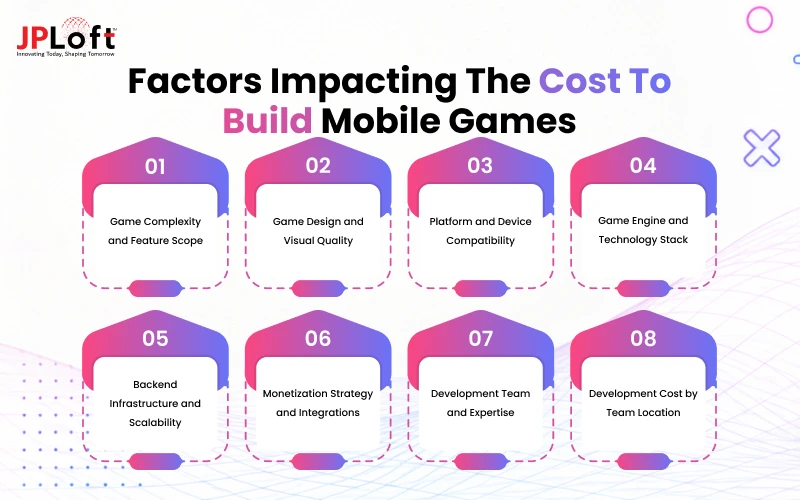
Feature scope, visual quality, platform requirements, technology choices, backend infrastructure, team expertise, and monetization all contribute to the resources required to build and maintain a mobile game.
Here are the key factors that can affect the overall mobile game development budget:
1. Game Complexity and Feature Scope
Game complexity is one of the key factors impacting the cost of developing mobile games. A simple game with basic mechanics requires less development effort, while advanced gameplay systems demand more time, testing, and technical precision.
Features like real-time multiplayer, AI-based opponents, open-world environments, and in-game economies increase both development and maintenance effort.
|
Scope |
What It Includes |
Cost Impact |
|
Core Gameplay |
Tap, swipe, or single-loop mechanics with minimal logic |
Low |
|
Progression Systems |
Levels, rewards, scoring systems, and user retention loops |
Medium |
|
Advanced Game Systems |
AI behavior, dynamic difficulty, in-game economies |
High |
|
Real-Time Gameplay |
Multiplayer interaction, matchmaking, synchronized sessions |
Very High |
2. Game Design and Visual Quality
The game's visual quality directly affects the app design and development effort required. High-quality visuals involve detailed assets, animations, environments, and interface elements, all of which increase production time.
2D games are generally more cost-efficient to produce, while 3D games with detailed environments and realistic rendering require more specialized skills, tools, and optimization.
|
Scope |
What It Includes |
Cost Impact |
|
Interface Design |
Basic UI screens, navigation flows, minimal styling |
Low |
|
Custom Visual Assets |
Branded elements, characters, and environment design |
Medium |
|
Animation Systems |
Motion effects, transitions, and character animations |
High |
|
3D Visual Environments |
Realistic rendering, lighting, and immersive design |
Very High |
3. Platform and Device Compatibility
Choosing among iOS app development, Android, or cross-platform development can affect both development and testing effort. Building for a single platform generally requires fewer resources, while supporting multiple platforms increases compatibility and optimization requirements.
Games must also perform consistently across different screen sizes, resolutions, operating systems, and hardware capabilities, making device compatibility an important consideration.
|
Scope |
What It Includes |
Cost Impact |
|
Single Platform Build |
iOS or Android development with standard configurations |
Low |
|
Cross-Platform Setup |
Shared codebase across platforms using top app development frameworks |
Medium |
|
Multi-Device Optimization |
Adapting for screen sizes, resolutions, and hardware types |
High |
|
Performance Optimization |
Frame rate tuning, memory management across devices |
Very High |
4. Game Engine and Technology Stack
The choice of game engine affects development speed, available capabilities, performance, and the overall project budget. Popular engines such as Unity and Unreal Engine provide pre-built tools and components that can reduce development effort for many types of games.
Custom engines can offer greater control but typically require a more specialized app tech stack and ongoing maintenance, resulting in increased cost to develop a mobile game app.
|
Scope |
What It Includes |
Cost Impact |
|
Standard Engine Usage |
Unity or Unreal with built-in features |
Medium |
|
Engine Customization |
Plugins, custom modules, and feature extensions |
Medium to High |
|
Advanced Integrations |
Physics engines, rendering tools, and external SDKs |
High |
|
Custom Engine Development |
Fully tailored engine for specific game needs |
Very High |
5. Backend Infrastructure and Scalability
Backend systems are critical for games with user accounts, data storage, or multiplayer features. However, planning for real-time syncing, matchmaking, and cloud storage increases the overall complexity.
Modern games often use cloud-based infrastructure to support scaling and LiveOps features, but this results in additional cost to make a mobile game app.
|
Scope |
What It Includes |
Cost Impact |
|
Basic Data Handling |
User profiles, game progress storage |
Medium |
|
Cloud Integration |
APIs, database management, and remote access |
Medium to High |
|
Real-Time Systems |
Live updates, leaderboards, session tracking |
High |
|
Scalable Multiplayer Infrastructure |
Matchmaking, concurrent users, server scaling |
Very High |
6. Monetization Strategy and Integrations
The app monetization strategy selected for the game can also influence development effort. Advertising, in-app purchases, subscriptions, and virtual goods may require third-party SDKs, payment integrations, backend logic, and additional testing.
More sophisticated monetization systems can therefore increase the app game development cost, particularly when they involve personalized offers, analytics, segmentation, or multiple revenue streams.
|
Scope |
What It Includes |
Cost Impact |
|
Ad Integration |
Banner ads, interstitial ads |
Low |
|
In-App Purchases |
Virtual goods, upgrades, and payment systems |
Medium |
|
Subscription Models |
Recurring billing, premium access features |
High |
|
Advanced Monetization Systems |
Hybrid models, analytics tools, and user segmentation |
Very High |
7. Development Team and Expertise
The size, composition, and experience of the development team directly influence project costs. A simple game may require a smaller team, while complex games often need specialized game designers, developers, backend engineers, artists, and QA professionals.
The engagement model and development location can also affect overall rates. Businesses planning to hire dedicated developers should evaluate technical expertise, relevant game-development experience, communication, and long-term support alongside pricing.
|
Scope |
What It Includes |
Cost Impact |
|
Small Core Team |
Limited developers for simple game builds |
Low |
|
Balanced Development Team |
Designers, developers, and testers |
Medium |
|
Specialized Roles |
Game designers, backend engineers, QA experts |
High |
|
High-End Expertise |
Senior specialists, large teams, complex coordination |
Very High |
8. Development Cost by Team Location
The location of your development team can significantly influence the overall project budget. Developer rates vary across regions based on experience, technical expertise, demand, and operating costs.
Choosing between in-house teams, freelancers, outsourcing agencies, or a dedicated app development company from Denver can also affect how much you spend throughout the development lifecycle.
|
Location |
Cost Impact |
Hourly Cost |
|
North America |
High |
$100–$200+ |
|
Western Europe |
Medium to High |
$80–$150 |
|
Eastern Europe |
Medium |
$40–$80 |
|
Latin America |
Low to Medium |
$40–$80 |
|
Asia |
Low |
$25–$60 |
Additional Costs to Consider When Developing a Mobile Game
The initial development estimate covers the core design and development work, but the total app development budget can extend beyond the planned expenses. Additional costs can arise during launch, scaling, optimization, and ongoing improvements.
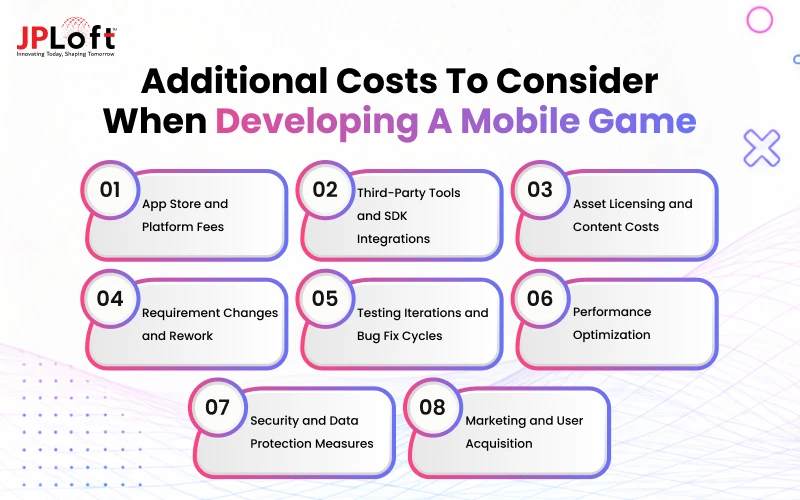
Planning for these expenses early can help you create a more realistic budget and avoid unexpected increases later.
1. App Store and Platform Fees
Publishing your game on the Play Store or App Store requires developer accounts and compliance with platform policies. There may also be platform fees and revenue-sharing requirements for in-app purchases and subscriptions.
These expenses should be considered when planning the game's launch and long-term monetization strategy.
2. Third-Party Tools and SDK Integrations
Most games depend on external tools for ads, analytics, crash reporting, and payments. Many of these services follow subscription or usage-based pricing.
As integrations increase, so does the gaming app development cost. This leads to a medium to high cost impact during development and scaling.
3. Asset Licensing and Content Costs
Games may require external assets such as music, sound effects, fonts, 3D models, or visual elements. Licensed assets can involve one-time or recurring fees, while custom assets require additional design and production resources.
For visually rich or content-heavy games, these expenses can become a significant part of the overall budget.
4. Requirement Changes and Rework
Game concepts often change during development as teams test mechanics, gather feedback, or identify new requirements. Adding features or modifying existing gameplay can create additional work across design, development, and testing.
Clearly defining the initial scope and prioritizing essential features can help reduce unnecessary rework.
5. Testing Iterations and Bug Fix Cycles
Mobile game testing typically takes place across multiple rounds to identify gameplay issues, bugs, compatibility problems, and performance limitations.
Complex games require more testing cycles, particularly when they support multiple devices, operating systems, multiplayer functionality, or advanced graphics.
6. Performance Optimization
Initial builds may require additional optimization to deliver smooth gameplay across supported devices. Frame-rate issues, memory usage, loading times, battery consumption, and network latency may all require further development work.
Optimization becomes particularly important for graphics-intensive and multiplayer games.
7. Security and Data Protection Measures
Games that handle user accounts, personal information, payments, or other sensitive data require appropriate security measures. These may include encryption, secure APIs, access controls, and data protection practices.
App security is often underestimated early, but becomes essential before launch, leading to a medium to high cost impact.
8. Marketing and User Acquisition
Developing the game is only one part of launching a successful product. Businesses may also need a separate marketing budget for paid user acquisition, influencer campaigns, promotional creatives, app store optimization, social media campaigns, and launch activities.
These expenses can vary significantly based on the target audience, market, competition, and growth goals.
How Much Does it Cost to Make a Popular Game App Clone?
Understanding “how much does it cost to create a mobile game?” becomes much easier when you connect it to real-life examples.
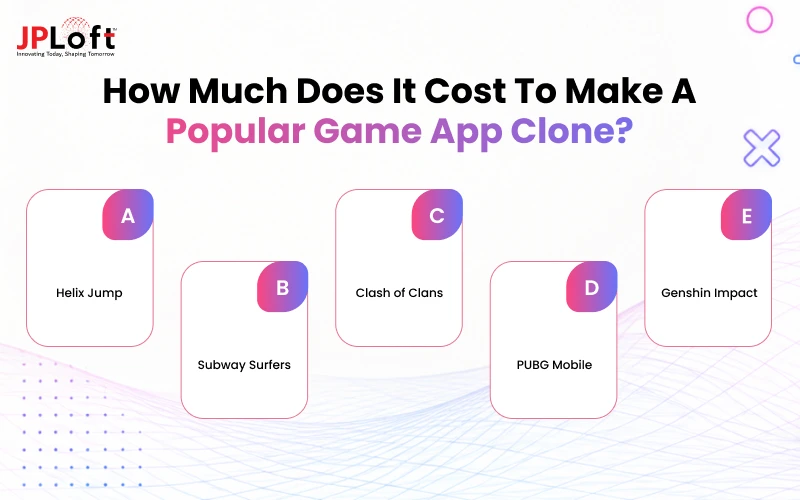
The figures mentioned below are approximate estimates for developing a simplified game inspired by the best mobile game apps. They do not represent the actual development budgets of the original games.
Here are some popular game examples and the cost to build clone gaming apps.
[A] Helix Jump
Helix Jump represents the hyper-casual category, with simple mechanics, short gameplay sessions, and relatively limited visual and backend requirements. Its focused gameplay loop makes it comparatively affordable to develop.
Estimated Development Cost: $20,000 – $50,000+
What the Cost includes:
-
One-touch gameplay loop
-
Basic UI and visual assets
-
Level design and progression logic
-
Minimal backend requirements
-
Basic advertising and analytics integration
[B] Subway Surfers
Subway Surfers represents the casual game category, combining 3D environments, character animations, progression systems, and regular content updates. Developing a similar experience requires more design, development, and optimization effort than a hyper-casual game.
Estimated Development Cost: $30,000 – $100,000+
What the Cost includes:
-
Character and environment design
-
3D animations and gameplay mechanics
-
Smooth gameplay across supported devices
-
Progression and reward systems
-
Monetization and analytics integrations
[C] Clash of Clans
Clash of Clans represents the mid-core category, with base-building mechanics, structured progression, player interactions, and multiple monetization layers. A similar game requires more extensive backend functionality and content management than a casual title.
Estimated Development Cost: $100,000 – $200,000+
What the Cost includes:
-
Base-building mechanics and progression systems
-
Player accounts and game data management
-
In-app purchases and monetization features
-
Backend systems for player interactions
-
Notifications, analytics, and LiveOps capabilities
[D] PUBG Mobile
PUBG Mobile combines high-complexity gameplay with real-time multiplayer functionality, advanced graphics, matchmaking, and extensive backend infrastructure. Developing a similar experience requires significantly more technical expertise, infrastructure, testing, and optimization.
Estimated Development Cost: $200,000 – $350,000+
What the Cost includes:
-
Real-time multiplayer infrastructure
-
Matchmaking and session management
-
High-quality 3D environments and rendering
-
Player synchronization and network optimization
-
Extensive testing and performance optimization
[E] Genshin Impact
Genshin Impact represents a high-complexity RPG with open-world environments, detailed character systems, advanced graphics, extensive content, and continuous LiveOps. Building a similar experience requires significant investment across game design, engineering, art, backend infrastructure, and content production.
Estimated Development Cost: $150,000 – $350,000+ (mobile scope approximation)
What the Cost includes:
-
Open-world environments and detailed assets
-
Advanced character, combat, and progression systems
-
3D animation, rendering, and visual effects
-
Backend infrastructure and player data management
-
Continuous content expansion and LiveOps
How to Estimate Cost for Your Mobile Game Idea?
The cost ranges and factors discussed above provide a starting point, but your actual budget depends on the specific requirements of your game.
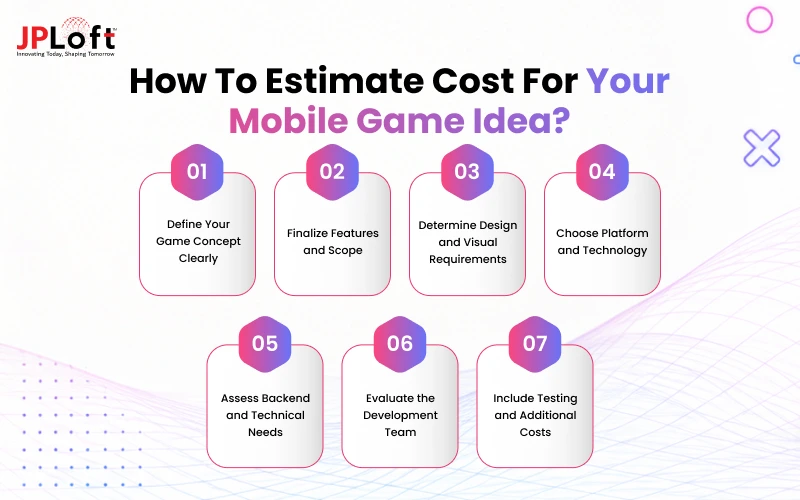
A structured estimation process can help you understand the resources involved and set a realistic budget before development begins.
Step 1: Define Your Game Concept Clearly
Identify your game type, core mechanics, target audience, and desired player experience. A clearly defined concept gives the development team a better understanding of the project's scope.
Step 2: Finalize Features and Scope
Separate essential launch features from advanced additions such as multiplayer, AI systems, social features, complex progression, or LiveOps. This helps determine the development effort required for the initial release.
Step 3: Determine Design and Visual Requirements
Decide whether your game requires 2D artwork, stylized graphics, or detailed 3D environments. Character design, animations, environments, visual effects, and UI/UX design service requirements can significantly influence design and development resources.
Step 4: Choose Platform and Technology
Decide whether the game will launch on iOS, Android, or both. Select the game engine, backend technologies, development approach, and third-party tools based on the game's requirements.
Step 5: Assess Backend and Technical Needs
Identify requirements such as user accounts, cloud saves, leaderboards, matchmaking, real-time multiplayer, analytics, payments, and LiveOps. More advanced systems require additional development and infrastructure resources.
Step 6: Evaluate the Development Team
Compare and hire app developers based on relevant experience, technical expertise, location, team structure, and engagement model. This helps you understand the resources required and select an approach that aligns with your project scope.
Step 7: Include Testing and Additional Costs
Account for testing, optimization, infrastructure, third-party services, platform fees, security, asset licensing, and post-launch support. Including these expenses early gives you a more complete view of the investment required.
How to Reduce the Cost of Mobile Game Development?
Reducing the cost to develop a mobile game does not mean cutting the features or quality that define the game's core experience. The better approach is to control unnecessary scope, avoid rework, and allocate resources where they create the most value for players.
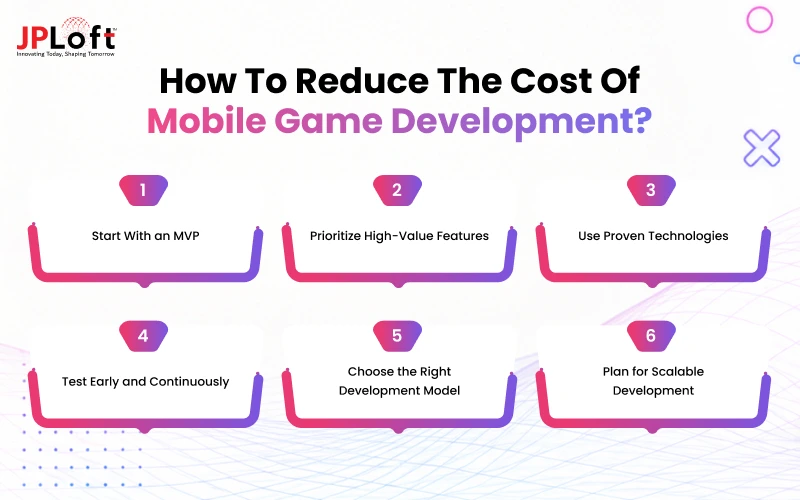
1. Start With an MVP
Launch with the core gameplay loop and essential features instead of building every planned feature from day one. Additional functionality can be introduced after validating player interest and collecting real usage data.
2. Prioritize High-Value Features
Rank app features based on their impact on gameplay, engagement, retention, and monetization. This prevents resources from being spent on features that add complexity without significantly improving the player experience.
3. Use Proven Technologies
Established game engines, development frameworks, SDKs, and cloud services can reduce development time compared with building core technologies from scratch. Choose tools that match the game's requirements rather than adding unnecessary technical complexity.
4. Test Early and Continuously
Early testing helps identify gameplay issues, compatibility problems, and performance bottlenecks before they become expensive to fix. Regular game app testing can reduce rework during the later stages of development.
5. Choose the Right Development Model
Compare in-house teams, freelancers, outsourcing, and dedicated development teams based on the game's complexity, timeline, and long-term requirements. The right model can provide access to specialized expertise without unnecessary overhead.
6. Plan for Scalable Development
Build the game's architecture with future expansion in mind, but avoid over-engineering the initial version. A balanced approach allows you to support future players, features, and LiveOps without investing heavily in infrastructure before it is needed.
How Can JPLoft Help You with Cost-Effective Game Builds?
The cost of developing a mobile game depends on the decisions made during planning, design, development, and post-launch operations. JPLoft helps businesses control unnecessary expenses by defining a clear scope, prioritizing essential features, and selecting technologies based on the game's actual requirements.
The team follows a phased development approach that allows businesses to launch a focused version first and expand the game using real user feedback and performance insights. This helps reduce unnecessary development effort while creating room for future features and content.
From gameplay development and 2D/3D design to multiplayer functionality, backend infrastructure, and performance optimization, JPLoft provides end-to-end development expertise across different game types. With transparent communication, scalable architecture, and structured execution, the team helps businesses balance development investment with quality, performance, and long-term growth.
Conclusion
The average cost of mobile game development varies based on the experience you aim to deliver.
From casual formats to RPG and AR or VR experiences, each game type brings its own technical scope, design depth, and infrastructure needs that shape the overall cost.
This means a fixed budget approach rarely works. The more aligned your concept is with real requirements, the more accurate your estimate becomes.
Before setting a final budget, assess your feature scope, expected updates, and long-term maintenance needs. A well-planned approach not only helps you control the cost to develop a mobile game but also ensures your product remains scalable, stable, and ready for growth.
FAQs
The cost of developing mobile games ranges from $20,000 to $350,000+. Simple games with basic features cost less, while multiplayer or high-end games with advanced graphics and backend systems require higher investment.
The cost to develop hyper casual mobile game depends on game complexity, design quality, platform selection, backend infrastructure, and monetization features. More advanced features and systems increase the overall cost.
Hyper-casual games are the most cost-effective. They use simple mechanics, minimal design, and limited backend systems, which keeps the cost to develop a mobile game low.
Mobile game development takes 2 to 18 months. Simple games take 2–4 months, while complex or multiplayer games require 8–18 months, depending on features and development scope.
You can reduce the cost by starting with an MVP, limiting features, choosing the right tech stack, and working with an experienced mobile game app development company.

Rahul Sukhwal is the CEO and Founder of JPLoft, with 18+ years of experience in software engineering, emerging technologies, and digital product development. His expertise spans artificial intelligence, including AI agents, generative AI, LLMs, chatbots, computer vision, and machine learning, as well as blockchain, IoT, AR/VR, mobile, web, and enterprise software. He focuses on applying these technologies to real business challenges across industries such as healthcare, education, mobility, finance, real estate, and on-demand services.




Share this blog