


Key Takeaways:
Mobile game app development requires a structured process covering research, game design, development, testing, launch, and post-launch support, with the approach tailored to the game type, audience, technical needs, and business goals.
Mobile game types can range from casual and hyper-casual titles to multiplayer, 3D, and AR-based experiences, with each requiring different development approaches.
The right tech stack should support the game's requirements across development, networking, analytics, LiveOps, monetization, and future scalability.
Development cost can range from $20,000 to $350,000+, depending on game complexity, graphics, multiplayer functionality, platform support, infrastructure, and post-launch requirements.
AI, generative AI, cross-platform gaming, social experiences, hybrid monetization, LiveOps, and AR are among the key trends shaping the future of mobile game development.
Mobile gaming has become one of the most accessible and commercially significant segments of the global gaming industry.
With smartphones reaching wider audiences and player expectations continuing to evolve, businesses now have opportunities to make a gaming app across casual, multiplayer, 3D, AR, and other emerging categories.
However, turning a game idea into a successful product requires more than an engaging concept. Game design, technology selection, performance optimization, monetization, multiplayer infrastructure, and post-launch engagement all influence the outcome.
This mobile game app development guide explores the complete process, from understanding game types and development stages to choosing the right tech stack, estimating costs, addressing key challenges, and preparing for future trends.
What Is a Mobile Game App and Why Should You Invest in One?
A mobile game app is a software application designed for smartphones and tablets that delivers interactive entertainment through touch-based controls.
These games range from simple puzzle and casual titles to complex multiplayer experiences with persistent progression, virtual economies, and live content.
Unlike PC or console games, mobile games account for varying screen sizes, device capabilities, network conditions, app store requirements, and different user behavior.
Why Businesses Should Invest in a Mobile Game App in 2026?
Mobile game development is considered to be a complex sector due to high player expectations, technical complexity, and the need to maintain engagement after launch.
But in 2026, advances in technology, evolving monetization models, and growing demand for engaging mobile experiences make game development a promising investment.
Here are some key reasons why now is the right time to invest in a mobile game app:
1. Access to a Growing Market: Smartphone accessibility has made mobile gaming one of the fastest-growing segments of the gaming industry.
The market is projected to reach USD 241.66 billion by 2031, growing at a CAGR of 10.17%, highlighting the growth opportunity that the sector offers.
2. Multiple Monetization Models: Mobile games can generate revenue through in-app purchases, advertising, subscriptions, premium downloads, and seasonal content.
According to available estimates, global mobile game revenue is expected to cross USD 100 billion by the end of 2026.
3. Lower Entry Barriers: Casual and hyper-casual games can be developed with smaller teams and lower initial investment than large-scale console or PC games.
This allows startups to start small and with a limited team size, making it easier to test and validate a game concept.
4. Global Distribution: The App Store and Google Play provide access to global audiences while simplifying distribution, updates, and payment infrastructure.
Mobile games account for 11.6% of apps on Google Play and 9.56% on the App Store, which is a significant number for any specific app category, reflecting the demand in the mobile gaming space.
5. Long-Term Engagement: Regular updates, events, rewards, and new content can encourage players to return.
Player behavior data also helps businesses improve gameplay, optimize monetization, and plan future updates, making it convenient to launch a mobile game app and keep it relevant.
How To Build a Mobile Game App: A Complete Process
Building a mobile game app requires a structured approach that moves from idea validation and game design to development, testing, launch, and ongoing improvements.
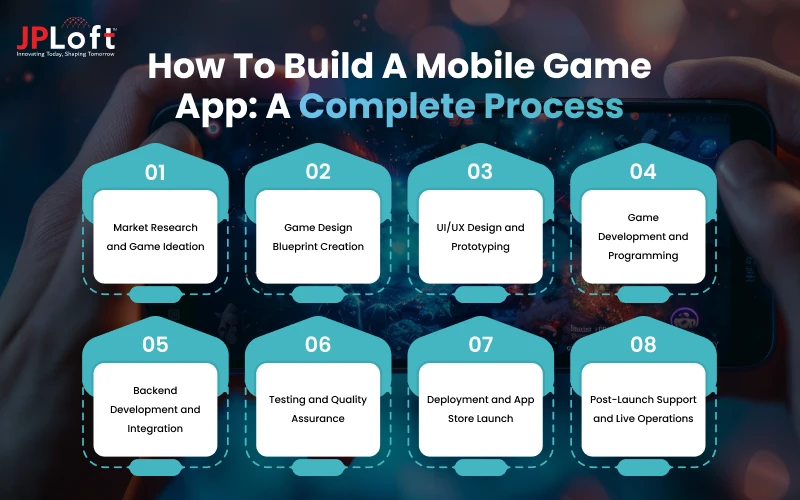
Each stage of the mobile game app development process helps ensure the game delivers a stable experience while supporting scalability, engagement, and long-term growth.
Step 1: Market Research and Game Ideation
The app development process begins by validating your game idea and understanding the market, target players, competitors, and potential monetization opportunities.
► Market Analysis and Competitor Review
Conduct app market research and analyze similar games to understand gameplay patterns, player feedback, monetization models, and common issues. This helps identify market gaps and establish realistic benchmarks.
► Game Concept and Monetization Planning
Define the core gameplay loop, target audience, session structure, rewards, and progression model. Also determine how the game will generate revenue through in-app purchases, advertising, subscriptions, or other suitable models.
Step 2: Game Design Blueprint Creation
Once the concept is validated, create a structured blueprint that gives the development team a clear direction for gameplay, features, progression, and player experience.
► Gameplay Mechanics and System Design
Define the game rules, controls, scoring systems, player interactions, and core gameplay loops. Planning these elements early helps create a consistent experience and reduces unnecessary changes during development.
► Storyline, Levels, and Progression Planning
Plan the storyline, level structure, difficulty curve, challenges, and reward systems. A well-balanced progression model gives players clear goals and encourages them to continue playing.
Step 3: UI/UX Design and Prototyping
This stage focuses on how players navigate, interact with, and experience the game. Intuitive interfaces and responsive controls can significantly improve usability and engagement.
► Wireframing and Interface Design
Plan app wireframes and design layouts for menus, navigation, controls, settings, and other player-facing elements. The interface should make important actions easy to access without interrupting the gameplay experience.
► Interactive Prototyping and User Flow Testing
Create app prototypes to test gameplay flows, navigation, controls, and player interactions before full-scale development. Early testing in the process to create mobile game apps helps identify usability issues and refine the experience before significant resources are invested.
Step 4: Game Development and Programming
With the app design and game structure finalized, the development team begins building the actual product, including gameplay mechanics, interactive elements, and supporting features.
► Core Gameplay Development and Engine Setup
Set up the selected game engine and implement core mechanics such as controls, physics, character movement, interactions, animations, and game logic. These components form the technical foundation of the game.
► Feature Implementation and Optimization
Add gaming features such as levels, rewards, achievements, leaderboards, and animations. Optimize asset loading, memory usage, rendering, and responsiveness to maintain consistent performance across supported devices.
Step 5: Backend Development and Integration
Games with user accounts, cloud saves, multiplayer functionality, or live content require a reliable backend infrastructure to manage data and player interactions.
► Server Architecture and Data Management
Build systems to manage user accounts, player profiles, game progress, leaderboards, and transactions. The backend should be designed to handle increasing user activity as the game grows.
► API Integration and Multiplayer Systems
Integrate services for authentication, payments, analytics, notifications, and social features. Multiplayer games may also require matchmaking, player synchronization, and real-time or asynchronous communication.
Step 6: Testing and Quality Assurance
Before launch, the game should be tested across different technical conditions to identify issues that could affect gameplay, performance, or the overall player experience.
► Functional Testing and Bug Fixing
Test the gaming app for the gameplay mechanics, controls, features, progression, rewards, and transactions to identify and resolve functional issues, and ensure that the game offers a seamless experience before release.
► Performance and Compatibility Testing
Evaluate the game across different devices, operating systems, hardware capabilities, screen sizes, and network conditions. Load testing of the app is also important for games expecting high levels of simultaneous player activity.
Step 7: Deployment and App Store Launch
Once the game is ready, prepare it for distribution and ensure it meets the technical and policy requirements of the selected app stores.
► App Store Preparation and Submission
Prepare the game listing with relevant keywords, screenshots, videos, descriptions, and other store assets. List the compliance requirements for submitting the app to the Google Play Store or Apple App Store.
► Release Management and Launch Strategy
Plan the game release through a soft launch, staged rollout, or full market launch. Monitoring early performance and player feedback can help identify issues that require immediate improvements.
Step 8: Post-Launch Support and Live Operations
The mobile game development process continues even after the launch. Ongoing monitoring, app maintenance services, and updates are essential for maintaining player engagement and supporting long-term growth.
► User Analytics and Performance Monitoring
Track player behavior, retention, session duration, progression, crashes, and in-game activity. These insights help identify technical issues, engagement gaps, and opportunities for improvement.
► Updates, Events, and Retention Strategies
Introduce new levels, features, rewards, seasonal events, and gameplay improvements based on player feedback and behavior. Consistent updates and effective LiveOps can help keep players engaged over time.
Types of Mobile Game Apps
Mobile games can be categorized based on gameplay complexity, target audience, technical requirements, and monetization potential.
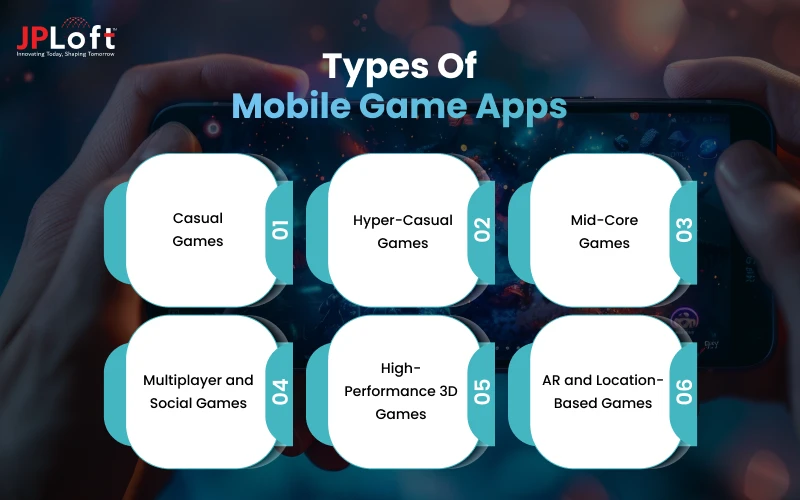
Choosing the right type when you are making a mobile game depends on your business goals, available budget, and the experience you want to deliver.
Type 1: Casual Games
Simple, accessible, and designed for broad audiences. Puzzle, arcade, card, and simulation games commonly fall into this category.
Key focus: Easy gameplay, short sessions, and high accessibility.
Examples: Candy Crush Saga, Subway Surfers, Fruit Ninja.
Type 2: Hyper-Casual Games
Built around minimal controls and a simple core mechanic, making them easy for players to understand and start playing immediately.
Key focus: Quick development, simple gameplay, and advertising-driven revenue.
Examples: Helix Jump, Stack Ball, Paper.io.
Type 3: Mid-Core Games
Offer deeper gameplay, progression systems, and more engaging mechanics than casual games. Strategy, action, role-playing, and simulation games often fall into this category.
Key focus: Player progression, in-app purchases, and long-term engagement.
Examples: Clash of Clans, Brawl Stars, PUBG Mobile.
Type 4: Multiplayer and Social Games
Allow players to compete, cooperate, or interact with others through real-time or asynchronous gameplay.
Key focus: Matchmaking, leaderboards, player synchronization, and social interaction.
Examples: Among Us, Call of Duty: Mobile, Clash Royale.
Type 5: High-Performance 3D Games
Designed around advanced graphics, immersive environments, and complex gameplay mechanics. These games typically require extensive optimization and testing across different mobile devices.
Key focus: High-quality graphics, performance optimization, and immersive gameplay.
Examples: Genshin Impact, Asphalt Legends, Diablo Immortal.
Type 6: AR and Location-Based Games
Combine digital gameplay with real-world environments using technologies such as GPS, cameras, sensors, and augmented reality.
Key focus: Immersive experiences, real-world interaction, and location-based gameplay.
Examples: Pokémon GO, Pikmin Bloom, Jurassic World Alive.
Tech Stack Required to Build a Mobile Game
Choosing the right mobile app tech stack is an important aspect when planning how to create a game app for mobile phones, as it directly affects performance, scalability, multiplayer capabilities, and future maintenance.
The technology stack for a mobile game depends on its genre, graphics requirements, multiplayer functionality, monetization model, and expected player base.
The following technologies can support different aspects of mobile game development:
|
Technology Area |
Common Technologies |
Role in Game App Development |
|
Game Engine |
Unity, Unreal Engine, Godot |
Supports the development of gameplay, graphics, physics, animations, and core game mechanics. |
|
Backend & Database |
Node.js, Python, PostgreSQL, MongoDB, Redis |
Manages player accounts, game progress, cloud saves, transactions, leaderboards, and other server-side data. |
|
Networking & Multiplayer |
Photon, Nakama, PlayFab |
Supports matchmaking, player synchronization, real-time or asynchronous gameplay, and multiplayer interactions. |
|
Cloud Infrastructure |
AWS, Azure, Google Cloud |
Provides scalable servers, storage, backend deployment, and infrastructure for growing player activity. |
|
Analytics & Monitoring |
GameAnalytics, Firebase Analytics, Crashlytics, Sentry |
Tracks player behavior, retention, session activity, crashes, errors, and overall game performance. |
|
LiveOps & Player Engagement |
PlayFab, Firebase Remote Config, OneSignal |
Supports live events, remote configuration, notifications, player segmentation, and ongoing content updates. |
|
Payments & Advertising |
Google Play Billing, Apple In-App Purchase, AdMob, Unity Ads |
Enables in-app purchases, subscriptions, rewarded ads, interstitials, and other monetization models. |
|
CI/CD & Asset Management |
GitHub Actions, Unity Build Automation, Unity Addressables |
Automates builds and releases while managing downloadable game assets, content updates, and version delivery. |
How Much Does It Cost to Build a Mobile Game App?
The cost to build a mobile game app typically ranges from $20,000 to $350,000+, depending on the game's complexity, graphics, features, multiplayer requirements, and technology infrastructure.
A simple casual game requires significantly less investment than a high-performance 3D or real-time multiplayer game.
|
Mobile Game Type |
Estimated Development Cost |
Estimated Timeline |
|
Simple Casual Game |
$20,000–$50,000 |
2–4 months |
|
Mid-Core Game |
$50,000–$120,000 |
4–7 months |
|
Multiplayer Game |
$80,000–$200,000+ |
7–10 months |
|
High-Performance 3D Game |
$150,000–$350,000+ |
10–18+ months |
The final development cost can vary based on several factors:
-
Game complexity: Advanced mechanics, multiple levels, and complex progression systems increase development effort.
-
Graphics and assets: Custom 2D or 3D assets, animations, characters, environments, and mobile game prototype development can significantly affect the budget.
-
Multiplayer functionality: Features such as matchmaking, real-time synchronization, chat, and leaderboards require additional backend and networking infrastructure.
-
Platform support: Planning how to create a gaming app for Android or iOS requires separate efforts, increasing development and testing requirements.
-
Backend and cloud infrastructure: User accounts, cloud saves, analytics, LiveOps, and scalable server infrastructure add to the overall investment.
-
Monetization features: Integrating in-app purchases, subscriptions, advertising, and payment systems requires additional development and testing.
-
Post-launch support: Regular updates, bug fixes, new content, and infrastructure maintenance should also be considered when planning the long-term budget.
Key Challenges in Building a Mobile Game App
Developing the best mobile games involves technical, business, and operational challenges that can affect performance, player retention, monetization, and long-term growth.
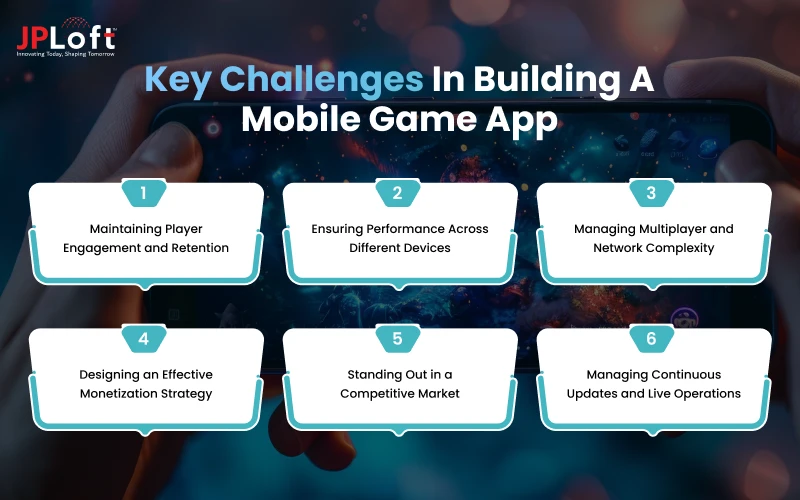
Identifying and resolving them early helps businesses plan for a scalable and profitable mobile game app.
Challenge 1. Maintaining Player Engagement and Retention
Attracting players is only the first step. Repetitive gameplay, poor difficulty balance, limited rewards, or unclear progression can cause players to lose interest and abandon the game.
Solution: Build engaging gameplay loops, balanced progression, meaningful rewards, and use player analytics to identify drop-off points.
Challenge 2. Ensuring Performance Across Different Devices
Mobile devices vary in processing power, memory, screen size, and operating system versions. Without proper optimization, games may experience lag, crashes, long loading times, or excessive battery consumption.
Solution: Hire dedicated developers and optimize assets, rendering, and memory usage while testing across a representative range of devices.
Challenge 3. Managing Multiplayer and Network Complexity
Multiplayer games add challenges such as matchmaking, player synchronization, latency, server capacity, and real-time communication. These requirements become more demanding as the player base grows.
Solution: Use scalable networking and backend infrastructure, supported by load testing and continuous performance monitoring.
Challenge 4. Designing an Effective Monetization Strategy
Aggressive advertising or poorly placed purchase windows can disrupt gameplay and reduce retention, while weak monetization can limit the game's revenue potential.
Solution: Choose app monetization models that fit the game and test ad placement, pricing, and premium content to balance revenue with player experience.
Challenge 5. Standing Out in a Competitive Market
With thousands of games competing for attention, even a well-developed product can struggle without differentiated gameplay, a clear value proposition, and an effective acquisition strategy.
Solution: Identify market gaps, define clear differentiation, and support growth through ASO, targeted acquisition, and continuous improvements.
Challenge 6. Managing Continuous Updates and Live Operations
Player expectations continue after launch, requiring bug fixes, new content, events, rewards, and gameplay improvements. Managing these updates requires ongoing resources and planning.
Solution: Establish a LiveOps strategy that prioritizes updates and content based on player feedback and performance data.
Future Trends in Developing Mobile Game Apps
Game development for mobile is increasingly shaped by technologies and strategies that improve gameplay, player engagement, content delivery, and monetization.
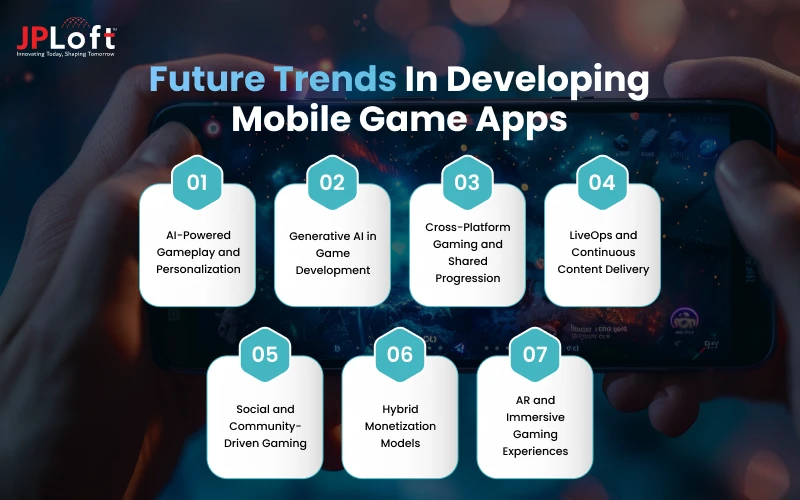
Here are some of the key game app development trends expected to influence the industry in the coming years.
1. AI-Powered Gameplay and Personalization
AI can help create more adaptive gaming experiences by adjusting difficulty, personalizing content, improving NPC behavior, and analyzing player preferences.
Hire AI developers who can use these insights to deliver experiences that better match individual gameplay patterns.
2. Generative AI in Game Development
Generative AI is changing how development teams approach content creation and production.
It can support concept development, dialogue generation, asset ideation, content variations, and testing, helping teams accelerate certain workflows while maintaining creative oversight.
3. Cross-Platform Gaming and Shared Progression
Players increasingly expect to access games across multiple devices without losing progress.
Mobile cross-platform game development, cloud saves, and shared player profiles can help deliver a more consistent experience across mobile, PC, and other supported platforms.
4. LiveOps and Continuous Content Delivery
Mobile games are increasingly managed as long-term digital products rather than one-time releases.
Seasonal events, challenges, rewards, limited-time content, and regular updates can help maintain engagement while creating ongoing monetization opportunities.
5. Social and Community-Driven Gaming
Multiplayer modes, guilds, social features, co-op gameplay, and in-game communities are becoming increasingly important for player engagement.
Planning for social interaction features when creating a gaming app can encourage stronger communities and improve long-term retention.
6. Hybrid Monetization Models
Entrepreneurs building mobile games are increasingly combining multiple revenue models instead of relying on a single source.
A game may use a mix of in-app purchases, rewarded advertising, subscriptions, battle passes, and seasonal content to generate revenue while supporting different player preferences.
7. AR and Immersive Gaming Experiences
Augmented reality continues to create opportunities for games that blend digital content with real-world environments.
Advances in mobile hardware, cameras, sensors, and spatial technologies can support AR game app development and more interactive and immersive gameplay experiences.
Why Partner With JPLoft for Mobile Game App Development?
Choosing the right development partner can determine how effectively your idea translates into a market-ready product.
JPLoft combines strategic game planning, intuitive design, robust development, and scalable technology to build mobile games designed for performance and long-term growth.
Our mobile game app development services support the complete development journey, from refining the game concept and designing engaging player experiences to developing core gameplay, integrating multiplayer systems, backend infrastructure, monetization, and analytics.
We also focus on device compatibility, performance optimization, security, and post-launch improvements to help your game remain reliable as player expectations and user demand grow.
Whether you are building a casual game, immersive 3D experience, or multiplayer platform, JPLoft helps transform your vision into a scalable mobile game aligned with your business objectives.
Conclusion
A successful mobile game depends on more than an engaging concept. The right game strategy, technology stack, performance optimization, monetization model, and post-launch support all play an important role in its long-term success.
As player expectations and mobile technologies continue to evolve, businesses need to focus on delivering experiences that are engaging, reliable, and adaptable. Whether the goal is a casual game, an immersive 3D experience, or a multiplayer platform, a clear strategy can help reduce risks and support sustainable growth.
With the right development approach and a focus on emerging trends, businesses can turn a game idea into a product that engages players, generates revenue, and continues to evolve with market demands.
FAQs
The process involves market research, game ideation, design, prototyping, development, backend integration, testing, deployment, and post-launch support.
The cost to build a gaming app ranges between $20,000 and $350,000+, depending on complexity, graphics, features, multiplayer functionality, and technology requirements.
A simple game may take 2–4 months, while complex multiplayer or high-performance 3D games can require 6–18+ months, depending on the scope.
The right stack depends on the game type and requirements, including the game engine, backend, database, cloud infrastructure, networking, analytics, and LiveOps tools.
AI can support adaptive gameplay, intelligent NPCs, personalized experiences, content generation, player behavior analysis, and testing to improve engagement and game performance.

Rahul Sukhwal is the CEO and Founder of JPLoft, with 18+ years of experience in software engineering, emerging technologies, and digital product development. His expertise spans artificial intelligence, including AI agents, generative AI, LLMs, chatbots, computer vision, and machine learning, as well as blockchain, IoT, AR/VR, mobile, web, and enterprise software. He focuses on applying these technologies to real business challenges across industries such as healthcare, education, mobility, finance, real estate, and on-demand services.




Share this blog