


Key Takeaways:
You can build an on-demand marketplace, a DIY lawn care tracker, or a subscription-based platform, each catering to different audiences and revenue goals.
Building a lawn care app can cost anywhere between $15,000 and $80,000+, depending on features, complexity, and the development team's location.
Flutter, React Native, Node.js, AWS, and APIs like Google Maps, Stripe, and Twilio form the backbone of a scalable, high-performing lawn care app.
Collaborating with an experienced development company like JPLoft ensures your app is built faster, smarter, and ready for long-term growth.
Do you want to develop an Uber-like Lawn care app? If yes, keep reading.
The lawn care industry is no longer just about mowers, trimmers, and trucks; it's increasingly powered by smartphones.
As homeowners demand on-demand services and lawn care businesses scramble to streamline scheduling, routing, and payments, mobile apps have become the backbone of modern operations.
In 2026, building a lawn care app isn't just a tech project; it's a competitive necessity driven by AI-based scheduling, GPS route optimization, IoT-enabled equipment, and seamless customer communication.
For startups aiming to launch the next big on-demand service and established providers looking to digitize operations, understanding the development process is critical.
This guide walks you through everything you need to know, features, technology stacks, costs, monetization models, and emerging trends to build a lawn care app that actually wins customers in 2026.
Overview of On-Demand Lawn Care App
A lawn care app is a mobile platform that connects homeowners with professional lawn care providers, making yard maintenance as simple as ordering food online.
Instead of searching directories or making endless phone calls, users can book trusted experts in just a few taps, anytime, anywhere.
These apps typically offer a wide range of services, including lawn mowing, edging, fertilization, weed control, aeration, leaf removal, irrigation setup, pest control, and seasonal cleanups.
If you’re planning to create an on-demand handyman app, lawn care is one of the most in-demand service categories you can include to expand your platform’s value and reach.
Yard Mastery, LawnStarter, and many others are some of the top examples of a lawn care app that handle real-time tracking, secure payments, and automated scheduling.
Essential Features to Have in a Lawn Care App
To successfully build an on-demand lawn care app, you need features that make booking, service delivery, and communication effortless.
The right functionality ensures a smooth experience for users while helping service providers manage tasks efficiently.
A well-structured feature set not only improves usability but also builds trust and drives repeat usage.
|
Feature |
Description |
|
User Registration & Profiles |
Enable users and providers to sign up, create profiles, and manage personal preferences easily. |
|
Service Selection |
Allow users to browse and choose services like mowing, trimming, fertilization, and more. |
|
Easy Booking & Scheduling |
Let users book services and select preferred time slots quickly. |
|
Real-Time Tracking |
Provide live tracking of service providers for better transparency and convenience. |
|
Secure In-App Payments |
Support multiple payment options for safe and smooth transactions. |
|
Ratings & Reviews |
Allow users to rate services and share feedback to build trust and credibility. |
|
Push Notifications |
Send updates on bookings, reminders, offers, and service status. |
|
Provider Job Management |
Help service providers accept, manage, and track assigned tasks efficiently. |
|
GPS & Location Integration |
Ensure accurate service delivery with map-based navigation and location detection. |
|
In-App Chat & Support |
Enable seamless communication between users and service providers. |
So, these features are the need for an on-demand lawn care app. Let’s get to know the development process.
How to Build a Lawn Care App: A Step-By-Step Guide
Launching a successful Uber-like lawn care app takes more than just an idea; it requires the right mix of strategy, technology, and user-focused design.
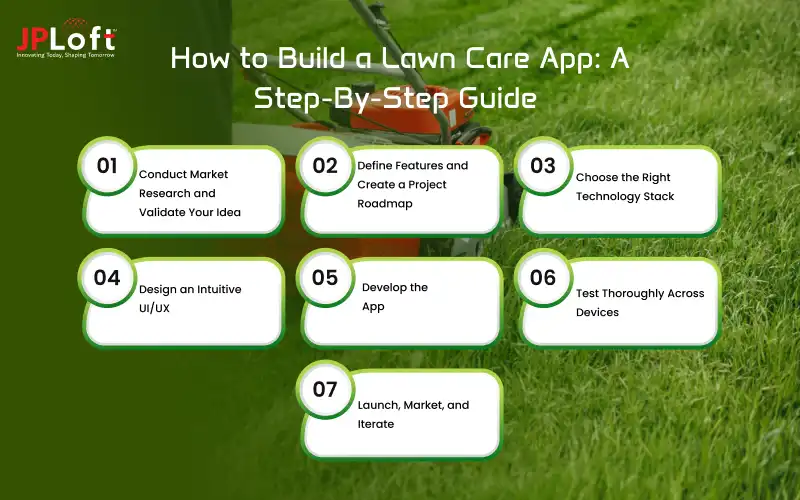
Let’s break down how to build a lawn care app step by step so you can turn your concept into a scalable, revenue-generating solution.
Step 1: Conduct Market Research and Validate Your Idea
Every successful app begins with market research. To create a lawn care app, you should start by analyzing the market, your target users, and existing competitors to shape a strong foundation.
-
Study your audience, including homeowners, property managers, and commercial clients, to understand their pain points.
-
Analyze competitors like GreenPal, LawnStarter, and Plowz & Mowz to identify gaps you can fill.
-
Decide on your app model: customer-to-provider marketplace, DIY lawn care tracker, or B2B service management platform.
-
Validate demand through surveys, interviews, and local market testing before investing in development.
Step 2: Define Features and Create a Project Roadmap
Once your app idea is validated, outline the features for your three app panels: customer, service provider, and admin.
-
Customer app: Registration, lawn size input, service selection, scheduling, GPS tracking, in-app payments, and reviews.
-
Provider app: Job acceptance, route optimization, earnings dashboard, and availability toggles.
-
Admin panel: User management, commission control, analytics, and dispute resolution.
Prioritize an MVP-first approach to launch faster and gather real user feedback before scaling advanced features.
Step 3: Choose the Right Technology Stack
Your app's tech stack directly affects its speed, scalability, and long-term cost efficiency.
-
Front end: Flutter or React Native for cross-platform; Swift (iOS) and Kotlin (Android) for native.
-
Backend: Node.js, Python (Django), or Ruby on Rails.
-
Database: PostgreSQL or MongoDB.
-
Cloud hosting: AWS, Google Cloud, or Microsoft Azure.
-
Third-party APIs: Google Maps for location, Stripe or Braintree for payments, and Twilio or Firebase for notifications.
Step 4: Design an Intuitive UI/UX
Lawn care users want convenience. So, the UI/UX design must be clean, fast, and easy to navigate.
-
Begin with wireframes, then move to interactive prototypes before finalizing the UI.
-
Keep the booking flow under three taps to reduce drop-offs.
-
Use readable typography, strong CTAs, and accessibility features for older users.
-
Maintain consistent branding with high-quality visuals of lawns, services, and providers.
-
Run usability tests with real users to identify friction points before development begins.
Step 5: Develop the App
This is the core phase where you truly develop a lawn care app, where your frontend, backend, and admin dashboard come together.
-
Follow Agile sprints to build features in parallel and release iteratively.
-
Implement secure authentication, real-time GPS tracking, in-app chat, and automated notifications.
-
Build dynamic pricing logic based on lawn size, service type, and location.
-
Ensure modular architecture so you can later add subscriptions, seasonal packages, or AI-based lawn assessments.
Step 6: Test Thoroughly Across Devices
App Testing determines whether users stay engaged or uninstall your app.
-
Conduct functional, performance, security, and usability testing on multiple iOS and Android devices.
-
Test edge cases like weak network connections, failed payments, and simultaneous bookings.
-
Use automated tools such as Selenium or Appium for regression testing.
-
Fix all critical and high-priority bugs before going live.
Step 7: Launch, Market, and Iterate
Once the final version of your app is ready, you can launch your app on the App Store or Play Store. A successful launch requires both technical readiness and a strong go-to market pain.
-
Promote the app through ASO, social media campaigns, local SEO, influencer partnerships, and referral programs.
-
Track KPIs like downloads, booking conversions, retention rates, and average order value.
-
Use tools like Mixpanel, Firebase Analytics, or Google Analytics to gather insights.
-
Release regular updates based on user feedback to improve features and stay ahead of competitors.
-
Once you deploy the app, time for app maintenance services.
So, this is how to build a lawn care app. Now, time to talk about the tech stack.
Tech Stack of Lawn Care App
To pick the right tech stack for a lawn care app. It is important to ensure performance, scalability, and a seamless user experience.
Below is a breakdown of the key technologies used to build an Uber-like lawn care app:
-
Frontend (User Interface): Use frameworks like Flutter or React Native to build cross-platform apps with a smooth and responsive UI for both Android and iOS users.
-
Backend (Server-Side Logic): Technologies like Node.js, Python, or Ruby on Rails help manage user data, bookings, notifications, and business logic efficiently.
-
Database Management: Use scalable databases like MongoDB, PostgreSQL, or MySQL to store user profiles, service history, and transaction data securely.
-
Real-Time Features & APIs: Integrate APIs like Google Maps for GPS tracking, Twilio for notifications, and Firebase for real-time updates and messaging.
-
Payment Integration: Secure payment gateways like Stripe, Razorpay, or PayPal ensure smooth and reliable in-app transactions.
-
Cloud & Hosting Services: Platforms like AWS, Microsoft Azure, or Google Cloud provide scalability, data storage, and high-performance hosting.
-
Admin Panel Technologies: Use web technologies like Angular or React.js to build a powerful dashboard for managing users, services, and analytics.
-
Security & Authentication: Implement OAuth, JWT, and SSL encryption to protect user data and ensure secure login and transactions.
Types of Lawn Care Apps You Can Build
Before you build a lawn care app, it's crucial to decide which model aligns with your business goals. Your choice will shape everything, from features and tech stack to monetization.
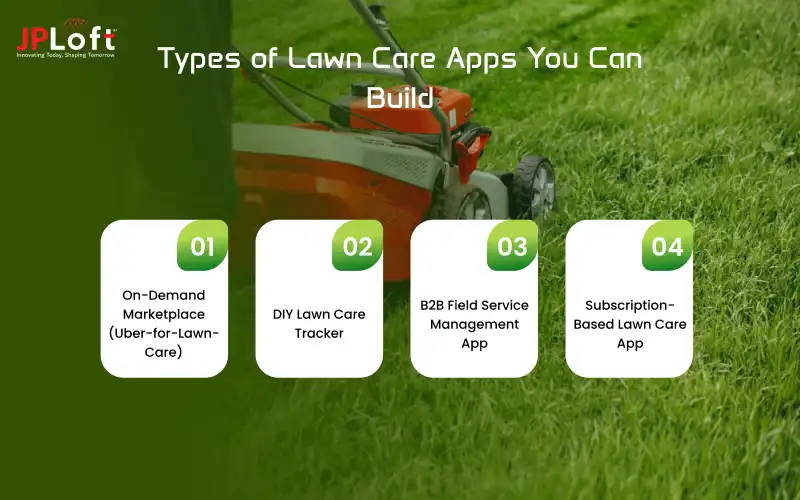
Here are the four most popular types to consider in your lawn care app development journey:
Type 1: On-Demand Marketplace (Uber-for-Lawn-Care)
This is the most popular model in today's lawn care app development guide, connecting homeowners with nearby lawn care professionals in real time.
Users can book, track, and pay for services instantly, while providers get a steady flow of new clients. Think of it as the Uber of landscaping, fast, seamless, and highly scalable.
Type 2: DIY Lawn Care Tracker
Perfect for homeowners who love taking care of their own lawns, this type of app guides users through personalized care plans, seasonal schedules, and treatment reminders.
It's an excellent model if you want to target hobbyists and green-thumbed enthusiasts.
Type 3: B2B Field Service Management App
Designed for established lawn care companies, this app streamlines daily operations like scheduling, routing, crew tracking, invoicing, and customer management.
It's less about end-users and more about helping businesses save time, reduce fuel costs, and boost productivity.
Type 4: Subscription-Based Lawn Care App
This model offers recurring lawn care services, such as weekly mowing, monthly fertilization, or seasonal treatments, under a subscription plan.
It guarantees predictable revenue for service providers and hassle-free maintenance for customers.
How Much Does it Cost to Build a Lawn Care App?
The cost to create a lawn care app can range from $15,000- $80,000+.
It’s shaped by your app’s complexity, feature set, tech stack, and the development team’s location.
A basic MVP with core booking and payment features will cost far less than a feature-rich platform powered by AI-based lawn analysis, real-time GPS tracking, and IoT integrations.
Partnering with the right on demand app development company ensures you get maximum value without overspending, striking the perfect balance between functionality, scalability, and budget.
|
App Complexity |
Features Included |
Estimated Cost |
Development Timeline |
|
Basic (MVP) |
User registration, service listing, booking, basic payments, notifications |
$15,000 – $25,000 |
2 – 3 months |
|
Mid-Level App |
Everything in MVP + GPS tracking, in-app chat, reviews, multiple payment gateways, admin panel |
$25,000 – $50,000 |
4 – 6 months |
|
Advanced App |
Mid-level + AI recommendations, IoT integration, weather APIs, AR previews, multi-language support |
$50,000 – $80,000+ |
7 – 9 months |
Key Factors That Influence the Cost
-
App platform: iOS, Android, or cross-platform (Flutter/React Native)
-
UI/UX design complexity: Custom animations and advanced interactions raise costs
-
Third-party integrations: Payment gateways, maps, SMS, and weather APIs
-
Developer location: North America ($100–$150/hr), Europe ($60–$100/hr), Asia ($25–$50/hr)
-
Post-launch maintenance: Typically 15–20% of total development cost annually
How JPLoft Can Help You Develop a Lawn Care App?
Behind every thriving lawn care app is a development partner that truly understands the on-demand ecosystem, and that's exactly where JPLoft shines.
With 15+ years of industry experience and a portfolio of 1,100+ successfully delivered apps, we've built lawn care platforms that homeowners love, and service providers rely on.
Our team blends creativity with technical expertise to design scalable, user-friendly, and feature-rich apps tailored to your business vision.
As a leading provider of handyman app development services, we bring deep expertise in on-demand platforms, covering UI/UX design, development, testing, deployment, and post-launch support.
Having already launched several successful lawn care apps, JPLoft knows exactly what drives engagement, bookings, and retention in this space.
Partner with us to transform your idea into a market-ready product built for growth.
Conclusion
The lawn care industry is no longer just about mowers and manual bookings; it's a booming digital ecosystem where convenience, speed, and smart technology define success.
Building a lawn care app gives you a front-row seat in this fast-growing market, letting you tap into recurring revenue, loyal customers, and scalable business opportunities.
The key to standing out lies in combining user-friendly design, the right features, and a dependable development partner who understands your vision.
With the global on-demand services market expanding rapidly, now is the perfect time to turn your idea into reality.
The greener side of business is just one smart app away.
FAQs
The cost to build a lawn care app typically ranges from $15,000 to $80,000+, depending on features, complexity, and tech stack. A basic MVP starts around $15,000–$25,000, while advanced apps with AI, IoT, and custom integrations can exceed $80,000.
On average, lawn care app development takes 3 to 9 months. An MVP can be launched in 2–3 months, while feature-rich or enterprise-grade apps may take 7–12 months, depending on design, testing, and third-party integrations.
Essential features include user registration, service booking, real-time GPS tracking, in-app payments, push notifications, provider profiles, ratings and reviews, and an admin dashboard. Advanced apps can also include AI-driven lawn analysis and subscription management.
Popular choices include Flutter or React Native for cross-platform apps, Swift and Kotlin for native builds, Node.js or Python for backend, and AWS or Google Cloud for hosting. APIs like Google Maps, Stripe, and Twilio power core functionalities.
Lawn care apps generate revenue through multiple monetization models, including commission-based bookings, subscription plans, platform fees, featured provider listings, and in-app advertising, ensuring steady and scalable income streams.

Kris Jacobs brings 20+ years of experience solving complex digital product challenges through strategic thinking and user-centric design. With deep exposure to on-demand services, entertainment, travel, and interactive platforms, she collaborates across teams to shape scalable, engaging solutions that align business goals with intuitive user experiences across evolving digital landscapes.


Share this blog