


Key Takeaways:
The global IoT market is expected to reach $3.27 trillion by 2033, creating significant business opportunities.
Around 21.9 billion connected IoT devices are expected to be active worldwide by the end of 2026.
Manufacturing leads enterprise IoT adoption, accounting for 34% of all IoT device deployments.
Asia-Pacific is expected to become the largest regional IoT market, reaching $1,139.4 billion by 2033.
- The IoT security market is forecast to reach USD 425.70 billion by 2034, reflecting the growing need for connected device protection.
A business owner skips checking IoT app market data and loses out to a competitor who didn't. That gap is closing fast, and the numbers prove it.
The global IoT app market is no longer a side conversation. It has become a core part of how businesses plan, spend, and grow in 2026.
The rapid rise of IoT analytics reflects this shift, with the market expected to grow from $35.4 billion in 2026 to $136.0 billion by 2033, at a CAGR of 21.2%.
From startups building their first connected product to enterprises scaling mobile fleets, every decision now hinges on real data, not guesswork.
However, understanding where the market is heading requires more than following trends. It requires reliable statistics that reveal growth, adoption, investment, and future opportunities.
In this blog, we have gathered the most important Internet of Things statistics businesses must know in 2026.
Global IoT Market Statistics in 2026
The global IoT market continues to grow as businesses invest in connected technologies to improve operations and support digital transformation.
The market is expected to grow from $1.8 trillion in 2026 to $3.27 trillion by 2033, reflecting strong long-term demand. During this period, it is projected to expand at a CAGR of 8.9%.
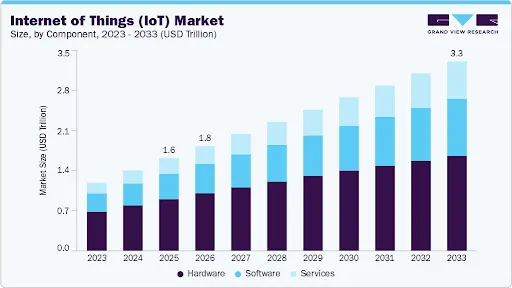
A major reason behind this growth is the rising adoption of Industry 4.0, with manufacturers increasingly using IoT solutions to automate processes, monitor equipment in real time, and improve overall productivity.
These IoT growth statistics highlight the growing opportunities for businesses planning to build an IoT app.
Connected Device & IoT Adoption Statistics
The number of connected devices continues to rise as businesses and consumers adopt IoT solutions across different industries. Have a look at the IoT devices statistics to understand what the current adoption landscape looks like heading into 2026 and beyond.
1. Connected IoT Devices Worldwide
Around 21.9 billion connected IoT devices are estimated to be active worldwide by the end of 2026. This shows how deeply IoT has spread across homes, offices, and industries, giving businesses more ways to collect data and improve daily operations.
2. Cellular IoT Connections
Cellular IoT connections are expected to reach 8 billion worldwide by 2031. This growth highlights how businesses are relying more on mobile networks to keep devices connected in real time, even in remote or hard-to-reach locations.
3. Smart Home Adoption
Worldwide smart home device shipments’ revenue is projected to reach $225.7 billion by 2029, at a CAGR of 8.82%. This steady rise in connected living spaces enables businesses to invest in smart home app development.

Enterprise IoT Adoption Statistics Across Industries
Different industries build an IoT app at different speeds, and each one shows a unique growth story. Here is how IoT adoption breaks down across major sectors.
1. Manufacturing
According to IoT Portal, manufacturing accounts for roughly 34% of all IoT device deployments, the largest share among industries.
This makes sense, since factories rely heavily on connected sensors to track machines, reduce downtime, and keep production running smoothly.
2. Healthcare
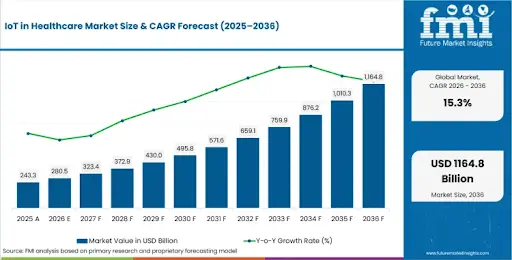
The IoT in healthcare market is forecast to reach USD 1164.8 billion by 2036, growing at a strong CAGR of 15.3%.
These IoT in healthcare statistics reflect how hospitals and clinics are turning to connected devices to monitor patients, manage equipment, and improve care delivery.
3. Retail
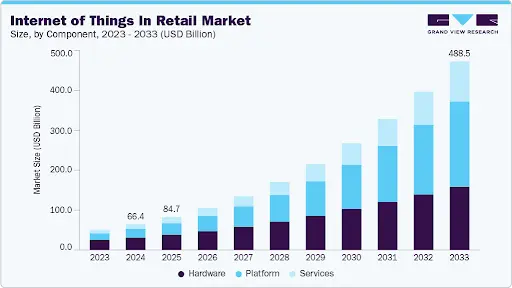
The global IoT in retail market is projected to reach USD 488.5 billion by 2033, growing at a CAGR of 24.5%.
Retailers are using connected devices to track inventory, personalize shopping experiences, and manage stores more efficiently.
4. Logistics
The global IoT in logistics market is projected to reach USD 130.5 billion by 2035, expanding at a CAGR of 13.2%.
Businesses are using IoT to track shipments, monitor fleets, and improve delivery accuracy across supply chains.
5. Agriculture
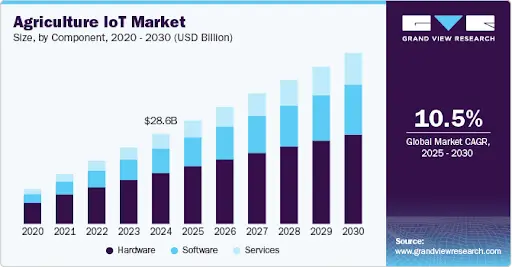
The global agriculture IoT market is projected to reach USD 80 billion by 2034, growing at a CAGR of 10.5% from 2025 to 2030.
Farmers are using connected sensors to monitor soil, crops, and weather conditions for better yields.
6. Automotive
The global automotive IoT market is expected to grow from USD 37.20 billion in 2026 to USD 91.69 billion by 2034, at a CAGR of 11.9%.
Automakers are expanding connected vehicle technologies to improve safety, predictive maintenance, navigation, and real-time vehicle performance monitoring.
7. Hospitality
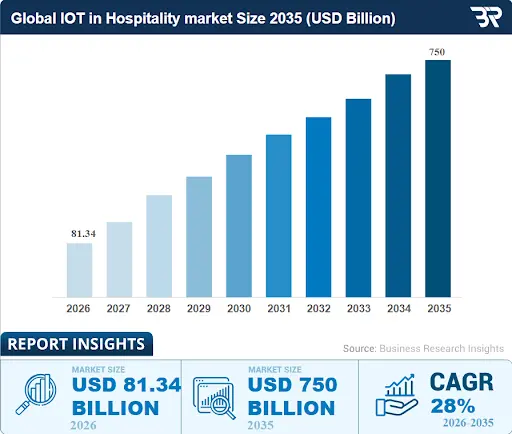
The global IoT in hospitality market is projected to increase from USD 81.34 billion in 2026 to USD 750 billion by 2035, growing at a CAGR of 28%.
Hotels are adopting IoT solutions to deliver smart room controls, contactless services, energy management, and personalized guest experiences.
8. Aviation
The global IoT in aviation market is projected to reach USD 11.27 billion by 2034, growing at a CAGR of 21.7%. Airlines and airports are adopting connected technologies to improve aircraft monitoring, reduce flight disruptions, and enhance passenger experiences.
IoT also supports predictive maintenance, helping operators lower maintenance costs by up to 30% while improving overall safety and operational efficiency.
9. Education
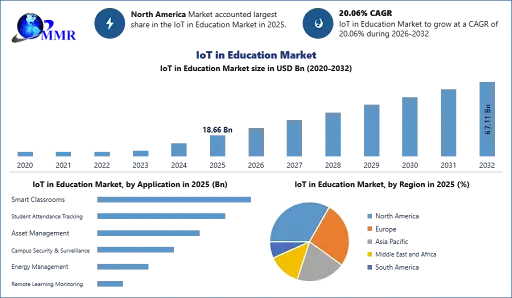
The global IoT in education market was valued at USD 18.66 billion in 2025 and is projected to reach USD 67.11 billion by 2032, growing at a CAGR of 20.06%.
These education IoT statistics show how schools, colleges, and universities are adopting IoT to build smart classrooms, improve campus security, track assets, and deliver more connected and interactive learning experiences.
Regional Market Statistics On IoT Across Major Economies
IoT growth looks different across regions, shaped by industry needs, infrastructure, and investment levels. Here is a breakdown of what businesses can expect region by region.
1. North America
The IoT market in North America is projected to reach $899.6 billion by 2033, at a CAGR of 6.4% from 2026 to 2033.
Strong tech infrastructure and early enterprise adoption continue to keep the region among the largest IoT markets globally.
2. Europe
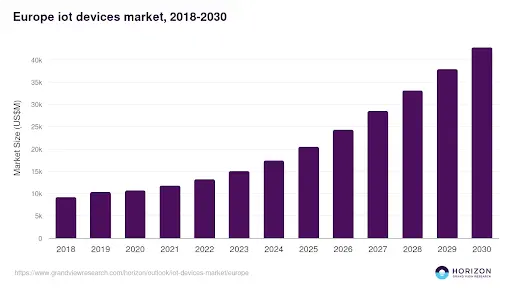
The IoT devices market in Europe is expected to reach $42.75 billion by 2030, growing at a CAGR of 15.9%.
Businesses across the region are steadily investing in connected devices, driven by strict data standards and a push toward smarter, more efficient operations.
3. Asia-Pacific
The IoT market in the Asia Pacific is set to reach $1,139.4 billion by 2033, making it one of the fastest-growing regions worldwide.
Rapid industrialization and rising manufacturing hubs are fueling this large-scale adoption.
4. Middle East
The IoT market in the Middle East and Africa is projected to reach $228.4 billion by 2033, growing at a CAGR of 11.5% between 2026 and 2033.
This growth reflects the region's increasing focus on smart infrastructure and digital transformation projects.
IoT Security & Enterprise Protection Statistics
As IoT adoption grows, businesses are investing more in securing connected devices and networks. Let’s understand better with IoT security statistics below:
-
The global IoT security market is projected to grow from USD 58.35 billion in 2026 to USD 425.70 billion by 2034.
-
This growth is visible through a strong CAGR of 28.2%.
-
North America held the largest market share of 33.84% in 2025.
-
According to IoT attacks statistics, there are currently over 820,000 daily attacks on IoT devices.
-
Manufacturing & Transport industries alone face around 40% of overall attacks on connected devices.
With the increase in connected devices, businesses are spending more on IoT security to prevent cyberattacks and protect critical data. Although this increases the cost to build an IoT app, it is beneficial for overall business growth.
Companies are prioritizing secure device management, stronger authentication, encryption, and regular updates to reduce vulnerabilities and maintain customer trust.
Statistics of Top IoT Market Trends For Businesses
The IoT market continues to evolve with new technologies that improve connectivity, automation, and real-time decision-making.
The top IoT trends highlight where businesses are investing and how emerging innovations are shaping the future of such applications.
1. Edge Computing
The global edge computing market is expected to grow from USD 25.63 billion in 2026 to USD 267.42 billion by 2034, at a CAGR of 34.1%. North America held the largest market share of 35.7% in 2025.
The increasing use of smart cameras, industrial systems, medical devices, and other connected equipment drives this growth. Processing data closer to devices helps businesses reduce delays, improve performance, and make faster decisions.
2. 5G
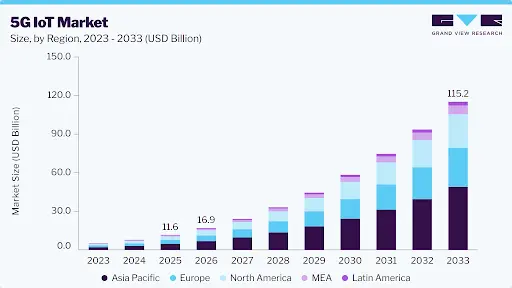
The global 5G IoT market is projected to grow from USD 16.9 billion in 2026 to USD 115.2 billion by 2033, expanding at a CAGR of 31.5%. Asia Pacific accounted for the largest market share at 39.7% in 2025.
High-speed connectivity is enabling businesses to connect more devices with greater reliability. This supports applications such as smart factories, connected vehicles, remote monitoring, and real-time industrial operations.
3. AIoT
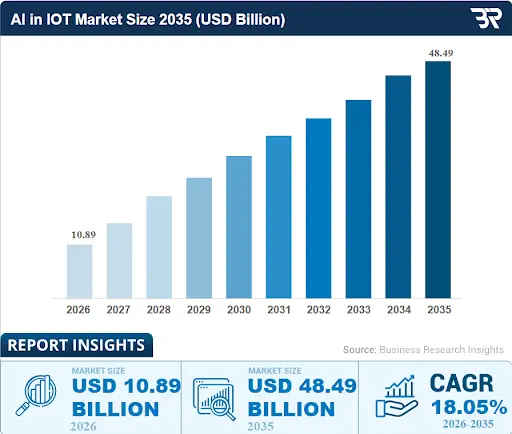
The global AIoT market is estimated at USD 10.89 billion in 2026 and is expected to reach USD 48.49 billion by 2035, growing at a CAGR of 18.05%.
By combining artificial intelligence with IoT, businesses can automate processes, predict equipment failures, and analyze data more effectively. This helps organizations improve productivity while reducing manual work and operational costs.
4. Blockchain Technology
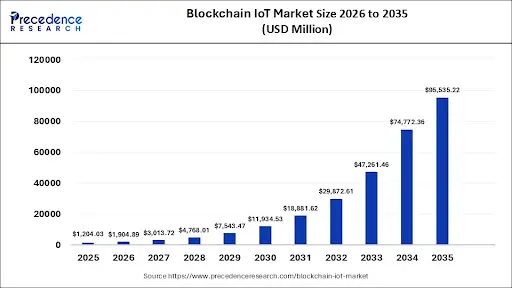
The global blockchain IoT market is valued at USD 1.2 billion in 2025 and is forecast to reach USD 95.5 billion by 2035, registering an impressive CAGR of 54.86%.
Businesses are integrating blockchain with IoT to improve data security, increase transparency, and verify connected device transactions. This combination is becoming valuable for industries managing sensitive or high-volume data.
5. Consumer IoT
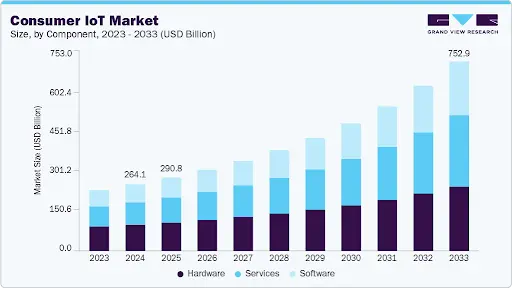
The global consumer IoT market is projected to grow from USD 321.7 billion in 2026 to USD 753 billion by 2030, at a CAGR of 12.6%.
Demand for smart home products, wearable devices, and connected appliances continues to increase. This creates new opportunities for businesses to build user-friendly IoT applications that enhance convenience and improve everyday experiences.
6. Digital Twins
The digital twins in the IoT market were valued at USD 6.5 billion in 2025 and are expected to exceed USD 26.1 billion by 2030, growing at a CAGR of 32.5%.
Businesses hire dedicated developers to create virtual models of physical assets for real-time monitoring and simulation. This helps improve maintenance planning, optimize operations, and support faster business decisions.
7. LPWAN
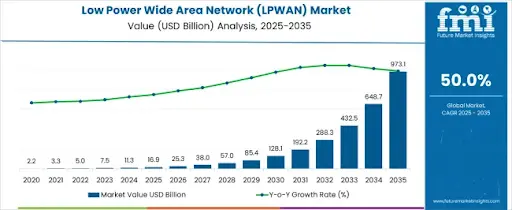
The global LPWAN market is estimated at USD 16.9 billion in 2025 and is projected to reach USD 973.1 billion by 2035, expanding at a CAGR of 50%.
LPWAN technology supports long-range, low-power communication for connected devices. As IoT deployments increase across industries and smart cities, businesses are adopting LPWAN to connect large numbers of devices while reducing energy consumption and operating costs.
Why Businesses Should Invest in IoT in 2026?
IoT is no longer an emerging technology. It has become a practical business solution that helps organizations improve efficiency, reduce operational costs, and make faster decisions.
As adoption continues to grow across industries, businesses are increasingly investing in IoT app development services to build connected solutions that support their digital transformation goals.
1. Growing Market Creates New Opportunities
The IoT market continues to expand as more industries adopt connected technologies. This creates opportunities for businesses to launch innovative products, improve services, and build new revenue streams while meeting changing customer expectations.
2. Better Operational Efficiency
IoT applications provide real-time data that helps businesses monitor equipment, automate routine tasks, and identify issues before they become costly. This improves productivity, reduces downtime, and supports more efficient day-to-day operations.
3. Rising Customer Expectations
Customers now expect faster, smarter, and more personalized experiences. IoT solutions enable businesses to offer features such as remote monitoring, real-time updates, and connected services that improve customer satisfaction and long-term engagement.

4. AI Makes IoT More Powerful
The combination of artificial intelligence and IoT allows businesses to turn raw device data into meaningful insights. This helps automate decisions, predict maintenance needs, and improve business performance with less manual effort.
5. Stronger Connectivity Supports Innovation
Technologies like 5G, edge computing, and LPWAN are making IoT solutions faster, more reliable, and easier to scale. Businesses can partner with a trusted mobile app development company to connect more devices, process data quickly, and deliver seamless experiences.
6. Competitive Advantage Across Industries
Organizations across healthcare, manufacturing, retail, logistics, hospitality, and agriculture are already investing in IoT. Businesses that adopt connected technologies today are better positioned to improve operations, respond to market changes, and stay ahead of competitors.
7. Build a Future-Ready Business
Investing in IoT is not only about solving today's challenges but also preparing for future growth. A well-designed IoT solution can support business expansion, integrate with emerging technologies, and create a strong foundation for long-term digital transformation.
Conclusion
The IoT market is growing steadily across industries. The latest statistics of the IoT app market show strong demand for connected technologies.
Businesses are investing in IoT to improve efficiency and support long-term growth. Connected devices are also transforming how organizations manage daily operations.
At the same time, AI, 5G, edge computing, and LPWAN continue to expand IoT capabilities. These technologies are creating new opportunities across multiple industries.
Businesses that follow market trends can make more informed investment decisions. They can also identify growth opportunities before their competitors.
Understanding reliable IoT market data reduces uncertainty and supports better planning. As IoT adoption continues to increase, staying informed will become even more important.
Businesses that act on these insights will be better prepared for future challenges and changing market demands.
FAQs
The global IoT market is projected to grow from $1.8 trillion in 2026 to $3.27 trillion by 2033, reflecting steady demand for connected technologies.
Manufacturing, healthcare, retail, logistics, automotive, agriculture, and hospitality are among the fastest-growing industries adopting IoT technologies.
Growing connected device adoption, Industry 4.0, AI integration, 5G networks, edge computing, and increasing digital transformation are driving IoT market growth.
North America leads the global IoT market due to strong digital infrastructure, early technology adoption, and high enterprise investment in connected solutions.
IoT will continue expanding with AI, 5G, edge computing, and automation, helping businesses build smarter, more connected, and data-driven operations.

Rahul Sukhwal is the CEO and Founder of JPLoft, with 18+ years of experience in software engineering, emerging technologies, and digital product development. His expertise spans artificial intelligence, including AI agents, generative AI, LLMs, chatbots, computer vision, and machine learning, as well as blockchain, IoT, AR/VR, mobile, web, and enterprise software. He focuses on applying these technologies to real business challenges across industries such as healthcare, education, mobility, finance, real estate, and on-demand services.





Share this blog